


Market OverviewThe
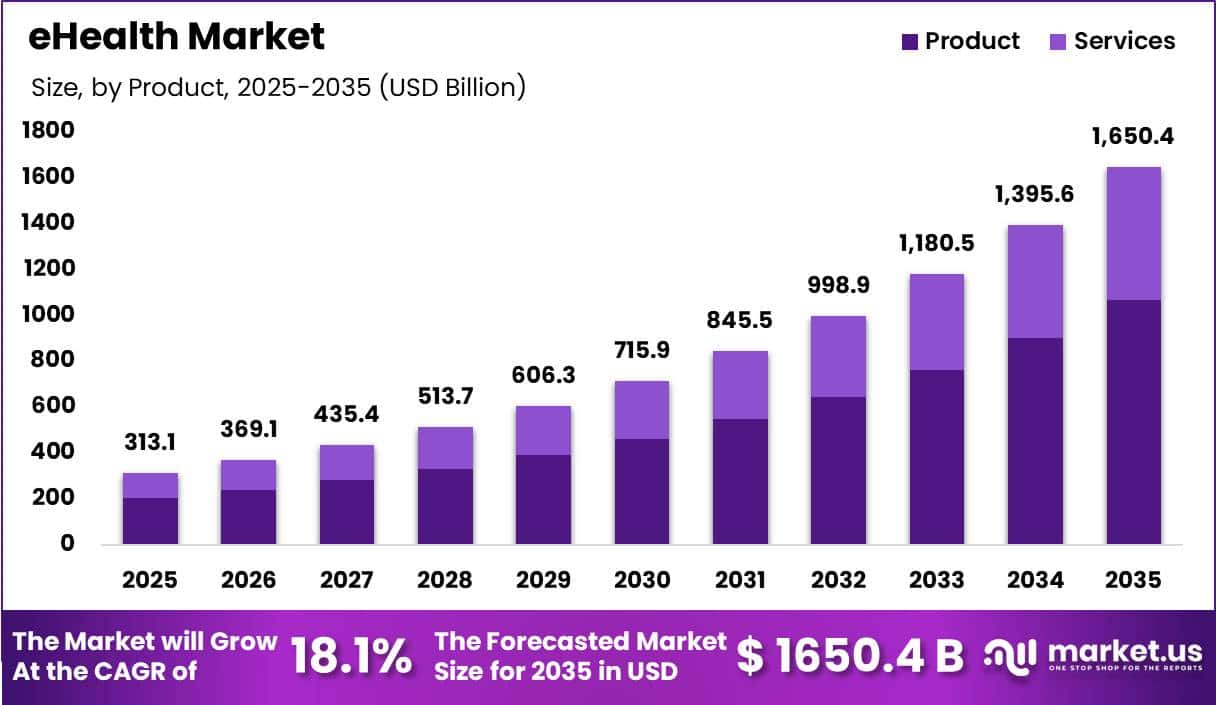
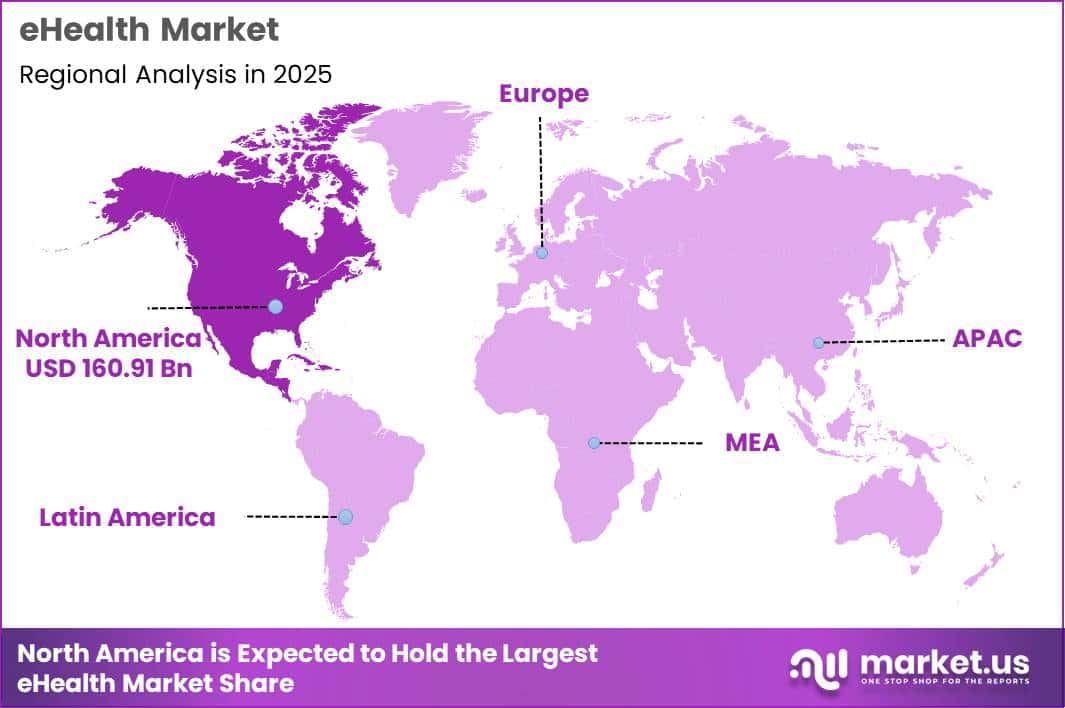
The Global eHealth Market size is expected to be worth around US$ 1,650.4 Billion by 2035 from US$ 313.1 Billion in 2025, growing at a CAGR of 18.1% during the forecast period from 2026 to 2035. In 2025, North America led the market, achieving over 51.4% share with a revenue of US$ 160.9 Billion.
The eHealth market is expanding rapidly as healthcare systems worldwide accelerate the adoption of digital technologies to improve patient care, increase efficiency, and expand access to medical services.
eHealth includes electronic health records (EHRs), telemedicine, mobile health (mHealth), e-prescribing, digital therapeutics, remote patient monitoring, and health information exchange platforms. Growing internet penetration, wider smartphone adoption, and investments in digital healthcare infrastructure continue to support market growth across both developed and emerging economies.
According to the World Health Organization (WHO), more than 120 countries have developed national digital health strategies, reflecting the increasing importance of technology-enabled healthcare delivery. The U.S. Centers for Medicare & Medicaid Services (CMS) continues to reimburse a broad range of telehealth services, encouraging healthcare providers to integrate virtual care into routine clinical practice.
Meanwhile, the Office of the National Coordinator for Health Information Technology (ONC) reports that approximately 96% of non-federal acute care hospitals in the United States have adopted certified electronic health record systems, demonstrating the maturity of digital recordkeeping.
The U.S. Food and Drug Administration (FDA) has also expanded oversight and guidance for software as a medical device (SaMD) and other digital health technologies, supporting innovation while maintaining patient safety.
The increasing prevalence of chronic diseases, aging populations, and rising demand for personalized healthcare are encouraging hospitals, physicians, and patients to embrace connected digital health solutions.
Advances in artificial intelligence, cloud computing, wearable medical devices, cybersecurity, and interoperability standards are further strengthening healthcare ecosystems, enabling better clinical decision-making, real-time patient monitoring, and improved health outcomes across global healthcare systems.
Key Takeaways
- Market Size:eHealth Market size was US$ 313.1 billion in 2025.The market is estimated to grow to US$ 1,650.4 billion by 2035.
- Market Share: The Compound Annual Growth Rate (CAGR) of the market from 2026 to 2035 will be 18.1%.
- By Offering:Product has the largest market share, accounting for 64.7% of total sales.
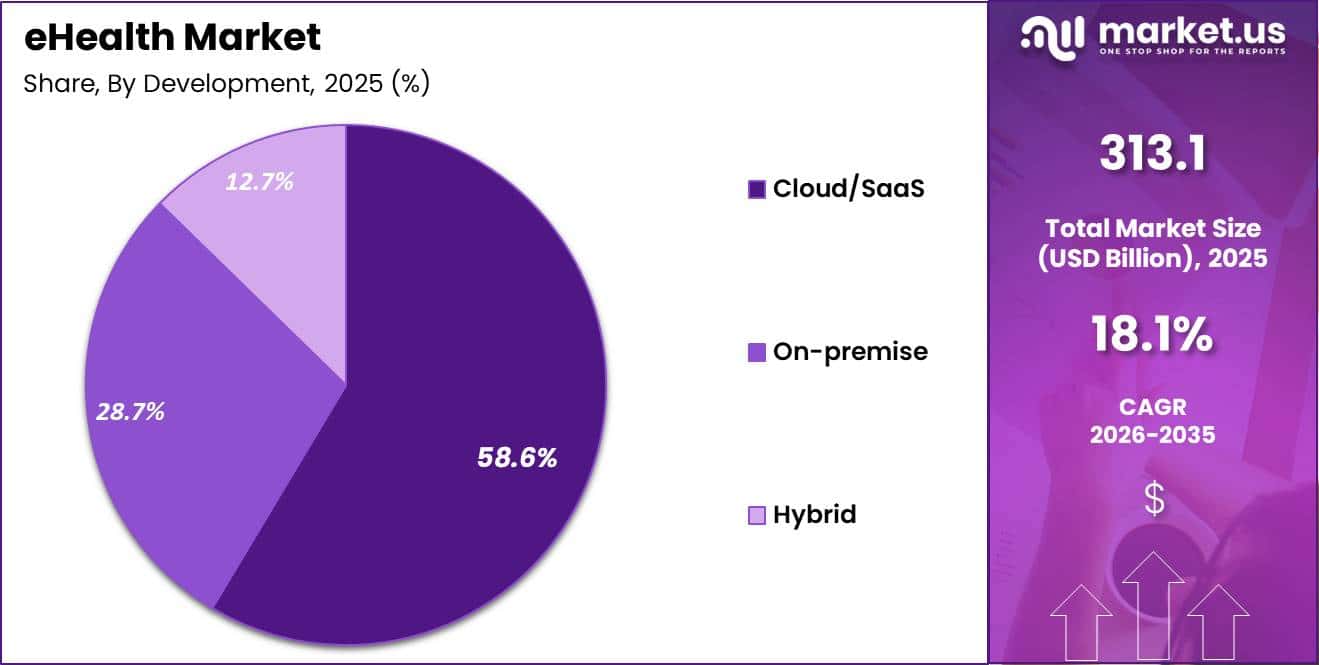
- By Deployment:Cloud/SaaS, accounting for 58.6% of total revenue.
- By End User:Hospitals & Health Systems leads the segment, accounting for 44.8% of total revenue.
- Regional: North America is the dominant regional market, accounting for 51.4% of global sales
Offering Segment Analysis
The product segment dominated the eHealth market in 2025, accounting for 64.7% of the global market share. This leadership is driven by the widespread adoption of digital healthcare technologies, including electronic health records (EHR), telemedicine platforms, remote patient monitoring devices, mobile health applications, clinical decision support systems, and healthcare analytics software.
Healthcare providers are increasingly investing in integrated digital solutions that improve patient care, streamline clinical workflows, and support data-driven decision-making. The growing use of artificial intelligence, cloud computing, and Internet of Things (IoT)-enabled medical devices has further strengthened demand for advanced eHealth products.
In addition, governments and healthcare organizations continue to modernize healthcare infrastructure through digital transformation initiatives, boosting product deployment across hospitals and clinics.
Meanwhile, the services segment, representing 35.3% of the market in 2025, continues to grow steadily as healthcare providers require implementation, consulting, training, integration, cybersecurity, maintenance, and technical support services to maximize the value of digital health investments.
The increasing complexity of healthcare IT systems has encouraged organizations to partner with specialized service providers for system upgrades and regulatory compliance. As digital health ecosystems expand globally, both products and services are expected to experience sustained demand, with products maintaining their leading position due to continuous technological innovation and higher capital investment.
Deployment Segment Analysis
The Cloud/SaaS segment held the largest share of the eHealth market in 2025, accounting for 58.6% of total revenue. Healthcare organizations are increasingly adopting cloud-based platforms because they offer scalability, lower infrastructure costs, easier software updates, and secure remote access to patient information.
Cloud deployment also enables seamless interoperability between healthcare providers, laboratories, pharmacies, and insurers while supporting telehealth, electronic medical records, and AI-powered analytics.
The growing demand for real-time healthcare data sharing and flexible digital infrastructure has accelerated cloud adoption among hospitals, clinics, and diagnostic centers. The on-premise segment accounted for 28.7% of the market, supported by healthcare institutions that prioritize complete control over sensitive patient information, regulatory compliance, and customized IT environments.
Large hospitals and government healthcare facilities continue to rely on on-premise systems for critical operations where data security remains a primary concern.
Meanwhile, the hybrid deployment model captured 12.7% of the market, offering organizations a balance between cloud flexibility and on-premise security. Hybrid solutions are becoming increasingly attractive for healthcare providers undergoing phased digital transformation, allowing them to modernize operations while protecting legacy systems.
As cybersecurity capabilities improve and digital healthcare expands, cloud deployment is expected to maintain its market leadership throughout the forecast period.
End User Segment Analysis
The Hospitals & Health Systems segment dominated the global eHealth market in 2025, capturing 44.8% of the total market share. Hospitals remain the largest adopters of digital health technologies due to their extensive patient volumes, complex clinical operations, and growing need for integrated healthcare management.
Electronic health records, telemedicine platforms, clinical decision support systems, remote patient monitoring, and hospital information systems are increasingly deployed to improve patient outcomes, optimize resource utilization, and enhance operational efficiency. Rising investments in digital transformation, interoperability, and AI-enabled healthcare solutions have further strengthened adoption among large health systems.
Hospitals also benefit from government-supported healthcare digitization initiatives and increasing demand for value-based care models. Other end users, including ambulatory care centers, diagnostic laboratories, specialty clinics, pharmacies, home healthcare providers, insurance organizations, and patients, are also expanding their use of eHealth solutions as healthcare delivery becomes more decentralized.
The rapid growth of virtual care, mobile health applications, and remote monitoring technologies has encouraged broader adoption beyond traditional hospital settings.
Healthcare organizations across all end-user categories are increasingly leveraging digital platforms to improve care coordination, patient engagement, and clinical efficiency. Nevertheless, hospitals and integrated health systems are expected to remain the largest end-user segment owing to their significant technology investments and central role in delivering comprehensive healthcare services.
Market Segmentations
By Offering
- Product
- Clinical Information Systems (CIS)
- Virtual Care & Telehealth Platforms
- Remote Patient Monitoring (RPM) & Connected Monitoring
- Patient Engagement & Consumer Access
- ePrescribing Solutions
- Interoperability Platforms
- Others
- Services
- Remote Monitoring Services
- Diagnostic Services
- Database Management
- Others
By Deployment
- Cloud/SaaS
- On-premise
- Hybrid
By End User
- Hospitals & Health Systems
- Healthcare Payers
- Pharmacies
- Government and Public Health Bodies
- Others
Driver
Telehealth and remote monitoring reimbursement expansion
Reimbursement remains one of the clearest near-term accelerators because it converts eHealth from an efficiency story into a billable care-delivery model with measurable provider revenue.
CMS-linked 2026 remote monitoring changes indicate continued refinement of reimbursement pathways, including lower-threshold remote physiologic monitoring constructs such as 2–15 monitoring days and first 10-minute treatment-service increments, which broadens the number of eligible patient episodes and increases the commercial viability of lighter-intensity monitoring programs that previously struggled to meet legacy utilization thresholds.
That matters strategically because providers can deploy eHealth into broader chronic-care cohorts, post-acute follow-up, and medication-titration use cases without requiring every patient to generate dense data streams every month, improving enrollment conversion and lowering operational friction.
The business-model effect is significant: software vendors can price around reimbursement-enabled workflow units, device logistics, and managed-service staffing, while health systems can justify implementation through direct claims contribution instead of only downstream readmission avoidance.
In the U.S., this tends to accelerate RPM, RTM, asynchronous check-ins, and virtual nurse-coordination stacks faster than in markets where reimbursement remains fragmented.
| Driver | (~) % Impact on CAGR Forecast | Geographic Relevance | Impact Timeline |
|---|---|---|---|
| Chronic disease digital management demand | +2.3% | North America core, EU5, Japan, South Korea, urban China, GCC | Short term (≤ 2 years) |
| Telehealth and remote monitoring reimbursement expansion | +1.9% | United States core, Canada follow-through, Western Europe selective, Australia | Short term (≤ 2 years) |
| Interoperability and patient-data access mandates | +1.6% | United States core, EU, India public-platform corridors, OECD spill-over | Medium term (2-4 years) |
| AI-enabled clinical software commercialization | +2.1% | United States core, EU innovation hubs, APAC advanced provider markets | Medium term (2-4 years) |
| Cybersecurity and compliance-driven platform upgrades | +1.2% | North America core, EU, Japan, South Korea | Short term (≤ 2 years) |
| Health system capacity pressure and virtual-first care models | +1.5% | North America, UK, Nordics, Australia, high-density APAC metros | Medium term (2-4 years) |
Challenge
Advanced Materials Sourcing Risks Constrain Solid-State Battery Growth
The solid-state battery value chain relies on advanced ceramic and sulfide electrolytes, lithium metal foils, and high-purity cathode materials whose upstream extraction, refining, and specialized processing are concentrated in limited geographies, leading to systemic sourcing risk and price volatility that act as a structural challenge rather than an immediate demand freeze.
For example, current solid electrolyte precursors and lithium metal feedstock can experience quarterly price swings of 15–25% relative to contract baselines when upstream mines or processing facilities encounter disruptions, and lead times for certain engineered powders and foils can extend from 8–10 weeks to 18–24 weeks in periods of tight capacity.
This volatility forces OEMs to maintain safety inventories equivalent to 2–3 months of production, versus 4–6 weeks in mature Li-ion chains, locking up working capital and increasing inventory carrying costs by an estimated 20–30% per kWh, while also creating 5–10% swings in bill-of-materials costs that complicate multi-year pricing commitments to large EV and grid customers.
Strategic mitigation requires multi-continental sourcing, long-term offtake agreements covering thousands of tonnes of critical materials over 5–10 years, and investments in recycling streams capable of recovering 30–40% of key metals and compounds from end-of-life packs.
Until these initiatives materially reduce single-point-of-failure exposure and stabilize input costs, the market faces an estimated 1.2 % point drag on maximum growth potential because OEMs stagger capacity additions, delay entry into high-volume price-sensitive segments, and prioritize premium niches where volatility can be priced in more easily.
| Challenge | (~) % CAGR Friction Drag | Geographic Relevance | Mitigation Horizon |
|---|---|---|---|
| Electrolyte interface instability | -1.8% | NA, EU, APAC EV hubs | Long term (≥ 4 years) |
| Scale-up yield loss & scrap | -1.4% | NA gigafactories, EU, East Asia | Medium term (2-4 years) |
| Advanced materials sourcing risk | -1.2% | EU, East Asia, resource-rich EM | Long term (≥ 4 years) |
| Pack integration & safety validation | -1.0% | Global automotive & grid OEMs | Medium term (2-4 years) |
| Talent & process engineering deficit | -0.9% | NA core, EU R&D, APAC manufacturing | Long term (≥ 4 years) |
| Standards & test protocols fragmentation | -0.8% | Global regulatory & testing hubs | Medium term (2-4 years) |
Restraints
Data Privacy Enforcement Raises eHealth Growth Challenges
Escalating enforcement around health data privacy, especially from the FTC in the US and data protection authorities in Europe, is converting privacy compliance from a background hygiene factor into a material strategic restraint, raising operating costs, elevating liability risk, and deterring aggressive data-monetization plays that underpin many eHealth business models.
The FTC’s revised Health Breach Notification Rule and high-profile enforcement actions demonstrate that non-compliant data-sharing can trigger multi-million-dollar penalties, 10–20-year consent decrees, and mandatory third-party security audits, effectively adding a quasi-regulatory “tax” to health-app growth strategies and forcing platforms to invest 5–10% of annual revenue into security and legal infrastructure to manage risk.
Under the updated HBNR, companies must notify all affected users, the FTC, and sometimes media when breaches occur, which can drive immediate churn rates of 10–25% among active users, compressing lifetime value and discouraging experimentation with granular behavioral data that might otherwise support premium analytics products or cross-selling.
In the EU and other high-income OECD markets, strict interpretations of consent, purpose limitation, and cross-border data transfer under general data-protection regimes further limit the ability of eHealth firms to pool data across countries and product lines, reducing the scale of training datasets for AI tools by an estimated 30–40% relative to unconstrained scenarios and adding 12–24 months to development cycles for advanced analytics offerings.
Taken together, the need to maintain conservative data architectures, avoid opaque tracking, and budget for potential regulatory action supports a modeled 2.0 % point reduction in global eHealth CAGR through lower monetization per user, higher security-related OpEx, and more cautious product roadmaps.
| Restraint | (~) % Impact on CAGR Forecast | Geographic Relevance | Impact Timeline |
|---|---|---|---|
| Fragmented digital health regulation & approval pathways | -2.3% | US, EU, selected APAC | Medium term (2-4 years) |
| Data privacy & health breach enforcement risk | -2.0% | US, EU, high-income OECD | Long term (≥ 4 years) |
| Telehealth reimbursement uncertainty & parity gaps | -1.7% | US, parts of EU, emerging markets | Medium term (2-4 years) |
| Interoperability and health data infrastructure deficits | -1.5% | Emerging markets, fragmented EU/APAC systems | Long term (≥ 4 years) |
| Chronic underfunding of public digital health programs | -1.3% | Low- and middle-income countries, selected EU | Long term (≥ 4 years) |
| Cybersecurity costs and security-driven adoption drag | -1.2% | Global, especially US/EU hospitals & payers | Short–medium term (≤ 4 years) |
Opportunity
Integrated payer-provider data liquidity & interoperability hubs
This opportunity centers on creating regional interoperability hubs that deliver true data liquidity between payers, providers, and digital health vendors, going beyond current incremental EHR integration and siloed telehealth data flows that underpin baseline growth.
Today, health data are distributed across hospital systems, payer claims databases, registries, and consumer apps, with limited standardized exchange; even in advanced markets, less than 30–40% of providers report seamless data sharing with external organizations, and payer access to near-real-time clinical data for risk and quality management is often below 20%.
By building hub-and-spoke architectures that aggregate standardized clinical, claims, and patient-generated data for millions of covered lives, and exposing them via secure APIs, organizations can unlock new monetization layers risk-adjustment analytics, real-time quality scoring, fraud detection, and dynamic network optimization, each able to command per-member-per-month (PMPM) fees of USD 1–3 from payers alongside platform access fees for providers.
At 150–200 million covered lives in North America and the EU for early adoption by 2030, this can translate into an incremental USD 2–5 billion annual revenue pool on top of existing analytics spend, while the underlying infrastructure becomes a strategic asset driving M&A roll-ups of smaller health IT vendors.
Operationally, these hubs can reduce manual data reconciliation costs by 30–40%, cut care gaps through automated alerts by 10–15%, and enable more accurate value-based contract settlements, improving EBITDA margins for platform operators by 5–8 % points relative to traditional software licensing.
Because interoperability mandates and regional health information exchanges are only partially implemented and often under-monetized today, aggressively scaling commercially oriented data liquidity hubs in North America and Europe over the next 2–4 years represents a clear upside lever capable of adding 2.0 % points to baseline eHealth CAGR as new transaction-based and PMPM revenue streams layer onto today’s one-time license and service models.
| Opportunity | (~) % Potential CAGR Upside | Geographic Relevance | Execution Window |
|---|---|---|---|
| AI-driven longitudinal chronic care platforms | +2.5% | North America, EU, APAC urban | Medium term (2-4 years) |
| Integrated payer-provider data liquidity & interoperability hubs | +2.0% | North America core, EU | Medium term (2-4 years) |
| Value-based virtual primary care for underserved populations | +1.8% | APAC emerging, Latin America, Africa | Long term (≥ 4 years) |
| Regulatory-grade digital therapeutics (DTx) for metabolic and mental health | +2.2% | North America, EU, select APAC | Medium term (2-4 years) |
| Hospital-at-home and advanced remote monitoring ecosystems | +2.0% | North America, EU, APAC tier-1 cities | Short term (≤ 2 years) |
| Consumer-centric preventive health and wellness data monetization | +1.5% | Global, skew to North America & EU | Long term (≥ 4 years) |
Regional Analysis
In 2025, North America led the market, achieving over 51.4% share with a revenue of US$160.9 billion.
North America region’s leadership is supported by its advanced healthcare infrastructure, widespread adoption of electronic health records (EHRs), strong internet connectivity, and favorable government initiatives promoting digital health. Healthcare providers across the United States and Canada have increasingly integrated telemedicine, remote patient monitoring, e-prescribing, and AI-powered clinical decision support systems into routine care.
The growing burden of chronic diseases, an aging population, and rising healthcare expenditures have further accelerated investments in digital healthcare platforms. Public and private healthcare organizations continue to modernize healthcare delivery through cloud-based solutions and interoperable health information systems, improving patient outcomes and operational efficiency.
The presence of leading health IT companies, established reimbursement frameworks for virtual care, and a mature regulatory environment also strengthen regional market growth. Furthermore, increased consumer acceptance of mobile health applications and wearable health devices has expanded patient engagement and preventive healthcare services.
Strategic collaborations among hospitals, technology providers, insurers, and government agencies continue to drive innovation in digital healthcare ecosystems. Ongoing advancements in artificial intelligence, cybersecurity, and data analytics are enabling more personalized and secure healthcare services across the region.
As healthcare systems prioritize value-based care and digital transformation, North America is expected to maintain its dominant position while serving as a key innovation hub for the global eHealth market throughout the forecast period.
Key Regions and Countries
North America
- The US
- Canada
Europe
- Germany
- France
- The U.K.
- Italy
- Spain
- Russia & CIS
- Rest of Europe
Asia Pacific
- China
- India
- Japan
- South Korea
- ASEAN
- Australia & New Zealand
- Rest of Asia Pacific
Middle East & Africa
- GCC
- South Africa
- Rest of Middle East & Africa
Latin America
- Brazil
- Mexico
- Rest of Latin America
Key Player Analysis
The global eHealth market is moderately consolidated, with a mix of established healthcare technology providers, digital health specialists, telemedicine platforms, and connected medical device companies competing across diverse healthcare segments. Competition is driven by continuous innovation in digital care delivery, remote patient monitoring, artificial intelligence, cloud-based healthcare platforms, and data interoperability.
Companies are increasingly investing in integrated digital ecosystems that connect patients, providers, payers, and pharmacies while improving clinical workflows and healthcare accessibility. As healthcare systems continue their digital transformation, market participants are focusing on scalable, secure, and value-based solutions that enhance patient engagement and operational efficiency.
Veradigm LLC, Teladoc Health, Inc., American Well Corporation, Orange Health Care Pvt. Ltd., CVS Health Corporation, Koninklijke Philips N.V., UnitedHealth Group Incorporated, Medtronic plc, Epocrates, Inc., Telecare Corporation, MediSafe, Inc., SetPoint Medical Corporation, International Business Machines Corporation, Doximity, Inc., and Lift Labs are strengthening their competitive positions through strategic investments in research and development, digital platform enhancement, and collaborative partnerships.
Their innovation efforts emphasize artificial intelligence, virtual consultations, remote monitoring technologies, digital therapeutics, predictive analytics, medication adherence solutions, and connected healthcare devices.
These companies are also expanding interoperability capabilities to enable seamless integration with electronic health records and hospital information systems, helping clinicians make faster, data-driven decisions.
Ecosystem-based competition has become a key differentiator, with organizations building comprehensive digital healthcare networks through collaborations with hospitals, insurers, technology providers, and life sciences companies. This integrated approach supports personalized care, improves workflow efficiency, enhances patient outcomes, and strengthens long-term market competitiveness.
Top Key Players
- Veradigm LLC
- Teladoc Health, Inc.
- American Well Corporation
- Orange Health Care Pvt. Ltd.
- CVS Health Corporation
- Koninklijke Philips N.V.
- UnitedHealth Group Incorporated
- Medtronic plc
- Epocrates, Inc.
- Telecare Corporation
- MediSafe, Inc.
- SetPoint Medical Corporation
- International Business Machines Corporation
- Doximity, Inc.
- Lift Labs
Recent Developments
- In February 2025, Teladoc Health, Inc. announced the acquisition of Catapult Health, enhancing its preventive virtual care and at-home diagnostic testing capabilities for integrated care delivery.
- In August 2025, Telecare Corporation (Telecare Australia) was acquired by Teladoc Health, strengthening Teladoc’s integrated virtual care capabilities in the Asia-Pacific region.
- In May 2026, Veradigm LLC launched Veradigm Health Network Architecture, a real-time interoperability platform designed to connect EHR, revenue cycle, and patient engagement data, helping independent physician practices improve clinical and operational decision-making.
Report Scope
| Report Features | Description |
|---|---|
| Market Value (2025) | US$ 313.1 Billion |
| Forecast Revenue (2035) | US$ 1,650.4 Billion |
| CAGR (2026-2035) | 18.1% |
| Base Year for Estimation | 2025 |
| Historic Period | 2020-2024 |
| Forecast Period | 2026-2035 |
| Report Coverage | Revenue Forecast, Market Dynamics, Competitive Landscape, Recent Developments |
| Segments Covered | By Offering(Product(Clinical Information Systems (CIS), Virtual Care & Telehealth Platforms, Remote Patient Monitoring (RPM) & Connected Monitoring, Patient Engagement & Consumer Access, ePrescribing Solutions, Interoperability Platforms,Others)Services (Remote Monitoring Services, Diagnostic Services, Database Management, Others) By Deployment (Cloud/SaaS, On-premise, Hybrid)By End User(Hospitals & Health Systems, Healthcare Payers, Pharmacies, Government and Public Health Bodies, Others))By Region and Companies – Industry Segment Outlook, Market Assessment, Competition Scenario, Trends and Forecast 2026-2035 |
| Regional Analysis | North America – The US, Canada; Europe – Germany, France, U.K., Italy, Spain, Russia & CIS, Rest of Europe; Asia Pacific – China, India, Japan, South Korea, ASEAN, Australia & New Zealand, Rest of Asia Pacific; Middle East & Africa – GCC, South Africa, Rest of Middle East & Africa; Latin America – Brazil, Mexico, Rest of Latin America |
| Competitive Landscape | Veradigm LLC ,Teladoc Health, Inc. ,American Well Corporation ,Orange Health Care Pvt. Ltd. ,CVS Health Corporation ,Koninklijke Philips N.V. ,UnitedHealth Group Incorporated ,Medtronic plc ,Epocrates, Inc. ,Telecare Corporation ,MediSafe, Inc. ,SetPoint Medical Corporation ,International Business Machines Corporation ,Doximity, Inc. ,Lift Labs |
| Customization Scope | Customization for segments, region/country-level will be provided. Moreover, additional customization can be done based on the requirements. |
| Purchase Options | We have three licenses to opt for: Single User License, Multi-User License (Up to 5 Users), Corporate Use License (Unlimited User and Printable PDF) |





































