


Market Overview
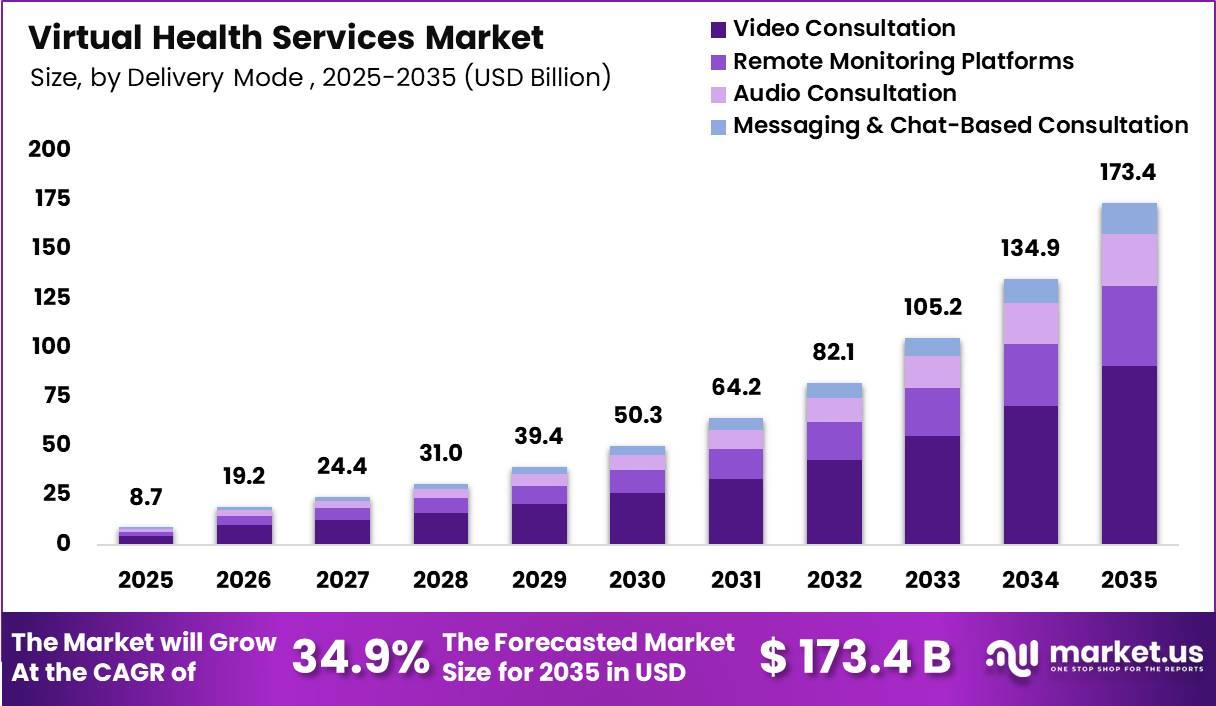
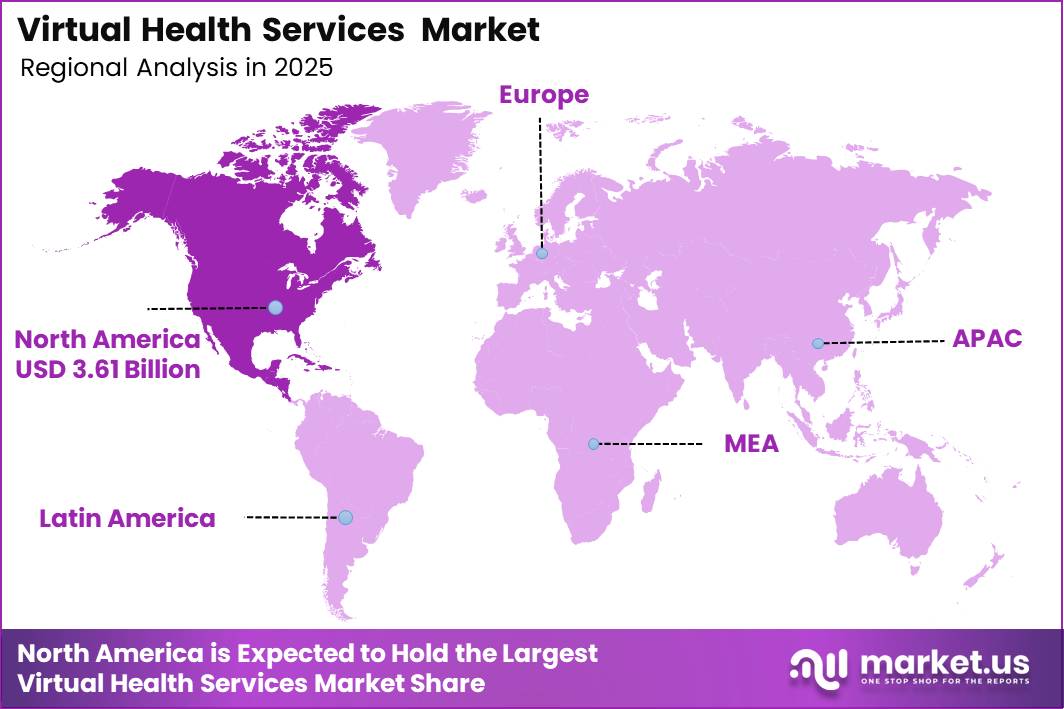
Global Virtual Health Service Market size is expected to be worth around US$ 173.4 Billion by 2035 from US$ 8.7 Billion in 2025, growing at a CAGR of 34.9% during the forecast period from 2026 to 2035. In 2025, North America led the market, achieving over 41.5% share with a revenue of US$ 3.61 Billion.
The Virtual Health Services Market is experiencing rapid expansion as healthcare systems worldwide increasingly adopt telehealth, remote patient monitoring, virtual consultations, digital therapeutics, and mobile health platforms. The growing demand for accessible healthcare, rising internet penetration, and widespread smartphone usage are transforming how medical services are delivered and consumed.
According to the World Health Organization (WHO), digital health technologies have become a critical component of modern healthcare delivery, supporting improved access, efficiency, and continuity of care. WHO’s Global Strategy on Digital Health highlights the role of telemedicine and digital health solutions in strengthening health systems and expanding healthcare access, particularly in underserved and remote regions.
The COVID-19 pandemic significantly accelerated the adoption of virtual healthcare services. Government and healthcare agencies reported substantial increases in telehealth utilization, with virtual consultations becoming an established part of routine healthcare delivery.
Data published by the U.S. Department of Health and Human Services indicate that telehealth usage remained consistently elevated even after pandemic-related restrictions eased, demonstrating sustained patient and provider acceptance.
Virtual health services are increasingly being used across primary care, mental health, chronic disease management, specialist consultations, and post-treatment follow-ups. The integration of artificial intelligence, wearable devices, and remote monitoring technologies is further enhancing patient engagement and clinical decision-making.
Additionally, expanding broadband infrastructure, supportive reimbursement policies, and growing investments in digital healthcare ecosystems continue to strengthen market development.
As healthcare systems focus on improving accessibility, reducing costs, and addressing workforce shortages, virtual health services are expected to remain a key pillar of healthcare delivery worldwide, supporting millions of remote consultations and digital patient interactions annually.
Key Takeaways
- Market Size : Virtual Health Service Market size is expected to be worth around US$ 173.4 Billion by 2035 from US$ 8.7 Billion in 2025.
- Market Share : The Market is growing at CAGR of 34.9% during the forecast period from 2026 to 2035.
- Service Type Analysis : The Teleconsultation Services segment dominated the Virtual Health Services Market with 42.3% of the market share in 2025.
- Delivery Mode Analysis : In 2025, The Video Consultation segment led the Virtual Health Services Market with 52.3% of the market share.
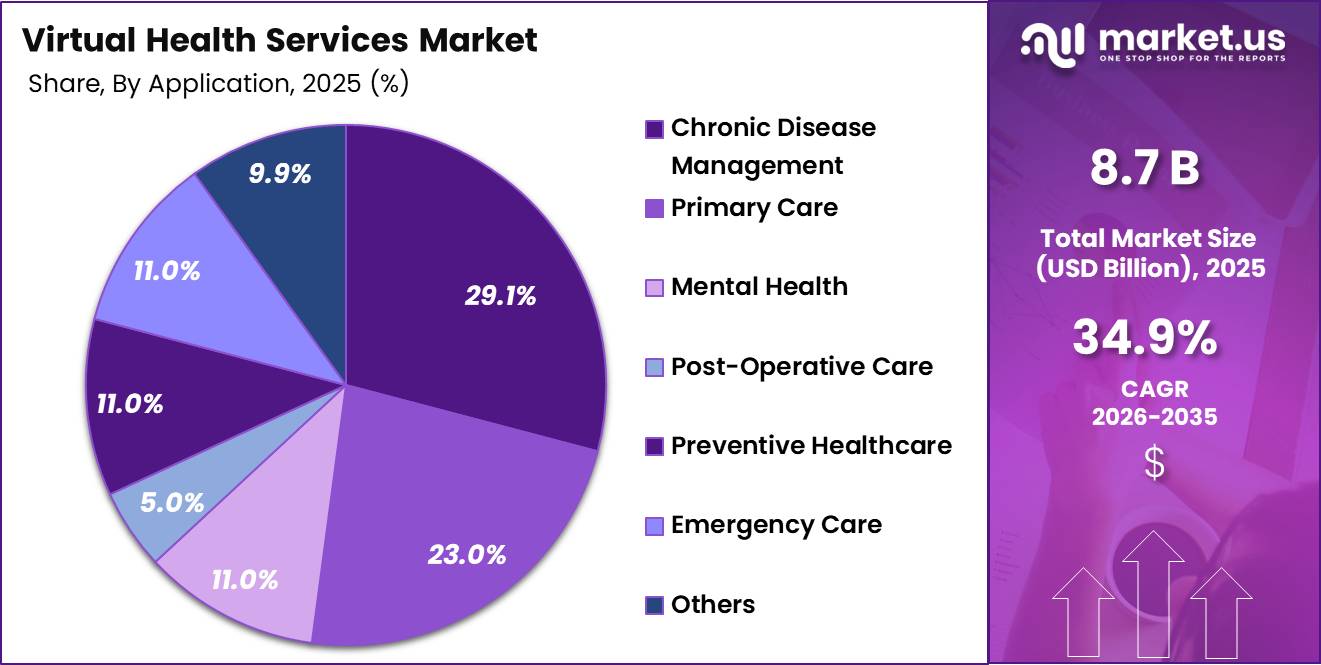
- Application Analysis : The Chronic Disease Management segment dominated the Virtual Health Services Market with 29.1% of the market share in 2025.
- Regional Analysis : In 2025, North America led the market, achieving over 41.5% share with a revenue of US$ 3.61 Billion.
Service Type Analysis
The Teleconsultation Services segment dominated the Virtual Health Services Market with 42.3% of the market share in 2025. This leadership is driven by the growing preference for online doctor consultations, shorter waiting times, and improved access to healthcare in both urban and rural areas.
Hospitals, clinics, and healthcare providers increasingly use teleconsultation to deliver primary care, specialist consultations, follow-up visits, and chronic disease management. Supportive digital health policies, wider internet access, and higher smartphone adoption have also accelerated demand for virtual consultations. The convenience of receiving medical advice from home continues to make teleconsultation the most widely used virtual healthcare service.
Remote Patient Monitoring (RPM) accounted for 28.9% of the market, supported by the increasing use of connected medical devices for monitoring patients with chronic conditions. Tele-Psychiatry Services held 12.0%, reflecting rising awareness of mental health and easier access to behavioral care. Tele-Pharmacy Services captured 10.0%, helping patients receive medication guidance and prescription management remotely.
Tele-ICU Services represented 6.0%, enabling specialists to support intensive care units remotely, while Others contributed 0.8%, covering niche virtual healthcare services. These segments continue to expand as healthcare systems invest in digital care delivery and integrated patient management solutions.
Delivery Mode Analysis
The Video Consultation segment led the Virtual Health Services Market with 52.3% of the market share in 2025. Video-based consultations remain the preferred delivery mode because they enable real-time interaction between healthcare professionals and patients while allowing visual assessment, improved communication, and stronger patient engagement.
Healthcare providers increasingly rely on secure video platforms for primary care, specialist consultations, follow-up appointments, and chronic disease management. The growing availability of high-speed internet and smartphones has further strengthened the adoption of video consultations across healthcare systems.
Remote Monitoring Platforms accounted for 23.4% of the market, supported by the increasing use of wearable devices and connected health technologies that continuously track patient health outside hospitals. Audio Consultation represented 15.2%, offering an accessible option for patients with limited internet connectivity or those requiring simple follow-up care.
Messaging & Chat-Based Consultation captured 10.2%, driven by demand for quick medical advice, prescription renewals, and routine healthcare guidance. As digital healthcare continues to evolve, healthcare providers are combining multiple delivery modes to improve patient convenience, increase care accessibility, and support continuous monitoring across different medical conditions.
Application Analysis
The Chronic Disease Management segment dominated the Virtual Health Services Market with 29.1% of the market share in 2025. The increasing prevalence of long-term conditions such as diabetes, hypertension, cardiovascular diseases, and respiratory disorders has significantly increased the demand for continuous virtual care.
Healthcare providers use virtual health platforms to conduct regular follow-ups, monitor patient health remotely, improve medication adherence, and reduce unnecessary hospital visits. These advantages make virtual healthcare an effective solution for long-term disease management. Primary Care remains a major application area, supported by growing demand for routine consultations and early diagnosis through digital platforms.
Mental Health continues to expand as virtual counseling and psychiatric consultations improve access to behavioral healthcare services. Post-Operative Care benefits from remote follow-up appointments that help monitor patient recovery after surgery.
Preventive Healthcare is growing through online wellness consultations, health screenings, and lifestyle management programs. Emergency Care also utilizes virtual health services for rapid triage, initial medical assessment, and timely specialist support. Others include rehabilitation, maternal care, and pediatric services, further expanding the role of virtual healthcare across diverse clinical applications.
Market Segmentations
Service Type
- Teleconsultation Services
- General Physician Consultation
- Specialist Consultation
- Mental Health Consultation
- Follow-Up Consultation
- Others
- Remote Patient Monitoring (RPM)
- Chronic Disease Monitoring
- Cardiac Monitoring
- Diabetes Monitoring
- Respiratory Monitoring
- Post-Acute Care Monitoring
- Others
- Tele-ICU Services
- Intensive Care Monitoring
- Critical Care Consultation
- Remote Specialist Support
- Tele-Psychiatry Services
- Psychiatric Evaluation
- Therapy & Counseling
- Medication Management
- Tele-Pharmacy Services
- E-Prescription Services
- Medication Counseling
- Medication Adherence Monitoring
- Others
Delivery Mode
- Video Consultation
- Audio Consultation
- Messaging & Chat-Based Consultation
- Remote Monitoring Platforms
Application
- Chronic Disease Management
- Primary Care
- Mental Health
- Post-Operative Care
- Preventive Healthcare
- Emergency Care
- Others
Opportunities
Senior care virtual bundles
This is a future upside pocket, not a baseline driver, because ageing populations are already increasing care demand, but most virtual health companies still monetize seniors through isolated consultations rather than bundled longitudinal offerings that combine primary care check-ins, medication adherence, caregiver access, fall-risk monitoring, and chronic-condition management into one recurring ARPU stream.
By 2030, 1 in 6 people globally will be aged 60 or older, rising from 1.0 billion in 2020 to 1.4 billion, and the 80-plus population is projected to reach 426 million by 2050, creating a large and under-segmented cohort for higher-frequency, lower-churn digital care subscriptions.
If providers repackage services into family-paid or insurer-sponsored bundles priced 20% to 35% above standard teleconsulting plans, they can reduce acquisition payback periods through household-level cross-sell and lift retention by an estimated 15% to 25%.
The upside is most attractive in Japan, Europe, North America, and wealthier Asian urban markets where caregiver shortages and elder dependency ratios are worsening, yet it remains an opportunity because current virtual health product design is still optimized around working-age, on-demand users rather than multi-stakeholder senior-care journeys.
| Opportunity | (~) % Potential CAGR Upside | Geographic Relevance | Execution Window |
|---|---|---|---|
| Hospital-at-home orchestration | +2.8% | North America core, EU | Medium term |
| Senior care virtual bundles | +2.3% | Japan, EU, North America, urban China | Medium term |
| RPM-to-risk contracts | +2.1% | US core, Gulf, Australia | Short term |
| Behavioral health subscription layers | +1.9% | US, UK, Nordics, India metros | Short term |
| Interoperability monetization | +1.6% | EU, OECD markets, GCC | Medium term |
| Virtual specialist pharmacy hubs | +1.7% | US, Canada, Western Europe | Medium term |
Drivers
Medicare reimbursement extension and permanent code expansion
The single most important 2026 demand stabilizer is that many Medicare telehealth flexibilities now extend through December 31, 2027, preserving home-based access and reducing the near-term reimbursement cliff that had restrained provider technology investment and virtual clinic staffing plans.
Centers for Medicare & Medicaid Services’ December 2025 telehealth booklet also shows several structural upgrades for 2026: services added to the Medicare telehealth list are now considered on a permanent basis, five new CPT/HCPCS codes were added for 2026.
Rural Health Clinics and Federally Qualified Health Centers continue to receive payment for medical telehealth services through December 31, 2026, and home-based telehealth continues to bill at the non-facility Physician Fee Schedule rate, all of which improves revenue visibility for multisite providers and platform vendors.
The financial signal is not just symbolic: the originating site facility fee rose from $31.04 for CY 2025 services to $31.85 for CY 2026 services, reflecting a 2.7% Medicare Economic Index increase, while CMS retained operational billing clarity through POS 02 and POS 10 and maintained RPM/RTM compatibility with several care-management pathways when time is not double counted.
Strategically, this shifts virtual health from a provisional access channel to a line-item budget category with clearer recurring reimbursement, encouraging providers to replace episodic teleconsult models with integrated virtual front doors, care coordination layers, and specialty-specific digital pathways that support higher patient retention and better capacity utilization.
| Driver | (~) % Impact on CAGR Forecast | Geographic Relevance | Impact Timeline |
|---|---|---|---|
| Medicare reimbursement extension and permanent code expansion | +2.4% | North America core, selective spill-over into OECD payer systems | Short term (≤ 2 years) |
| Chronic disease load accelerating RPM and longitudinal virtual care | +2.1% | North America core, EU, developed APAC | Medium term (2-4 years) |
| Provider capacity optimization through virtual wards and hospital-at-home | +1.7% | UK, EU, North America, Australia | Medium term (2-4 years) |
| AI-enabled triage, documentation, and decision support in virtual workflows | +1.5% | North America core, EU, advanced APAC | Medium term (2-4 years) |
| Audio-only access and home-based telehealth widening inclusion | +1.2% | North America, rural OECD, parts of LATAM spill-over | Short term (≤ 2 years) |
| Cross-setting care integration across mental, home, and specialty services | +1.0% | North America core, EU, APAC urban corridors | Long term (≥ 4 years) |
Challenges
Clinical workforce capacity strain
Virtual health demand is scaling into a structurally constrained global clinical workforce, with US projections alone pointing to a physician shortfall approaching 80,000–86,000 by the mid-2030s and similar density gaps evident in geriatrics, behavioral health, and primary care across OECD markets, which turns every incremental 10–15% increase in virtual visit volumes into incremental burnout, churn, and scheduling bottlenecks rather than pure volume expansion.
Physicians already using telehealth weekly rose to over 70% by 2024, but their total patient-facing hours have not grown proportionally, meaning that virtual health in many systems simply cannibalizes in-person slots rather than expanding aggregate capacity, with some specialties reporting 5–10% point increases in average panel loads but 2–4 percentage point declines in perceived work-life sustainability.
Operationally, average teleconsult lengths in complex specialties still cluster around 18–22 minutes, leaving limited scope to squeeze in more visits without automation of pre-visit intake, coding, documentation, and post-visit tasks that currently consume another 8–12 minutes per encounter.
Strategically, platforms will have to build multi-tiered clinical models that shift 20–35% of encounters to advanced practice providers and digital triage, embed AI-assisted scribing and decision support to reclaim 3–5 minutes per consult, and design outcome-based compensation and flexible scheduling frameworks that reduce churn risk among high-value clinicians, accepting that growth will be gated not only by patient demand but also by the rate at which such productivity tools diffuse across the active telehealth user base over the next 5–10 years.
| Challenge | (~) % CAGR Friction Drag | Geographic Relevance | Mitigation Horizon |
|---|---|---|---|
| Fragmented digital infrastructure | -1.6% | Rural US, LATAM, Africa, emerging APAC | Long term (≥ 4 years) |
| Clinical workforce capacity strain | -1.3% | North America, Western Europe, Japan, GCC | Long term (≥ 4 years) |
| Interoperability and data silos | -1.1% | EU regulatory hubs, US, Asia metros | Medium term (2-4 years) |
| Cybersecurity and privacy overhang | -0.9% | North America core, EU, East Asia | Medium term (2-4 years) |
| Reimbursement and pricing complexity | -1.0% | US, Canada, EU mixed-payer, Australia | Medium term (2-4 years) |
| Patient engagement and digital divide | -0.8% | Aging high-income, rural global South | Short term (≤ 2 years) |
Restraints
Reimbursement concentration
The largest structural restraint remains reimbursement concentration around public programs and a still-fragile payer mix, because virtual health utilization can stay clinically relevant while revenue realization remains uneven across specialties, visit types, and site-of-care coding pathways.
Although Centers for Medicare & Medicaid Services has extended many Medicare telehealth flexibilities through December 31, 2027, that extension is still policy-dependent rather than fully normalized into a stable long-duration reimbursement architecture, and even the 2026 Medicare telehealth originating site facility fee rises only to $31.85, which illustrates incremental fee support rather than a broad reset of virtual-care unit economics.
In practice, this creates a modeled 2.1 percentage-point drag on market CAGR because operators price growth off reimbursable encounters, not raw consultations, and because uncertainty around which codes remain durable suppresses platform CapEx, slows specialty expansion, reduces appetite for full-stack care navigation, and forces providers to prioritize higher-yield in-person pathways whenever blended margins tighten.
| Restraint | (~) % Impact on CAGR Forecast | Geographic Relevance | Impact Timeline |
|---|---|---|---|
| Reimbursement concentration | -2.1% | North America core | Medium term (2-4 years) |
| Controlled-drug rule uncertainty | -1.7% | U.S. national | Short term (≤ 2 years) |
| State licensure fragmentation | -1.4% | U.S. interstate corridors | Medium term (2-4 years) |
| Cybersecurity and privacy overhead | -1.9% | North America core, EU | Short term (≤ 2 years) |
| Rural broadband and digital access gaps | -1.3% | U.S. rural, Canada remote, APAC ex-urban | Long term (≥ 4 years) |
| Provider cost inflation and workflow friction | -1.6% | North America core, EU, developed APAC | Medium term (2-4 years) |
Regional Analysis
North America dominated the Virtual Health Services Market in 2025, accounting for over 41.5% of the global market and generating approximately US$ 3.61 billion in revenue. The region’s leadership is primarily driven by advanced healthcare infrastructure, widespread adoption of digital technologies, and strong support for telehealth integration across healthcare systems.
The United States remains the largest contributor, supported by high internet penetration, extensive smartphone usage, and growing demand for convenient, patient-centered care solutions. The region has witnessed significant adoption of telemedicine platforms, remote patient monitoring systems, virtual consultations, and digital behavioral health services.
Healthcare providers are increasingly leveraging artificial intelligence, cloud-based healthcare applications, and wearable devices to improve clinical outcomes and patient engagement. Favorable reimbursement frameworks and regulatory initiatives supporting virtual care have further accelerated market expansion.
Canada also contributes substantially to regional growth through government-led digital health programs and investments aimed at improving healthcare accessibility in rural and remote communities. The increasing prevalence of chronic diseases, aging populations, and physician shortages has encouraged healthcare organizations to adopt virtual care models that reduce hospital visits and enhance care continuity.
Furthermore, the presence of leading technology firms, healthcare IT vendors, and telehealth service providers strengthens innovation across the region. Continuous investments in cybersecurity, interoperability, and data analytics are improving the efficiency and reliability of virtual healthcare platforms.
As healthcare systems continue their digital transformation journey, North America is expected to maintain its dominant position in the global Virtual Health Services Market over the coming years.
Key Regions and Countries
North America
- The US
- Canada
Europe
- Germany
- France
- The U.K.
- Italy
- Spain
- Russia & CIS
- Rest of Europe
Asia Pacific
- China
- India
- Japan
- South Korea
- ASEAN
- Australia & New Zealand
- Rest of Asia Pacific
Middle East & Africa
- GCC
- South Africa
- Rest of Middle East & Africa
Latin America
- Brazil
- Mexico
- Rest of Latin America
Key Player Analysis
The Virtual Health Services Market is highly competitive, with leading companies focusing on expanding virtual consultations, remote patient monitoring, mental health support, and chronic disease management. Teladoc Health Inc. remains one of the strongest players by offering a broad portfolio of virtual healthcare solutions for hospitals, employers, insurers, and individual patients.
The company continues to strengthen its position through integrated digital care platforms, artificial intelligence, and data-driven healthcare services.
Amwell (American Well) focuses on connecting healthcare providers, payers, and patients through scalable telehealth technology, helping health systems improve access to virtual care and clinical workflows. MDLIVE Inc., part of Evernorth, has built a strong presence by providing 24/7 access to primary care, behavioral health, and dermatology services through health plans and employers.
Doctor On Demand, now operating under Included Health, expands its offerings through integrated primary care and mental health services. Babylon Health contributed to the growth of AI-enabled digital healthcare by combining virtual consultations with symptom assessment technology, influencing the wider adoption of technology-driven healthcare delivery across global markets.
Top Key Players
- Teladoc Health Inc.
- Amwell (American Well)
- MDLIVE Inc.
- Doctor On Demand
- Babylon Health
- Ping An Good Doctor
- Practo Technologies
- 1Life Healthcare (One Medical)
- HealthTap Inc.
- LIVI (Kry International AB)
- Telstra Health
- MeMD (Part of Walmart Health)
- Maple Corporation
- Ada Health GmbH
- Doctor Anywhere
- Other Key Players.
Recent Developments
- In February 2025 – Teladoc Health signed a definitive agreement to acquire Catapult Health for US$ 65 million in cash plus up to US$ 5 million in earnout payments, expanding its virtual preventive care, at-home diagnostic testing, and chronic-care management capabilities across its 93+ million member base.
- In August 2025 – Amwell (American Well) secured an extension of its Digital First Program contract with the U.S. Defense Health Agency through a Leidos-led partnership. The initiative supports the ongoing digital transformation of the Military Health System, serving approximately 9.6 million beneficiaries with enhanced virtual care delivery capabilities.
- In May 2025 – Practo Technologies announced plans to accelerate international expansion, targeting a doubling of its overseas revenue within the next two to three years. The company highlighted growth opportunities across Southeast Asia, the Middle East, Africa, and developed markets such as Canada and Australia, reflecting a broader investment and expansion strategy in virtual healthcare services.
Report Scope
| Report Features | Description |
|---|---|
| Market Value (2025) | US$ 8.7 Billion |
| Forecast Revenue (2035) | US$ 173.4 Billion |
| CAGR (2026-2035) | 34.9% |
| Base Year for Estimation | 2025 |
| Historic Period | 2020-2024 |
| Forecast Period | 2026-2035 |
| Report Coverage | Revenue Forecast, Market Dynamics, Competitive Landscape, Recent Developments |
| Segments Covered | Service Type (Teleconsultation Services(General Physician Consultation, Specialist Consultation, Mental Health Consultation, Follow-Up Consultation, Others)), (Remote Patient Monitoring(RPM)(Chronic Disease Monitoring, Cardiac Monitoring, Diabetes Monitoring, Respiratory Monitoring, Post-Acute Care Monitoring, Others)), (Tele-ICU Services (Intensive Care Monitoring, Critical Care Consultation, Remote Specialist Support)), (Tele-Psychiatry Services(Psychiatric Evaluation, Therapy & Counseling, Medication Management)), (Tele-Pharmacy Services(E-Prescription Services, Medication Counseling, Medication Adherence Monitoring)), (Others) (Delivery Mode (Video Consultation, Audio Consultation, Messaging & Chat-Based Consultation, Remote Monitoring Platforms)), (Application (Chronic Disease Management, Primary Care, Mental Health, Post-Operative Care, Preventive Healthcare, Emergency Care, Others)) |
| Regional Analysis | North America – The US, Canada; Europe – Germany, France, U.K., Italy, Spain, Russia & CIS, Rest of Europe; Asia Pacific – China, India, Japan, South Korea, ASEAN, Australia & New Zealand, Rest of Asia Pacific; Middle East & Africa – GCC, South Africa, Rest of Middle East & Africa; Latin America – Brazil, Mexico, Rest of Latin America |
| Competitive Landscape | Teladoc Health Inc., Amwell (American Well), MDLIVE Inc., Doctor On Demand, Babylon Health, Ping An Good Doctor, Practo Technologies, 1Life Healthcare (One Medical), HealthTap Inc., LIVI (Kry International AB), Telstra Health, MeMD (part of Walmart Health), Maple Corporation, Ada Health GmbH, Doctor Anywhere, Other Key Players |
| Customization Scope | Customization for segments, region/country-level will be provided. Moreover, additional customization can be done based on the requirements. |
| Purchase Options | We have three licenses to opt for: Single User License, Multi-User License (Up to 5 Users), Corporate Use License (Unlimited User and Printable PDF) |





































