



Overview
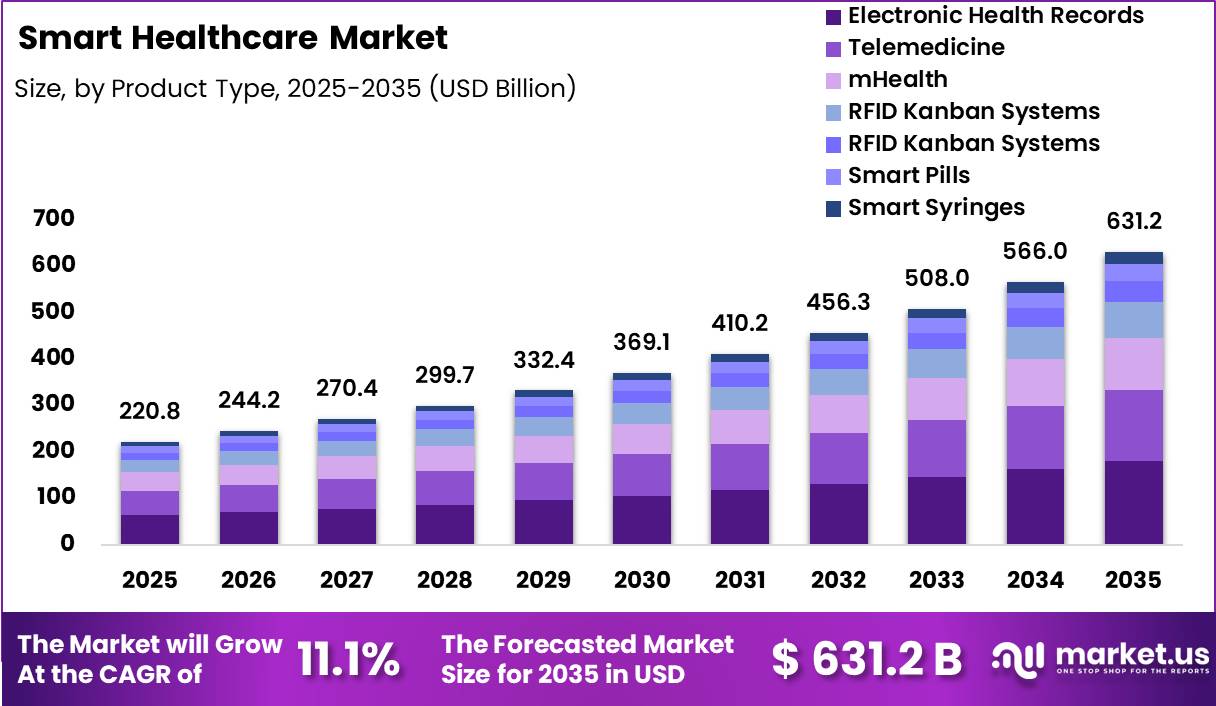
The Global Smart Healthcare Market size is expected to be worth around US$ 631.2 Billion by 2035 from US$ 220.8 Billion in 2025, growing at a CAGR of 11.1% during the forecast period from 2026 to 2035. In 2025, North America led the market, achieving over 39.1% share with a revenue of US$ 86.32 Billion.
The smart healthcare market is experiencing steady expansion as healthcare systems increasingly adopt connected medical devices, artificial intelligence (AI), cloud-based platforms, electronic health records (EHRs), and remote patient monitoring solutions to improve patient care and operational efficiency.
Rising demand for value-based healthcare, aging populations, and the growing burden of chronic diseases are encouraging healthcare providers to invest in digital technologies that enable real-time monitoring, predictive analytics, and personalized treatment. Governments are also accelerating digital transformation through national health IT strategies and interoperability initiatives, creating a supportive environment for smart healthcare adoption.
According to the World Health Organization (WHO), 129 countries have established national digital health strategies, highlighting the global commitment to modernizing healthcare systems through digital innovation. WHO also reports that more than 1,600 government officials from over 100 countries have received training in digital health and artificial intelligence, strengthening policy implementation and digital health governance worldwide.
Healthcare organizations are increasingly integrating AI-powered clinical decision support, telehealth platforms, wearable health devices, and connected hospital infrastructure to improve care coordination while reducing unnecessary hospital visits. These technologies enhance patient engagement, enable earlier disease detection, and support efficient resource management.
The World Health Assembly’s extension of the WHO Global Strategy on Digital Health through 2027 further reinforces international efforts to expand secure, ethical, and interoperable digital health ecosystems. As regulatory frameworks mature and investments in healthcare IT continue to rise, smart healthcare solutions are expected to play an increasingly important role in improving healthcare accessibility, quality, and long-term system resilience across developed and emerging economies.
Key Takeaways
- Market Size: The global Smart Healthcare Market was valued at US$ 220.8 Billion in 2025 and is projected to reach US$ 631.2 Billion by 2035.
- Market Growth: The market is expected to register a CAGR of 11.1% during the forecast period from 2026 to 2035.
- Product Type: Electronic Health Records (EHR) accounted for the largest share of the product type segment, representing 28.7% of the total market revenue.
- Technology: IoT in Healthcare dominated the technology segment, holding 29.1% of the total market revenue.
- Application: Remote Patient Monitoring emerged as the leading application segment, capturing 26.3% of the overall market revenue.
- End User: Hospitals & Health Systems led the end-user segment, contributing 54.5% of the total market revenue.
- Regional Analysis: North America remained the leading regional market, accounting for 39.1% of the global market revenue in 2025.
Statistical Information
- 95.0% of U.S. office-based physicians had adopted an Electronic Health Record (EHR) system in 2024, while 83.6% were using a certified EHR system.
- 80.0% of U.S. office-based physicians reported using telemedicine technology in 2024, compared with 86.5% in 2021, according to the CDC National Electronic Health Records Survey.
- 86.2% of U.S. primary care physicians used telemedicine in 2024, highlighting continued integration of virtual care into routine clinical practice.
- The CDC’s National Electronic Health Records Survey (NEHRS) has tracked EHR adoption across all 50 U.S. states and the District of Columbia since 2010.
- 13 out of 17 OECD countries reported that 95% or more of primary care practices use electronic medical records (EMRs), demonstrating widespread digital record adoption.
- Across OECD countries, 93% of primary care practices reported having electronic medical records available during consultations, supporting digital clinical workflows.
- Only 18% of patients across OECD countries were aware that they could access their health records online, indicating a gap between digital infrastructure and patient engagement.
- Patients who had to repeatedly provide health information because records were not shared electronically gave 15 percentage points lower ratings for trust and healthcare quality than those whose information was exchanged seamlessly.
- OECD data show that person-centred care scores were 20 percentage points lower among patients who had to repeat their medical information due to poor interoperability.
- Among 19 OECD countries surveyed, only 3 countries (Belgium, the Netherlands, and Norway) reported that more than 90% of primary care practices could electronically exchange medical records with other practices.
Regional Analysis
In 2025, North America maintained its leadership in the global smart healthcare market, accounting for over 39.1% of total revenue. The region benefits from advanced healthcare IT infrastructure, widespread adoption of electronic health records (EHRs), telehealth, artificial intelligence (AI), and connected medical devices.
Continuous investments in interoperable health information systems and supportive digital health policies are accelerating technology adoption across hospitals and healthcare networks. The OECD also highlights that interoperability can improve healthcare efficiency by enabling secure data exchange across providers and care settings.
Europe remains a mature market, supported by regional digital health strategies and investments in interoperable healthcare systems that strengthen cross-border care and patient data sharing.
The Asia-Pacific region is expected to witness the fastest growth due to expanding digital infrastructure, rising healthcare expenditure, and government initiatives promoting AI, telemedicine, and digital health ecosystems across countries such as China, India, Japan, and South Korea.
Meanwhile, Latin America and the Middle East & Africa are gradually advancing digital healthcare through increased investments in telehealth, mobile health applications, and national digital health programs, creating long-term opportunities for smart healthcare adoption despite infrastructure and funding challenges.
Emerging Trends
- Digital health services are becoming widely available across healthcare systems: Healthcare providers are expanding online appointment booking, e-prescriptions, patient portals, and electronic health records. According to the OECD, the average availability of online digital health services reached 82% in 2024, up from 79% in 2023, showing continued investment in digital healthcare infrastructure.
- Governments are rapidly expanding national digital health strategies: Digital health is becoming a national priority worldwide. By 2025, 129 countries had established national digital health strategies, while more than 1,600 government officials from over 100 countries had completed WHO training in digital health and AI, accelerating adoption of smart healthcare systems.
- Cross-border digital health interoperability is gaining momentum: Countries are investing in secure health data exchange to improve patient care. The WHO’s Global Digital Health Certification Network already supports health data exchange for 1.8 billion people across 80 countries, encouraging broader adoption of interoperable smart healthcare platforms.
- AI is becoming a core component of healthcare delivery: Healthcare organizations are increasingly deploying AI for clinical decision support, workflow automation, diagnostics, and personalized medicine. The OECD reports that AI is emerging as a key technology to improve healthcare efficiency while supporting more patient-centered care through digital transformation.
- Digital health platforms are improving patient engagement: Healthcare systems are expanding patient access to digital services, including online health records, virtual consultations, and secure messaging. OECD data show online digital health service availability increased, reflecting stronger adoption of patient-centered digital healthcare models.
Use Cases
- Electronic Health Records improve coordinated patient care: Smart healthcare platforms integrate EHRs across hospitals and clinics, enabling clinicians to securely access patient histories, prescriptions, laboratory reports, and imaging. The OECD reports that 13 of 17 countries have 95% or higher electronic medical record adoption in primary care practices.
- Connected digital platforms support remote clinical services: Healthcare providers increasingly use telemedicine, connected monitoring devices, and cloud platforms to manage patients outside hospitals. WHO recognizes these digital interventions as essential components of modern healthcare delivery, improving continuity of care and healthcare accessibility.
- Smart healthcare enables secure cross-border health data exchange: Interoperable digital platforms allow healthcare professionals to access patient information across different care settings and countries. WHO reports that the Global Digital Health Certification Network supporting international digital health services.
- AI supports faster clinical decision-making: Hospitals are integrating AI into imaging analysis, clinical workflows, risk prediction, and patient triage to improve operational efficiency. The FDA highlights digital health technologies as tools that use software, sensors, and connected platforms to improve patient monitoring and clinical decision-making.
- Digital health systems strengthen healthcare resilience: Healthcare organizations use integrated digital platforms for disease surveillance, care coordination, and health system management. WHO reports nations have implemented national digital health strategies, demonstrating widespread use of smart healthcare technologies to strengthen health systems and improve service delivery.
Frequently Asked Questions About Smart Healthcare
- What factors are driving the growth of the smart healthcare market?
The market is growing because healthcare providers are increasingly adopting digital health technologies to improve efficiency, reduce costs, and enhance patient outcomes. Rising chronic diseases, aging populations, demand for remote care, government digital health initiatives, and advances in AI and connected medical devices continue to support market expansion. - Which technologies are commonly used in smart healthcare?
Smart healthcare relies on technologies including artificial intelligence, IoT-enabled medical devices, cloud computing, electronic health records, mobile health applications, wearable sensors, robotics, and telemedicine. Together, these technologies help clinicians make informed decisions while enabling continuous monitoring and personalized patient care. - How does smart healthcare benefit patients?
Smart healthcare improves patient access to medical services through virtual consultations, connected monitoring devices, and digital health records. It supports earlier disease detection, continuous monitoring of chronic conditions, better communication with healthcare providers, and more personalized treatment plans while reducing unnecessary hospital visits. - What role does artificial intelligence play in smart healthcare?
Artificial intelligence helps healthcare providers analyze medical images, identify disease risks, support clinical decisions, automate administrative tasks, and personalize treatment recommendations. AI also improves operational efficiency by reducing manual workloads and enabling healthcare professionals to make faster, data-driven decisions. - What challenges does the smart healthcare market face?
Despite rapid growth, smart healthcare faces challenges including cybersecurity risks, patient data privacy concerns, interoperability between digital systems, regulatory compliance, and integration with legacy healthcare infrastructure. Addressing these issues is essential for ensuring secure, reliable, and scalable digital healthcare services. - What is the future outlook for the smart healthcare market?
The future of the smart healthcare market is expected to be shaped by greater adoption of AI, wearable technologies, digital twins, IoT-connected devices, and predictive analytics. Continued investments in digital infrastructure and interoperable healthcare platforms are likely to improve care quality, accessibility, and operational efficiency worldwide.
Conclusion
The global smart healthcare market is entering a period of sustained growth as healthcare providers increasingly embrace digital technologies to improve clinical outcomes, operational efficiency, and patient experiences. Innovations such as artificial intelligence, IoT-enabled medical devices, electronic health records, telemedicine, and remote patient monitoring are transforming healthcare delivery worldwide. Government initiatives promoting interoperability, secure data exchange, and national digital health strategies are further accelerating market adoption.
As healthcare systems prioritize value-based care and personalized medicine, demand for integrated digital health solutions will continue to rise. With ongoing technological advancements and supportive regulatory frameworks, smart healthcare is expected to play a critical role in building more connected, efficient, resilient, and patient-centric healthcare systems across both developed and emerging economies over the coming decade.




















