


Report Overview
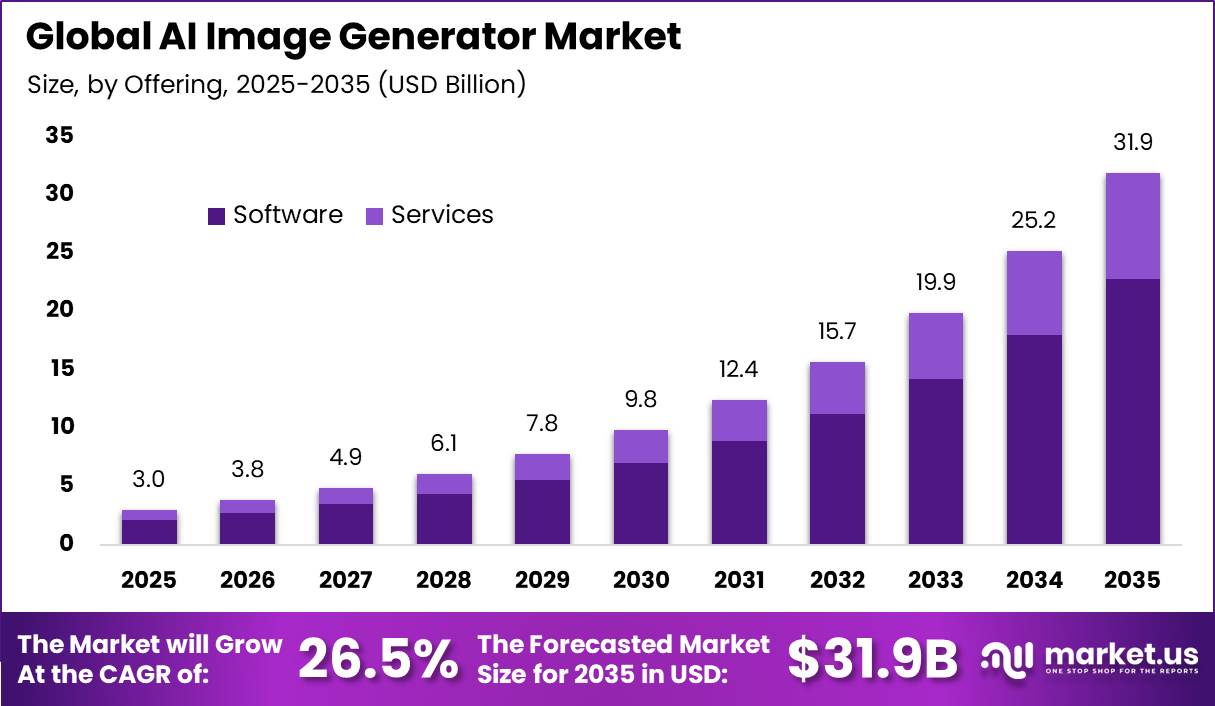
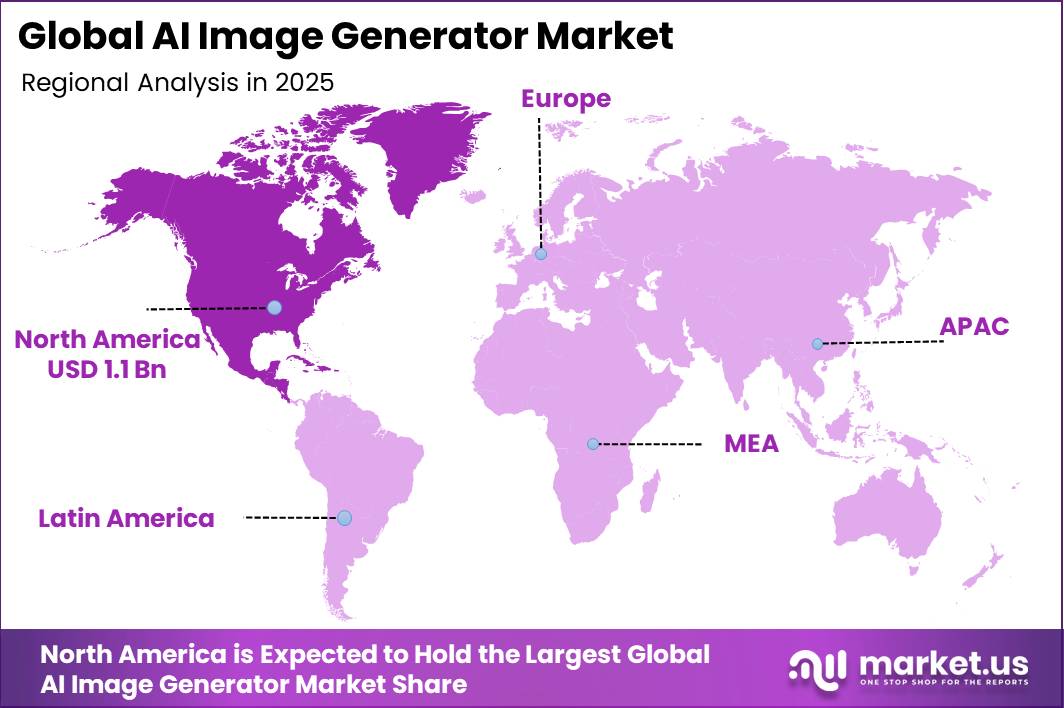
In 2025, the Global AI Image Generator Market was valued at USD 3.0 billion. The market is projected to grow at a CAGR of 26.5% during 2026–2035, reaching approximately USD 31.9 billion by 2035. North America dominated the global market in 2025, accounting for more than 38.2% of the total market share and generating approximately USD 1.1 billion in revenue.
Market growth is being supported by the rapid expansion of internet access and digital infrastructure worldwide. According to the International Telecommunication Union, around 6 billion people were using the internet in 2025, compared with 5.8 billion in 2024, representing an increase of more than 240 million users within one year.
This larger connected population is expanding access to cloud-based AI image generation tools used in marketing, e-commerce, media, advertising, and design. In addition, UNCTAD stated that global corporate investment in artificial intelligence increased from USD 15 billion in 2013 to USD 189 billion in 2023, highlighting the strong flow of capital into AI technologies and related applications.
Microsoft’s AI Diffusion data showed that generative AI adoption among the working-age population in Global North countries reached 24.7% by late 2025, compared with 14.1% in the Global South. Higher adoption continues to support paid subscriptions, enterprise licenses, and wider commercial use of AI image generation platforms across the region.
Key Takeaway
- The AI Image Generator Market was valued at USD 3.0 billion in 2025 and is projected to reach USD 31.9 billion by 2035, growing at a CAGR of 26.5%.
- The Software segment dominated the Offering category, holding 71.4% of the total market share.
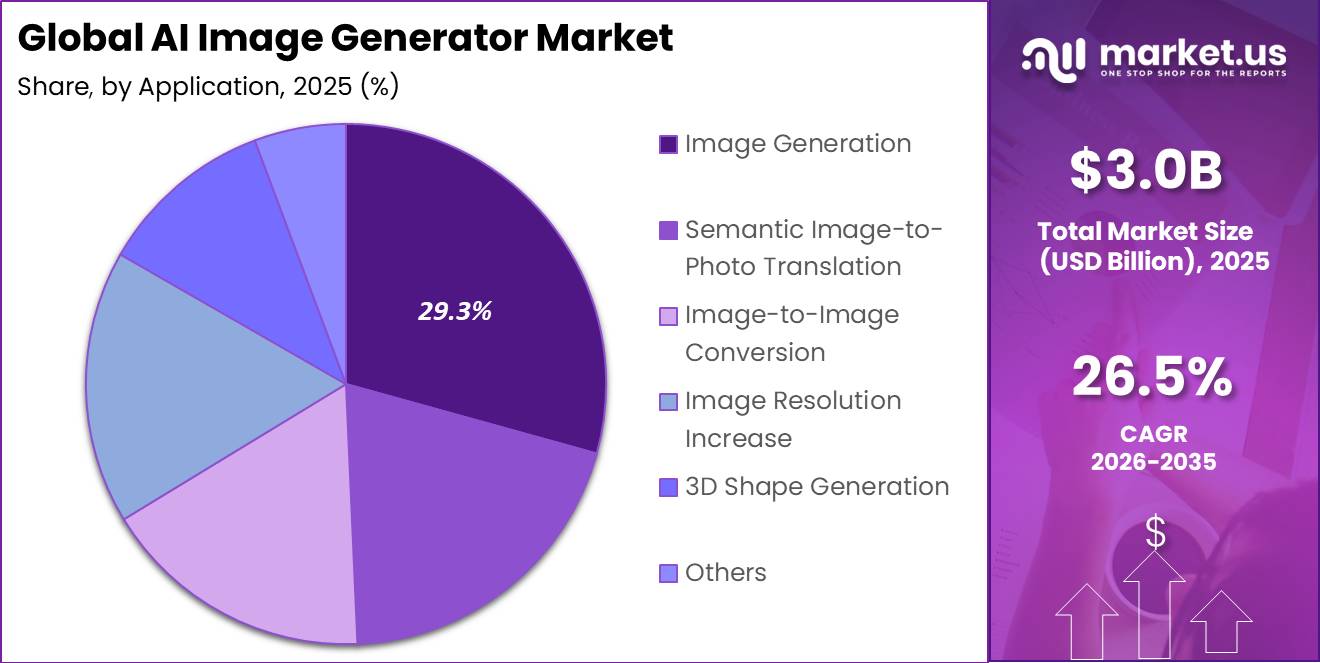
- Image Generation was the leading Application segment, accounting for 29.3% of the market.
- Media and Entertainment led the End-User category with 32.7% share, driven by demand across film, streaming, and publishing.
- North America led the market in 2025 with more than 38.2% share and approximately USD 1.1 billion in revenue.
Market Statistics and Data Insights
- Cloud infrastructure is already established across a large portion of the enterprise sector. OECD data show that an average of 49% of firms with 10 or more employees use cloud computing across OECD economies, with adoption ranging from 16% to 78%. Finland reached 78.3% overall cloud adoption, Denmark 69.5%, and Brazil 68.7% in the latest reported years.
- Consumer response to integrated image generation has already reached mass scale. OpenAI reported that more than 130 million users created over 700 million images within the first week after native image generation was introduced in ChatGPT in 2025.
- The wider creative economy provides a large commercial base for AI-generated visual content. UNCTAD estimated global creative-services exports at a record USD 1.7 trillion in 2024, increasing 12% year over year. Creative services represented 20% of total global services trade, while creative-goods exports totaled USD 709 billion.
- Electricity availability is becoming a structural constraint for compute-intensive AI services. The IEA estimates global data-center electricity consumption at 485 TWh in 2025, rising to around 950 TWh by 2030, or approximately 3% of global electricity demand. AI-focused data-center electricity consumption is expected to triple during this period.
- An Adobe survey of 2,165 Australian creators found measurable barriers to creative generative-AI adoption: 35% cited unreliable output quality, 34% cited high costs, and 32% were concerned about uncertainty regarding how AI models were trained. In addition, 72% were concerned about their content being used for AI training without permission.
- E-commerce offers a large use case for automated product images, advertising creatives, virtual merchandising, and catalog production. UNCTAD reported that business e-commerce sales across 45 economies reached USD 28 trillion in 2024, increasing 4.4% from 2023. These economies account for roughly three-quarters of global GDP and exports.
- Adobe’s survey of more than 5,000 U.S. consumers found that 38% had already used generative AI for online shopping by July 2025, while 52% planned to use it during the year. Among users, 53% used AI for product research, 40% for recommendations, 36% to find deals, and 26% for virtual try-on.
- Adobe’s 2026 Australian creator survey found that 94% of creative-AI users said the technology helped them produce content faster, while 91% said it accelerated growth of their business or audience. Around 80% described creative AI as either integrated into or essential to their workflow.
- AI image generation is moving toward lower-cost, high-volume API usage. When OpenAI launched GPT Image 1 in April 2025, approximate API costs were USD 0.02 for low-quality, USD 0.07 for medium-quality, and USD 0.19 for high-quality square images. OpenAI’s current GPT Image 1 documentation lists a 1024×1024 low-quality image at USD 0.011, medium quality at USD 0.042, and high quality at USD 0.167.
- Pew Research Center’s analysis of U.S. browsing behavior found that 13% of respondents visited an AI tool website, including chatbots and image generators, during March 2025. Around 49% visited at least one webpage primarily focused on AI, while 58% encountered at least one AI-generated summary in their search activity.
By Offering
The Software segment holds a dominant position in the AI Image Generator Market, accounting for 71.4% of the total market share. This leadership is mainly supported by the growing use of cloud-based software across businesses. According to the OECD, cloud computing adoption among companies with 10 or more employees averaged 49% across member countries in 2023, while adoption reached as high as 78% in leading economies.
This shift toward cloud platforms supports demand for software-based AI image generators, as these solutions can be accessed through subscription models without requiring dedicated hardware installations. UNCTAD reported that global IT services value added expanded at a CAGR of 8% between 2000 and 2022, nearly 2 times faster than the broader economy.
The World Bank also reported that total value added from the ICT sector exceeded USD 6.1 trillion in 2022. These trends show the increasing importance of software and digital services within the global technology ecosystem.
By Application
The Image Generation application segment holds the largest share of the AI Image Generator Market, accounting for 29.3% of the total market. This leadership is supported by the growing need for visual content across advertising, e-commerce, media, and creative industries. According to UNCTAD, global advertising revenues reached USD 806 billion in 2023, with North America contributing around USD 327.5 billion.
At the same time, cultural and creative industries generate nearly USD 2.3 trillion in annual revenue and contribute about 3.1% to global GDP, showing the strong economic role of visual design and media content. The rapid expansion of e-commerce is also creating higher demand for product images and digital marketing materials.
E-commerce sales across 45 economies reached USD 28 trillion in 2024, increasing by 4.4% from 2023. As online sellers and advertisers require large volumes of visual content at a faster pace, businesses are increasingly using AI image generation tools to reduce dependence on traditional photography and manual design.
By End-User
The Media and Entertainment end-user segment holds a dominant position in the AI Image Generator Market, accounting for 32.7% of the total market share. This leadership is mainly supported by the great and continuous demand for visual content across films, streaming platforms, publishing, gaming, advertising, and digital media.
According to UNCTAD’s Creative Economy Outlook, the global box office reached USD 33.9 billion in 2023, increasing by 30.5% compared with 2022. Global entertainment and media revenues also stood at nearly USD 2.7 trillion in 2023, reflecting the massive volume of content produced and promoted worldwide.
Media companies require large numbers of posters, promotional images, social media creatives, and digital assets across different markets, making faster content production increasingly important. In addition, global creative services exports reached a record USD 1.7 trillion in 2024, representing 12% year-on-year growth.
Key Market Segments
By Offering
- Software
- Cloud-based
- On-premises
- Services
- Professional Services
- Training and Consulting Services
- System Integration and Implementation Services
- Support and Maintenance Services
- Managed Services
By Application
- Image Generation
- Semantic Image-to-Photo Translation
- Image-to-Image Conversion
- Image Resolution Increase
- 3D Shape Generation
- Others
By End-User
- Media and Entertainment
- BFSI
- Healthcare and Life Sciences
- Manufacturing
- Retail and Ecommerce
- Transportation and Logistics
- Construction and Real Estate
- Energy and Utilities
- Government and Defense
- Others
Geopolitical Impact Analysis
The AI Image Generator Market is highly dependent on GPU computing infrastructure, making operating costs sensitive to the ongoing US-China semiconductor trade conflict. Effective January 15, 2026, the US introduced a 25% Section 232 tariff on advanced AI semiconductors and related derivative products, replacing an earlier proposed 100% tariff on semiconductor imports.
Covered products include chips and computing equipment under HTSUS codes 8471.50, 8471.80, and 8473.30, although certain uses, including US data centers and R&D activities, are excluded. In addition, since October 2022, the US has maintained export controls on advanced chips classified under ECCN 3A090, limiting China’s access to high-performance AI hardware and increasing pressure on domestic providers to use alternative computing systems.
Energy costs add another layer of pressure. AI-focused data centers consumed around 155 TWh of electricity in 2025, representing a 50% increase within a single year. The US accounts for about 45% of global data center electricity demand, followed by China at 25% and Europe at 15%. These regions are therefore more exposed to electricity-price changes and grid constraints.
US tariffs on Chinese photovoltaic cells also increased from 25% to 50% in 2025, potentially raising renewable-energy costs for data centers using solar power. At the same time, data center electricity demand increased by 17% year-over-year.
Regional Analysis
North America holds a dominant position in the global AI Image Generator Market, accounting for 38.2% of the market and generating approximately USD 1.1 billion in revenue in 2025. The region’s leadership is supported by strong AI investment, advanced cloud infrastructure, and early adoption of generative AI across marketing, media, advertising, and design.
Based on Barclays calculations using US Bureau of Economic Analysis data, AI-related capital spending by US technology companies contributed nearly 1.0 percentage point to GDP growth during the first half of 2025. Internet penetration across the Americas also reached around 88%, creating a large digital user base for cloud-based AI applications.
Asia Pacific is emerging as the fastest-growing regional market as digital connectivity and cloud infrastructure expand rapidly. Internet penetration increased by 27 percentage points, from 50% in 2019 to 77% in 2025, representing the largest regional increase reported by the ITU. Cloud spending across Asia Pacific is projected to expand at a 22.2% Clogin 9:14
lunch: 14 min
mandatory: 10 minAGR, reaching approximately USD 471.2 billion by 2028, following a 34.6% year-over-year increase in 2024.
With internet usage already reaching 77%, the region has a growing base of consumers and enterprises able to access AI-powered platforms. Increasing digital adoption across China, India, Southeast Asia, and Pacific markets is expected to strengthen demand for AI image generation solutions, positioning Asia Pacific for the fastest revenue growth through 2035.
Key Regions and Countries
North America
- US
- Canada
Europe
- Germany
- France
- The UK
- Spain
- Italy
- Rest of Europe
Asia Pacific
- China
- Japan
- South Korea
- India
- Australia
- Rest of APAC
Latin America
- Brazil
- Mexico
- Rest of Latin America
Middle East & Africa
- GCC
- South Africa
- Rest of MEA
Market Dynamics
Drivers
| Driver | (~) % CAGR | Geographic Relevance | Impact Timeline |
|---|---|---|---|
| Native multimodal model integration into productivity suites | +3.2% | North America, Europe | Short term (2 years or less) |
| Falling per-image inference cost via model distillation | +2.4% | Global | Short term (2 years or less) |
| Enterprise creative workflow automation adoption | +1.9% | North America, Asia Pacific | Medium term (2 to 4 years) |
| Mobile-first content creation habits in emerging economies | +1.3% | Asia Pacific, Latin America | Medium term (2 to 4 years) |
| API monetization layer for third-party app developers | +0.9% | Global | Short term (2 years or less) |
Native Multimodal Integration Reshaping Licensing Economics
The shift from standalone diffusion tools to image generation built directly into chat and productivity platforms is changing how AI image services are sold. Since 2025, native image-generation features inside major conversational AI platforms have pushed weekly usage into the hundreds of millions of users. Bundling these tools with existing subscriptions has also helped reduce customer acquisition costs by an estimated 30% to 40%.
Improvements in model efficiency have reduced per-unit inference costs by around 80% across model refresh cycles. This has allowed providers to lower API prices from several cents per image toward sub-cent pricing for some workloads while maintaining stronger unit economics. Lower customer acquisition costs and declining inference expenses are therefore supporting wider enterprise adoption and strengthening the market’s underlying growth rate.
Restraints
| Restraint | (~) % CAGR | Geographic Relevance | Impact Timeline |
|---|---|---|---|
| GPU compute scarcity and allocation rationing | -2.6% | Global | Short term (2 years or less) |
| Copyright litigation and training-data legal exposure | -1.8% | North America, Europe | Short term (2 years or less) |
| Export control restrictions on advanced AI accelerators | -1.1% | Asia Pacific | Medium term (2 to 4 years) |
| Elevated capital cost for data center financing | -0.7% | North America, Europe | Short term (2 years or less) |
GPU Compute Scarcity Constraining Near-Term Capacity Deployment
Limited access to computing capacity remains a major constraint on AI Image Generator Market growth. In 2025, order backlogs for advanced GPU supply extended beyond 12 months, restricting API capacity and delaying expansion for several AI image generation platforms. Rental prices for high-end AI accelerators increased by around 35% to 45% year over year, putting additional pressure on operating costs.
Higher compute prices have reduced gross margins for smaller AI platforms by an estimated 800 to 1,200 basis points. Data center expansion is also being slowed by grid connection delays, with approvals taking around 18 to 24 months in some markets. These delays can postpone hyperscaler investment and limit the new computing capacity needed to meet growing enterprise demand.
Challenges
| Challenge | (~) % CAGR | Geographic Relevance | Mitigation Horizon |
|---|---|---|---|
| AI model talent shortage | -1.4% | Global | Medium term (2 to 4 years) |
| Model output quality standardization gaps | -1.0% | Global | Medium term (2 to 4 years) |
| Fragmented regional data residency rules | -0.8% | Europe, Asia Pacific | Long term (4 years or more) |
| Energy grid capacity mismatch | -0.6% | North America, Europe | Long term (4 years or more) |
Specialized AI Talent Shortage Limiting Model Differentiation
A shortage of skilled machine learning researchers remains a major challenge for the AI Image Generator Market. Through 2025, advanced AI research roles recorded vacancy-to-hire ratios of nearly 3 to 1 across major economies. This talent shortage has also pushed compensation for senior AI researchers up by around 20% to 25% annually, increasing development costs for smaller and mid-sized AI companies.
Limited access to experienced researchers can extend model development and refresh cycles by around 4 to 6 months compared with planned timelines. At the same time, the supply of STEM graduates specializing in machine learning is growing by only 8% to 10% annually, while demand for these skills is increasing by more than 25%.
Opportunities
| Opportunity | (~) % CAGR | Geographic Relevance | Execution Window |
|---|---|---|---|
| Vertical-specific enterprise licensing (retail, real estate, gaming) | +2.1% | Global | Medium term (2 to 4 years) |
| On-device and edge inference monetization | +1.5% | North America, Asia Pacific | Long term (4 years or more) |
| SME and creator-economy self-serve expansion in underpenetrated markets | +1.2% | Latin America, Africa, Southeast Asia | Medium term (2 to 4 years) |
| Consolidation roll-up of niche generation tool providers | +0.8% | North America, Europe | Medium term (2 to 4 years) |
Vertical Enterprise Licensing as Untapped Monetization White Space
Vertical licensing in areas such as retail catalog imagery, real estate staging, and game asset production remains a major untapped opportunity for AI image generator providers. In 2025, less than 15% of large retailers had integrated generative image tools into core catalog workflows, showing that a large share of visual production spending is still outside current platform use.
Dedicated vertical APIs with compliance, brand-control, and workflow features could improve revenue quality. Comparable vertical software categories can deliver gross margins around 10 to 15 percentage points higher than generalized consumer tiers, while early enterprise pilots have shown contract values around 3 to 5 times larger than standard seat-based licenses.
Key Players Analysis
The AI Image Generator Market shows a clear Tier-1/Tier-2 split based on infrastructure scale and revenue base. Adobe leads on commercial monetization, reporting record fiscal 2025 revenue of USD 23.7 billion, with R&D spend rising to USD 4.29 billion, roughly 18% of revenue, funding Firefly, whose users have generated over 24 billion image assets to date.
Microsoft holds a dominant infrastructure position, having closed FY25 with USD 281.7 billion in total revenue and capital expenditure of USD 64.5 billion, up 45.1% year-over-year, largely directed at AI-optimized data centers supporting Copilot and Azure OpenAI image services.
OpenAI, though private, reported 2025 revenue of USD 13.1 billion and closed a funding round in April 2026 at a USD 852 billion post-money valuation, with backers including Nvidia and Amazon committing USD 30 billion and USD 50 billion respectively, reinforcing its Tier-1 status in image and multimodal generation.
Tier-2 challengers show sharper, segment-focused growth. Canva reported 2025 annualized revenue of USD 4 billion, up from USD 2.7 billion in 2024, a 43% jump, alongside a USD 42 billion valuation following an August 2025 employee share sale backed by Fidelity and JPMorgan Asset Management. This capital, paired with 265 million monthly active users and a 12% free-to-paid conversion rate, funds Canva’s push into AI-native design tools competing directly with Adobe’s Firefly suite.
Google, AWS, Meta, Anthropic, Databricks, Lightricks, Midjourney, and Jasper round out the competitive field, largely leveraging proprietary model development and enterprise cloud distribution rather than standalone image-generation revenue disclosure, positioning them as scale-dependent Tier-2 to Tier-1 hybrids reliant on parent-company cloud infrastructure and capital reserves.
Top Key Players in the Market
- Microsoft
- AWS
- Adobe
- NVIDIA
- OpenAI
- META
- Anthropic
- Databricks
- Lightricks
- Midjourney
- Canva
- Jasper
Recent Developments
- In 2025, OpenAI introduced native GPT-4o image generation on March 25, 2025, bringing image creation directly into ChatGPT with improved text rendering, instruction following, and image editing capabilities. Within its first week, more than 130 million users generated over 700 million images. Low-, medium-, and high-quality square images cost approximately USD 0.02, USD 0.07, and USD 0.19 per image, respectively.
- In 2026, Google launched Nano Banana 2, also known as Gemini 3.1 Flash Image, combining higher-quality image generation with faster editing and generation speeds. Google expanded access through AI Mode and Lens to 141 new countries and territories and 8 additional languages. Gemini API pricing was equivalent to approximately USD 0.045 for a 0.5K image, USD 0.067 for 1K, USD 0.101 for 2K, and USD 0.151 for 4K resolution under standard pricing.
Report Scope
| Report Features | Description |
|---|---|
| Market Value (2025) | USD 3.0 Billion |
| Forecast Revenue (2035) | USD 31.9 Billion |
| CAGR (2026-2035) | 26.5% |
| Base Year for Estimation | 2025 |
| Historic Period | 2020-2024 |
| Forecast Period | 2026-2035 |
| Report Coverage | Revenue Forecast, Market Dynamics, Competitive Landscape, Recent Developments |
| Segments Covered | By Offering (Software, Services); By Application (Image Generation, Semantic Image-to-Photo Translation, Image-to-Image Conversion, Image Resolution Increase, 3D Shape Generation, Others); By End-User (Media and Entertainment, BFSI, Healthcare and Life Sciences, Manufacturing, Retail and Ecommerce, Transportation and Logistics, Constructure and Real Estate, Energy and Utilities, Government and Defense, Others) |
| Regional Analysis | North America – US, Canada; Europe – Germany, France, The UK, Spain, Italy, Rest of Europe; Asia Pacific – China, Japan, South Korea, India, Australia, Singapore, Rest of APAC; Latin America – Brazil, Mexico, Rest of Latin America; Middle East & Africa – GCC, South Africa, Rest of MEA |
| Competitive Landscape | Google, Microsoft, AWS, Adobe, NVIDIA, OpenAI, META, Anthropic, Databricks, Lightricks, Midjourney, Canva, Jasper |
| Customization Scope | We will provide customization for segments and region/country levels. Additional customization can be done based on requirements. |
| Purchase Options | We have three licenses to opt for: Single User License, Multi-User License (Up to 5 Users), Corporate Use License (Unlimited Users and Printable PDF) |





























