



Overview
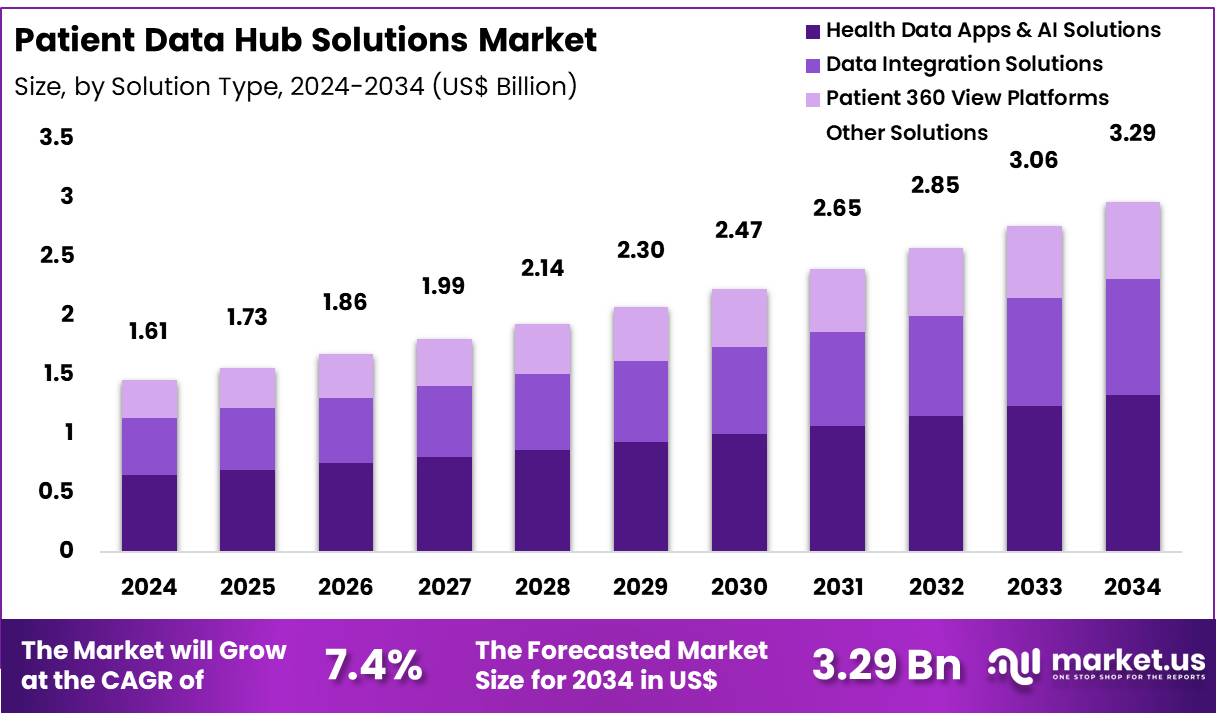
Global Patient Data Hub Solutions Market size is expected to be worth around US$ 3.29 Billion by 2034 from US$ 1.61 Billion in 2024, growing at a CAGR of 7.4% during the forecast period 2025 to 2034. In 2024, North America led the market, achieving over 41.5% share with a revenue of US$ 668.2 Million.
The growing adoption of digital health infrastructure is transforming how healthcare organizations collect, manage, and exchange patient information. Patient Data Hub Solutions enable secure integration of electronic health records (EHRs), clinical data, laboratory results, imaging information, and patient-generated health data from multiple sources into unified platforms. These solutions support healthcare providers in improving care coordination, reducing data fragmentation, and enabling faster clinical decision-making.
Government healthcare initiatives worldwide are accelerating demand for interoperable patient data systems. In the United States, the Office of the National Coordinator for Health Information Technology (ONC) reported that in 2023, 71% of hospitals had routine access to necessary clinical information from external providers at the point of care, highlighting the increasing importance of connected health data environments.
Healthcare organizations are increasingly adopting standards-based data exchange technologies such as HL7 FHIR APIs to improve information sharing between hospitals, applications, and patient platforms. ONC data shows that approximately 9 in 10 hospitals enabled patients to electronically access their health information through APIs in 2024, supporting the expansion of patient-centered digital ecosystems.
Public health agencies are also strengthening data interoperability frameworks to improve disease surveillance, emergency response, and population health management. The CDC and federal partners are promoting seamless health information exchange to ensure healthcare data can move efficiently across clinical and public health systems. With rising demand for connected healthcare delivery, secure data governance, and personalized medicine, patient data hub solutions are becoming essential components of modern healthcare IT infrastructure.
Key Takeaways
- In 2024, the Patient Data Hub Solutions Market generated revenue of US$ 1.61 Billion and is projected to reach US$ 3.29 Billion by 2034, expanding at a CAGR of 7.4% during the forecast period.
- Based on Solution Type, the market is segmented into Health Data Apps & AI Solutions, Data Integration Solutions, Patient 360 View Platforms, and Other Solutions. Health Data Apps & AI Solutions dominated the segment in 2024, accounting for a 40.3% market share.
- By Deployment Mode, the Patient Data Hub Solutions Market is categorized into Cloud-based and On-premise solutions. Cloud-based deployment held the leading position in 2024, capturing a 72.1% market share.
- Based on End-Use, the market is segmented into Healthcare Companies, Healthcare Providers, Healthcare Payers, and Others. Healthcare Providers emerged as the leading segment in 2024, representing 44.5% of the market share.
- Regionally, North America dominated the Patient Data Hub Solutions Market in 2024, holding a 41.5% market share.
Statistical Information
- 95.0% of U.S. office-based physicians adopted electronic health record (EHR) systems in 2024, creating a strong digital foundation for patient data hub platforms and healthcare data integration.
- 83.6% of U.S. office-based physicians were using certified EHR systems in 2024, supporting standardized healthcare data exchange and interoperability across digital health platforms.
- 9 out of 10 hospitals enabled patients to electronically access their health information through application programming interfaces (APIs), highlighting increasing adoption of patient-centered data access models.
- 95.5% of physicians with certified EHR systems electronically sent patient health information, while 95.3% electronically received health information from external sources, demonstrating growing data exchange capabilities.
- 92.8% of physicians with certified EHR systems electronically integrated patient health information, supporting the need for centralized patient data hub solutions.
- 90.5% of physicians with certified EHR systems electronically searched for patient health information, reflecting increased reliance on connected healthcare records for clinical decisions.
- 50 U.S. states + Washington D.C. are covered under the National Electronic Health Records Survey (NEHRS), which monitors EHR adoption and health information exchange trends among physicians.
- Since 2008, the CDC’s National Electronic Health Records Survey has tracked healthcare providers’ adoption of EHR systems and interoperability capabilities, supporting the development of connected patient data ecosystems.
Regional Analysis
North America dominates the Patient Data Hub Solutions Market due to advanced healthcare infrastructure, increasing adoption of electronic health records (EHRs), and strong investments in digital health technologies. The United States represents a major contributor, supported by rising demand for healthcare data interoperability, AI-powered analytics, and personalized care solutions.
Government initiatives, including the 21st Century Cures Act, are encouraging secure health information exchange and improving patient access to medical data. The Office of the National Coordinator for Health Information Technology (ONC) continues to promote healthcare interoperability through standardized data-sharing frameworks.
The growing adoption of cloud-based healthcare platforms and value-based care models is further driving demand for patient data hubs among hospitals, payers, and healthcare organizations. Additionally, the presence of leading technology companies developing advanced data management solutions strengthens regional growth.
Continuous innovation in artificial intelligence, healthcare analytics, and data integration platforms is expected to support North America’s leading position in the Patient Data Hub Solutions Market.
Emerging Trends
- Expansion of Trusted Health Information Networks: The adoption of nationwide interoperability frameworks is increasing as healthcare organizations move toward secure data exchange. TEFCA establishes a common framework for electronic health information sharing, supporting connected networks among providers, patients, and public health organizations.
- Growth of Patient-Controlled Health Data Access: Healthcare platforms are shifting toward patient-owned data models where individuals can use digital applications to access and share medical information. CMS interoperability frameworks support access to clinical, claims, and healthcare data through standardized digital connections.
- Increasing Use of FHIR Data Standards: FHIR-based healthcare data exchange is becoming a major trend as organizations require structured information sharing between different systems. CDC programs support adoption of FHIR and USCDI standards to improve healthcare data usability and interoperability.
- Integration of Public Health and Clinical Data: Patient data hubs are increasingly connecting hospital records with public health information systems. CDC interoperability programs focus on modernizing data infrastructure through improved exchange capabilities, supporting faster disease surveillance and emergency response activities.
- Stronger Healthcare Data Security Models: Healthcare organizations are prioritizing secure data governance as patient information moves across multiple platforms. CMS interoperability frameworks highlight requirements for identity verification, access control, consent management, and audit tracking to protect sensitive health information.
Use Cases
- Coordinated Care Across Multiple Providers: Patient data hubs enable healthcare providers to combine information from different facilities, improving treatment coordination. CMS Provider Access API requirements support sharing claims, encounter data, clinical information, and prior authorization details with authorized healthcare providers.
- Chronic Disease Management Programs: Healthcare organizations use integrated patient data platforms to monitor long-term conditions by combining clinical records, laboratory results, and patient-generated information. These systems help providers identify care gaps and support continuous disease management strategies.
- Population Health Analytics Applications: Patient data hubs support population-level healthcare analysis by connecting multiple datasets. CDC data interoperability initiatives focus on improving access, integration, and analysis of health information to strengthen public health decision-making.
- Digital Health Application Integration: Healthcare applications increasingly depend on patient data hubs to securely exchange information with healthcare systems. CMS frameworks allow patients to use applications of their choice to access electronic medical information across connected healthcare networks.
- AI-Based Clinical Decision Support: Patient data hubs are becoming essential for AI-driven healthcare tools by providing structured and connected medical information. Integrated datasets help healthcare systems analyze patient histories, identify risks, and support more personalized clinical decisions.
Frequently Asked Questions About Patient Data Hub Solutions
- Why are Patient Data Hub Solutions becoming important in healthcare?
Patient Data Hub Solutions help reduce fragmented healthcare information by connecting different healthcare systems. They support faster access to medical records, improve care coordination, and enable healthcare organizations to make data-driven decisions using connected and standardized patient information. - How do Patient Data Hub Solutions improve healthcare interoperability?
These solutions improve interoperability by using standards such as FHIR and other healthcare data exchange frameworks. They allow hospitals, healthcare providers, applications, and public health organizations to securely exchange information in a consistent and usable format. - What types of data are managed by Patient Data Hub Solutions?
Patient Data Hub Solutions manage various healthcare information types, including clinical records, laboratory reports, medication history, claims information, encounter data, and patient-generated health information. These platforms combine different data sources to provide a complete view of patient health. - How do Patient Data Hub Solutions support AI and analytics?
Patient Data Hub Solutions create structured and connected healthcare datasets that support artificial intelligence, predictive analytics, and clinical decision-making. AI tools require reliable healthcare information from multiple sources to identify patterns, assess risks, and improve personalized treatment approaches. - What role do cloud technologies play in Patient Data Hub Solutions?
Cloud technologies enable scalable storage, faster processing, and easier integration of healthcare information across multiple systems. Cloud-based patient data hubs allow healthcare organizations to manage increasing digital health data volumes while supporting secure access and collaboration. - What are the major challenges in adopting Patient Data Hub Solutions?
Major challenges include healthcare data privacy requirements, cybersecurity risks, integration with existing systems, and maintaining consistent data standards. Organizations must implement strong governance frameworks and secure exchange methods to ensure reliable patient information management. - What is the future outlook for the Patient Data Hub Solutions Market?
The future of Patient Data Hub Solutions is driven by increasing healthcare digitization, interoperability initiatives, AI adoption, and demand for connected healthcare ecosystems. Government programs focusing on modern data infrastructure and secure information exchange will continue supporting market development.
Conclusion
The Patient Data Hub Solutions Market is becoming a crucial component of modern healthcare infrastructure as organizations focus on connected care, interoperability, and data-driven decision-making. The increasing adoption of EHR systems, cloud platforms, AI analytics, and standardized data exchange frameworks is transforming healthcare data management. Patient data hubs enable seamless integration of clinical, administrative, and patient-generated information, helping providers deliver personalized and coordinated care.
Government initiatives supporting interoperability, secure data sharing, and healthcare data modernization are further strengthening market adoption. With rising demand for efficient healthcare delivery and real-time insights, patient data hub solutions are expected to play a significant role in the future digital healthcare ecosystem.




















