



Overview
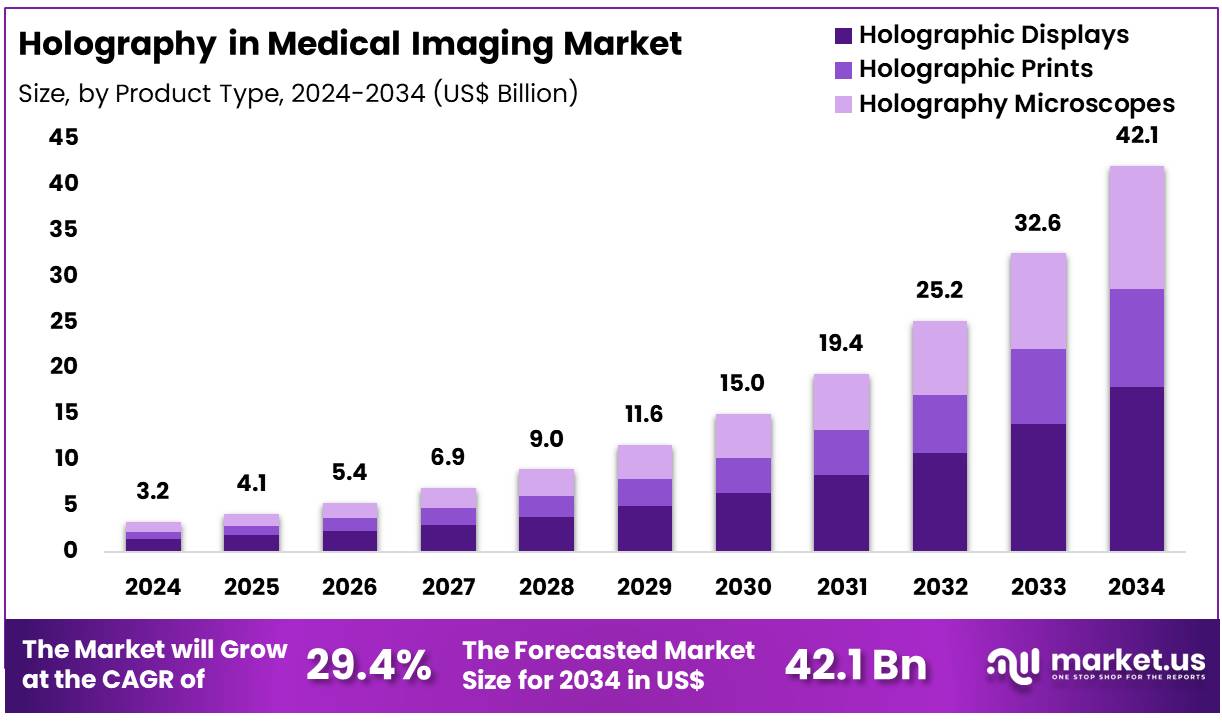
Global Holography in Medical Imaging Market size is expected to be worth around US$ 42.1 Billion by 2034 from US$ 3.2 Billion in 2024, growing at a CAGR of 29.4% during the forecast period 2025 to 2034. In 2024, North America led the market, achieving over 41.5% share with a revenue of US$ 1.3 Billion
The global holography in medical imaging market is gaining strong momentum as healthcare providers increasingly adopt advanced three-dimensional visualization technologies to improve diagnostic accuracy, surgical planning, and medical education. Holography enables clinicians to examine complex anatomical structures in realistic 3D views, supporting better treatment decisions while enhancing communication among multidisciplinary care teams.
The technology is also expanding into pathology, ophthalmology, oncology, and biomedical research, where detailed visualization is becoming increasingly valuable. The U.S. Food and Drug Administration (FDA) continues to support regulatory science for innovative imaging technologies through dedicated research programs focused on ensuring the safety, effectiveness, and evaluation of next-generation medical imaging devices.
Growing investments in digital healthcare infrastructure, artificial intelligence, and mixed reality platforms are further accelerating innovation in holographic imaging systems. According to the U.S. National Library of Medicine, digital holography and quantitative phase imaging are emerging as important tools for label-free cellular imaging and high-resolution biomedical analysis, creating new opportunities for clinical diagnostics and life science research.
Healthcare institutions are also increasing research efforts to improve image quality, workflow efficiency, and real-time visualization. The FDA reports that its Medical Imaging and Diagnostics Program has conducted about 600 technical consults related to novel endoscopic technologies since 2013, reflecting the rapid pace of imaging innovation.
Additionally, the U.S. National Institutes of Health awarded US$ 224,104 for a research project advancing high-speed microscopic holography for biomedical imaging, highlighting continued public-sector support for next-generation imaging technologies.
Key Takeaways
- In 2024, the global holography in medical imaging market was valued at US$ 3.2 Billion and is projected to reach US$ 42.1 Billion by 2034, expanding at a robust CAGR of 29.4% during the forecast period.
- Based on product type, the market is categorized into holographic displays, holographic prints, and holography microscopes. Among these, the holographic displays segment emerged as the leading category, accounting for 42.8% of the market share.
- By application, the market is segmented into medical imaging, biomedical research, and medical education. The medical imaging segment dominated the market, capturing the largest share of 50.7% due to its expanding use in advanced diagnostic and visualization procedures.
- In terms of imaging modality, the market comprises computed tomography (CT), X-ray, ultrasound, and magnetic resonance imaging (MRI). The computed tomography (CT) segment held the leading position, representing 40.5% of the total market revenue.
- Regionally, North America maintained its leadership in the global market, accounting for a 41.5% market share, supported by the region’s strong healthcare infrastructure, technological advancements, and early adoption of innovative medical imaging solutions.
Statistical Information
- Japan has 115.7 CT scanners per million population, the highest density among OECD and Asia-Pacific countries, demonstrating one of the world’s most advanced diagnostic imaging infrastructures.
- Japan operates 57.4 MRI units per million population, making it one of the global leaders in MRI availability and supporting widespread adoption of advanced 3D imaging technologies.
- Australia has 70.5 CT scanners per million population (2023), ranking among the highest worldwide for CT imaging capacity and healthcare imaging infrastructure.
- The United States performs more than 278 CT, MRI, and PET examinations per 1,000 population annually, reflecting one of the highest utilization rates of advanced diagnostic imaging among OECD countries.
- Luxembourg, Korea, Austria, France, and Portugal each recorded more than 370 CT, MRI, and PET examinations per 1,000 population in 2023, highlighting the increasing use of advanced diagnostic imaging technologies.
- Between 2013 and 2023, Korea more than doubled its CT examination rate, while Australia and Latvia increased CT examinations by over 50%, indicating rapid expansion in advanced imaging utilization.
- Over the same 2013–2023 period, MRI examinations more than doubled in Korea and Latvia, while France recorded an increase of around 70%, demonstrating sustained growth in high-resolution imaging services.
- A Swedish appropriateness study of 13,075 MRI and CT examinations found that 76% of MRI scans and 63% of CT scans met established imaging referral guidelines, underscoring the growing emphasis on optimized diagnostic imaging practices.
Regional Analysis
North America accounted for 41.5% of the global holography in medical imaging market, supported by its advanced healthcare infrastructure, strong research ecosystem, and rapid adoption of innovative diagnostic technologies. The United States continues to lead the region through significant investments in digital health, artificial intelligence (AI), and advanced medical imaging.
The U.S. Food and Drug Administration (FDA) is actively advancing regulatory science programs for emerging imaging and diagnostic devices, including AI-enabled imaging systems, photoacoustic imaging, MRI, ultrasound, and other next-generation technologies that improve diagnostic accuracy and patient care. In addition, the FDA’s Diagnostic Data Program promotes interoperable diagnostic data and digital diagnostics to strengthen clinical decision-making and healthcare innovation.
Asia Pacific is expected to record the fastest growth during the forecast period owing to expanding healthcare infrastructure, increasing government support for digital health, and rising demand for advanced diagnostic solutions. The World Health Organization (WHO) states that countries across the South-East Asia Region are accelerating digital health and AI adoption to address workforce shortages, improve healthcare accessibility, and strengthen disease management.
Growing investments in hospital modernization, biomedical research, and medical education are expected to further support the adoption of holography-based imaging technologies across the region.
Emerging Trends
- AI-powered digital holography is improving clinical imaging. Researchers are increasingly combining artificial intelligence with digital holography to reconstruct high-quality 3D images faster while reducing image noise. A 2024 review reported 284 scientific citations and over 39,000 article accesses, reflecting rapidly growing global research interest in holographic imaging technologies.
- Label-free imaging is becoming a major research focus. Digital holographic microscopy is gaining attention because it can visualize living cells without dyes or contrast agents. According to a 2024 review, holography has evolved over 75 years since its invention in 1948 and now supports quantitative imaging in pathology, hematology, and infectious disease research.
- Government funding is accelerating holography innovation. The U.S. National Institutes of Health (NIH) awarded in 2024 to develop high-speed nonlinear digital microscopic holography capable of revealing chemical signatures and structural changes in biological tissues for future clinical diagnostics.
- Computational imaging is expanding holography capabilities. Advanced computing and optical diffraction tomography are enabling holographic systems to reconstruct three-dimensional biological structures from multiple two-dimensional measurements, improving cellular and tissue-level visualization for biomedical research and precision medicine applications.
- Research output continues to increase worldwide. According to the 2024 Light: Science & Applications review, publications related to digital holography have shown continuous growth since the 1990s, driven by advances in lasers, image sensors, computing power, and biomedical applications.
Use Cases
- Live cell imaging without damaging samples. Digital holographic microscopy enables continuous monitoring of living cells without fluorescent labels, allowing researchers to observe cell growth, movement, and disease progression while preserving natural biological behavior. This capability is increasingly used in biomedical laboratories.
- Cancer and tissue research. NIH-supported projects are developing holographic imaging systems capable of capturing tissue structure and chemical information simultaneously, improving studies of tumors, neural tissue, and disease mechanisms through faster three-dimensional microscopic imaging.
- Medical education and surgical training. Holographic visualization converts conventional CT and MRI datasets into interactive three-dimensional anatomical models, helping physicians, surgeons, and medical students better understand complex anatomy before performing procedures or clinical interventions.
- Clinical pathology and hematology. Quantitative holographic imaging is increasingly used to measure cell thickness, refractive index, and morphology without physical contact, supporting research on blood disorders, infectious diseases, and other cellular abnormalities with improved measurement accuracy.
- Real-time biomedical diagnostics. Emerging holographic imaging systems are being designed for rapid, high-speed three-dimensional visualization of biological specimens, enabling researchers to monitor dynamic cellular processes in milliseconds and supporting future applications in precision diagnostics and personalized medicine.
Frequently Asked Questions About Holography in Medical Imaging
- How does holography improve medical diagnosis?
Holography enables physicians to view complex anatomical structures from multiple angles without physically manipulating patients. This detailed 3D visualization improves understanding of tumors, blood vessels, bones, and organs, supporting more informed clinical decisions and reducing interpretation errors. - Which medical fields use holographic imaging the most?
Holographic imaging is widely applied in radiology, neurosurgery, orthopedics, cardiology, oncology, dentistry, pathology, and medical education. It is particularly valuable where accurate three-dimensional visualization helps clinicians understand complex anatomical structures before treatment or surgery. - What technologies are commonly integrated with holography?
Modern holographic systems increasingly integrate artificial intelligence (AI), augmented reality (AR), virtual reality (VR), and advanced imaging software. The FDA also supports research on AI-enabled imaging technologies to improve image quality, workflow efficiency, and diagnostic performance. - Why is the holography in medical imaging market growing?
Market growth is supported by rising demand for precision diagnostics, minimally invasive procedures, digital healthcare, and advanced medical imaging. Increasing investments in AI-enabled imaging, hospital modernization, and biomedical research are also expanding opportunities for holographic visualization technologies. - What are the major applications of holography in healthcare?
Healthcare providers use holography for surgical planning, disease diagnosis, anatomy visualization, medical training, biomedical research, and patient communication. It also supports quantitative cell imaging and pathology research by providing detailed three-dimensional visualization without damaging biological samples. - Which imaging modalities work with holographic systems?
Holographic visualization can utilize data generated from CT, MRI, ultrasound, X-ray, fluoroscopy, and other medical imaging modalities. These datasets are reconstructed into detailed three-dimensional models for diagnosis, surgical planning, and educational applications. - What is the future outlook for the holography in medical imaging market?
The future outlook remains positive as healthcare systems continue investing in digital transformation, AI-assisted diagnostics, and advanced visualization technologies. Ongoing research, regulatory support, and increasing clinical acceptance are expected to expand holography’s role in precision medicine and next-generation medical imaging.
Conclusion
The global holography in medical imaging market is poised for significant expansion as healthcare systems increasingly adopt advanced three-dimensional visualization technologies to improve diagnosis, surgical planning, and medical education. Rising investments in artificial intelligence, digital healthcare, and biomedical imaging research are accelerating innovation, while regulatory support from organizations such as the U.S. FDA and research initiatives led by the NIH continue to advance next-generation imaging solutions.
Growing use of holography in pathology, oncology, and cell imaging, together with expanding healthcare infrastructure across emerging economies, is expected to create substantial opportunities. As clinical adoption increases, holographic imaging is likely to become an essential component of precision medicine, supporting more accurate, efficient, and patient-centered healthcare delivery worldwide.




















