



Overview
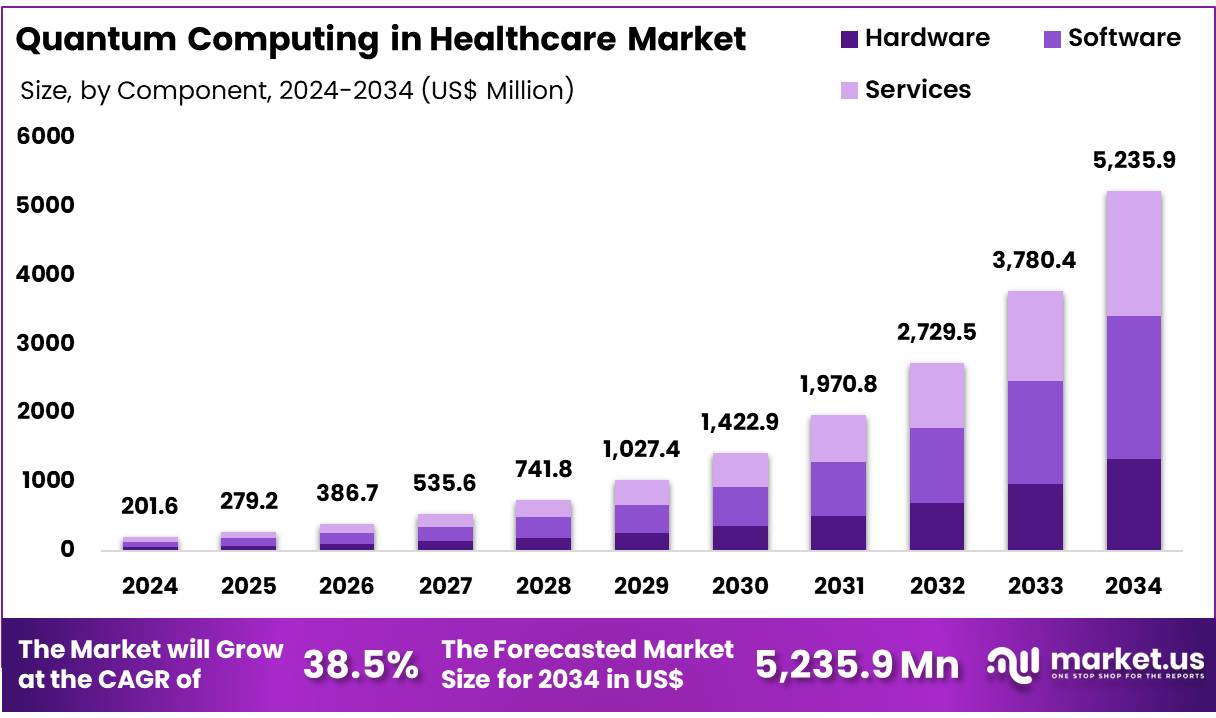
Global Quantum Computing in Healthcare Market size is expected to be worth around US$ 5,235.9 Million by 2034 from US$ 201.6 Million in 2024, growing at a CAGR of 38.5% during the forecast period 2025 to 2034. In 2024, North America led the market, achieving over 39.6% share with a revenue of US$ 79.83 Million.
The global healthcare sector is witnessing increased adoption of quantum computing technologies as researchers explore their potential to solve complex challenges in drug discovery, molecular simulation, genomics, and personalized medicine. Quantum computing can process highly complex datasets by using qubits, enabling new approaches for analyzing biological systems and improving computational efficiency.
The U.S. National Science Foundation highlights that quantum technologies may support breakthroughs in areas such as medicine development and advanced scientific research.
Government and healthcare organizations are actively supporting quantum-enabled biomedical innovation. The National Institutes of Health (NIH) launched the Quantum Computing Challenge to identify and develop quantum algorithms for clinical, translational, and biomedical applications.
The initiative focuses on discovering practical healthcare use cases where quantum approaches can improve current computational workflows. Additionally, an NIH quantum computing innovation program involved experts from quantum science, biomedical research, computational biology, and data science to explore future healthcare applications.
Public investments are also accelerating quantum technology development worldwide. The U.S. Government Accountability Office reported that federal agencies spend approximately US$ 200 million annually on quantum computing activities, supporting research and technology advancement. India’s National Quantum Mission is another major initiative, with an approved outlay of ₹6,003.65 crore over eight years to strengthen quantum research and development capabilities.
As healthcare organizations continue generating large-scale clinical and genomic datasets, quantum computing is expected to create new opportunities for faster biomedical analysis, precision medicine development, and next-generation healthcare innovation.
Key Takeaways
- In 2024, the Quantum Computing in Healthcare Market generated revenue of US$ 201.6 Million and is projected to reach US$ 5,235.9 Million by 2034, expanding at a CAGR of 38.5% during the forecast period.
- Based on Component, the market is segmented into Hardware, Software, and Services, with Software dominating the segment in 2024 by accounting for 39.7% market share.
- By Technology, the market is categorized into Superconducting Qubits, Trapped Ions, Quantum Annealing, Quantum Machine Learning, and Others, where Superconducting Qubits held the leading position in 2024 with a 44.4% market share.
- Based on Application, the market is segmented into Drug Discovery and Development, Genomics and Precision Medicine, Medical Diagnostics, Radiotherapy, Risk Analysis, Cybersecurity & Data Encryption, Healthcare Logistics & Scheduling, and Others, with Drug Discovery and Development leading the market with a 32.3% share in 2024.
- By End User, the market is segmented into Oncology, Neurology, Cardiology, Rare Diseases, Reproductive Health, and Others, with Oncology representing the largest segment in 2024, holding a 30.5% market share.
- Based on the End User category, the market is divided into Pharmaceutical and Biopharmaceutical Companies, Labs and Research Institutes, Healthcare Payers, Healthcare Providers, and Other End Users, with Pharmaceutical and Biopharmaceutical Companies dominating the segment with a 30.5% share in 2024.
- Regionally, North America emerged as the leading market in 2024, capturing a 39.6% market share due to strong investments in quantum technology research and healthcare innovation.
Statistical Information
- NIH allocated up to US$ 1.3 Million in prize funding through the NIH Quantum Computing Challenge to support the development of quantum algorithms for biomedical applications, including drug discovery, clinical risk prediction, diagnostics, and genomic data analysis.
- 27 experts participated in the NIH Quantum Computing Innovation Lab in December 2024, bringing together specialists from quantum computing, quantum physics, biomedical research, computational biology, and data science to explore healthcare applications.
- The NIH Innovation Lab provided US$ 100,000 in challenge prizes to support promising quantum computing projects focused on biomedical research and healthcare innovation.
- Cleveland Clinic and IBM established a 10-year partnership in 2021 to combine quantum computing, artificial intelligence, and high-performance computing for healthcare and life sciences research.
- In 2023, Cleveland Clinic and IBM deployed the first IBM Quantum System One dedicated to healthcare research, creating a dedicated quantum computing platform for biomedical discovery.
- Cleveland Clinic researchers are applying quantum machine learning approaches across 3 major healthcare areas: drug discovery, genomics, and medical imaging, using hybrid quantum-classical computing methods.
- The NIH Quantum Computing Challenge focuses on 3 priority healthcare application areas: quantum algorithms for drug discovery, clinical risk prediction/diagnosis/therapeutics, and biomedical imaging/genomic data analysis.
- The Cleveland Clinic–IBM Discovery Accelerator partnership uses 3 advanced technology areas high-performance computing, artificial intelligence, and quantum computing to accelerate healthcare and life sciences research.
Regional Analysis
North America dominates the Quantum Computing in Healthcare Market with a 39.6% share in 2024, supported by strong technology infrastructure, advanced healthcare research capabilities, and increasing investments in quantum innovation. The United States plays a major role due to collaborations between technology companies, pharmaceutical firms, and healthcare organizations focused on applying quantum computing in drug discovery, genomics, and precision medicine.
Cleveland Clinic, in partnership with IBM, operates a quantum computer dedicated to healthcare and life sciences research, supporting applications such as biomedical discovery and clinical research optimization.
Government-backed quantum initiatives and growing research ecosystems are further strengthening regional growth. Leading academic institutions, healthcare providers, and technology companies are exploring quantum algorithms to address complex healthcare challenges. With continued innovation, partnerships, and funding, North America is expected to maintain its leadership in quantum healthcare development.
Emerging Trends
- Quantum Computing Accelerates Drug Discovery and Molecular Research: Quantum computing is emerging as a powerful tool for pharmaceutical research by improving molecular simulation and drug candidate analysis. Healthcare researchers are testing quantum algorithms to study complex biological interactions. A 2025 clinical care review analyzed 35 studies published between 2015 and 2024, showing applications in diagnostics, treatment optimization, and biomedical decision-making.
- Growth of Quantum-Powered Precision Medicine Applications: Precision medicine is becoming a major healthcare use case as quantum algorithms help analyze complex genomic and clinical datasets. Research reviews have identified more than 40 quantum healthcare proof-of-concept experiments and studies covering genomics, clinical research, diagnostics, and treatment planning.
- Rising Adoption of Quantum Machine Learning for Medical Imaging: Quantum machine learning is gaining attention for improving medical imaging analysis, disease classification, and diagnostic accuracy. Researchers are exploring quantum models for imaging-related healthcare challenges, including cancer detection and neurological disease analysis. A clinical review highlighted quantum applications for improving imaging accuracy and supporting earlier disease identification.
- Healthcare Organizations Build Quantum Research Ecosystems: Leading healthcare institutions are creating dedicated quantum innovation programs to move beyond theoretical research. Cleveland Clinic’s Quantum Innovation Catalyzer Program provides startups with access to IBM Quantum System One and selects up to 4 companies for its healthcare innovation program, supporting biomedical quantum applications.
- Government Funding Supports Quantum Healthcare Development: Public investment is strengthening quantum computing research in North America. The U.S. Government Accountability Office reported that federal agencies spend on quantum computing activities, supporting future applications including medicine development and advanced scientific research.
Use Cases
- Quantum Algorithms for Oncology Research: Oncology is becoming a key application area as researchers investigate quantum methods for improving cancer treatment strategies, molecular modeling, and personalized therapies. Recent clinical research reviews identified quantum computing potential in oncology treatment optimization and improving healthcare decision-support systems.
- Quantum Computing in Genomic Data Analysis: Large-scale genomic datasets are creating demand for advanced computational methods. Quantum computing research programs are exploring applications in genomic analysis, helping researchers investigate complex biological patterns and support precision healthcare development.
- Quantum-Based Clinical Decision Support Systems: Healthcare researchers are evaluating quantum algorithms for improving patient risk prediction and clinical decision-making. Studies reviewed applications across diagnostic support, treatment planning, and real-time healthcare analytics, showing increasing interest in quantum-enhanced clinical workflows.
- Quantum Startups Enter Healthcare Innovation Programs: Healthcare quantum ecosystems are expanding through startup participation and technology partnerships. Cleveland Clinic’s Quantum Innovation Catalyzer Program provides a 12-month immersive experience for early and venture-stage companies developing healthcare and life science quantum solutions.
- Hybrid Quantum-Classical Computing Becomes a Near-Term Strategy: Healthcare organizations are focusing on hybrid computing approaches that combine quantum processors with traditional high-performance computing systems. Cleveland Clinic highlights quantum research spanning basic science, technology translation, and workforce development to accelerate healthcare applications.
Frequently Asked Questions About Quantum Computing in Healthcare
- What are the major applications of quantum computing in healthcare?
Key applications include drug development, genomic analysis, medical imaging, clinical trial optimization, disease modeling, and precision medicine. Healthcare researchers are developing quantum approaches to address complex biological challenges and improve future treatment discovery. - How does quantum computing support precision medicine?
Quantum computing supports precision medicine by helping researchers analyze complex biological and clinical datasets. Applications include genomic research, personalized treatment modeling, and understanding molecular behavior for developing more targeted healthcare solutions. - Which organizations are using quantum computing for healthcare research?
Cleveland Clinic and IBM are among the leading organizations developing healthcare quantum applications. Their 10-year Discovery Accelerator partnership combines quantum computing, artificial intelligence, and high-performance computing for biomedical research. - What role does quantum machine learning play in healthcare?
Quantum machine learning combines quantum computing with artificial intelligence to analyze healthcare data. Researchers are exploring its potential in drug design, genomics, medical imaging, and improving complex healthcare prediction models. - What recent advancements have been achieved in healthcare quantum computing?
In 2026, Cleveland Clinic, RIKEN, and IBM demonstrated quantum-based simulation of a biological protein complex containing 12,635 atoms, representing one of the largest known biologically relevant molecular simulations using quantum computing. - What is the future outlook for quantum computing in healthcare?
Quantum computing is expected to advance healthcare research through improved molecular simulations, genomic analysis, and clinical optimization. Continued collaboration between technology companies and healthcare institutions will accelerate practical applications in life sciences.
Conclusion
The Quantum Computing in Healthcare Market is entering a transformative phase as healthcare organizations increasingly explore quantum technologies for complex biomedical challenges. Advancements in drug discovery, genomics, precision medicine, medical imaging, and clinical research are creating new opportunities for healthcare innovation. Government programs, research institutions, and technology partnerships are accelerating the development of practical quantum applications.
Organizations such as Cleveland Clinic and IBM are demonstrating the potential of quantum computing through dedicated healthcare research initiatives and hybrid computing approaches. As quantum technologies continue to mature, they are expected to support faster discoveries, improved healthcare analytics, and next-generation personalized treatment solutions.




















