



Overview
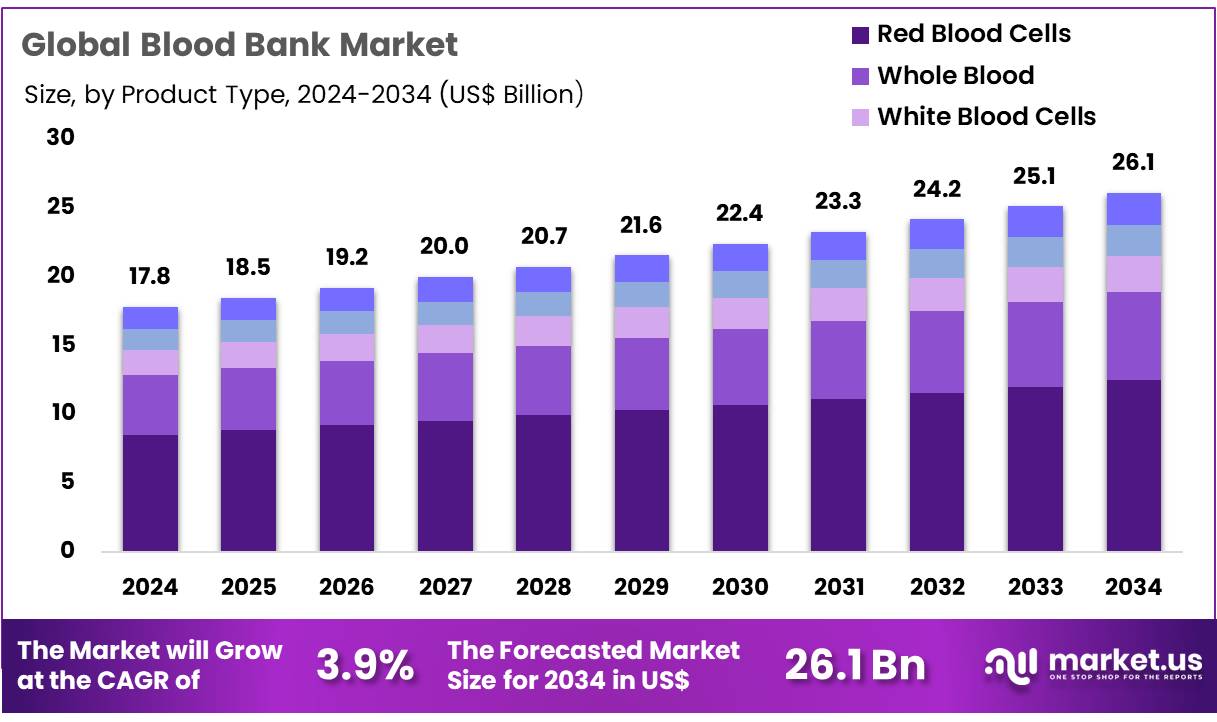
Global Blood Bank Market size is expected to be worth around US$ 26.1 Billion by 2034 from US$ 17.8 Billion in 2024, growing at a CAGR of 3.9% during the forecast period 2025 to 2034. In 2024, North America led the market, achieving over 42.3% share with a revenue of US$ 7.5 Billion.
The global blood bank sector is witnessing steady development as healthcare systems focus on improving blood collection, storage, screening, and distribution capabilities. Growing demand for safe transfusion services, increasing surgical procedures, rising cases of chronic diseases, and the need for reliable emergency care are encouraging investments in modern blood management infrastructure. Blood banks play a critical role in supporting hospitals by ensuring the availability of red blood cells, plasma, platelets, and other blood components for patients requiring transfusion therapies.
According to the World Health Organization (WHO), approximately 120.4 million blood donations are collected globally, highlighting the importance of organized donation programs and efficient blood supply networks. WHO also recommends comprehensive screening of donated blood for infections, including HIV, hepatitis B, hepatitis C, and syphilis, to improve transfusion safety.
Technological advancements are further transforming blood bank operations through automated testing systems, digital inventory management, traceability solutions, and improved cold-chain monitoring. Governments and healthcare organizations are increasingly supporting voluntary unpaid donation programs to build sustainable blood supplies and enhance patient safety. WHO reported that voluntary unpaid donors contributed more than 85% of global blood donations in recent data, reflecting progress toward safer blood systems.
The continued expansion of healthcare facilities, rising awareness about blood donation, and adoption of advanced blood processing technologies are expected to support the long-term growth of the blood bank ecosystem while improving access to safe and timely transfusion services worldwide.
Key Takeaways
- In 2024, the blood bank market generated revenue of US$ 17.8 Billion and is projected to grow at a CAGR of 3.9%, reaching an estimated value of US$ 26.1 Billion by 2034.
- Based on product type, the market is segmented into red blood cells, whole blood, white blood cells, platelets, and plasma. Among these, red blood cells dominated the market in 2023, accounting for a leading share of 47.8%.
- By application, the blood bank market is categorized into testing, transportation, storage, processing, and collection. The testing segment emerged as a major contributor, capturing a significant market share of 35.6%.
- In terms of end users, the market is segmented into hospitals, pharmaceutical companies, clinics and nursing homes, ambulatory surgery centers, and others. The hospital segment held the largest revenue share, representing 55.3% of the blood bank market.
- Regionally, North America maintained its leading position in the blood bank market, accounting for a market share of 42.3% in 2023.
Statistical Information
- The U.S. healthcare system requires approximately 29,000 units of red blood cells every day, along with nearly 5,000 platelet units and 6,500 plasma units daily, highlighting the continuous dependence on blood bank infrastructure for emergency care, surgeries, and chronic disease treatment.
- The U.S. National Blood Collection and Utilization Survey reported that approximately 11.78 million whole blood and apheresis red blood cell units were collected in 2021, while around 10.76 million RBC units were transfused, reflecting the large-scale operational demand placed on blood collection and distribution networks.
- According to the World Health Organization (WHO), global blood collection reached around 120.4 million donations, with high-income countries contributing 36% of donations despite representing only 15% of the global population, demonstrating differences in blood availability across regions.
- WHO data shows that 80 countries obtain more than 90% of their blood supply from voluntary unpaid donors, emphasizing the importance of donor engagement programs for maintaining reliable blood inventories.
- Blood component processing is becoming increasingly important, as WHO reported that 98% of collected blood in high-income countries is separated into components, such as red cells, platelets, and plasma, allowing one donation to support multiple patients.
- The adoption of stronger blood safety systems is increasing globally, with 133 out of 168 reporting countries having a national blood policy in 2023, supporting standardized collection, testing, storage, and distribution practices.
- WHO reported that voluntary unpaid blood donations increased by approximately 10.7 million donations between 2013 and 2023, reflecting improved awareness campaigns and stronger national donation programs.
- The U.S. Food and Drug Administration reported that 2,611 establishments submitted biological product and blood-related deviation reports in fiscal year 2024, compared with 2,432 establishments in FY2023, showing continued regulatory monitoring of blood safety and manufacturing activities.
- FDA data showed that licensed blood establishments submitted 5,570 deviation reports in FY2024, while source plasma establishments submitted 5,365 reports, reflecting the scale of quality monitoring across blood collection and processing facilities.
- Blood donor demographics remain an important focus area, as WHO reported that women contribute approximately 29% of global blood donations, highlighting the need for broader donor recruitment strategies among different population groups.
- Plasma collection is becoming a strategic priority, with WHO reporting that approximately 21.5 million liters of plasma from 36 reporting countries were fractionated for plasma-derived medicinal products, supporting treatments for immune deficiencies, bleeding disorders, and other medical conditions.
Regional Analysis
North America Leads the Blood Bank Market
North America accounted for a leading share of the blood bank market, supported by advanced healthcare infrastructure, rising surgical procedures, and increasing demand for safe blood components. The region benefits from well-established blood collection networks, advanced transfusion technologies, and strong regulatory frameworks that ensure blood safety.
According to the American Hospital Association, U.S. hospitals recorded more than 34 million admissions in 2023, highlighting the continuous requirement for blood products across surgeries, emergency care, and chronic disease treatments. Growing adoption of automated blood processing systems and cell therapy technologies is further strengthening regional market growth.
Asia Pacific Expected to Register Strong Growth
Asia Pacific is projected to witness significant growth during the forecast period due to increasing healthcare investments, expanding hospital infrastructure, and rising awareness regarding voluntary blood donation. Government initiatives to improve blood collection and transfusion services are supporting market expansion.
China recorded 16.99 million voluntary blood donations in 2023, reflecting growing participation in blood donation programs. The adoption of advanced blood management technologies and increasing healthcare accessibility are expected to drive future growth across the region.
Emerging Trends
- Artificial Intelligence in Blood Bank Operations: Artificial intelligence is becoming an important tool in blood banking for donor management, inventory forecasting, transfusion decision support, and safety monitoring. AI-based systems analyze large healthcare datasets to predict blood demand and improve operational efficiency. Recent research highlights AI applications across donor engagement, hemovigilance, and patient blood management workflows.
- Patient Blood Management (PBM) Adoption: Healthcare systems are increasingly implementing patient blood management programs to optimize transfusion practices, reduce unnecessary blood use, and improve patient outcomes. WHO identifies PBM as a key strategy for sustainable blood systems. These programs focus on anemia control, minimizing blood loss, and improving clinical decision-making.
- Pathogen Reduction Technologies for Safer Blood Products: Blood banks are adopting advanced pathogen reduction technologies to improve transfusion safety beyond conventional screening methods. FDA supports the development of innovative solutions designed to reduce infectious risks in blood components, including technologies targeting emerging pathogens that may affect the blood supply.
- Digital Traceability and Blood Supply Chain Management: Digital platforms are transforming blood bank operations by improving tracking of blood units from donation through storage and transfusion. Integrated systems support better inventory control, quality management, and traceability. WHO emphasizes coordinated blood systems with strong data collection, surveillance, and quality assurance frameworks.
- Expansion of Plasma Collection and Plasma-Derived Therapies: Plasma collection is becoming a strategic focus as demand increases for plasma-derived medicines used in immune disorders, bleeding conditions, and other therapies. WHO reported that plasma availability and domestic plasma processing remain important priorities for strengthening global blood product access.
Use Cases
- Advanced Hemovigilance and Transfusion Monitoring: Blood services are improving hemovigilance systems to detect, report, and prevent transfusion-related complications. WHO identifies surveillance systems as a major component of safe blood programs. New digital approaches and AI-based monitoring tools are being explored to improve adverse event detection and reporting speed.
- Automation in Blood Testing and Component Processing: Automation is increasingly used in blood testing, component preparation, and laboratory workflows to improve accuracy and reduce manual processes. Blood regulatory agencies continue supporting technologies related to blood collection devices, screening systems, and component separation solutions to strengthen transfusion safety.
- AI-Based Predictive Analytics for Blood Demand Forecasting: Predictive analytics is emerging as a valuable application for managing blood inventories. AI models can analyze clinical patterns, transfusion history, and hospital demand trends to help blood centers maintain appropriate supply levels and reduce shortages or wastage.
- Growth of National Blood Safety Frameworks: Governments and healthcare organizations are focusing on stronger national blood policies, regulatory systems, and quality programs. WHO’s global assessment highlights continued efforts toward improving governance, laboratory screening, blood availability, and sustainable transfusion services.
- Integration of Blood Banks with Healthcare Data Systems: Blood banks are increasingly connecting laboratory information systems, electronic health records, and hospital platforms to improve transfusion workflows. These integrations support faster access to patient information, improved compatibility checks, and better coordination between hospitals and blood service providers.
Frequently Asked Questions About Blood Bank
- What is a blood bank and what services does it provide?
A blood bank is a specialized healthcare facility that collects, tests, processes, stores, and distributes blood and blood components. It manages products such as red blood cells, platelets, plasma, and whole blood to support surgeries, trauma care, chronic diseases, and emergency treatments. - Why are blood banks important for the healthcare system?
Blood banks are essential because many medical procedures depend on safe and timely blood availability. Transfusions support patients with severe injuries, cancer treatments, pregnancy complications, blood disorders, and complex surgeries where adequate blood supply is critical for patient survival. - How do blood banks ensure the safety of donated blood?
Blood banks maintain safety through donor screening, laboratory testing, blood grouping, compatibility checks, and quality control systems. WHO recommends testing donated blood for transfusion-related infections, including HIV, hepatitis B, hepatitis C, and syphilis, before clinical use. - What are the major products available through blood banks?
Blood banks provide multiple blood components, including red blood cells, platelets, plasma, and whole blood. Component separation allows healthcare providers to deliver specific treatments based on patient needs, improving the utilization of each donated blood unit. - What factors are driving growth in the blood bank market?
The blood bank market is supported by increasing demand for transfusion services, rising healthcare procedures, improved blood safety programs, digital tracking solutions, and advancements in blood processing technologies. Stronger national blood systems are also improving access to safe blood products. - How is technology transforming blood bank operations?
Technology is improving blood bank efficiency through automated testing, digital inventory management, traceability systems, and data-based monitoring. These solutions help organizations reduce errors, improve storage management, track blood units, and strengthen coordination between blood centers and hospitals. - What are the emerging trends in the blood bank market?
Key trends include artificial intelligence-based inventory management, advanced pathogen reduction technologies, digital blood tracking platforms, automation in testing, and improved hemovigilance systems. These innovations are helping blood banks increase safety, reduce wastage, and improve operational performance.. - What is the future outlook for the blood bank market?
The future of the blood bank market will focus on safer transfusion practices, digital healthcare integration, automation, improved donor management, and stronger blood supply networks. Continued investments in quality systems and healthcare infrastructure will support more efficient blood services worldwide.
Conclusion
The blood bank market is expected to witness steady growth as healthcare systems continue to prioritize safe transfusion practices, advanced blood processing technologies, and efficient supply chain management. Rising surgical procedures, increasing chronic disease burden, and growing awareness about voluntary blood donation are strengthening the demand for reliable blood services.
Innovations such as artificial intelligence, automation, digital traceability, and improved hemovigilance systems are transforming blood bank operations and enhancing patient safety. With continued investments from governments, healthcare organizations, and technology providers, the blood bank ecosystem is positioned to improve accessibility, efficiency, and safety of blood products worldwide.




















