


Market Overview
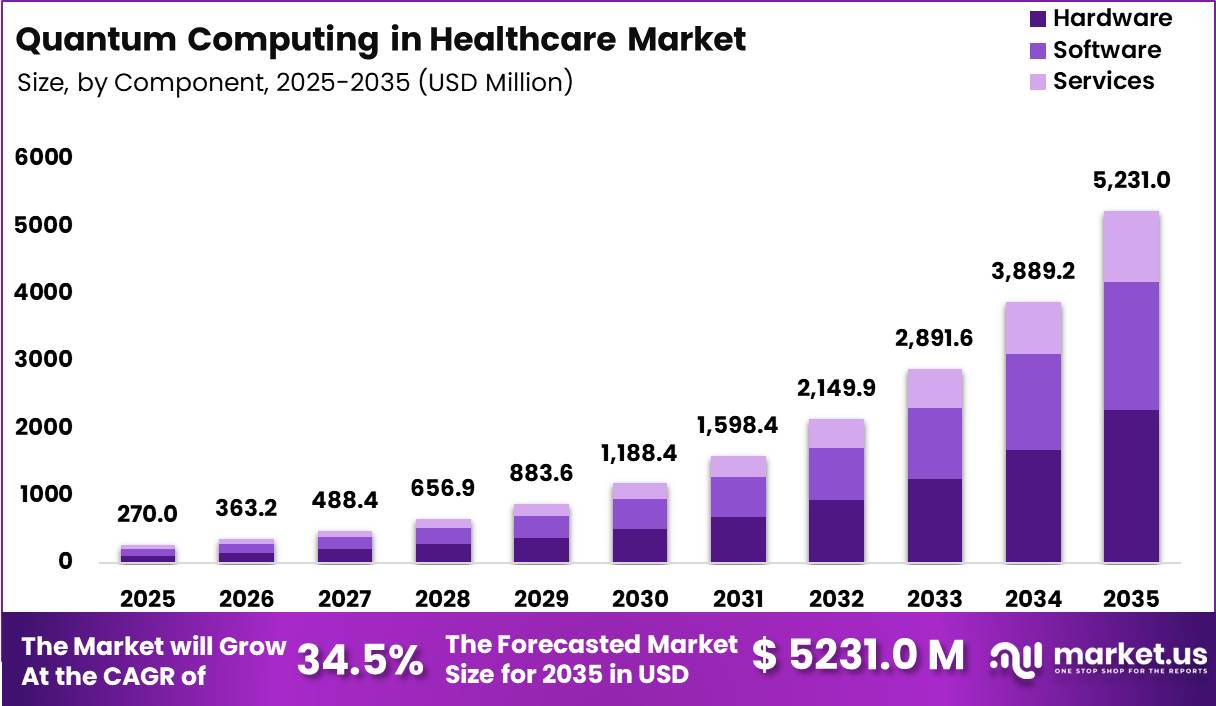
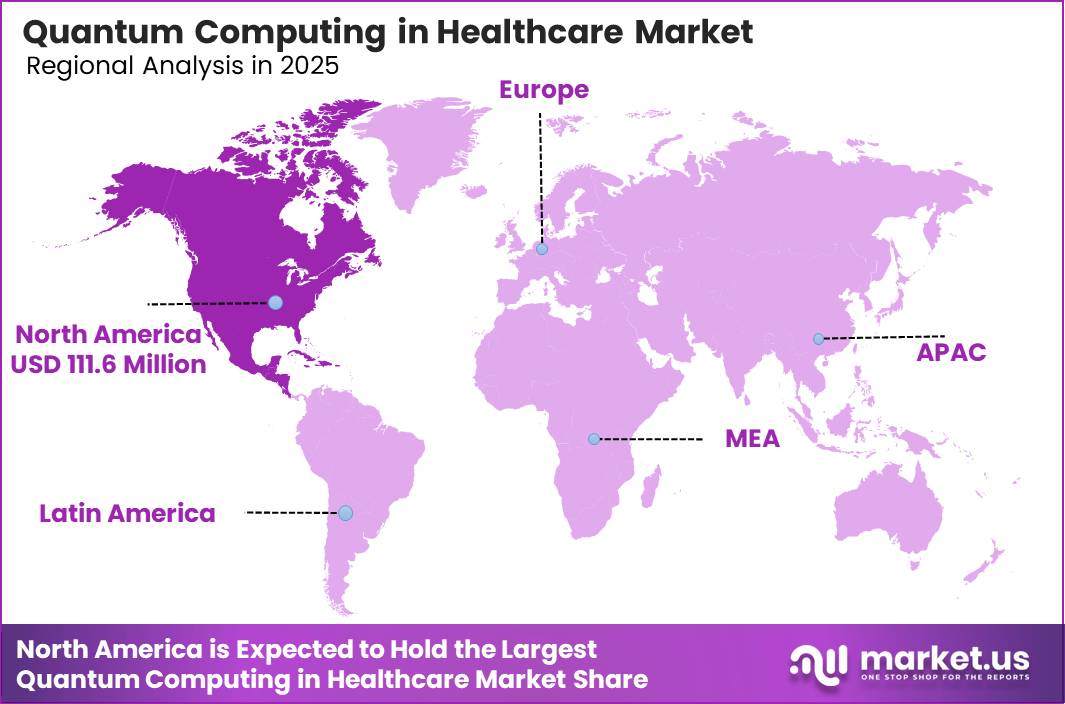
Global Quantum Computing in Healthcare Market size is expected to be worth around US$ 5231.0 Million by 2035 from US$ 270.0 Million in 2025, growing at a CAGR of 34.5% during the forecast period from 2026 to 2035. In 2025, North America led the market, achieving over 41.3% share with a revenue of US$ 111.6 Million.
The healthcare industry is entering a new era of computational innovation as quantum computing gains attention for its ability to solve highly complex biomedical problems beyond the capabilities of traditional computing.
Governments, research institutes, and healthcare organizations are increasingly investing in quantum technologies to accelerate drug discovery, optimize clinical decision-making, improve medical imaging, and support precision medicine.
The U.S. National Institutes of Health (NIH) has established a dedicated Quantum Computing Program to advance biomedical research through collaborations, funding initiatives, and innovation programs aligned with the National Quantum Initiative. The program focuses on disease modeling, personalized medicine, data-driven healthcare, and next-generation computational tools for life sciences.
Quantum computing is particularly valuable in analyzing large-scale genomic and multi-omics datasets, where conventional computing often faces significant computational limitations. According to the NIH, quantum algorithms are being explored for molecular simulations, protein and DNA/RNA folding, clinical risk prediction, medical image analysis, and genomic data processing.
Through the NIH Quantum Computing Challenge, the agency is encouraging the development of quantum algorithms across three major areas: drug discovery, clinical diagnosis and therapeutics, and biomedical imaging and genomic analysis. The challenge includes total prize funding of US$ 1.3 million, highlighting growing public-sector commitment to quantum-enabled healthcare innovation.
Healthcare is also generating unprecedented volumes of biological and clinical data that require advanced computational capabilities. The NIH All of Us Research Program has already enrolled more than 747,000 participants, creating one of the world’s largest precision medicine datasets. Such massive genomic and health databases are expected to benefit from future quantum-enabled analytics, enabling faster biomarker discovery and more personalized treatment strategies.
Beyond research initiatives, organizations supported by the NIH are developing hybrid quantum-classical methods for antibody engineering, pediatric disease diagnosis using genomic and electronic health record data, and digital twin models for predicting cancer treatment outcomes.
These collaborative efforts demonstrate how quantum computing is steadily moving from theoretical research toward practical biomedical applications, supporting innovation across diagnostics, therapeutics, and healthcare data science.
Key Takeaways
- Market Size : Quantum Computing in Healthcare Market size is expected to be worth around US$ 5231.0 Million by 2035 from US$ 270.0 Million in 2025.
- Market Share : The market is growing at a CAGR of 34.5% during the forecast period from 2026 to 2035.
- Component Analysis : The hardware segment dominated the Quantum Computing in Healthcare Market, accounting for 43.5% of the market share in 2025.
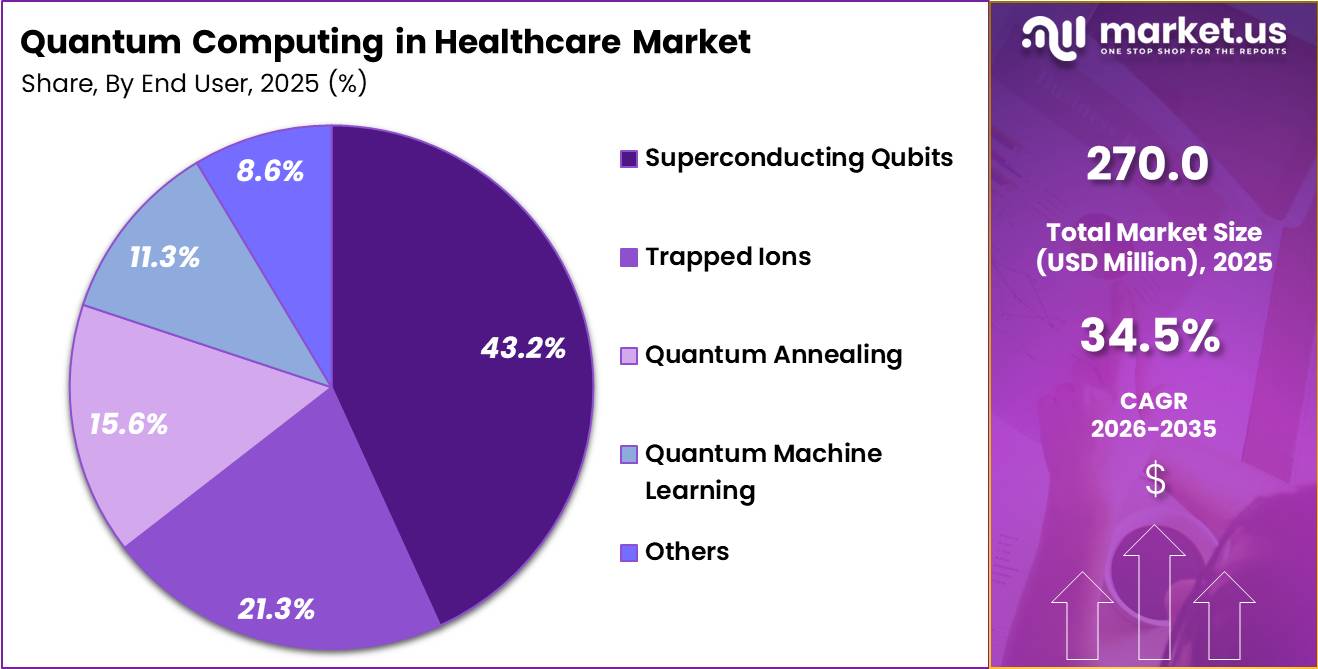
- Technology Analysis : The Superconducting Qubits segment held the largest share of the Quantum Computing in Healthcare Market, capturing 43.2% in 2025.
- Application Analysis : The Drug Discovery and Development segment dominated the Quantum Computing in Healthcare Market with 32.6% of the market share in 2025.
- End User Analysis : The Pharmaceutical and Biopharmaceutical Companies segment accounted for the largest share of the Quantum Computing in Healthcare Market, representing 37.6% in 2025.
- Regional Analysis : In 2025, North America led the market, achieving over 41.3% share with a revenue of US$ 111.6 Million.
Component Analysis
The hardware segment dominated the Quantum Computing in Healthcare Market, accounting for 43.5% of the market share in 2025. Hardware remains the foundation of quantum computing because it includes quantum processors, cryogenic systems, control electronics, and networking equipment required to perform quantum calculations.
Leading companies such as IBM, Google, IonQ, and Rigetti continue to improve qubit stability, error correction, and processor scalability, making hardware increasingly capable of solving complex healthcare problems.
Advanced hardware enables faster molecular simulations, protein folding analysis, and optimization tasks that are difficult for conventional computers. Governments and research organizations are also investing heavily in quantum hardware infrastructure to support biomedical innovation and drug discovery programs.
The software segment is expanding rapidly as developers create quantum algorithms, simulation tools, and hybrid computing platforms for genomics, diagnostics, and clinical decision support. Quantum software simplifies access to different hardware platforms and improves workflow integration with artificial intelligence.
Meanwhile, the services segment is gaining momentum through cloud-based quantum computing, consulting, implementation, system integration, and research support. Healthcare providers, pharmaceutical companies, and research institutes increasingly rely on these services to evaluate quantum applications without investing in their own quantum infrastructure, supporting broader adoption across the healthcare ecosystem.
Technology Analysis
The Superconducting Qubits segment held the largest share of the Quantum Computing in Healthcare Market, capturing 43.2% in 2025. This technology leads because it offers high processing speed, continuous improvements in gate fidelity, and compatibility with cloud-based quantum platforms.
Major technology companies continue to invest in superconducting architectures for applications including molecular simulation, protein interaction analysis, and pharmaceutical research. These systems are considered well suited for hybrid quantum-classical computing and are increasingly used in biomedical research projects focused on drug discovery and disease modeling.
Trapped Ions represent another important segment due to their long coherence times and high computational accuracy, making them valuable for precision chemistry and biological simulations. Quantum Annealing continues to find applications in optimization tasks such as healthcare logistics, treatment scheduling, and resource allocation.
Quantum Machine Learning is expanding quickly as healthcare organizations combine quantum computing with artificial intelligence to improve medical image analysis, patient risk prediction, genomics, and personalized medicine.
The Others category includes photonic, neutral atom, and silicon-spin quantum technologies that continue to advance through research programs and commercial development, offering additional opportunities for healthcare innovation in the coming years.
Application Analysis
The Drug Discovery and Development segment dominated the Quantum Computing in Healthcare Market with 32.6% of the market share in 2025. Drug discovery remains the leading application because quantum computers can simulate molecular interactions, protein structures, and chemical reactions far more efficiently than conventional computing for certain complex problems.
This capability has the potential to reduce the time required to identify promising drug candidates and optimize pharmaceutical research. Government initiatives and biomedical research programs continue to prioritize quantum algorithms for drug discovery, reflecting strong industry interest in accelerating therapeutic innovation.
The Genomics and Precision Medicine segment is growing as quantum algorithms help analyze large genomic datasets and support personalized treatment strategies. Medical Diagnostics benefits from improved image processing and disease prediction through quantum-enhanced machine learning.
Radiotherapy applications are emerging through better treatment planning and dose optimization. Risk Analysis supports clinical prediction models and healthcare forecasting, while Cybersecurity & Data Encryption strengthens protection of sensitive patient information using quantum-safe technologies.
Healthcare Logistics & Scheduling applies quantum optimization to hospital operations, workforce management, and supply chain efficiency. The Others category includes biomedical imaging, clinical trial optimization, and healthcare data analytics, all expected to benefit from future quantum computing advancements.
End User Analysis
The Pharmaceutical and Biopharmaceutical Companies segment accounted for the largest share of the Quantum Computing in Healthcare Market, representing 37.6% in 2025. These organizations are the primary adopters because they invest heavily in computational drug discovery, molecular modeling, and precision medicine research.
Quantum computing enables pharmaceutical companies to investigate complex molecular structures, optimize candidate compounds, and improve research efficiency. Growing collaborations between quantum technology providers and pharmaceutical firms continue to accelerate innovation and support the development of next-generation therapeutics.
Labs and Research Institutes form another significant segment, supported by increasing government funding and academic research into quantum-enabled biomedical applications. Healthcare Payers are exploring quantum computing for risk assessment, fraud detection, and advanced predictive analytics to improve operational efficiency.
Healthcare Providers, including hospitals and healthcare systems, are evaluating quantum technologies for diagnostics, clinical decision support, imaging, and workflow optimization. The Other End Users segment includes biotechnology companies, contract research organizations, public health agencies, and technology firms that continue to explore quantum computing for healthcare innovation, secure data management, and personalized medicine applications.
Market Segmentations
Component
- Hardware
- Software
- Services
Technology
- Superconducting Qubits
- Trapped Ions
- Quantum Annealing
- Quantum Machine Learning
- Others
Application
- Drug Discovery and Development
- Genomics and Precision Medicine
- Medical Diagnostics
- Radiotherapy
- Risk Analysis
- Cybersecurity & Data Encryption
- Healthcare Logistics & Scheduling
- Others
End User
- Pharmaceutical and Biopharmaceutical Companies
- Labs and Research Institutes
- Healthcare Payers
- Healthcare Providers
- Other end user
Drivers
Drug discovery quantum classical workflows scaling
Drug discovery is the strongest near term demand driver for quantum computing because it targets a clear pain point: the cost and time required for molecule selection, lead optimization, and trial prioritization. A 2026 review in Nature highlights growing use of quantum machine assisted methods in molecular simulation, drug target interaction prediction, and clinical trial optimization.
While IBM reported in April 2026 that the Wellcome Leap Q4Bio initiative is funding health focused algorithms designed to run on near term systems within three to five years, with performance thresholds beyond 50 qubits and circuit depths of 1,000 to 10,000 gates.
This is sufficient for commercial uptake because buyers only need narrow hybrid quantum classical workflow insertions that reduce screening time, wet lab failure rates, or improve trial design, rather than full fault tolerant advantage.
Proof of concept programs at Cleveland Clinic with IBM and new translational startup programs signal a shift from hardware access toward co developed software and validation contracts, supporting recurring revenue models instead of one off research pilots.
| Driver | (~) % Impact on CAGR Forecast | Geographic Relevance | Impact Timeline |
|---|---|---|---|
| Drug discovery quantum-classical workflows scaling | +2.8% | North America core, EU pharma hubs, Japan, selective APAC biotech clusters | Medium term |
| Precision medicine and multi-omics compute demand | +2.3% | US core, EU, UK, Japan, South Korea, advanced APAC corridors | Medium term |
| Provider–quantum ecosystem partnerships and challenge funding | +1.9% | US core, UK, Western Europe spill-over | Short term |
| Quantum-safe cybersecurity for medical data and devices | +1.6% | North America core, EU, regulated APAC markets | Short term |
| Reimbursement and clinical genomics monetization pathways | +1.5% | US core first, EU translational centers, developed APAC follow-on | Short term |
| Precision-medicine policy and public-health integration | +1.4% | Global, with strongest effect in US, EU, WHO-aligned emerging systems | Long term |
Challenges
Regulatory ambiguity and complex validation pathways for quantum applications
Quantum healthcare applications span medical device approval, clinical trial oversight, and data protection, yet regulators have only begun to clarify how quantum components fit existing frameworks. This uncertainty makes quantum accelerated algorithms harder for reviewers to validate, extending review timelines by roughly 25 to 50 % and keeping most deployments limited to decision support rather than automation.
Hospitals also face higher governance burdens, including documentation of hardware versions, noise profiles, and error correction, raising validation costs by about 20 to 30 % and limiting how many use cases can be adopted each year.
Together, these factors create an estimated 1.0 to 1.2 % age point drag on potential CAGR as providers wait for clearer guidance from the Food and Drug Administration and Centers for Medicare and Medicaid Services, with progress likely dependent on regulatory sandboxes and standardized validation approaches.
| Challenge | (~) % CAGR Friction Drag | Geographic Relevance | Mitigation Horizon |
|---|---|---|---|
| Limited clinical proof points | -1.6% | North America, EU, Japan | Medium term (2-4 years) |
| Extreme QIST talent scarcity | -1.4% | US, EU, UK, Canada, India | Long term (≥ 4 years) |
| Hybrid QC–HPC integration drag | -1.2% | North America core, EU hubs, APAC | Medium term (2-4 years) |
| Data security & PQC transition | -1.0% | US, EU, GCC, East Asia | Long term (≥ 4 years) |
| Vendor lock-in & ecosystem immaturity | -0.9% | Global academic–hospital centers | Medium term (2-4 years) |
| Regulatory & validation complexity | -1.1% | US, EU, Japan, Gulf | Long term (≥ 4 years) |
Restraints
Immature clinical evidence sharply limits scalable quantum healthcare adoption
The main constraint on quantum healthcare adoption from 2026 to 2030 is the gap between research promise and proven clinical or operational benefit.
Reviews of quantum machine learning in digital health show no consistent outperformance versus classical methods, with advantages limited to narrow use cases, leading fewer than 5 to 10 % of proof of concept projects to reach hospital scale and extending commercialization timelines to 7 to 10 years compared with 3 to 5 years for classical AI tools.
As a result, life sciences leaders and provider CIOs treat quantum as a small experimental investment rather than core infrastructure, compressing near term deal flow and raising evidence requirements for startups through costly comparative trials.
Meanwhile, healthcare systems continue to scale classical AI as GPU costs fall, keeping quantum largely confined to research settings and delaying meaningful healthcare revenue until robust clinical and economic comparisons emerge in the early 2030s.
| Restraint | (~) % Impact on CAGR Forecast | Geographic Relevance | Impact Timeline |
|---|---|---|---|
| Immature clinical evidence and R&D yield | -2.3% | North America, EU, Japan, UK | Medium term (2-4 years) |
| Quantum hardware scarcity and capex intensity | -2.0% | North America core, EU, APAC corridors | Medium term (2-4 years) |
| Regulatory and validation uncertainty for quantum-enabled devices | -1.7% | US, EU, UK, selective APAC | Long term (≥ 4 years) |
| Post-quantum cybersecurity and data governance burden | -1.5% | US, EU, GCC, advanced APAC | Medium term (2-4 years) |
| Skills gap and vendor lock-in risk | -1.4% | Global Tier-1 health systems | Long term (≥ 4 years) |
| Payer skepticism and unclear reimbursement pathways | -1.6% | US, EU, Canada, Australia | Medium term (2-4 years) |
Opportunity
Quantum optimized clinical operations and clinical trial productivity engines
Quantum optimized clinical operations and trials offer upside by addressing cost and productivity gaps that classical optimization and AI have not fully solved, especially in complex scheduling, resource allocation, and trial design.
Quantum methods perform well in combinatorial optimization and have shown efficiency gains in areas such as imaging reconstruction and neurosurgical registration, using mathematical structures similar to those in operating room scheduling, staffing, and multi variable trial design.
Today, few healthcare quantum efforts target operational use cases, and most market forecasts exclude recurring subscription revenue from quantum optimization tools embedded in hospital command centers or trial operations platforms.
If hybrid quantum classical solvers can cut operating room idle time by 10 to 15 %, reduce length of stay by 2 to 3 %, and shorten clinical trials by 10 to 20 %, large health systems and pharma sponsors could realize substantial savings.
With adoption by 5 to 10 % of large hospitals and leading pharma by 2035, this could generate roughly 1 to 2 billion USD in incremental revenue with margins near 30 %, adding about 1.7 %age points to sector CAGR, particularly in North America and Europe.
| Opportunity | (~) % Potential CAGR Upside | Geographic Relevance | Execution Window |
|---|---|---|---|
| Quantum-native oncology decision suites | +2.5% | North America, Western Europe, Japan | Medium term (2–4 years) |
| Quantum-enhanced imaging & radiomics platforms | +2.2% | North America, EU, APAC tier-1 | Medium term (2–4 years) |
| Quantum–genomics cloud for precision medicine | +2.0% | US, EU-5, China, Korea | Long term (≥ 4 years) |
| Quantum-secured health data & devices | +1.8% | US, EU, APAC digital hubs | Short–medium (≤ 4 years) |
| Quantum-optimized clinical operations & trials | +1.7% | US, EU, global pharma hubs | Medium term (2–4 years) |
| Integrated drug discovery–to–clinical QC platforms | +1.5% | US, EU, Japan, China | Long term (≥ 4 years) |
Regional Analysis
In 2025, North America maintained its leading position in the Quantum Computing in Healthcare market, accounting for 41.3% of the global market with a value of US$ 111.6 million. The region’s leadership is supported by strong public investments, advanced healthcare infrastructure, and the presence of world-leading research organizations working on quantum technologies for biomedical applications.
The United States remains the primary growth engine, driven by the National Quantum Initiative and extensive federal funding for quantum research. These initiatives are helping bridge quantum research with real-world healthcare applications.
In addition, collaborations among national laboratories, universities, and technology companies continue to strengthen the regional innovation ecosystem. Europe represents the second-largest regional market, supported by coordinated government initiatives and cross-border research programs.
The European Commission’s Quantum Technologies Flagship has committed approximately €1 billion to advance quantum research and innovation, while the Quantum Europe Strategy, introduced in 2025, aims to establish Europe as a global quantum leader by 2030, with healthcare and pharmaceutical innovation identified among the major application areas.
The Asia-Pacific region is witnessing rapid expansion through increasing government-backed investments in quantum research, growing digital healthcare adoption, and expanding precision medicine programs. Countries such as Japan, China, South Korea, Singapore, and Australia are strengthening national quantum capabilities while encouraging collaboration between healthcare institutions and academic research centers to accelerate medical innovation.
Latin America and the Middle East & Africa currently account for a smaller share of the market but are steadily progressing through investments in digital health infrastructure, research collaborations, and national innovation strategies.
Although commercialization remains at an early stage, growing awareness of advanced computing technologies and increasing participation in international quantum research initiatives are expected to support future regional growth.
Key Regions and Countries
North America
- The US
- Canada
Europe
- Germany
- France
- The U.K.
- Italy
- Spain
- Russia & CIS
- Rest of Europe
Asia Pacific
- China
- India
- Japan
- South Korea
- ASEAN
- Australia & New Zealand
- Rest of Asia Pacific
Middle East & Africa
- GCC
- South Africa
- Rest of Middle East & Africa
Latin America
- Brazil
- Mexico
- Rest of Latin America
Key Player Analysis
The Quantum Computing in Healthcare Market is driven by leading technology companies that are investing in quantum hardware, cloud platforms, artificial intelligence, and healthcare research partnerships.
These companies are working with hospitals, pharmaceutical firms, universities, and research institutes to improve drug discovery, genomics, medical imaging, and clinical data analysis. Their focus on scalable quantum systems, hybrid computing, and cloud-based quantum access is supporting innovation across the healthcare sector.
IBM Corporation leads with IBM Quantum and collaborates with research organizations to accelerate drug discovery and molecular simulation. Google LLC advances quantum processors and quantum algorithms that support complex biomedical research.
Microsoft Corporation offers Azure Quantum, enabling healthcare researchers to access multiple quantum platforms through a cloud environment. Amazon Web Services (AWS) provides Amazon Braket, helping healthcare organizations explore quantum applications without building dedicated hardware.
Honeywell International Inc. contributes through high-performance trapped-ion quantum technologies. Intel Corporation develops silicon-based quantum chips for scalable computing.
Fujitsu Ltd combines quantum-inspired computing with healthcare optimization solutions. IonQ Inc. expands commercial trapped-ion quantum systems through cloud partnerships, while D-Wave Systems focuses on quantum annealing for healthcare optimization, scheduling, and medical research problems.
Top Key Players
- IBM Corporation
- Google LLC
- Microsoft Corporation
- Amazon Web Services (AWS)
- Honeywell International Inc.
- Intel Corporation
- Fujitsu Ltd
- IonQ Inc.
- D-Wave Systems
- Rigetti Computing
- 1QBit
- Multiverse Computing
- QC Ware
- Xanadu Quantum Technologies
- Cambridge Quantum Computing
- Other Key Players
Recent Developments
- In February 2026, IBM and RIKEN demonstrated quantum-centric supercomputing by integrating an IBM Quantum Heron processor with Japan’s Fugaku supercomputer, achieving large-scale quantum chemistry simulations that are highly relevant to drug discovery and healthcare research.
- In January 2026, IonQ completed its acquisition of Oxford Ionics in a transaction valued at approximately US$1.075 billion, strengthening trapped-ion quantum technology to accelerate commercial applications in pharmaceutical discovery, molecular simulation, and healthcare research.
- In February 2025, Microsoft introduced the Majorana 1 quantum chip, unveiling a topological quantum computing architecture designed to advance fault-tolerant quantum computing for molecular modeling, pharmaceutical research, and healthcare applications.
- In February 2025, Quantinuum secured a US$600 million funding round, with participation from NVIDIA, Amgen, JPMorganChase, Mitsui & Co., and Honeywell, to accelerate commercialization of quantum computing platforms for chemistry, pharmaceutical research, and life sciences.
- In February 2025, Quantinuum announced a planned joint venture with Qatar-based Al Rabban Capital valued at up to US$1 billion, to expand quantum computing infrastructure and commercial applications across the Middle East, including healthcare, drug discovery, and scientific research.
Report Scope
| Report Features | Description |
|---|---|
| Market Value (2025) | US$ 270.0 Million |
| Forecast Revenue (2035) | US$ 5231.0 Million |
| CAGR (2026-2035) | 34.5% |
| Base Year for Estimation | 2025 |
| Historic Period | 2020-2024 |
| Forecast Period | 2026-2035 |
| Report Coverage | Revenue Forecast, Market Dynamics, Competitive Landscape, Recent Developments |
| Segments Covered | Component (Hardware, Software, Services), Technology (Superconducting Qubits, Trapped Ions, Quantum Annealing, Quantum Machine Learning, Others), Application (Drug Discovery and Development, Genomics and Precision Medicine, Medical Diagnostics, Radiotherapy, Risk Analysis, Cybersecurity & Data Encryption, Healthcare Logistics & Scheduling, Others), End User (Pharmaceutical and Biopharmaceutical Companies, Labs and Research Institutes, Healthcare Payers, Healthcare Providers, Other end user) |
| Regional Analysis | North America – The US, Canada; Europe – Germany, France, U.K., Italy, Spain, Russia & CIS, Rest of Europe; Asia Pacific – China, India, Japan, South Korea, ASEAN, Australia & New Zealand, Rest of Asia Pacific; Middle East & Africa – GCC, South Africa, Rest of Middle East & Africa; Latin America – Brazil, Mexico, Rest of Latin America |
| Competitive Landscape | IBM Corporation, Google LLC, Microsoft Corporation, Amazon Web Services (AWS), Honeywell International Inc., Intel Corporation, Fujitsu Ltd, IonQ Inc., D-Wave Systems, Rigetti Computing, 1QBit, Multiverse Computing, QC Ware, Xanadu Quantum Technologies, Cambridge Quantum Computing, Other Key Players |
| Customization Scope | Customization for segments, region/country-level will be provided. Moreover, additional customization can be done based on the requirements. |
| Purchase Options | We have three licenses to opt for: Single User License, Multi-User License (Up to 5 Users), Corporate Use License (Unlimited User and Printable PDF) |





































