


Market Overview
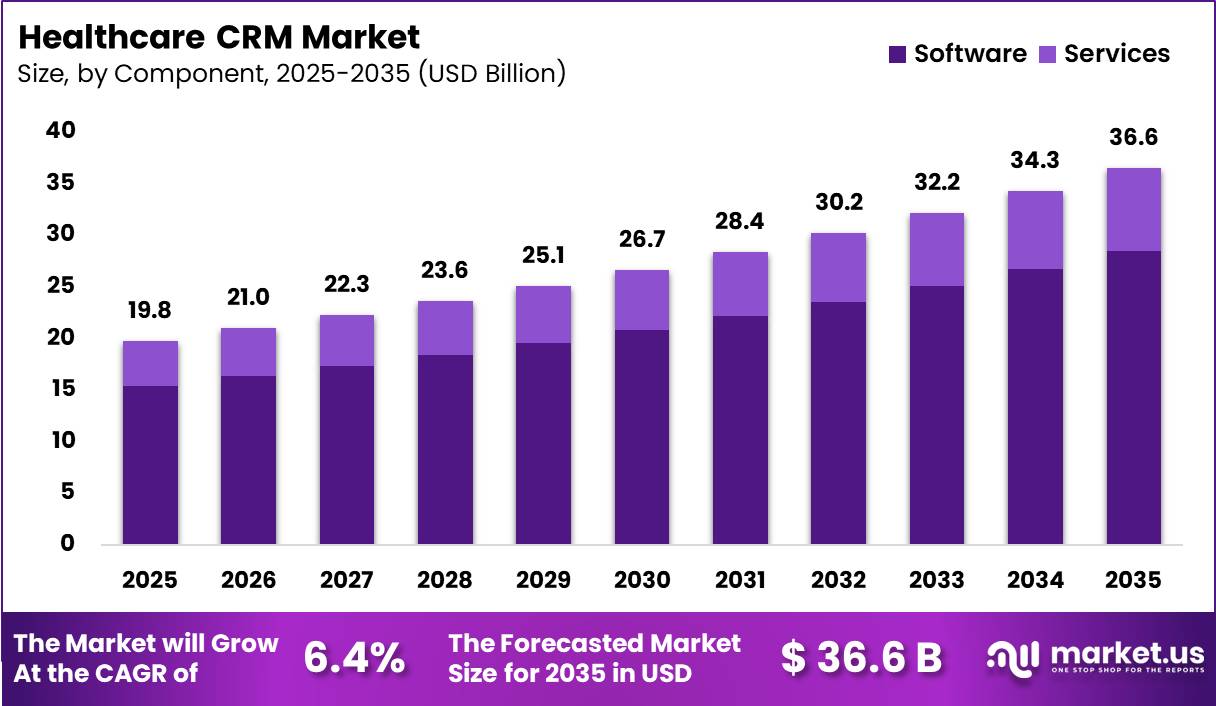
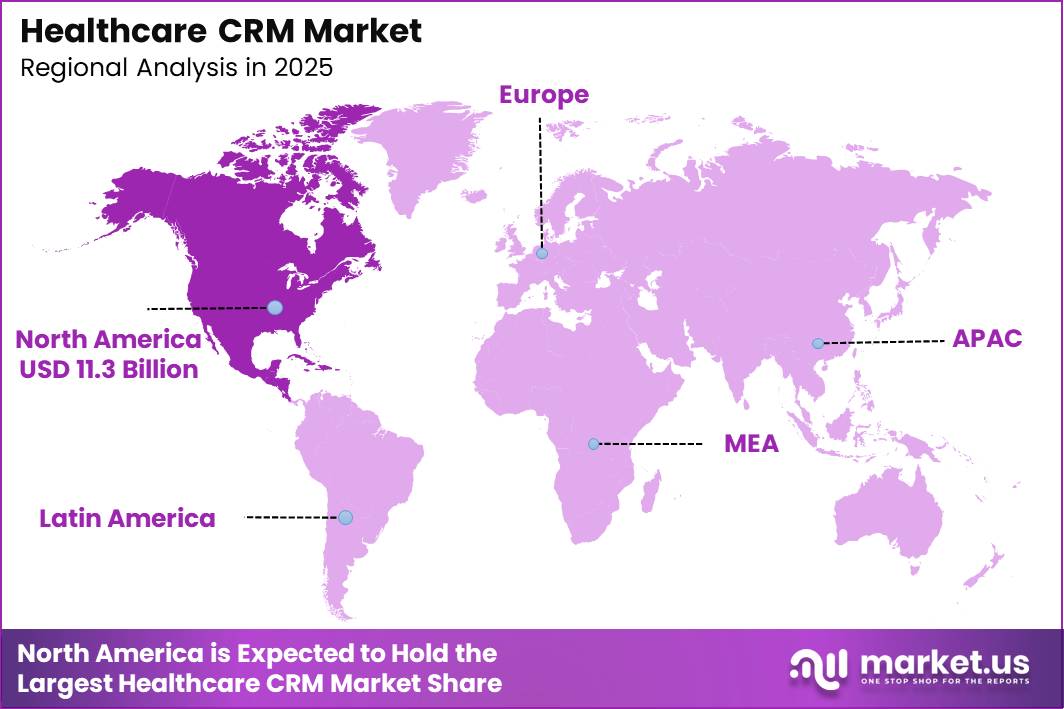
Global Healthcare CRM Market size is expected to be worth around US$ 36.6 Billion by 2035 from US$ 19.8 Billion in 2025, growing at a CAGR of 6.4% during the forecast period from 2026 to 2035. In 2025, North America led the market, achieving over 57.00% share with a revenue of US$ 11.3 Billion.
The Healthcare CRM market is gaining momentum as healthcare organizations increasingly prioritize patient engagement, digital communication, and coordinated care delivery. Rising adoption of electronic health records (EHRs), value-based care models, and digital patient services is creating strong demand for CRM platforms that help providers manage patient relationships, automate workflows, and improve care experiences.
Government initiatives promoting interoperability and patient access to health information are also accelerating CRM adoption across hospitals, clinics, and physician practices. Healthcare providers are investing in integrated digital ecosystems that combine CRM, EHR, telehealth, and analytics to deliver personalized patient experiences while improving operational efficiency.
Recent statistics from the U.S. Office of the National Coordinator for Health Information Technology (ONC) highlight the rapid digital transformation supporting CRM implementation. As of 2024, 91% of office-based physicians and more than 99% of non-federal acute care hospitals had adopted certified electronic health records, creating a strong foundation for CRM solutions that leverage patient data for engagement and care coordination.
Patient engagement capabilities have expanded significantly across healthcare systems, supported by widespread digital adoption. According to the ONC, by 2024, 99% of hospitals enabled patients to view health information electronically, 96% provided access to clinical notes, 93% supported secure messaging, 87% offered API-based access to medical records, and 65% accepted patient-generated health data.
These advancements rely on CRM platforms to manage personalized communication, appointment reminders, follow-ups, and patient outreach. In addition, CMS strengthened interoperability efforts in 2025 by promoting secure data exchange and patient-centered digital care, further accelerating demand for CRM solutions integrated with EHRs and other healthcare technologies.
Key Takeaways
- Market Size : Healthcare CRM Market size is expected to be worth around US$ 36.6 Billion by 2035 from US$ 19.8 Billion in 2025.
- Market Share : The market is growing at a CAGR of 6.4% during the forecast period from 2026 to 2035.
- Component Analysis : In 2025, the Software segment dominated the Healthcare CRM market, accounting for 78.00% of the total market share.
- Deployment Mode Analysis : In 2025, Cloud/Web-Based deployment dominated the Healthcare CRM market with an 81.50% market share.
- Functionality Analysis : In 2025, the Sales segment led the Healthcare CRM market with a 31.00% market share.
- End User Analysis : Healthcare Providers held the largest share of the Healthcare CRM market at 42.20%, In 2025.
- Application Analysis : Relationship Management / Patient Management dominated the Healthcare CRM market with a 34.00% market share In 2025.
- Product Type Analysis : In 2025, Operational CRM accounted for the largest share of the Healthcare CRM market, representing 46.00%.
- Regional Analysis : In 2025, North America led the market, achieving over 57.00% share with a revenue of US$ 11.3 Billion.
Component Analysis
In 2025, the Software segment dominated the Healthcare CRM market, accounting for 78.00% of the total market share. The strong position of software solutions is driven by the growing need for centralized patient data, appointment scheduling, workflow automation, communication tools, and regulatory compliance.
Healthcare organizations are increasingly adopting CRM software to improve patient engagement, personalize care, reduce administrative work, and support value-based healthcare models. Modern CRM platforms also integrate with electronic health records (EHRs), telehealth systems, and analytics tools, enabling providers to deliver connected and efficient care.
Cloud-enabled software with artificial intelligence, automation, and predictive analytics has further strengthened adoption across hospitals, clinics, and specialty care centers. These capabilities help healthcare organizations improve operational efficiency while enhancing patient satisfaction and retention.
The Services segment held the remaining 22.00% market share in 2025. This segment includes consulting, implementation, customization, integration, training, technical support, and maintenance services. As healthcare providers continue modernizing digital infrastructure, demand for professional services remains strong to ensure smooth CRM deployment and integration with existing clinical and administrative systems.
Ongoing support services also help organizations maximize software performance, maintain cybersecurity, and comply with evolving healthcare regulations, contributing to the steady growth of this segment.
Deployment Mode Analysis
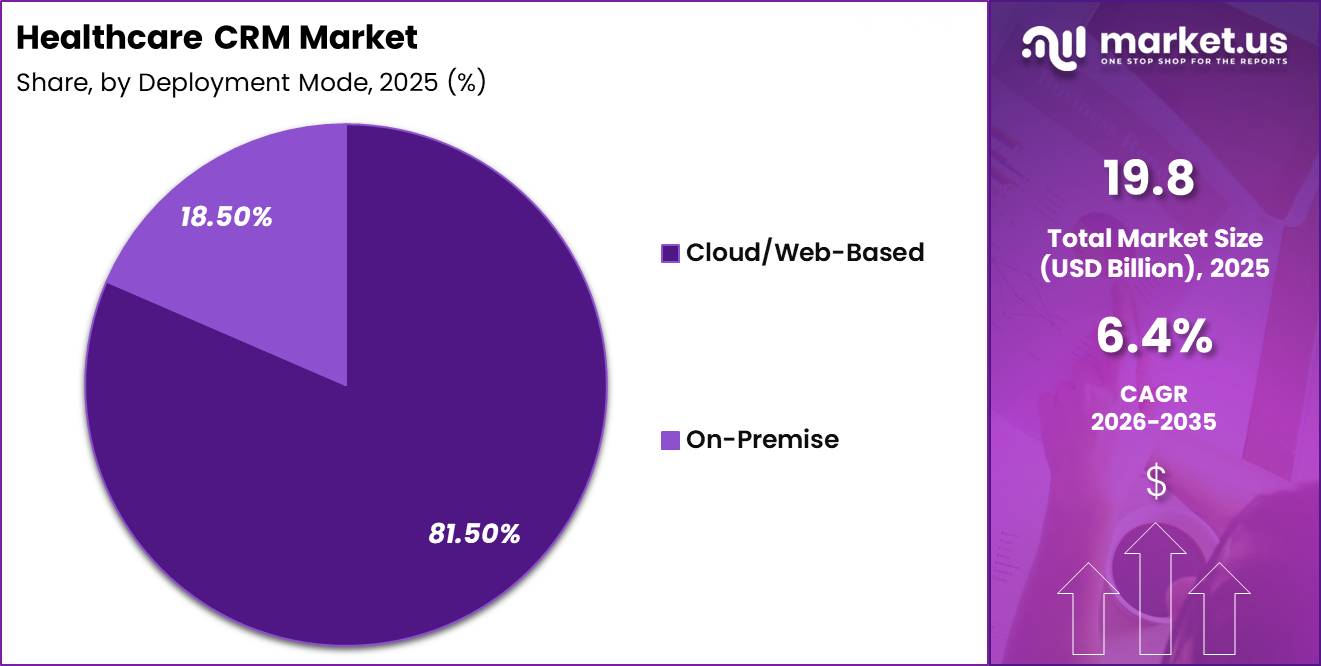
In 2025, Cloud/Web-Based deployment dominated the Healthcare CRM market with an 81.50% market share. Healthcare organizations increasingly prefer cloud-based CRM platforms because they offer flexibility, faster deployment, lower infrastructure costs, and easy access from multiple locations.
Cloud solutions enable healthcare professionals to securely access patient information, schedule appointments, manage communication, and monitor patient engagement through web portals and mobile devices. They also simplify software updates, improve scalability, and support integration with electronic health records, telemedicine platforms, and analytics applications.
The growing adoption of digital healthcare, remote patient management, and AI-powered CRM capabilities continues to strengthen the demand for cloud-based deployments across hospitals, clinics, and healthcare networks.
The On-Premise segment accounted for 18.50% of the market in 2025. Large healthcare organizations with strict internal security policies and legacy IT infrastructure continue to rely on on-premise CRM systems. These solutions provide greater control over sensitive patient data, customized configurations, and compliance with internal governance requirements.
Although adoption is growing more slowly than cloud solutions, on-premise deployments remain important for organizations that require dedicated infrastructure, high levels of data control, or operate in regions with strict data residency regulations. Continued investments in cybersecurity and system upgrades are expected to support this segment over the coming years.
Functionality Analysis
In 2025, the Sales segment led the Healthcare CRM market with a 31.00% market share. Healthcare providers, pharmaceutical companies, and medical device manufacturers increasingly rely on CRM sales tools to manage customer relationships, physician engagement, referral networks, and lead management.
These platforms help organizations monitor sales pipelines, automate follow-ups, improve communication, and generate valuable business insights. AI-powered recommendations and workflow automation further improve productivity while supporting stronger relationships with healthcare professionals and patients. Growing competition among healthcare organizations has also increased the demand for efficient sales management solutions.
The Customer Service & Support segment continues to expand as healthcare organizations focus on improving patient experience through appointment management, inquiry handling, and personalized communication.
Marketing solutions help organizations promote healthcare services, wellness campaigns, and patient education initiatives, while Digital Marketing capabilities strengthen patient outreach through email campaigns, social media, SMS, and online engagement.
Other Functionalities, including analytics, workflow automation, reporting, referral management, and patient engagement tools, also contribute significantly to market growth. As healthcare organizations increasingly adopt integrated CRM platforms, demand across all functionality segments continues to rise with greater emphasis on personalized care and operational efficiency.
End User Analysis
In 2025, Healthcare Providers held the largest share of the Healthcare CRM market at 42.20%. Hospitals, clinics, physician practices, and specialty care centers are rapidly adopting CRM platforms to strengthen patient relationships, improve appointment scheduling, automate communication, and enhance care coordination.
Providers increasingly use CRM systems to personalize patient engagement, reduce administrative workload, and improve clinical workflows through integration with electronic health records and digital health platforms. Rising patient expectations and the shift toward value-based care continue to accelerate CRM adoption across provider organizations.
The Healthcare Payers segment is also experiencing steady growth as insurance companies use CRM platforms to improve member engagement, claims communication, and customer support while streamlining policy management.
Meanwhile, Life Sciences Companies, including pharmaceutical and biotechnology firms, increasingly deploy healthcare CRM solutions to strengthen physician relationships, manage commercial operations, support clinical engagement, and improve marketing effectiveness.
As digital transformation continues across the healthcare ecosystem, CRM adoption among payers and life sciences organizations is expected to expand alongside providers, creating broader opportunities for integrated customer relationship management solutions.
Application Analysis
In 2025, Relationship Management / Patient Management dominated the Healthcare CRM market with a 34.00% market share. Healthcare organizations increasingly prioritize long-term patient engagement by using CRM platforms to manage patient records, appointment reminders, follow-up communication, personalized care plans, and treatment history.
These solutions improve patient satisfaction, strengthen provider-patient relationships, and support better care coordination across healthcare facilities. Integration with electronic health records and digital communication tools further enhances operational efficiency while helping organizations deliver personalized healthcare services.
The Community Outreach segment continues to grow as healthcare providers use CRM systems to conduct awareness campaigns, preventive health programs, and public health initiatives. Case Management solutions support healthcare professionals in tracking patient care journeys, coordinating treatment plans, and improving clinical outcomes.
Case Coordination applications help connect multiple healthcare providers, specialists, and care teams to ensure seamless communication and continuity of care, particularly for patients with chronic or complex conditions. Increasing emphasis on patient-centered care, digital engagement, and coordinated healthcare delivery continues to support demand across all application segments.
Product Type Analysis
In 2025, Operational CRM accounted for the largest share of the Healthcare CRM market, representing 46.00%. Operational CRM solutions help healthcare organizations automate patient interactions, appointment scheduling, communication, referral management, workflow automation, and service delivery.
These systems improve daily operations by reducing manual tasks, increasing staff productivity, and enhancing patient experiences. Growing demand for efficient patient engagement, integrated workflows, and digital healthcare services has made operational CRM the preferred choice for hospitals, clinics, and healthcare networks. AI-enabled automation and integration with healthcare information systems continue to strengthen this segment’s leadership.
The Analytical CRM segment is expanding steadily as healthcare organizations increasingly rely on data analytics to understand patient behavior, measure operational performance, identify healthcare trends, and support strategic decision-making. Collaborative CRM also plays an important role by improving communication among healthcare providers, payers, patients, and other stakeholders.
These platforms facilitate information sharing, care coordination, and collaborative patient management across healthcare networks. As healthcare organizations continue investing in digital transformation, analytical and collaborative CRM solutions are expected to gain wider adoption alongside operational CRM platforms.
Market Segmentations
Component
- Software
- Services
Deployment Mode
- Cloud/Web-Based
- On-Premise
Functionality
- Sales
- Customer Service & Support
- Marketing
- Digital Marketing
- Other Functionalities
End User
- Healthcare Providers
- Healthcare Payers
- Life Sciences Companies
Application
- Relationship Management / Patient Management
- Community Outreach
- Case Management
- Case Coordination
Product Type
- Operational CRM
- Analytical CRM
- Collaborative CRM
Drivers
FHIR-led interoperability and CRM EHR unification
The strongest 2026 demand catalyst is the migration from stand alone contact management toward CRM layers embedded into clinical, scheduling, payer, and care coordination workflows through FHIR based interoperability.
In the U.S., CMS’ Interoperability and Prior Authorization Final Rule requires certain operational provisions from January 1, 2026, while API development and enhancement requirements generally begin January 1, 2027, forcing payers and connected providers to redesign data exchange and member provider communication rails around standardized APIs rather than portal or fax centric workflows.
In parallel, ONC’s HTI-1 rule made USCDI v3 effective January 1, 2025, extended version 1 expiration to January 1, 2026, and begins interoperability related data collection in calendar 2026, which increases the value of CRM platforms that can normalize broader patient and encounter data into campaign, service, referral, and adherence workflows.
Commercially, this shifts healthcare CRM from a marketing tool to middleware plus engagement infrastructure: vendors that can connect CRM records to EHR, payer, and call center data capture larger ACVs, while providers gain lower integration friction, faster patient service resolution, and better referral conversion.
That is why this driver contributes the largest estimated uplift, about 2.1% points to CAGR, with the clearest monetization in North America and spillover into EU and advanced APAC systems where FHIR programs and national digital health architectures are accelerating.
| Driver | (~) % Impact on CAGR Forecast | Geographic Relevance | Impact Timeline |
|---|---|---|---|
| FHIR-led interoperability and CRM-EHR unification | +2.1% | North America core, EU, advanced APAC | Short term (≤ 2 years) |
| AI automation in prior authorization, triage, and service workflows | +1.8% | North America core, UK, Western Europe, APAC tier-1 | Short term (≤ 2 years) |
| Omnichannel patient engagement and digital front door expansion | +1.6% | North America, EU, GCC, urban APAC | Medium term (2-4 years) |
| Chronic disease and longitudinal care management complexity | +1.5% | North America core, EU, Japan, Australia | Medium term (2-4 years) |
| Privacy-governed data sharing and regional health data frameworks | +1.2% | EU core, North America, selective APAC | Long term (≥ 4 years) |
Challenges
Interoperability retrofit burden
The Healthcare CRM market faces a persistent execution drag from the need to retrofit platforms around evolving interoperability baselines rather than building net new commercial functionality, especially as U.S. health IT certification now shifts to USCDI v3 as of January 1, 2026 and TEFCA linked FHIR alignment deadlines continue to force architecture updates across connected ecosystems.
In practice, enterprise deployments commonly require 6 to 18 bidirectional integrations across EHRs, patient portals, labs, revenue cycle systems, call center tools, and consent layers, while each major workflow redesign can add 3 to 9 months to implementation cycles and push services costs up by roughly 12% to 20% versus a standard single instance CRM rollout, creating a recurring friction layer that slows full feature activation even when contract wins continue.
The strategic implication is that vendors must reallocate product roadmaps toward API reliability, terminology mapping, consent orchestration, and implementation accelerators, because growth increasingly depends less on license expansion alone and more on compressing integration effort, lowering failed interface rates, and turning interoperability compliance work into reusable deployment assets that protect future margins.
| Challenge | (~) % CAGR Friction Drag | Geographic Relevance | Mitigation Horizon |
|---|---|---|---|
| Interoperability retrofit burden | -1.4% | North America core, EU digital health systems, APAC enterprise hospital groups | Medium term (2-4 years) |
| Clinical workflow adoption fatigue | -1.1% | North America provider networks, EU public systems, GCC tertiary hospitals, APAC private chains | Medium term (2-4 years) |
| Cybersecurity and vendor exposure | -1.6% | U.S. payer-provider ecosystem, EU regulated care networks, digitally mature APAC markets | Long term (≥ 4 years) |
| Cross-border data governance complexity | -0.9% | EU regulatory hubs, U.K., North America multinationals, Asia cross-border delivery centers | Long term (≥ 4 years) |
| ROI pressure from provider margins | -1.0% | North America hospitals, EU budget-constrained systems, LATAM private providers | Short term (≤ 2 years) |
| CRM analytics talent bottleneck | -0.8% | U.S. enterprise vendors, Western Europe, India delivery hubs, Southeast Asia scaling centers | Long term (≥ 4 years) |
Restraints
Heightened data privacy & consent compliance
Tightening enforcement around HIPAA, GDPR, CCPA and newer health‑data rules (e.g., 21st Century Cures Act data‑sharing obligations) is forcing providers and life sciences firms to re‑architect CRM workflows around granular consent, data minimization and strict secondary‑use controls, adding 8–12% to initial healthcare CRM implementation budgets and extending enterprise roll‑outs by 4–7 months on average.
From 2024–2026, hospitals in the US and EU have seen privacy and compliance headcount for digital programs rise by roughly 20–30%, with many large health systems now requiring two to three independent privacy/security sign‑offs before any new CRM campaign, throttling the pace of use‑case activation and reducing realized ROI per deployment year by an estimated 150–250 basis points in the first two years post‑go‑live.
At the same time, stricter interpretations of “minimum necessary” and patient consent in cross‑border data flows are forcing global pharma and medtech firms to keep regional CRM instances or deploy complex data‑localization architectures, increasing multi‑region CRM TCO by an estimated 10–15% and prompting 15–20% of planned cross‑region roll‑outs to be deferred beyond 2027.
Strategically, this drives margin compression on CRM vendors who must bundle compliance features without fully passing costs through, delays large‑ticket cloud CRM upgrades at providers that are already running at operating margins below 3–4%, and materially caps upside from AI‑driven personalization because only 60–70% of theoretically available patient behavioral and claims data can be legally and operationally tapped at scale in high‑regulation markets.
| Restraint | (~) % Impact on CAGR Forecast | Geographic Relevance | Impact Timeline |
|---|---|---|---|
| Heightened data privacy & consent compliance | -1.3% to -1.8% | North America, EU, select APAC | Short–Medium term |
| Fragmented health IT & CRM interoperability | -0.9% to -1.4% | North America core, EU, APAC corridors | Medium–Long term |
| Budget pressure at hospitals & payers | -0.8% to -1.2% | North America, EU, LATAM, emerging APAC | Short term |
| Shortage of health IT & data talent | -0.6% to -1.0% | North America, EU, India, GCC | Medium term |
| Cybersecurity risk & insurance cost escalation | -0.5% to -0.8% | North America core, EU, APAC tier-1 | Medium–Long term |
| Vendor lock-in & complex legacy migrations | -0.4% to -0.7% | North America, EU, Japan, Middle East | Medium–Long term |
Opportunity
AI care orchestration layer
This is an opportunity rather than a current driver because baseline Healthcare CRM spending is still centered on sales force automation, patient outreach, and workflow management, whereas the next layer of upside comes from repositioning CRM as a real time clinical commercial orchestration system that converts interoperable data into retention, adherence, referral, and risk intervention actions across disease cohorts.
ONC’s HTI-1 framework sets USCDI v3 as the certification baseline from January 2026 and expands reporting around FHIR enabled app usage, which materially improves the feasibility of embedding event triggered engagement models into CRM products rather than leaving them as disconnected EHR utilities.
The monetization white space is substantial: vendors can move from seat based licensing toward PMPM, episode based, or outcome linked pricing, lifting gross margins by an estimated 400 to 700 basis points versus pure workflow licenses while reducing provider customer churn by roughly 15% to 20% through deeper workflow lock-in.
For large U.S. health systems and ACO linked networks, even capturing only high risk chronic, oncology, and post acute navigation use cases can expand addressable revenue per enterprise account by 1.6x to 2.1x, because CRM shifts from front office software into a cross functional care coordination layer tied to readmission prevention, referral leakage reduction, and quality measure closure.
| Opportunity | (~) % Potential CAGR Upside | Geographic Relevance | Execution Window |
|---|---|---|---|
| AI care-orchestration layer | +2.4% | North America core, EU | Short term |
| Specialty CRM for behavioral health | +1.9% | U.S., Canada, UK, ANZ | Short term |
| Payer-provider prior auth CRM | +1.7% | U.S. core | Medium term |
| Independent practice roll-up platforms | +2.1% | U.S., EU fragmented markets | Medium term |
| FHIR app marketplace monetization | +1.5% | North America, EU, advanced APAC | Medium term |
| Rural/FQHC virtual engagement stack | +1.3% | U.S. rural, selected APAC emerging markets | Long term |
Regional Analysis
In 2025, North America dominated the Healthcare CRM market, accounting for over 57.0% of global revenue. The region benefits from advanced healthcare IT infrastructure, high healthcare spending, and mature digital health policies.
According to the U.S. Office of the National Coordinator for Health Information Technology (ONC), 91% of office-based physicians and more than 99% of non-federal acute care hospitals had adopted certified electronic health records (EHRs) by 2024, providing a strong foundation for CRM platforms that support patient engagement, appointment management, and coordinated care.
Additionally, the top three EHR vendors accounted for more than 80% of the U.S. hospital EHR market in 2024, reflecting a highly integrated digital ecosystem that facilitates CRM deployment. Europe remains the second-largest regional market, supported by large-scale investments in digital health infrastructure.
According to the OECD, the average availability of online digital health services across OECD countries reached 82 in 2024, up from 79 in 2023, while countries such as Belgium and Estonia provide comprehensive electronic health record access, strengthening the adoption of patient relationship management solutions.
The Asia-Pacific region is expected to witness the fastest growth due to expanding healthcare digitalization, government-backed health IT initiatives, and increasing hospital modernization. Countries including Japan, Australia, South Korea, Singapore, and India continue investing in interoperable health information systems and digital patient services, creating favorable conditions for CRM adoption.
Latin America and the Middle East & Africa are gradually adopting healthcare CRM solutions as governments invest in electronic medical records, telehealth services, and national digital health strategies. Although adoption remains at an earlier stage than in developed regions, ongoing healthcare modernization and cloud-based technology implementation are expected to support steady market expansion.
Key Regions and Countries
North America
- The US
- Canada
Europe
- Germany
- France
- The U.K.
- Italy
- Spain
- Russia & CIS
- Rest of Europe
Asia Pacific
- China
- India
- Japan
- South Korea
- ASEAN
- Australia & New Zealand
- Rest of Asia Pacific
Middle East & Africa
- GCC
- South Africa
- Rest of Middle East & Africa
Latin America
- Brazil
- Mexico
- Rest of Latin America
Key Player Analysis
The Healthcare CRM market features several established technology providers that continue to expand their healthcare-specific capabilities through cloud platforms, AI, analytics, and workflow automation. Salesforce Inc. remains a leading provider with its Health Cloud platform, helping healthcare organizations improve patient engagement, care coordination, and personalized communication through AI-powered solutions.
Microsoft Corporation offers Dynamics 365 integrated with Microsoft Cloud for Healthcare, enabling providers to connect patient data, automate workflows, and enhance collaboration across care teams. Oracle Corporation strengthens its market position by combining Oracle Health with Oracle Fusion Cloud applications, allowing healthcare organizations to unify clinical and administrative information for better decision-making.
SAP SE focuses on enterprise healthcare management by integrating CRM with business analytics, supply chain, and finance solutions, helping providers improve operational efficiency. IQVIA Holdings Inc. delivers customer engagement platforms tailored to pharmaceutical and life sciences companies, supporting commercial operations with real-world data and advanced analytics.
Veeva Systems Inc. specializes in life sciences CRM, offering compliant cloud solutions for pharmaceutical sales, medical affairs, and customer engagement. Zoho Corporation provides affordable cloud-based CRM solutions suitable for hospitals, clinics, and healthcare service providers seeking digital patient communication tools.
HubSpot Inc. emphasizes patient relationship management through marketing automation, communication, and workflow features designed to improve patient experiences. Pegasystems Inc. differentiates itself with AI-driven workflow automation and case management solutions that help healthcare organizations streamline patient services and administrative processes.
Top Key Players
- Salesforce Inc.
- Microsoft Corporation
- Oracle Corporation
- SAP SE
- IQVIA Holdings Inc.
- Veeva Systems Inc.
- Zoho Corporation
- HubSpot Inc.
- Pegasystems Inc.
- Creatio
- SugarCRM Inc.
- Freshworks Inc.
- NICE Ltd.
- Infor Inc.
- Adobe Inc.
Recent Developments
- In September 2025, Veeva Systems completed its transition away from the Salesforce platform, moving customers to its proprietary Vault CRM platform to deliver a fully integrated CRM solution for pharmaceutical and medtech companies.
- In August 2025, Salesforce continued expanding its healthcare CRM portfolio through Health Cloud and Life Sciences Cloud, adding healthcare-specific AI, FHIR-aligned data models, integrated care management, and healthcare workflows for providers and life sciences organizations.
- In July 2025, Veeva Systems announced that Merck committed to deploy Veeva Vault CRM for its global commercial organization, expanding the companies’ long-term strategic partnership and strengthening Veeva’s position in life sciences CRM.
- In June 2025, Veeva Systems expanded its collaboration with Amazon Web Services (AWS) to support the Veeva Vault CRM Suite with AWS cloud infrastructure, improving scalability and performance for life sciences CRM customers.
Report Scope
| Report Features | Description |
|---|---|
| Market Value (2025) | US$ 19.8 Billion |
| Forecast Revenue (2035) | US$ 36.6 Billion |
| CAGR (2026-2035) | 6.4% |
| Base Year for Estimation | 2025 |
| Historic Period | 2020-2024 |
| Forecast Period | 2026-2035 |
| Report Coverage | Revenue Forecast, Market Dynamics, Competitive Landscape, Recent Developments |
| Segments Covered | Component (Software, Services), Deployment Mode (Cloud/Web-Based, On-Premise), Functionality (Sales, Customer Service & Support, Marketing, Digital Marketing, Other Functionalities), End User (Healthcare Providers, Healthcare Payers, Life Sciences Companies), Application (Relationship Management / Patient Management, Community Outreach, Case Management, Case Coordination), Product Type (Operational CRM, Analytical CRM, Collaborative CRM) |
| Regional Analysis | North America – The US, Canada; Europe – Germany, France, U.K., Italy, Spain, Russia & CIS, Rest of Europe; Asia Pacific – China, India, Japan, South Korea, ASEAN, Australia & New Zealand, Rest of Asia Pacific; Middle East & Africa – GCC, South Africa, Rest of Middle East & Africa; Latin America – Brazil, Mexico, Rest of Latin America |
| Competitive Landscape | Salesforce Inc., Microsoft Corporation, Oracle Corporation, SAP SE, IQVIA Holdings Inc., Veeva Systems Inc., Zoho Corporation, HubSpot Inc., Pegasystems Inc., Creatio, SugarCRM Inc., Freshworks Inc., NICE Ltd., Infor Inc., Adobe Inc. |
| Customization Scope | Customization for segments, region/country-level will be provided. Moreover, additional customization can be done based on the requirements. |
| Purchase Options | We have three licenses to opt for: Single User License, Multi-User License (Up to 5 Users), Corporate Use License (Unlimited User and Printable PDF) |





































