



Overview
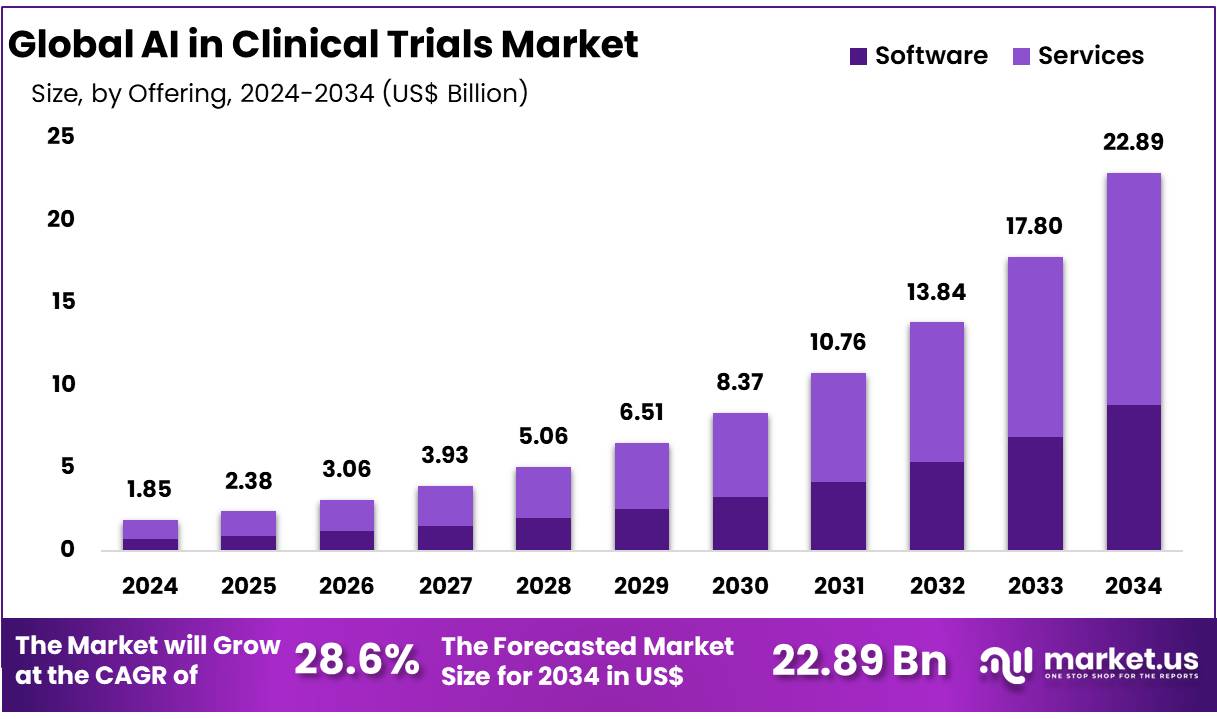
Global AI in Clinical Trials Market size is expected to be worth around US$ 22.89 Billion by 2034 from US$ 1.85 Billion in 2024, growing at a CAGR of 28.6% during the forecast period 2025 to 2034. In 2024, North America led the market, achieving over 31.5% share with a revenue of US$ 582.75 Billion.
The growing adoption of artificial intelligence (AI) in clinical research is transforming the way pharmaceutical companies, biotechnology firms, and healthcare organizations design, manage, and optimize clinical trials. AI-powered solutions are increasingly being used for patient recruitment, trial site selection, protocol optimization, data analysis, and real-time monitoring to improve research efficiency and reduce operational challenges.
Artificial intelligence is helping researchers process complex healthcare datasets, including electronic health records, clinical notes, and real-world evidence, enabling faster identification of eligible participants and more personalized trial approaches.
The National Institutes of Health (NIH) developed TrialGPT, an AI-based framework that assists in matching patients with suitable clinical trials by analyzing patient information and trial eligibility criteria. The system demonstrated strong performance, including 87.3% accuracy in patient-criterion matching evaluations and a 42.6% reduction in screening time during patient recruitment studies.
Regulatory agencies are also focusing on responsible AI implementation in healthcare research. The U.S. Food and Drug Administration (FDA) has evaluated the role of AI in drug development and reported experience with more than 500 submissions containing AI components between 2016 and 2023, supporting the development of regulatory approaches for safe and effective AI use.
The increasing complexity of clinical trials, demand for faster drug development, and expansion of precision medicine are driving the adoption of AI-based platforms. AI technologies are expected to improve trial efficiency by automating repetitive tasks, enhancing data interpretation, and supporting evidence-based decision-making across the clinical research ecosystem.
Key Takeaways
- Market Size Analysis: The AI in Clinical Trials Market was valued at USD 1.85 billion in 2024 and is expected to reach USD 22.89 billion by 2034, demonstrating significant growth during the forecast period.
- Offering Analysis: The services segment accounted for the largest market share, capturing 61.3% of the market in 2024, driven by increasing demand for AI implementation, consulting, and support services in clinical research.
- Technology Analysis: The deep learning segment dominated the technology landscape, holding 54.7% market share in 2024, supported by its ability to analyze complex clinical datasets and improve predictive outcomes.
- Application Analysis: The oncology segment emerged as the leading application area, accounting for 45.9% market share, as AI adoption increases in cancer research, drug discovery, and clinical trial optimization.
- End User Analysis: Pharmaceutical companies represented the largest end-user segment, securing 65.8% market share in 2024 due to growing investments in AI-driven drug development and clinical trial management.
- Regional Analysis: North America held the dominant position in the global AI in Clinical Trials Market, accounting for 31.5% market share in 2024, supported by advanced healthcare infrastructure, AI adoption, and strong research activities.
Statistical Information
- The NIH-developed TrialGPT AI framework was evaluated using 3 cohorts of 183 synthetic patients with more than 75,000 clinical trial annotations to assess AI-based patient-to-trial matching performance.
- TrialGPT achieved 87.3% accuracy in patient eligibility matching based on 1,015 manually evaluated patient-criterion pairs, demonstrating the potential of AI tools in improving clinical trial recruitment workflows.
- NIH research found that TrialGPT could reduce clinical trial screening time by 42.6% during patient recruitment activities, supporting faster identification of suitable trial participants.
- TrialGPT-Retrieval was able to identify more than 90% of relevant clinical trials while using less than 6% of the initial trial collection, showing efficiency in large-scale trial matching.
- In a TrialGPT evaluation study, AI-assisted screening improved annotation accuracy to 97.2% compared with 91.7% without AI assistance, demonstrating potential improvements in clinical research review processes.
- The TrialGPT study evaluated AI performance against expert judgment using 1,015 patient-criterion evaluations, highlighting the role of large language models in supporting clinical trial eligibility assessment.
- The FDA received more than 800 external comments on its discussion paper regarding AI use in drug development, demonstrating significant industry and stakeholder interest in AI regulatory frameworks.
- A clinical evidence synthesis AI pipeline called TrialMind was evaluated using 100 systematic reviews and 2,220 clinical studies, demonstrating AI applications beyond recruitment, including clinical evidence analysis.
- TrialMind demonstrated 44.2% time savings in study screening and 63.4% time savings in data extraction when combined with human experts for clinical evidence synthesis tasks.
- TrialMind achieved a 71.4% recall improvement in study screening through human-AI collaboration compared with manual approaches in evaluation studies.
Regional Analysis
North America emerged as the leading region in the global AI in Clinical Trials Market, accounting for 31.5% market share in 2024. The region’s strong position is supported by the presence of advanced healthcare infrastructure, established pharmaceutical and biotechnology companies, significant research investments, and rapid adoption of artificial intelligence across clinical research workflows.
The U.S. Food and Drug Administration (FDA) has highlighted that AI and machine learning technologies are increasingly being integrated into clinical trial design, digital health applications, and real-world data analysis to improve research efficiency and decision-making.
The region also benefits from strong innovation activities, with organizations using AI platforms to improve patient recruitment, trial matching, and data management. For example, the National Institutes of Health (NIH) developed the TrialGPT AI algorithm to help match potential volunteers with suitable clinical trials, supporting faster enrollment processes.
Meanwhile, the Asia-Pacific region is expected to witness significant growth due to increasing healthcare digitization, government support for AI adoption, expanding clinical research activities, and access to large patient populations. Growing investments in AI-driven healthcare solutions and cost-effective clinical trial capabilities are encouraging pharmaceutical and research organizations to expand their presence across emerging Asian markets.
Emerging Trends
- Growing Adoption of Multimodal AI Systems: Clinical research is moving toward AI models capable of combining multiple healthcare datasets, including imaging, electronic health records, laboratory information, and genomic data. This approach enables deeper patient analysis and supports precision medicine-based clinical trial strategies.
- Expansion of Real-World Evidence (RWE) Integration: AI is increasingly being combined with real-world data sources to improve clinical trial planning, patient selection, and outcome assessment. FDA identifies real-world data analytics as a key area where AI is influencing modern drug development processes.
- Rise of AI Regulatory Frameworks: Regulatory authorities are developing guidelines to ensure safe and reliable AI adoption in clinical research. FDA has issued guidance discussions around AI-supported regulatory decision-making, focusing on model performance, data quality, transparency, and risk management.
- Increasing Use of AI in Drug Development Workflows: Pharmaceutical companies are expanding AI usage beyond discovery into clinical trial operations, regulatory documentation, and data management. Reports indicate companies including major global pharmaceutical firms are applying AI to improve enrollment processes and regulatory workflows.
- Acceleration of AI-Based Drug Development Timelines: AI platforms are helping biotechnology companies shorten early development cycles by improving target identification and candidate selection. Insilico Medicine reported achieving drug candidate discovery in approximately 9 months, compared with traditional multi-year development timelines.
Use Cases
- AI-Based Patient Recruitment and Trial Matching: AI is being used to identify suitable clinical trial participants by analyzing electronic health records, patient histories, and eligibility criteria. NIH-supported AI research tools are helping researchers improve participant screening and trial discovery.
- AI for Clinical Trial Data Analysis: AI systems are increasingly applied to process complex clinical datasets, including real-world data, laboratory results, and patient outcomes. FDA recognizes AI applications in clinical research for trial design, digital health technologies, and real-world data analytics, supporting faster evidence generation and improved decision-making.
- AI-Driven Protocol Optimization: Pharmaceutical companies are using AI to improve trial design by predicting patient populations, selecting appropriate endpoints, and identifying operational risks. FDA highlights AI’s role in optimizing clinical development processes, helping researchers create more efficient and data-driven study designs.
- AI in Safety Monitoring and Adverse Event Detection: AI models are being adopted to analyze safety signals, identify potential adverse events, and support pharmacovigilance activities. Research shows AI combined with real-world healthcare data is increasingly used for adverse event detection and drug safety evaluation.
- AI-Powered Decentralized Clinical Trials: AI is supporting remote clinical research through digital health technologies, wearable sensors, and connected devices. FDA notes that digital health technologies can collect patient data continuously outside traditional trial sites, improving convenience and enabling decentralized trial approaches.
Frequently Asked Questions on
- What is AI in Clinical Trials?
AI in clinical trials refers to the use of artificial intelligence technologies to improve clinical research activities such as patient recruitment, trial design, data analysis, and monitoring. AI systems analyze large healthcare datasets to support faster and more efficient research decisions. - How is AI used in clinical trial patient recruitment?
AI helps researchers identify suitable trial participants by analyzing medical records, patient information, and eligibility requirements. NIH-developed TrialGPT uses large language models to match patients with suitable clinical studies and supports clinicians in finding relevant trials more efficiently. - Can AI reduce the time required for clinical trial screening?
Yes, AI can significantly improve screening efficiency by automating patient eligibility evaluation. NIH research on TrialGPT showed that the technology reduced patient recruitment screening time, helping researchers accelerate the participant identification process. - What are the major applications of AI in clinical trials?
AI applications include patient matching, clinical data analysis, protocol optimization, trial monitoring, adverse event detection, and regulatory documentation support. These technologies help pharmaceutical companies manage complex trial processes and improve research accuracy throughout the clinical development lifecycle. - How does AI improve clinical trial data analysis?
AI improves data analysis by processing large volumes of structured and unstructured healthcare information, including medical records and trial datasets. Advanced AI models identify patterns, support evidence generation, and help researchers make data-driven decisions during clinical studies. - What role does AI play in oncology clinical trials?
AI plays an important role in oncology trials by helping researchers analyze complex patient information, identify suitable participants, and support precision medicine approaches. NIH researchers developed TrialGPT partly to address challenges in matching cancer patients with relevant clinical trials. - How accurate are AI-based clinical trial matching systems?
AI-based matching systems have demonstrated strong performance in research evaluations. TrialGPT achieved accuracy in patient-criterion matching assessments and was tested using trial annotations, showing potential for improving recruitment workflows. - What are the benefits of AI in clinical trials?
AI helps reduce manual workload, improve participant identification, optimize trial operations, and accelerate healthcare research. By automating repetitive tasks and analyzing complex datasets, AI enables researchers to improve efficiency while maintaining better oversight of clinical development activities. - What challenges affect AI adoption in clinical trials?
AI adoption challenges include data privacy concerns, model transparency requirements, regulatory compliance, and the need for reliable healthcare datasets. Regulatory agencies such as the FDA emphasize responsible AI use with proper validation, risk assessment, and human oversight. - What is the future outlook for AI in Clinical Trials Market?
The future of AI in clinical trials is expected to focus on advanced automation, real-world data integration, personalized medicine, and faster drug development. Companies are increasingly exploring AI platforms to shorten research timelines, with some AI-driven drug discovery processes reaching candidate identification.
Conclusion
The AI in Clinical Trials Market is rapidly transforming clinical research by improving patient recruitment, trial design, data analysis, and operational efficiency. AI-powered platforms are enabling pharmaceutical companies and researchers to manage complex healthcare data, accelerate decision-making, and support precision medicine approaches. Government initiatives and regulatory frameworks from organizations such as the FDA and NIH are encouraging responsible AI adoption in clinical development.
Technologies like TrialGPT demonstrate the potential of AI to improve trial matching and enrollment efficiency. With continued advancements in multimodal AI, real-world data integration, and automated workflows, AI is expected to become an essential component of future clinical trial ecosystems.




















