


Overview
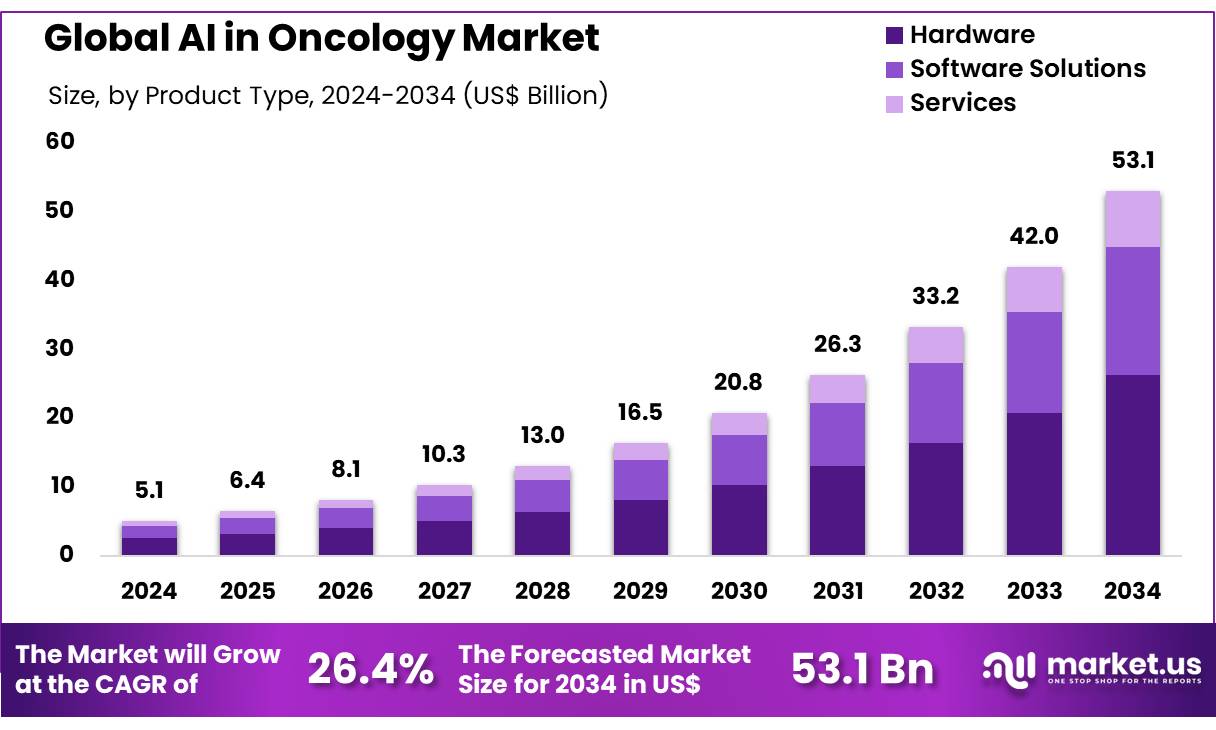
Global AI in Oncology Market size is expected to be worth around US$ 53.1 Billion by 2034 from US$ 5.1 Billion in 2024, growing at a CAGR of 26.4% during the forecast period 2025 to 2034. In 2024, North America led the market, achieving over 42.1% share with a revenue of US$ 2.1 Billion.
The increasing integration of artificial intelligence (AI) technologies into oncology is transforming cancer diagnosis, treatment planning, drug discovery, and patient monitoring. AI-powered solutions are helping healthcare providers analyze complex medical data, including imaging scans, genomic information, and clinical records, to support faster and more personalized cancer care decisions. The National Cancer Institute (NCI) highlights that AI applications are creating new opportunities across cancer research and care by improving understanding of cancer biology and supporting advanced clinical approaches.
AI-based oncology platforms are increasingly being used for medical imaging analysis, early cancer detection, pathology interpretation, treatment response prediction, and precision medicine. The availability of large-scale cancer datasets, improved computing capabilities, and advanced machine learning algorithms is accelerating innovation in this field. According to the U.S. Food and Drug Administration (FDA), AI-enabled medical devices are undergoing regulatory review to ensure safety, effectiveness, and transparency before clinical adoption.
Government initiatives are also supporting AI development in oncology. In 2025, the National Cancer Institute issued a request for information focused on establishing AI benchmarks and datasets to improve validation and adoption of AI applications in cancer research and care. Additionally, the FDA recognized AI-based oncology technologies, including machine-learning tools designed to assist clinicians in detecting cancer-related abnormalities.
The growing focus on precision oncology, digital health infrastructure, and data-driven treatment approaches is expected to strengthen the adoption of AI solutions across hospitals, research centers, and cancer care organizations worldwide.
Key Takeaways
- The global AI in oncology market was valued at US$ 5.1 billion in 2024 and is projected to reach US$ 53.1 billion by 2034, expanding at a CAGR of 26.4% during the forecast period.
- By product type, the market is categorized into software solutions, services, and hardware. Hardware emerged as the leading segment in 2024, accounting for 49.4% of the total market share.
- Based on application, the market includes diagnostics, research & development, radiation therapy, immunotherapy, and chemotherapy. Among these, the diagnostics segment dominated the market with a 47.6% revenue share in 2024.
- By cancer type, the market is segmented into breast cancer, prostate cancer, lung cancer, colorectal cancer, brain tumor, and other cancers. The breast cancer segment held the largest share, contributing 32.4% of the market revenue in 2024.
- In terms of end users, the market is divided into hospitals, surgical centers & medical institutes, and others. Hospitals maintained their leading position by capturing 50.8% of the overall market share in 2024.
- North America remained the largest regional market, representing 42.1% of the global AI in oncology market revenue in 2024.
Statistical Information
- The U.S. FDA Oncology Center of Excellence (OCE) authorized 76 oncology devices in 2024, including AI-enabled diagnostic imaging, radiation therapy, and pathology solutions that support cancer diagnosis and treatment workflows.
- In 2024, the FDA approved 17 novel oncology drugs and 34 new indications for previously approved cancer therapies, highlighting continued innovation in precision oncology that increasingly relies on AI-supported biomarker analysis and companion diagnostics.
- The FDA’s Precision Oncology Program recorded 32 precision oncology therapeutic approvals in 2024, reflecting growing adoption of biomarker-driven and data-intensive cancer treatment approaches where AI can support clinical decision-making.
- The FDA authorized 27 in vitro diagnostic (IVD) oncology devices during 2024, including two new next-generation sequencing (NGS) tumor profiling assays with companion diagnostic claims for precision cancer treatment.
- The FDA’s Project Facilitate processed 761 single-patient Expanded Access applications for cancer therapies in 2024, supporting access to investigational oncology treatments for eligible patients.
- Through Project Orbis, the FDA collaborated with international regulatory agencies on 23 oncology product approvals in 2024, helping accelerate simultaneous global review of innovative cancer therapies.
- GE HealthCare reported US$ 19.7 billion in total revenue for fiscal year 2024, with continued investment in Advanced Visualization and Pharmaceutical Diagnostics technologies that support AI-enabled oncology imaging and diagnostics.
Regional Analysis
North America dominated the AI in Oncology market, accounting for 42.1% of the global market share in 2024. The region’s leadership is supported by its advanced healthcare infrastructure, strong adoption of precision medicine, and continuous integration of artificial intelligence into oncology care. Healthcare providers are increasingly utilizing AI to improve cancer detection, medical imaging analysis, pathology workflows, treatment planning, and clinical decision-making.
Ongoing support from regulatory agencies such as the U.S. Food and Drug Administration (FDA) and research organizations including the National Cancer Institute (NCI) is fostering the development and adoption of AI-enabled oncology technologies. Strong collaboration among healthcare institutions, technology companies, and research organizations continues to accelerate innovation, making North America a key hub for AI-driven cancer care.
Asia Pacific is anticipated to register the fastest growth during the forecast period, driven by expanding healthcare infrastructure, growing adoption of digital health technologies, and increasing government initiatives supporting artificial intelligence in healthcare. Rising awareness of early cancer detection, improving access to advanced diagnostic services, and continued investments in healthcare digitalization are encouraging the adoption of AI-powered oncology solutions across the region.
Countries including China, Japan, India, South Korea, and Australia are strengthening their AI capabilities through research collaborations and healthcare modernization programs. As hospitals and cancer centers increasingly adopt intelligent diagnostic and clinical decision-support systems, AI is expected to play a greater role in improving cancer diagnosis, treatment planning, and personalized patient care across Asia Pacific.
Emerging Trends
- AI-powered digital pathology is becoming a major trend as hospitals increasingly digitize tissue slides for faster and more consistent cancer diagnosis. The U.S. National Cancer Institute (NCI) highlighted digital pathology as a priority area for cancer research and clinical trials, while an NCI workshop identified AI-enabled pathology as a key driver for future oncology innovation.
- AI is increasingly being used to predict immunotherapy response instead of relying only on conventional biomarkers. In 2025, the NCI introduced the HistoTME AI model, which analyzes digital pathology images to evaluate the tumor microenvironment and identify patients more likely to benefit from checkpoint inhibitor therapies, supporting more personalized cancer treatment decisions.
- Foundation AI models are emerging across oncology pathology workflows. Researchers are developing large-scale AI models trained on extensive pathology datasets collected from multiple healthcare institutions to improve cancer detection, grading, and biomarker discovery. This trend aims to enhance model reliability while supporting broader clinical adoption across different cancer types.
- Greater emphasis is being placed on validating AI before routine clinical use. Healthcare organizations and regulators are focusing on rigorous clinical validation, standardized datasets, and transparent AI evaluation to ensure safety and accuracy. This reflects a shift from experimental AI tools toward trusted clinical solutions that can be integrated into everyday oncology practice.
- Multi-modal AI platforms are gaining momentum by combining pathology images, genomic data, radiology scans, and clinical records into a single analytical framework. According to the NCI, integrating multiple data sources enables AI to generate more comprehensive insights, supporting precision oncology and individualized treatment planning.
Use Cases
- AI is improving digital pathology interpretation by automatically identifying cancer cells, grading tumors, and assisting pathologists in reviewing whole-slide images. According to the NCI workshop report, only three AI/ML Software as a Medical Device tools had received FDA clearance for digital pathology at the time of the report, highlighting significant future opportunities for clinical deployment.
- AI is being used to accelerate biomarker discovery by analyzing large pathology datasets that would be difficult to evaluate manually. Researchers are using AI to identify hidden tissue patterns associated with disease progression and treatment response, enabling more targeted drug development and precision oncology strategies.
- Cancer clinical trials are increasingly adopting AI to improve patient selection, automate image analysis, and identify eligible participants based on complex clinical and molecular information. The NCI recognizes AI-assisted clinical trials as an important approach for improving trial efficiency and advancing oncology research.
- AI is supporting real-time surgical oncology through intelligent histology systems that rapidly analyze tumor tissue during surgery. These platforms generate high-resolution digital images within seconds, enabling surgeons to make faster intraoperative decisions while helping improve surgical precision and tissue assessment.
- AI is enabling predictive oncology by forecasting treatment outcomes using imaging, pathology, and molecular information. Instead of relying solely on traditional clinical assessments, AI models estimate the likelihood of therapy response, recurrence, and disease progression, helping clinicians personalize treatment strategies and optimize patient management.
Frequently Asked Questions About AI in Oncology
- Why is AI becoming important in the AI in Oncology Market?
AI is becoming increasingly important because healthcare organizations are managing growing volumes of cancer-related data. AI helps identify patterns that may not be easily recognized by humans, improving clinical efficiency, supporting precision medicine, and accelerating oncology research and therapeutic development. - How is AI used in cancer diagnosis?
AI assists physicians by analyzing radiology images, digital pathology slides, and laboratory data to detect abnormalities and support earlier cancer diagnosis. It also helps prioritize suspicious cases for review, improving workflow efficiency while complementing, rather than replacing, clinical expertise. - Which healthcare organizations are driving AI adoption in oncology?
Organizations such as the U.S. Food and Drug Administration (FDA) and the National Cancer Institute (NCI) are actively supporting responsible AI adoption. They provide regulatory guidance, research initiatives, and scientific resources to encourage safe and effective use of AI technologies in oncology. - What are the major applications of AI in the AI in Oncology Market?
Key applications include cancer screening, diagnostic imaging, pathology analysis, treatment planning, biomarker discovery, clinical trial optimization, drug development, and patient monitoring. These applications help healthcare providers improve accuracy, reduce workload, and deliver more personalized oncology care. - What is the future outlook for the AI in Oncology Market?
The market is expected to expand as hospitals adopt precision medicine, digital pathology, and AI-enabled clinical decision support. Continued collaboration among healthcare providers, researchers, technology companies, and regulatory agencies is expected to accelerate innovation and broaden AI applications across cancer care.
Conclusion
The AI in Oncology market is witnessing strong momentum as healthcare providers increasingly adopt artificial intelligence to improve cancer diagnosis, treatment planning, pathology, medical imaging, and precision medicine. Advances in machine learning, digital pathology, and multimodal data analysis are enabling more personalized and efficient cancer care.
Regulatory support from organizations such as the U.S. FDA and research initiatives led by the National Cancer Institute are accelerating clinical adoption while promoting safe and reliable AI integration. As healthcare systems continue investing in digital transformation and data-driven oncology, AI is expected to play an increasingly important role in enhancing clinical outcomes, improving operational efficiency, and advancing the future of precision cancer care worldwide.




















