


Overview
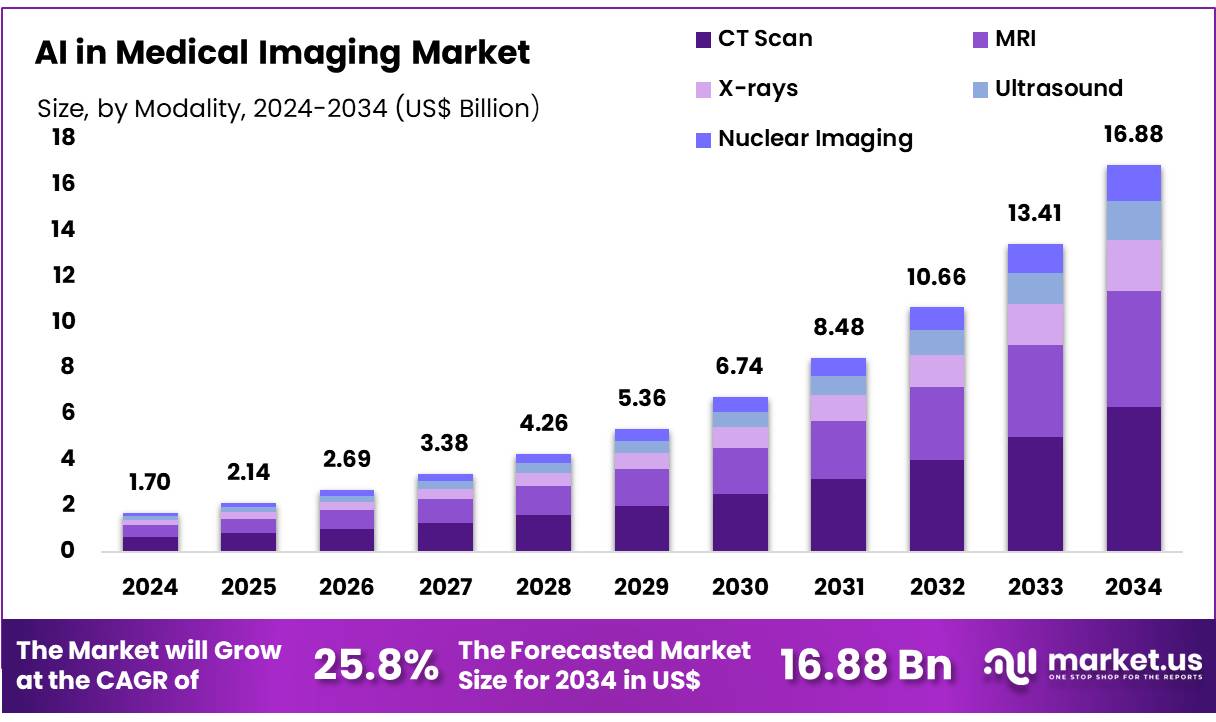
Global AI in Medical Imaging Market size is expected to be worth around US$ 16.88 Billion by 2034 from US$ 1.70 Billion in 2024, growing at a CAGR of 25.8% during the forecast period 2025 to 2034. In 2024, North America led the market, achieving over 45.2% share with a revenue of US$ 0.77 Billion.
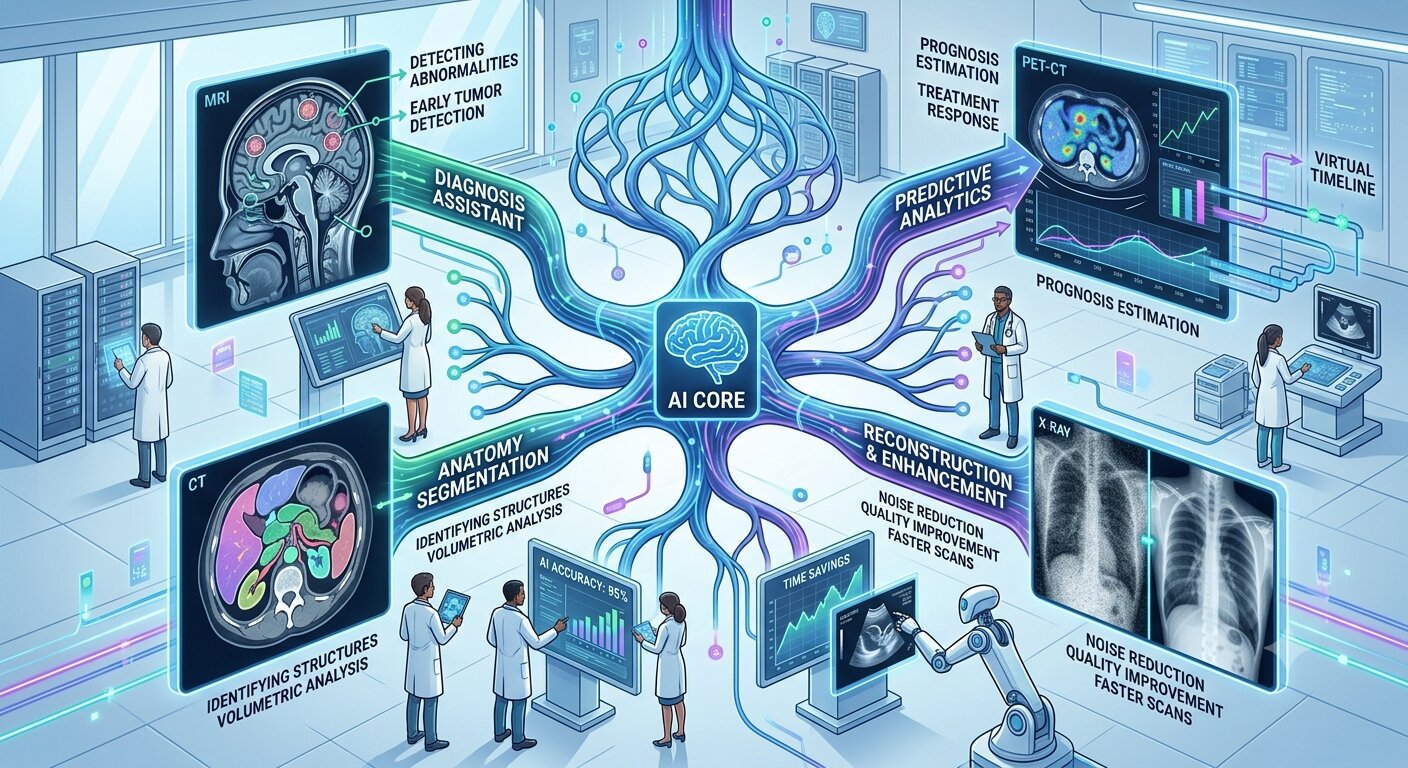
Artificial intelligence (AI) is transforming medical imaging by enabling healthcare professionals to analyze complex medical scans, identify abnormalities, and improve diagnostic decision-making. AI-based imaging technologies are increasingly being integrated into radiology departments, supporting applications across X-ray, computed tomography (CT), magnetic resonance imaging (MRI), and ultrasound platforms. These solutions help clinicians manage growing imaging workloads while improving workflow efficiency and supporting earlier disease detection.
The U.S. Food and Drug Administration (FDA) continues to promote the development of safe and effective AI-enabled medical devices through regulatory frameworks that evaluate device performance, clinical benefits, and patient safety. The FDA maintains an AI-enabled medical device database to provide transparency regarding authorized technologies used in healthcare.
The rapid expansion of AI adoption in healthcare is reflected by regulatory progress, with the FDA authorizing more than 1,300 AI-enabled medical devices across multiple clinical specialties by 2025. Medical imaging remains one of the leading areas for AI application due to the availability of large volumes of diagnostic image data and the need for efficient interpretation.
Hospitals and healthcare providers are increasingly adopting AI solutions to reduce diagnostic delays, support radiologists, and enhance personalized treatment strategies. Growing demand for precision medicine, rising chronic disease prevalence, and improvements in machine learning technologies are expected to further accelerate AI integration within medical imaging workflows. These advancements are positioning AI as a critical component of future digital healthcare systems.
Key Takeaways
- In 2024, the AI in Medical Imaging Market generated US$ 1.70 billion in revenue and is projected to expand at a CAGR of 25.8%, reaching US$ 16.88 billion by 2034.
- Based on Modality, the market is segmented into CT Scan, MRI, X-rays, Ultrasound, and Nuclear Imaging. Among these, CT Scan emerged as the leading segment in 2024, capturing 37.4% of the market share.
- By Application, the market is categorized into Neurology, Respiratory and Pulmonary, Cardiology, Breast Screening, Orthopedics, and Other Applications. The Neurology segment dominated the market with a 39.8% share.
- Based on Technology, the market is segmented into Deep Learning, Natural Language Processing (NLP), Machine Learning, and Other Technologies. Deep Learning held the leading position with a 57.9% market share.
- By End Use, the market is divided into Hospitals, Diagnostic Imaging Centers, and Other End-Users. The Hospitals segment accounted for the largest revenue share of 53.7%, maintaining its dominance in the market.
- Regionally, North America dominated the AI in Medical Imaging Market in 2024, accounting for a 45.2% market share.
Regional Analysis
North America is leading the AI in Medical Imaging Market
North America is the dominant region in the global AI medical imaging market. It is expected that North America accounted for the highest revenue share, 45.2%. Owing to North America has strong research & development infrastructure, especially in the field of medical imaging. Many of the world’s major research institutions & universities are situated in North America. North America has a large healthcare industry, which provides a large market for medical imaging technology.
The region also has a high level of healthcare expenditure, which allows healthcare providers to invest in advanced medical imaging technologies. Many countries in the APAC are investing heavily in healthcare infrastructure & technology, which includes AI in medical imaging. Additionally, the region has a huge number of skilled workforces in the field of artificial intelligence & medical imaging, which has contributed to the growth of new and innovative technologies in the market.
Emerging Trends
- Generative AI for Medical Image Creation and Enhancement: Generative AI is becoming an important trend in medical imaging by improving image resolution, generating synthetic medical images, and supporting faster image reconstruction. These technologies help overcome limited datasets and are being researched for CT, MRI, and other imaging workflows. Research highlights applications including image enhancement and cross-modality conversion.
- Multimodal AI Integration in Clinical Decision Support: Healthcare providers are increasingly exploring AI models that combine medical images with electronic health records, laboratory data, and clinical information. This approach enables more comprehensive patient assessments and supports personalized treatment decisions. Multimodal AI is being studied across oncology, neurology, and cardiovascular imaging applications.
- AI-Based Automated Radiology Workflow Optimization: AI-powered workflow automation is gaining adoption to prioritize critical cases, reduce reporting delays, and support radiologists with routine image analysis. The American College of Radiology highlights multiple AI use cases designed to improve efficiency across radiology departments, including image interpretation and operational support.
- Federated Learning for Secure Medical Imaging AI: Federated learning is emerging as a solution for developing AI models while protecting patient privacy. Hospitals can train algorithms using local datasets without transferring sensitive medical images. This approach supports collaboration between healthcare institutions while maintaining data security and regulatory compliance.
- AI-Based Low-Dose Imaging and Radiation Reduction: AI technologies are being developed to improve image quality while reducing radiation exposure during imaging procedures. Recent clinical research has demonstrated AI-assisted reconstruction methods that can support lower-dose CT imaging while maintaining diagnostic performance, improving safety for repeated examinations.
Use Cases
- AI-Assisted Cancer Detection and Screening: AI medical imaging tools are increasingly used for detecting tumors and abnormalities in lung, breast, and other cancer screenings. These systems analyze imaging patterns and highlight suspicious regions for physicians. AI-supported screening helps improve early detection and assists clinicians in managing increasing diagnostic workloads.
- CT Scan Analysis for Disease Diagnosis: AI algorithms are being applied to analyze CT scans for identifying conditions such as abdominal disorders, infections, and tumors. NIH researchers developed machine learning models capable of interpreting 3D CT images and supporting faster diagnosis, helping reduce the time required for image analysis.
- AI Applications in Neurological Imaging: AI is increasingly used in brain imaging applications, including stroke detection, brain tumor assessment, and neurological disorder monitoring. Deep learning models analyze MRI and CT images to identify patterns that may assist physicians in diagnosis and treatment planning. Neurology remains one of the major clinical areas for imaging AI development.
- AI-Enhanced Eye and Retinal Imaging: AI is expanding into ophthalmology by improving retinal image analysis and supporting early detection of eye diseases. NIH researchers developed AI methods that enhanced retinal imaging quality and reduced required imaging data by approximately 75%, helping move advanced eye imaging closer to routine clinical use.
- AI-Based Emergency Radiology Support: Emergency departments are adopting AI tools to quickly identify critical findings in medical scans, including abnormalities in CT and X-ray images. These systems help prioritize urgent cases and support faster clinical responses. The American College of Radiology recognizes emergency imaging workflow support as a key AI application area.
Frequently Asked Questions About AI in Medical Imaging
- How does AI improve medical imaging?
AI improves medical imaging by detecting patterns in scans, highlighting possible diseases, automating image analysis, and helping clinicians make faster decisions. FDA research highlights AI applications in image processing, early disease detection, diagnosis improvement, and personalized healthcare support. - What are the major applications of AI in medical imaging?
Major applications include cancer detection, brain imaging analysis, cardiovascular assessment, lung disease screening, emergency radiology support, and treatment planning. AI tools assist physicians by improving workflow efficiency and extracting useful insights from complex medical image data. - Can AI replace radiologists in medical imaging?
AI is not expected to replace radiologists but works as a supporting technology. It helps prioritize urgent cases, analyze images faster, and reduce repetitive tasks, while physicians remain responsible for clinical interpretation and final medical decisions. - What technologies are driving the AI medical imaging market?
The AI medical imaging market is driven by deep learning, machine learning, computer vision, natural language processing, and advanced data analytics. Deep learning models are widely used for image recognition, segmentation, reconstruction, and automated diagnostic assistance. - Why is the AI medical imaging market growing?
The market is growing due to increasing medical imaging volumes, demand for faster diagnosis, shortage of healthcare specialists, and improvements in AI algorithms. Regulatory approvals are also supporting adoption, with the FDA maintaining a database of authorized AI-enabled medical devices. - What role does the FDA play in AI medical imaging?
The FDA evaluates AI-enabled medical devices to ensure safety and effectiveness before market authorization. The agency supports AI innovation through regulatory science programs focused on improving reliability, performance evaluation, and patient safety in AI-based healthcare technologies. - What is the future outlook for AI medical imaging?
The future of AI medical imaging focuses on multimodal AI, automated workflows, personalized diagnostics, and secure data sharing. Healthcare researchers are developing AI-ready imaging datasets and advanced models to improve disease detection and clinical decision support.
Conclusion
The AI in Medical Imaging Market is experiencing rapid transformation as artificial intelligence becomes increasingly integrated into diagnostic workflows, clinical decision support, and personalized healthcare. Advancements in deep learning, generative AI, and automated image analysis are improving the speed and accuracy of medical interpretation across multiple imaging modalities.
Strong regulatory support, rising adoption among healthcare providers, and continuous innovation from technology companies are accelerating market expansion. AI-powered imaging solutions are expected to play a crucial role in early disease detection, workflow optimization, and improving patient outcomes, making artificial intelligence a key technology shaping the future of medical imaging.




















