



Overview
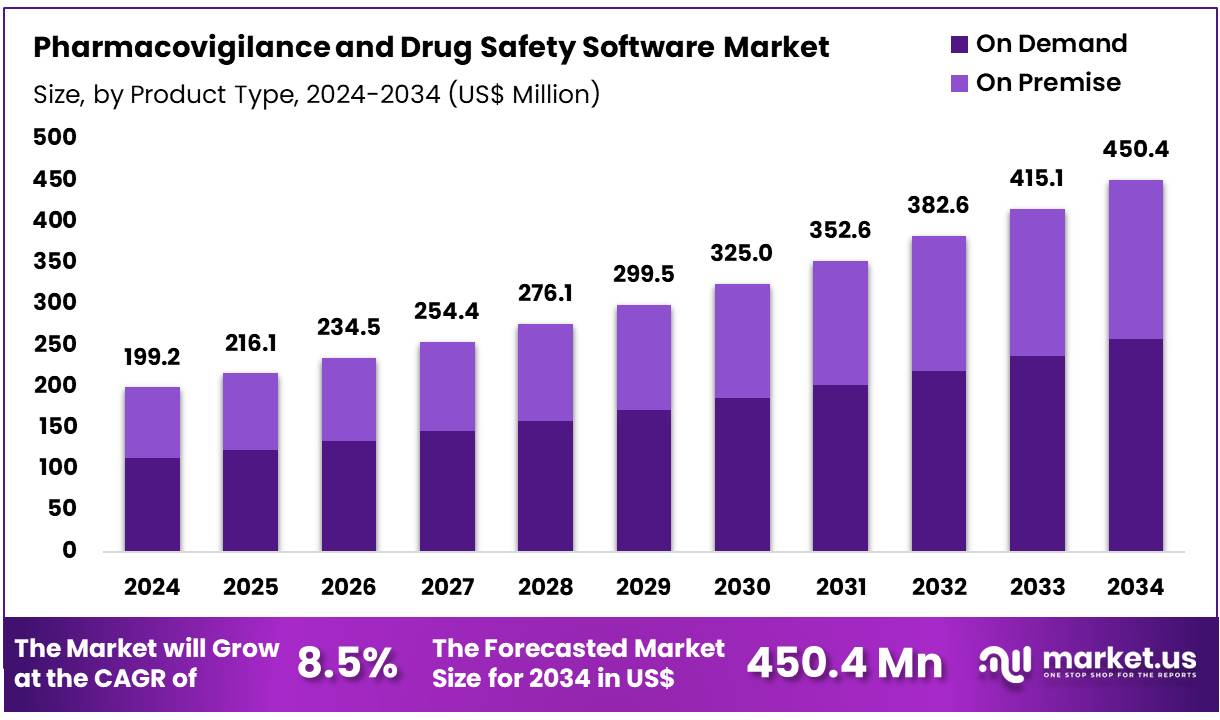
Global Pharmacovigilance and Drug Safety Software Market size is expected to be worth around US$ 450.4 Million by 2034 from US$ 199.2 Million in 2024, growing at a CAGR of 8.5% during the forecast period 2025 to 2034. In 2024, North America led the market, achieving over 36.5% share with a revenue of US$ 72.7 Million.
The pharmacovigilance and drug safety software market is becoming increasingly important as pharmaceutical companies, biotechnology firms, contract research organizations (CROs), and regulatory agencies strengthen their focus on drug safety monitoring and compliance.
Growing volumes of clinical and post-marketing safety data have created the need for advanced software platforms capable of identifying, evaluating, and reporting adverse drug reactions efficiently. The increasing adoption of cloud-based technologies, artificial intelligence, and automation is helping organizations streamline safety case processing, improve regulatory reporting accuracy, and reduce operational costs.
Global regulatory authorities continue to reinforce pharmacovigilance requirements to ensure patient safety. The U.S. Food and Drug Administration (FDA) emphasizes that post-marketing surveillance is essential because certain adverse reactions may only become apparent after medicines are used by larger and more diverse patient populations. The FDA’s pharmacovigilance framework relies on the FDA Adverse Event Reporting System (FAERS), post-marketing inspections, and active surveillance initiatives such as the Sentinel System to identify emerging safety signals and support timely regulatory actions.
The demand for drug safety software is also supported by the expanding volume of safety data handled by health authorities. According to the FDA, its Office of Surveillance and Epidemiology evaluates more than 2 million adverse event and medication error reports each year submitted through MedWatch, highlighting the growing need for automated pharmacovigilance solutions capable of managing large datasets and improving signal detection. Additionally, the FDA’s Sentinel System leverages real-world data from over 300 million people in the United States to strengthen active post-marketing safety surveillance and evidence generation.
Key Takeaways
- In 2024, the global pharmacovigilance and drug safety software market was valued at US$ 199.2 million and is projected to reach US$ 450.4 million by 2034, expanding at a CAGR of 8.5% during the forecast period.
- By deployment, the market is segmented into On-Premise and On-Demand solutions. The On-Demand segment dominated the market in 2024, accounting for 57.3% of the total market share.
- Based on application, the market comprises Case Data Collection & Management, Adverse Event Reporting & Analysis, and Signal Detection & Other Safety Risk Assessment. Among these, the Signal Detection & Other Safety Risk Assessment segment held the leading position with a 39.6% market share in 2024.
- By end user, the market is categorized into Healthcare Companies (Pharmaceuticals & Biotechnology Companies), CROs/BPOs or Pharmacovigilance Service Providers, and Others. The Pharmaceuticals & Biotechnology Companies segment emerged as the largest contributor, capturing 55.4% of the market revenue in 2024.
- North America remained the leading regional market in 2024, accounting for 36.5% of the global pharmacovigilance and drug safety software market.
Statistical Information
- The U.S. FDA’s Office of Surveillance and Epidemiology evaluates more than 2 million adverse event and medication error reports every year, demonstrating the growing volume of safety data that pharmacovigilance software must process for signal detection and regulatory compliance.
- The FDA Adverse Event Reporting System (FAERS) is updated quarterly and follows the internationally recognized ICH E2B data structure, enabling standardized electronic exchange of Individual Case Safety Reports (ICSRs) between pharmaceutical companies and regulators.
- The FDA is replacing multiple legacy reporting systems with the Adverse Event Monitoring System (AEMS), a unified platform that incorporates AI-based digitization, analytics, standardized reporting, and cross-product surveillance to improve pharmacovigilance operations.
- The European Medicines Agency (EMA) reported that more than 1.7 million adverse drug reaction (ADR) reports were submitted to EudraVigilance in 2025, demonstrating the continued expansion of global pharmacovigilance databases.
- According to EMA, 64% of all EudraVigilance reports in 2025 originated from outside the European Economic Area (EEA), reflecting increasing global participation in post-marketing drug safety monitoring.
- EMA reviewed 1,201 potential drug safety signals in 2025, with approximately 68% of these signals generated directly from EudraVigilance database monitoring, highlighting the importance of automated signal detection technologies.
- During 2025, the EMA’s Pharmacovigilance Risk Assessment Committee (PRAC) formally assessed 60 validated safety signals, supporting regulatory decisions such as updates to prescribing information and patient safety measures.
- The FDA requires pharmaceutical manufacturers to submit electronic Individual Case Safety Reports (ICSRs) for post-marketing adverse events, making digital pharmacovigilance platforms essential for regulatory compliance.
- The FDA’s new AEMS platform is designed to consolidate reporting for drugs, biologics, medical devices, food, cosmetics, tobacco products, and veterinary medicines into a single surveillance environment, increasing demand for integrated safety management technologies.
Regional Analysis
North America accounted for the largest share of the pharmacovigilance and drug safety software market in 2024, driven by a highly regulated pharmaceutical environment and advanced digital healthcare infrastructure. The U.S. Food and Drug Administration (FDA) requires pharmaceutical manufacturers to conduct continuous post-marketing safety surveillance and submit adverse event reports through its electronic reporting systems.
The FDA’s Office of Surveillance and Epidemiology reviews more than 2 million adverse event and medication error reports annually, reinforcing the need for advanced pharmacovigilance platforms that support signal detection, case management, regulatory compliance, and risk assessment. The FDA is also promoting AI-enabled safety monitoring and standardized electronic Individual Case Safety Report (ICSR) submissions, further accelerating software adoption across the region.
Asia Pacific is projected to register the fastest CAGR during the forecast period due to expanding pharmaceutical manufacturing, increasing clinical research activities, and stronger pharmacovigilance regulations across emerging economies. Governments and regulatory agencies are increasingly aligning with international pharmacovigilance standards to improve medicine safety.
The World Health Organization (WHO) continues to support countries in strengthening national pharmacovigilance systems through standardized reporting, signal detection, and safety monitoring frameworks, encouraging wider adoption of drug safety software throughout the region.
Emerging Trends
- AI is becoming a core part of pharmacovigilance workflows. The U.S. FDA launched its Emerging Drug Safety Technology Program (EDSTP) to evaluate artificial intelligence for case processing, signal detection, and safety surveillance. This reflects a major shift toward AI-assisted pharmacovigilance while maintaining regulatory oversight and human review.
- Electronic safety reporting standards are becoming mandatory. Starting October 1, 2026, the FDA requires post-marketing Individual Case Safety Reports (ICSRs) submitted through ESG NextGen to use the ICH E2B(R3) standard. This is accelerating software upgrades and cloud-based compliance platforms across pharmaceutical companies.
- European regulators are expanding AI adoption in medicine safety. In 2025, the EMA issued its first Qualification Opinion supporting an AI-assisted methodology in medicine development and is developing a regulatory AI roadmap with 10 guiding principles alongside the U.S. FDA for safe AI implementation.
- Unified safety monitoring platforms are replacing legacy systems. The FDA is introducing the Adverse Event Monitoring System (AEMS) to consolidate reporting for drugs, biologics, and combination products into a single digital environment, improving interoperability and supporting more efficient pharmacovigilance operations.
- Real-world health data is strengthening drug safety surveillance. The FDA continues to expand the Sentinel System, integrating electronic health record data and conducting numerous regulatory safety studies between 2022 and 2024, enabling faster identification of medicine safety concerns using real-world evidence.
Use Cases
- Automated adverse event case processing. Pharmaceutical companies use pharmacovigilance software to collect, validate, code, and submit Individual Case Safety Reports electronically using ICH-compliant formats. Automation reduces manual work, improves reporting quality, and helps organizations meet strict FDA reporting timelines.
- Continuous signal detection for medicine safety. Regulatory agencies monitor millions of safety records using advanced software to identify potential safety signals. In 2025, EMA’s reviewed safety signals originated from automated monitoring of the EudraVigilance database, demonstrating the value of digital signal detection.
- Risk-benefit assessment after product approval. Pharmacovigilance platforms help regulators and manufacturers continuously evaluate whether new adverse reactions change a medicine’s overall benefit-risk profile, supporting label updates, safety communications, and regulatory decisions throughout the product lifecycle.
- AI-assisted document review and safety analysis. The EMA has identified more than 150 AI use cases across medicine regulation, including pharmacovigilance applications such as duplicate case detection, literature screening, adverse drug reaction analysis, document summarization, and safety signal evaluation.
- Global regulatory compliance management. Modern pharmacovigilance software enables multinational pharmaceutical companies to manage safety reporting requirements across different regulatory authorities through standardized electronic submissions, centralized safety databases, audit trails, and automated compliance workflows that improve inspection readiness.
Conclusion
The pharmacovigilance and drug safety software market is poised for steady growth as pharmaceutical companies and regulatory authorities place greater emphasis on patient safety, real-time adverse event monitoring, and regulatory compliance. Increasing adoption of cloud platforms, artificial intelligence, and automated case management is improving the efficiency of pharmacovigilance operations while reducing manual workloads.
Regulatory initiatives from organizations such as the U.S. FDA and the European Medicines Agency continue to encourage standardized electronic reporting and advanced safety surveillance, creating long-term demand for modern software solutions. As drug development expands globally and post-marketing monitoring requirements become more stringent, pharmacovigilance software will remain a critical tool for ensuring medicine safety, operational efficiency, and compliance across the healthcare ecosystem.




















