


Overview
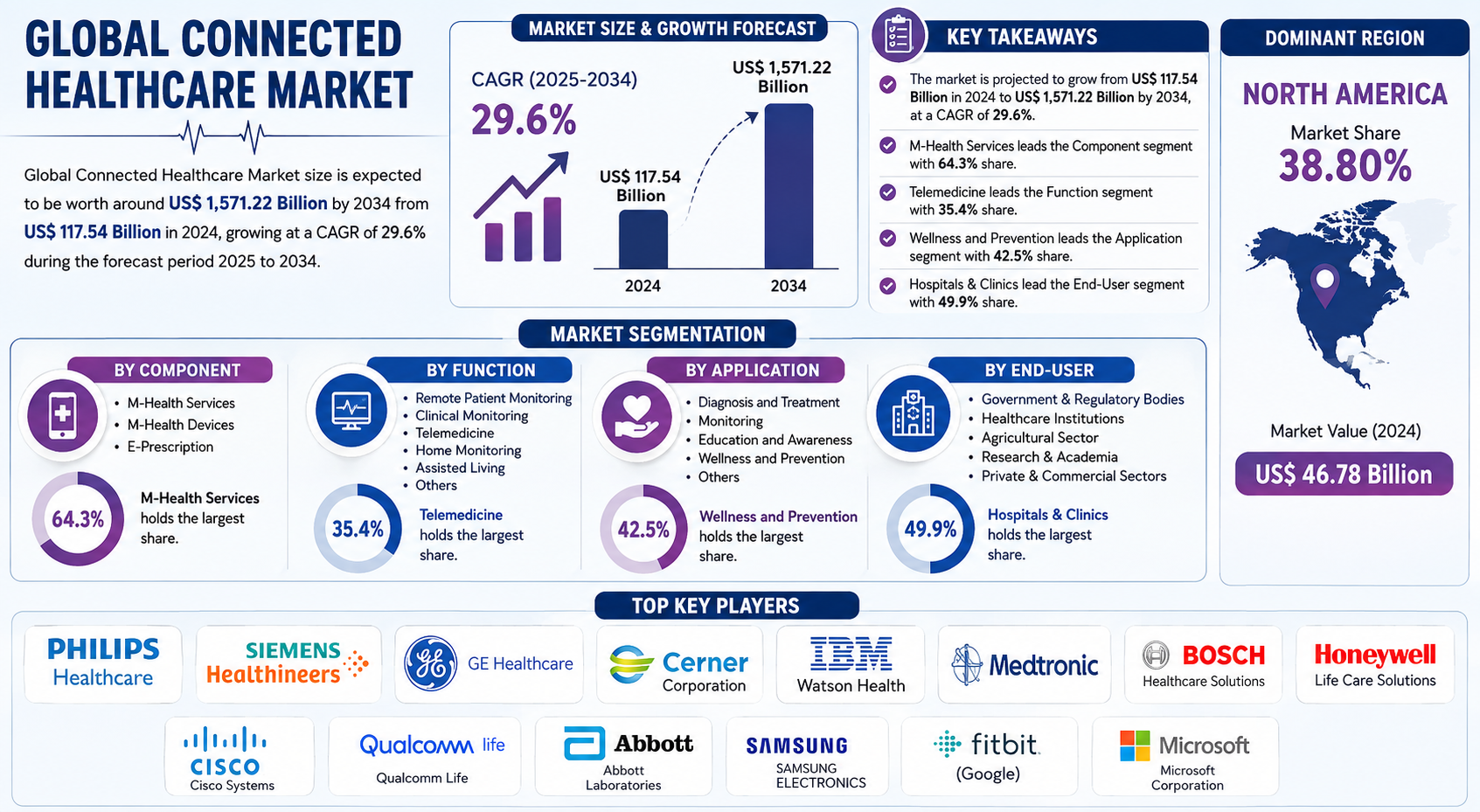
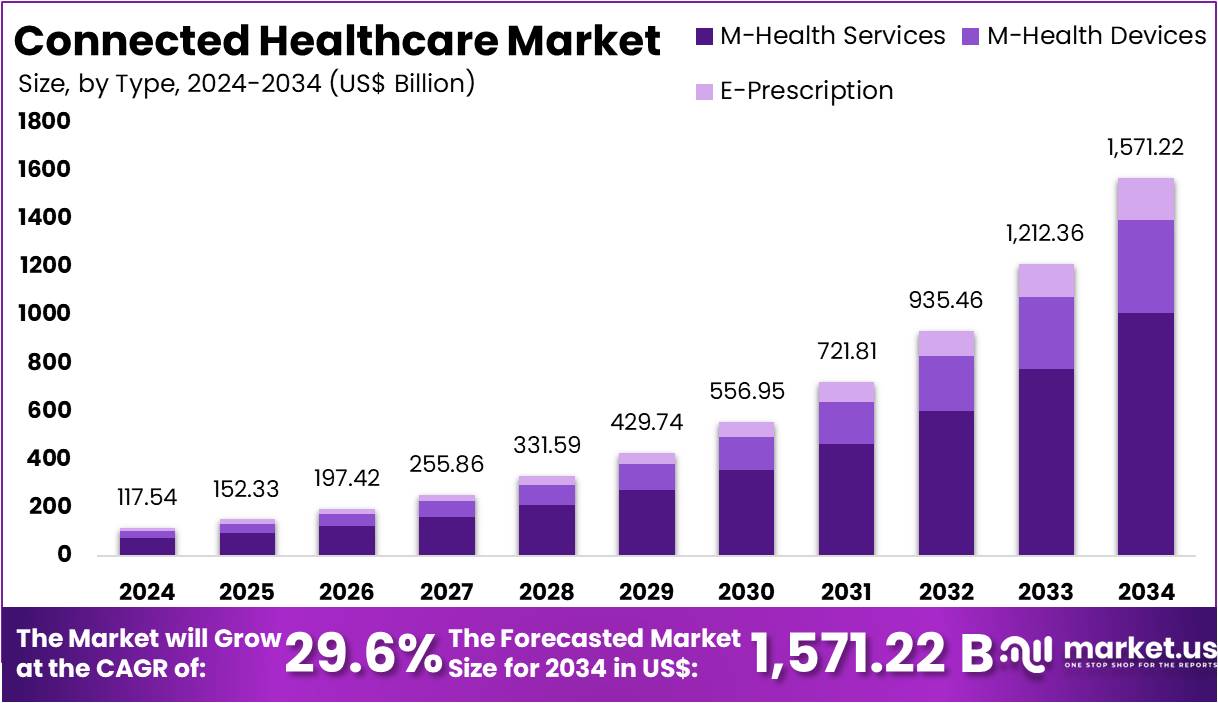
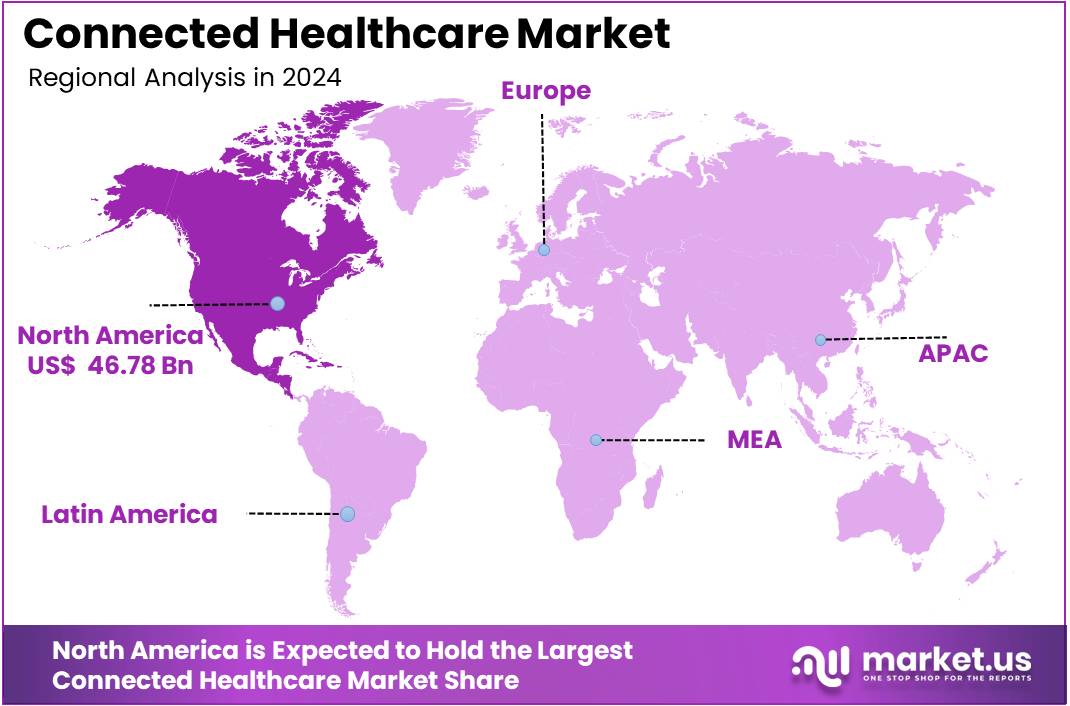
New York, NY – August 11, 2026 – The Connected Healthcare Market size is expected to be worth around US$ 1,571.22 Billion by 2034 from US$ 117.54 Billion in 2024, growing at a CAGR of 29.6% during the forecast period 2025 to 2034. North America held a dominant market position, capturing more than a 38.80% share and holds US$ 46.78 Billion market value for the year.
Connected healthcare is transforming healthcare delivery by linking patients, providers, medical devices, and digital health platforms through secure internet-based technologies. The growing use of electronic health records (EHRs), wearable devices, telehealth, remote patient monitoring (RPM), cloud computing, and artificial intelligence is enabling healthcare professionals to access real-time patient information, improve clinical decision-making, and provide continuous care beyond traditional hospital settings.
Governments and healthcare organizations are also strengthening interoperability standards to ensure that health information can be exchanged safely across different systems, improving care coordination and reducing administrative burden. According to the U.S. Centers for Medicare & Medicaid Services (CMS), remote patient monitoring uses internet-connected medical devices to automatically transmit health data such as blood pressure, glucose levels, and weight to healthcare providers, supporting both chronic and acute disease management. CMS also notes that eligible Medicare patients must use FDA-defined connected medical devices that transmit health data for at least 2 days every 30 days to qualify for coverage.
Furthermore, CMS continues to promote secure health information exchange through interoperability initiatives that improve patient access to electronic health records and encourage standardized application programming interfaces (APIs) across the healthcare ecosystem. As healthcare systems increasingly prioritize preventive care, home-based treatment, and digital connectivity, connected healthcare is expected to enhance patient outcomes, improve operational efficiency, and support more personalized, data-driven healthcare services worldwide.
Key Takeaways
- The Connected Healthcare market generated US$ 117.54 billion in revenue in 2024 and is projected to reach US$ 1,571.22 billion by 2034, expanding at a CAGR of 29.6% during the forecast period.
- Among components, M-Health Services dominated with a 64.3% market share, supported by their cost-effectiveness and the increasing use of smartphones for accessing healthcare services.
- By function, Telemedicine emerged as the leading segment, accounting for 35.4% of the market, driven by rising patient acceptance and the growing demand for virtual healthcare consultations.
- In terms of application, the Wellness and Prevention segment held the largest 42.5% market share, fueled by increasing health awareness and the widespread adoption of digital health technologies.
- By end user, Hospitals & Clinics led the market with a 49.9% revenue share, reflecting their extensive adoption of connected healthcare solutions for patient care and operational efficiency.
- North America remained the leading regional market, capturing 38.80% of the global Connected Healthcare market share in 2024.
Statistical Information
- 95.0% of U.S. office-based physicians had adopted an Electronic Health Record (EHR) system in 2024, while 83.6% were using a certified EHR, reflecting widespread digital healthcare adoption.
- In 2021, 37.0% of U.S. adults reported having at least one telemedicine visit with a healthcare professional during the previous 12 months.
- Among adults aged 65 years and older, 43.3% used telemedicine in 2021 the highest utilization rate among all adult age groups.
- 42.0% of women used telemedicine in 2021, compared with 31.7% of men, indicating higher digital healthcare engagement among female patients.
- Among adults aged 18–64 years, 35.3% completed a telemedicine visit in 2021. Usage reached 37.5% for people with private insurance and 39.3% for those covered by Medicaid or other public insurance.
- According to the CDC’s physician survey, 27.4% of medical specialists conducted 50% or more of their patient visits through telemedicine, demonstrating substantial integration of virtual care into specialist practice.
- Among primary care physicians, 53.9% reported using telemedicine for less than 25% of patient visits, while 14.7% conducted 50% or more of visits virtually, showing varied adoption across practices.
Market Segmentation Analysis
Type Analysis
The M-Health services segment dominated the connected healthcare market with a 64.3% share, driven by increasing smartphone use, expanding mobile health applications, and wider access to digital healthcare services. According to the World Health Organization, digital health technologies, including mobile health (mHealth), improve healthcare access, patient engagement, and continuity of care through secure digital platforms.
Growing adoption of wearable devices, e-prescriptions, and electronic health records is further supporting connected healthcare integration across hospitals, clinics, and home-based care.
Function Analysis
The Telemedicine segment accounted for 35.4% of the connected healthcare market, supported by rising demand for virtual consultations and remote patient care. The Centers for Medicare & Medicaid Services recognizes telehealth and remote patient monitoring as important tools for expanding healthcare access, particularly for chronic disease management and rural populations. Increasing use of connected monitoring devices, home healthcare solutions, and digital clinical services continues to improve patient outcomes while reducing unnecessary hospital visits.
Application Analysis
The Wellness and Prevention segment led the market with a 42.5% share, reflecting growing consumer focus on preventive healthcare and healthy lifestyles. The Centers for Disease Control and Prevention emphasizes that preventive care, health monitoring, and digital wellness initiatives help reduce chronic disease risks and improve long-term health outcomes. Rising adoption of wearable health devices, fitness applications, and connected monitoring platforms is encouraging individuals to actively manage their health through continuous digital engagement.
End-User Analysis
Hospitals and Clinics remained the largest end-user segment, accounting for 49.9% of the connected healthcare market as healthcare providers increasingly adopt digital technologies to improve patient care and operational efficiency. The Office of the National Coordinator for Health Information Technology supports nationwide adoption of interoperable electronic health records and secure health information exchange to strengthen care coordination. Growing investments in telehealth, remote monitoring, and connected clinical systems continue to accelerate digital transformation across healthcare facilities.
Regional Analysis
North America dominated the Connected Healthcare market with a 38.80% revenue share, supported by advanced healthcare infrastructure, widespread adoption of electronic health records (EHRs), telehealth, and remote patient monitoring technologies. The Centers for Medicare & Medicaid Services continues to promote interoperable digital health infrastructure, secure health information exchange, and patient access initiatives, strengthening connected healthcare adoption across the region.
Europe remained the second-largest regional market due to strong government support for digital health transformation, increasing telemedicine adoption, and expanding interoperability programs. The World Health Organization Regional Digital Health Action Plan (2023–2030) encourages member states to accelerate digital health implementation and improve healthcare delivery through connected technologies.
Asia-Pacific is expected to register the fastest growth, driven by increasing smartphone penetration, wearable device adoption, expanding internet connectivity, and government investments in digital healthcare. Meanwhile, Latin America and the Middle East & Africa are gradually adopting connected healthcare as digital infrastructure, healthcare investment, and awareness continue to improve.
Business Opportunities
The connected healthcare market offers significant business opportunities as healthcare providers increasingly invest in digital transformation, interoperability, and remote care. The growing adoption of electronic health records (EHRs), wearable medical devices, and telehealth platforms creates demand for secure data integration, cloud-based healthcare software, and AI-powered clinical decision support systems. The World Health Organization identifies digital health as a key enabler of universal health coverage, emphasizing interoperability, data sharing, and patient-centered healthcare delivery.
Healthcare technology companies can capitalize on expanding opportunities in remote patient monitoring, chronic disease management, home healthcare, and digital therapeutics. The U.S. Food and Drug Administration notes that digital health includes mobile health (mHealth), wearable devices, telemedicine, and software-based medical technologies, creating opportunities for innovative medical devices and connected care solutions.
Additionally, the Centers for Medicare & Medicaid Services continues to promote FHIR-based interoperability, secure health information exchange, and patient access initiatives, encouraging healthcare organizations to modernize digital infrastructure. These initiatives create opportunities for cybersecurity providers, health data analytics firms, API developers, and cloud service vendors while enabling technology companies to build scalable, compliant, and patient-centric connected healthcare ecosystems.
Emerging Trends
Interoperability is becoming a major connected healthcare trend as healthcare systems focus on seamless data exchange between providers, patients, and digital platforms. The CDC’s National Electronic Health Records Survey (NEHRS) tracks physician adoption of EHR systems and health information exchange, highlighting the growing importance of connected data networks for coordinated care delivery.
Healthcare organizations are increasingly investing in standardized digital health infrastructure. The CDC’s NEHRS program measures progress in electronic health record adoption and interoperability among U.S. office-based physicians, supporting the transition toward connected healthcare models where patient information can move securely across different healthcare settings.
Data exchange standards are creating new opportunities for connected healthcare solutions. Modern healthcare ecosystems are moving toward interoperable platforms that allow hospitals, clinics, and digital health applications to share information securely, improving care coordination, reducing duplication, and enabling more personalized healthcare services.
Connected healthcare platforms are shifting from isolated digital tools toward integrated healthcare networks. Government healthcare initiatives increasingly emphasize secure information sharing, patient data access, and interoperability frameworks to support more efficient and patient-centered healthcare delivery.
The demand for interoperable healthcare technology is creating opportunities for cloud platforms, health information exchange providers, cybersecurity companies, and API developers. As healthcare data volumes increase, secure connectivity between medical systems is becoming essential for improving clinical decision-making and operational efficiency.
Use Cases
Remote chronic disease management is expanding through connected devices that continuously monitor blood pressure, glucose levels, heart rhythm, and oxygen saturation, allowing clinicians to intervene earlier while reducing unnecessary hospital visits and improving long-term disease management.
Hospital-to-home care is becoming a major connected healthcare application. Digital monitoring systems enable healthcare providers to follow patients after discharge, improving recovery, medication adherence, and follow-up care while supporting value-based healthcare delivery models.
Connected healthcare supports public health surveillance. Modern interoperable systems enable healthcare organizations to securely transmit clinical information to public health authorities, helping detect outbreaks earlier and strengthening national emergency preparedness through real-time health data exchange.
Virtual specialty consultations are improving healthcare access. Connected telehealth platforms allow patients in underserved communities to receive consultations from specialists without traveling, reducing care delays while improving access to clinical expertise through secure digital communication.
Digital care coordination is improving clinical workflows. Connected healthcare platforms integrate electronic health records, laboratory data, imaging results, and clinical documentation into unified digital systems, enabling multidisciplinary care teams to make faster, more informed treatment decisions.
Recent Developments
- In June 2026, Philips partnered with Bajaj Integrated Health System (BIHS) to develop a digitally connected healthcare network using Philips IntelliBridge Enterprise technology. The collaboration aims to connect home, clinic, ambulatory, and hospital care settings through seamless health data exchange and improved patient care coordination.
- In April 2025, Teladoc Health completed the acquisition of UpLift for US$30 million, expanding its virtual mental health ecosystem. UpLift brought insurance-covered mental healthcare capabilities, relationships representing more than 100 million covered lives, and a network of over 1,500 mental health professionals.
- In April 2025, Siemens Healthineers and Tower Health launched a 10-year Value Partnership in the United States to modernize imaging infrastructure and digital healthcare workflows. The collaboration includes upgraded imaging systems, digital intelligence tools, automation solutions, and data-driven technologies supporting radiology, oncology, and cardiology services.
- In February 2025, Teladoc Health announced a definitive agreement to acquire Catapult Health, a virtual preventive care provider, to expand at-home diagnostic testing and strengthen integrated care capabilities. The acquisition supported Teladoc’s strategy to combine virtual care, preventive screening, and chronic disease management solutions across its healthcare platform.
Conclusion
The connected healthcare market is undergoing rapid transformation as healthcare providers increasingly adopt telemedicine, mHealth services, remote patient monitoring, wearable devices, cloud platforms, and interoperable digital systems. With the market projected to reach US$ 1,571.22 billion by 2034, strong growth will be supported by rising demand for preventive care, home-based treatment, and real-time health monitoring.
North America currently leads adoption, while Asia-Pacific is expected to record the fastest growth. Increasing investments in interoperability, AI, cybersecurity, and data analytics will further strengthen connected healthcare ecosystems. Overall, connected healthcare is expected to improve care accessibility, operational efficiency, patient outcomes, and personalized healthcare delivery worldwide.




















