


Overview
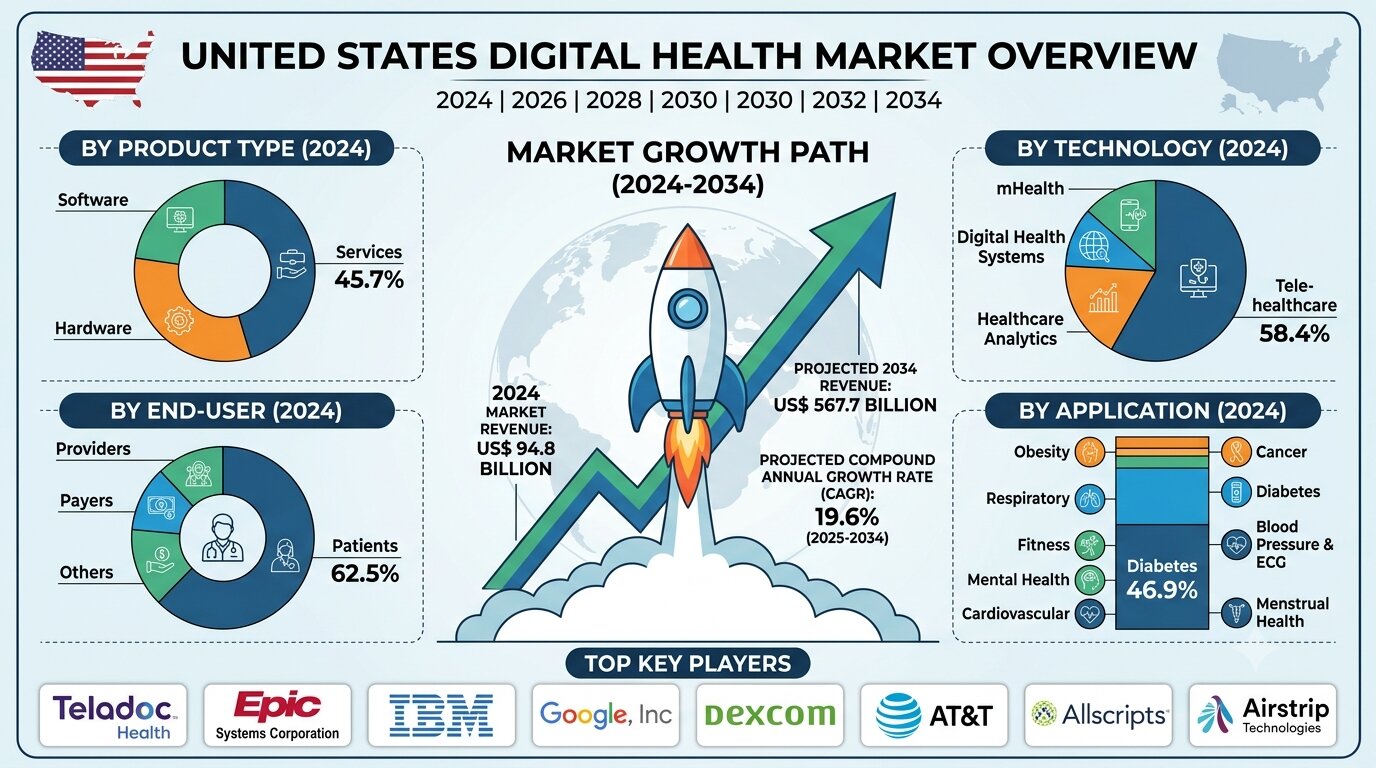
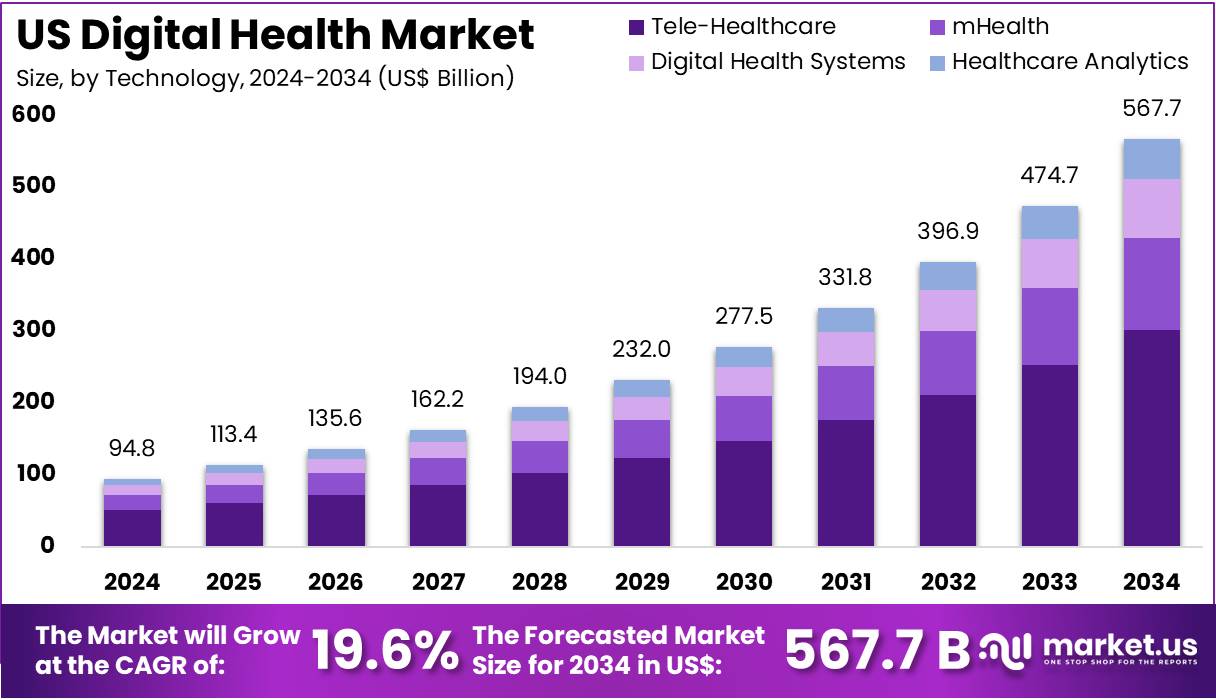
The US Digital Health Market Size is expected to be worth around US$ 567.7 Billion by 2034 from US$ 94.8 Billion in 2024, growing at a CAGR of 19.6% during the forecast period 2025 to 2034.
The U.S. digital health market is gaining momentum as healthcare providers, patients, and technology developers increasingly adopt connected tools for care delivery, health information access, remote monitoring, and clinical decision support. The U.S. Food and Drug Administration (FDA) defines digital health broadly to include mobile health, health information technology, wearable devices, telehealth, telemedicine, and personalized medicine. These technologies use computing platforms, connectivity, software, and sensors across healthcare and wellness applications.
Patient engagement is becoming an important component of this digital transformation. According to the Office of the National Coordinator for Health Information Technology (ONC), 65% of individuals in the U.S. accessed an online medical record or patient portal in 2024, up from 25% in 2014. App-based access to online medical records also reached 57% in 2024, compared with 38% in 2020, highlighting the growing role of smartphones in healthcare information access.
Regulatory activity is also supporting responsible digital health innovation. In 2025, the FDA issued guidance addressing artificial intelligence-enabled medical devices and launched the TEMPO pilot to evaluate digital health devices designed to improve outcomes for certain chronic conditions. These developments indicate continued opportunities for digital health platforms, connected devices, remote-care technologies, healthcare software, and AI-enabled solutions across the U.S. healthcare ecosystem.
Key Takeaways
- In 2024, the US digital health market generated revenue of US$ 94.8 billion, growing at a 19.6% CAGR. The market is projected to reach US$ 567.7 billion by 2034.
- By product type, the market is segmented into software, hardware, and services, with services dominating the segment. Services accounted for a 45.7% market share in 2024.
- Based on technology, the market includes tele-healthcare, mHealth, digital health systems, and healthcare analytics. Tele-healthcare led the segment with a significant 58.4% market share.
- By application, the market covers obesity, cancer, respiratory diseases, fitness, mental health management, diabetes, blood pressure & ECG monitoring, cardiovascular diseases, menstrual health, and others. Diabetes dominated with a 46.9% revenue share.
- By end user, the market is segmented into providers, payers, patients, and others. Patients held the leading position, accounting for a 62.5% revenue share.
Statistical Information
- 81% of physicians surveyed by the AMA reported using AI professionally in 2026, more than double the level recorded in the AMA’s initial 2023 survey. The leading applications include summarizing medical research, documenting visits, and creating discharge instructions, supporting opportunities for AI-enabled clinical workflow and decision-support solutions.
- 71.4% of U.S. physicians reported using telehealth in 2024, compared with 25.1% in 2018. The sustained adoption creates opportunities for virtual-care platforms, telehealth infrastructure, remote consultations, and technologies that integrate virtual services into existing provider workflows.
- 73.5% of physicians in hospital-owned practices used videoconferencing with patients in 2024, compared with 58.3% among physicians in private practices. The difference highlights opportunities for solutions designed specifically for smaller and independent practices seeking easier telehealth implementation.
- 67% of U.S. individuals managing a chronic condition accessed their patient portal or online medical records in 2024. This higher engagement among chronic-care populations supports opportunities for digital platforms focused on disease management, patient communication, medication support, and personalized health information.
- 76% of individuals with a recent cancer diagnosis accessed their patient portal or online medical records in 2024. The high level of engagement creates opportunities for digital solutions supporting oncology communication, care coordination, appointment management, treatment information, and caregiver participation.
- Medicare’s remote patient monitoring framework requires three core components: device setup and education, connected-device supply, and treatment management based on transmitted patient data. This creates business opportunities across hardware, onboarding, data platforms, monitoring services, and clinical-management solutions rather than hardware alone.
- CMS added three new remote therapeutic monitoring codes for 2026, 98979, 98984, and 98985. The expansion of reimbursable remote-care coding creates opportunities for companies developing digital therapeutic monitoring platforms and technologies that support virtual management of patients.
- The FDA selected Dexcom as the first participant in its 2026 TEMPO digital-health pilot. Its Glucose Health Program is being evaluated for applications involving real-time data, AI insights, metabolic monitoring, and tailored guidance, demonstrating a regulatory pathway for digitally enabled chronic-disease technologies.
- The FTC’s Health Breach Notification Rule requires notification within 60 calendar days for breaches involving 500 or more individuals. The rule also explicitly applies to many health apps and connected technologies outside HIPAA, creating demand for privacy, cybersecurity, breach-response, and compliance solutions.
- FTC penalties for violations of the Health Breach Notification Rule can reach $51,744 per violation. This creates a tangible commercial need for health-app developers and connected-device companies to strengthen privacy controls, data governance, security monitoring, and regulatory compliance.
Market Segmentation Analysis
Product Type Analysis
The services segment held the leading position in 2024, accounting for a 45.7% market share of the US digital health market. Its strong position reflects the growing need for implementation, integration, maintenance, training, technical support, and cybersecurity services associated with digital healthcare technologies. Healthcare providers increasingly require specialized expertise to connect digital platforms with existing clinical and administrative systems while maintaining efficient workflows.
The expansion of telehealth, remote patient monitoring, digital diagnostics, and healthcare software is further increasing demand for supporting services. In addition, growing concerns surrounding patient-data protection and regulatory compliance are creating opportunities for cybersecurity and managed services providers. As digital adoption expands, demand for reliable services is expected to remain strong.
Technology Analysis
Tele-healthcare accounted for a significant 58.4% share of the US digital health market, making it the leading technology segment. Its dominance is supported by increasing demand for convenient, flexible, and remotely accessible healthcare services. Tele-healthcare allows patients to consult healthcare professionals without requiring frequent in-person visits, improving access for individuals facing geographic or mobility-related barriers. Healthcare providers are also adopting virtual consultations and remote monitoring to improve care coordination and manage resources more efficiently.
Advances in video consultations, connected medical devices, digital communication platforms, and data security are strengthening the technology’s capabilities. Continued consumer acceptance, wider provider adoption, and the integration of remote monitoring technologies are expected to support further expansion of tele-healthcare across the US healthcare system.
Application Analysis
The diabetes segment accounted for a leading 46.9% revenue share of the US digital health market, reflecting the growing importance of technology-enabled diabetes management. Digital health solutions are increasingly being used to help patients monitor glucose levels, track nutrition, manage physical activity, and maintain medication routines. Mobile health applications, wearable devices, connected glucose monitors, and remote-care platforms can provide continuous access to health information and support more personalized disease management.
Integration of real-time patient data can also help healthcare professionals identify changes in health conditions and adjust care strategies more efficiently. As diabetes management becomes increasingly data-driven, the demand for digital tools that support monitoring, prevention, patient engagement, and personalized care is expected to remain strong in the US.
End-User Analysis
The patients segment dominated the US digital health market in 2024, representing a 62.5% revenue share. Its leading position reflects the increasing adoption of digital tools that enable individuals to take a more active role in managing their health. Patients are increasingly using mobile health applications, wearable devices, remote monitoring technologies, and telehealth platforms to track health indicators and communicate with healthcare professionals. These technologies provide convenient access to health information while supporting continuous monitoring beyond traditional clinical settings.
The growing emphasis on patient-centered care is also encouraging healthcare organizations to provide personalized digital services and connected care experiences. As consumers become more engaged in preventive care and self-management, patient demand is expected to remain a major driver of US digital health adoption.
Business Opportunities
The US digital health market offers strong opportunities for companies developing interoperable software, connected devices, telehealth platforms, and patient engagement solutions. The FDA recognizes digital health across areas including mobile health, wearable devices, telemedicine, health IT, artificial intelligence, and software-enabled medical technologies, creating opportunities for businesses that combine these capabilities into integrated healthcare solutions.
Interoperability is another important opportunity, as the Office of the National Coordinator for Health Information Technology continues advancing standards that enable secure exchange of electronic health information. Businesses can develop platforms that connect EHRs, applications, providers, patients, and healthcare networks while supporting standardized data exchange.
Remote monitoring and chronic disease management also offer attractive opportunities. The FDA’s TEMPO pilot is encouraging digital health technologies designed to support chronic disease care, creating opportunities for companies developing connected monitoring devices and digitally enabled care models.
Additional opportunities exist in AI-enabled clinical decision support, cybersecurity, digital clinical trials, and software that captures health data remotely. Recent FDA guidance and funding initiatives are further supporting innovation in these areas.
Emerging Trends
- AI Is Becoming More Diverse: AI adoption is expanding beyond a few basic tasks. AMA research shows physicians now use an average of 2.3 AI use cases, compared with 1.1 in 2023. This indicates digital health is moving toward broader, multi-purpose AI adoption across clinical and administrative workflows.
- Wearable Data Integration Is Gaining Attention: Healthcare organizations are increasingly exploring how smartwatch, fitness-tracker, and biosensor information can support patient care. Recent AMA research involving 2,222 physicians found strong interest in wearable health technologies, while workflow, reimbursement, and data infrastructure remain important barriers to wider clinical integration.
- Digital Health Is Becoming More Interoperable: Healthcare technology is moving toward easier connections between EHRs and third-party applications. ONC found that hospitals increasingly use APIs for clinical and administrative data exchange, including remote monitoring, telehealth, prior authorization, and quality reporting, supporting a more connected digital healthcare environment.
- Patient-Controlled Health Information Is Expanding: Patients are gaining more control over their healthcare information through apps and digital portals. ONC reports that 85% of hospitals enabled patients to electronically transmit health information in a structured format in 2024, supporting greater movement toward consumer-directed healthcare data management.
- AI Confidence Is Increasing Among Physicians: Physician confidence in healthcare AI is strengthening as practical applications become more familiar. AMA research found that more than three-quarters of physicians believe AI can improve patient care, while concerns remain around privacy and maintaining the physician-patient relationship.
Use Cases
- AI-Powered Patient Communication: AI is increasingly being applied to communication between healthcare providers and patients. AMA research found that 19% of physicians reported using AI to generate draft responses to patient portal messages in 2026. This creates opportunities for faster communication while keeping clinicians involved in final decisions.
- AI Translation in Healthcare: Language support is emerging as a practical digital-health application. 18% of physicians reported using AI for translation services in the AMA’s 2026 survey. This can help healthcare organizations improve communication with patients who have limited English proficiency and support more accessible digital and clinical services.
- AI-Assisted Diagnosis: AI is increasingly being explored as a clinical support tool rather than a replacement for physicians. AMA data shows 17% of physicians reported using AI for assistive diagnosis in 2026. This creates opportunities for tools that help clinicians identify patterns, review information, and support diagnostic decision-making.
- Digital Prior Authorization: Digital connectivity is increasingly being applied to administrative healthcare processes such as prior authorization. ONC found that hospitals exchange information with third-party technologies for administrative purposes, creating opportunities for automated workflows that connect clinical records, insurers, providers, and authorization platforms.
- AI-Enabled Chart Summarization: Healthcare providers are using AI to reduce the time required to review large volumes of clinical information. The AMA reported that 28% of physicians used AI to generate chart summaries in 2026. This supports use cases involving faster record review, clinical preparation, and information organization.
Recent Developments
- In June 2026, IBM announced plans to invest more than $10 billion in quantum computing over five years, covering R&D, manufacturing, M&A, and ecosystem expansion. The company specifically cited healthcare-related work with Cleveland Clinic and RIKEN on large-scale protein modeling.
- In May 2026, IBM, Cleveland Clinic, and RIKEN reported a simulation of a 12,635-atom protein, described as the largest known protein simulated with quantum computers. The work demonstrates potential applications of quantum-centric computing in biomedical research and complex molecular modeling.
- In December 2025, AT&T Business announced its collaboration with Sovato to support remote medical procedures through secure, reliable connectivity. Sovato’s platform is designed to enable healthcare organizations to conduct remote surgical, interventional, and diagnostic procedures, expanding access to specialized medical expertise.
- In October 2025, AirStrip Technologies secured a $50 million committed growth-credit facility from OrbiMed, alongside a preferred-stock investment. The financing is intended to accelerate AirStrip’s innovation and expansion in enterprise AI healthcare technology, remote patient monitoring, and clinical intelligence.
- In August 2025, IBM and AMD announced plans to develop quantum-centric supercomputing architectures, combining quantum computing with high-performance computing and AI accelerators. The collaboration targets demanding computational problems and strengthens IBM’s broader healthcare and life-sciences technology potential.
- In July 2025, Google Cloud and HCA Healthcare developed an AI-powered Nurse Handoff application designed to reduce the administrative workload associated with shift-to-shift patient handoffs. HCA operates 190 hospitals and approximately 2,400 ambulatory sites, giving the technology a significant U.S. healthcare deployment context.
- In April 2025, Teladoc Health completed its acquisition of UpLift for $30 million in cash, with up to $15 million in additional contingent earnout consideration. UpLift’s virtual mental-health services and health-plan relationships were incorporated into Teladoc’s BetterHelp business.
Conclusion
The US digital health market is entering a period of sustained transformation as healthcare providers, patients, technology companies, and regulators increasingly embrace connected and digitally enabled care. Rising adoption of telehealth, AI, remote monitoring, wearable technologies, interoperable platforms, and patient-focused applications is creating new opportunities across the healthcare ecosystem.
Services, tele-healthcare, diabetes management, and patient-focused solutions remain important areas of market activity, while cybersecurity and regulatory compliance are becoming increasingly critical. Continued investments, strategic partnerships, acquisitions, and technology development are expected to strengthen the digital health landscape. Overall, innovation, interoperability, personalized care, and AI-driven healthcare solutions will remain key factors shaping the US market.




















