Report Overview
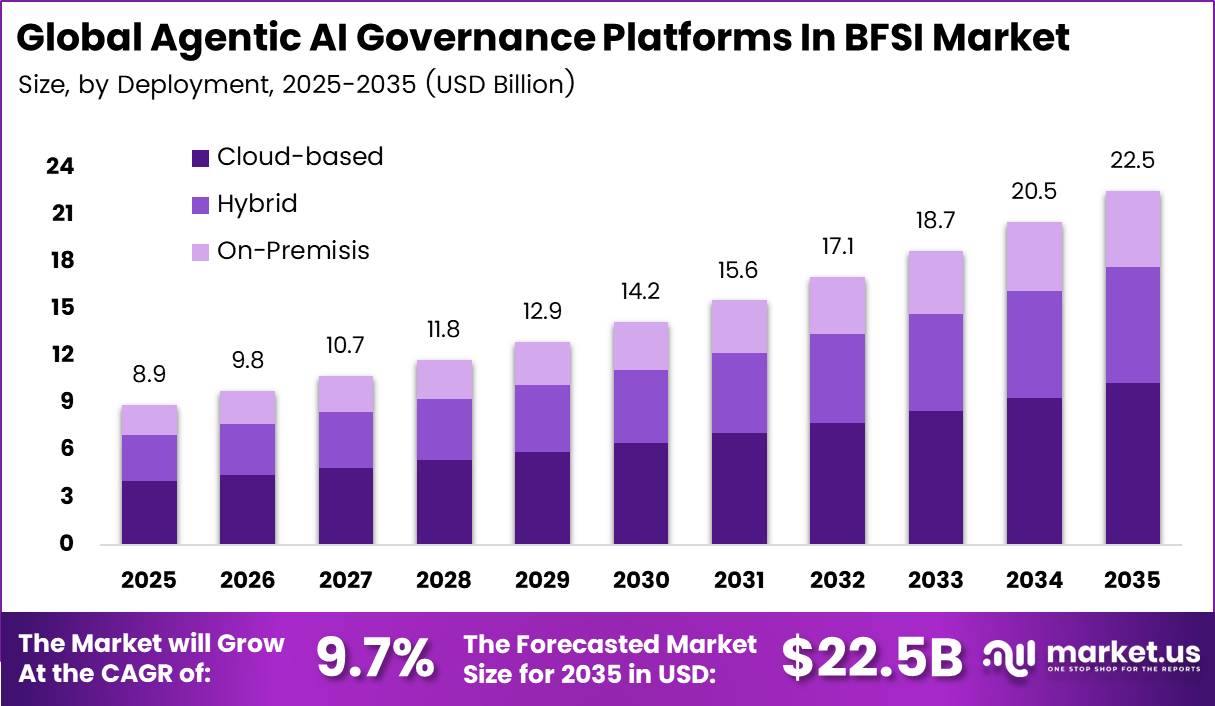
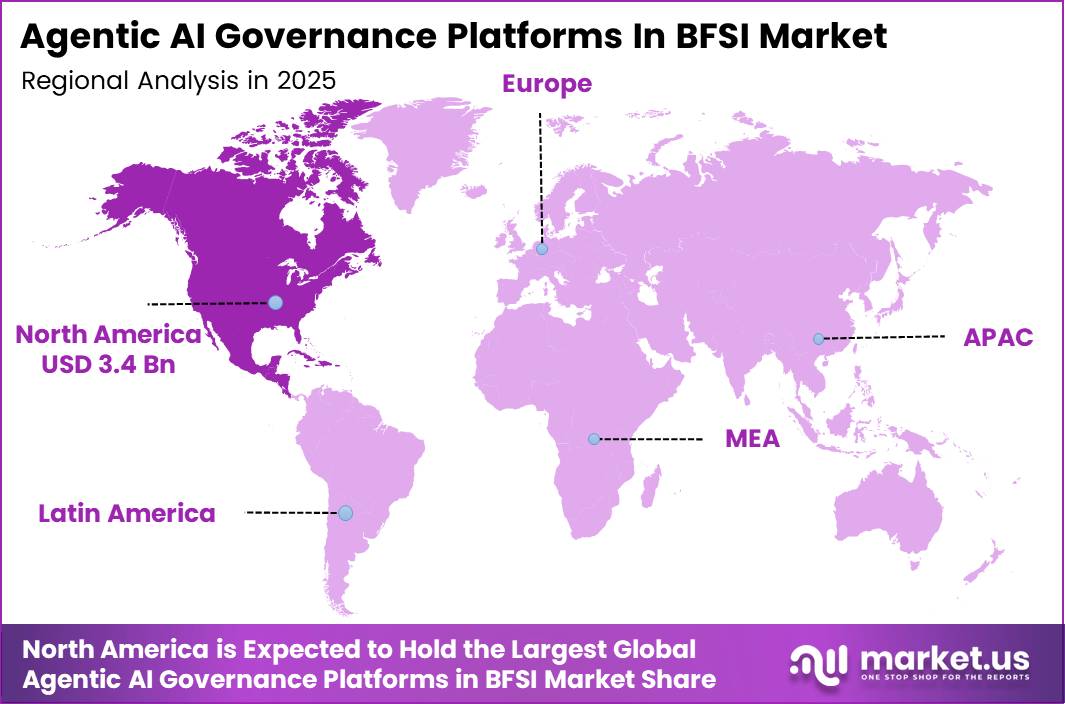
In 2025, the Global Agentic AI Governance Platforms In BFSI Market was valued at USD 8.9 billion. The market is projected to grow at a CAGR of 9.7% during 2026–2035, reaching approximately USD 22.5 billion by 2035. North America dominated the global market in 2025, accounting for more than 38.2% of the total market share and generating approximately USD 3.4 billion in revenue.
Financial inclusion provides a clear foundation for demand. According to the World Bank, global account ownership rose from 51% of adults in 2011 to 79% in 2024, giving banks and payment providers a broader customer base to serve, screen, and protect. The Bank of England and FCA reported that 75% of surveyed financial firms used AI in 2024.
The FDIC reported full-year 2025 net income of USD 295.6 billion across US insured banking institutions, up 10.2% from 2024. Strong earnings can support investment in software, specialist staff, and risk controls, while large financial groups need governance across business units rather than individual AI projects. This creates a plausible opportunity for shared inventories, approval workflows, and monitoring tools.
Key Takeaways
- The Agentic AI Governance Platforms In BFSI Market stood at USD 8.9 billion in 2025 and should reach USD 22.5 billion by 2035. grow at a 9.7% CAGR from 2026 to 2035.
- By offerings, Software/Platform leads with a 68.5% share.
- By deployment, Cloud-based leads with a 53.8% share.
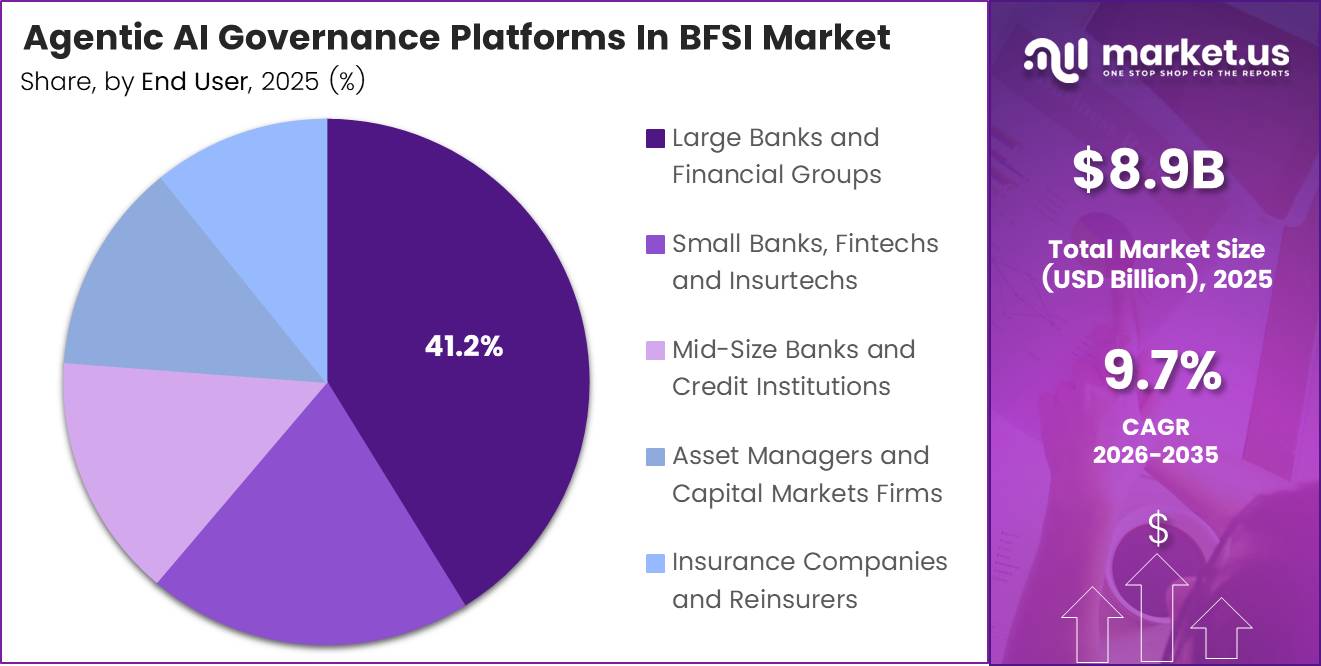
- By end-user industry, Large Banks and Financial Groups lead with a 41.2% share.
- By function, Regulatory Compliance and Control Mapping leads with a 19.4% share.
- North America leads with a 38.2% share and USD 3.4 billion in revenue.
By Offerings
Software/Platform dominates with 68.5% due to central control over all AI agents.
Software/Platform holds the largest share because banks need one central system to track, control, and record every AI agent they run. The Bank of England and FCA found that 84% of UK financial firms now name an accountable person for AI, and over half use nine or more governance components for AI use cases.
Teams cannot manage that many controls by spreadsheet, so they buy platforms that log decisions, set guardrails, and create audit trails. The same survey shows 55% of AI use cases include automated decision-making, which raises the need for always-on software checks.
Services, however, are growing fastest because many firms still struggle to understand the tools they deploy. The survey reports that 46% of respondents have only a partial grasp of the AI systems they use. This skills gap pushes banks to hire outside experts for setup, model reviews, and staff training.
By Deployment
Cloud-based dominates with 53.8% due to fast scaling without new hardware.
Cloud-based deployment leads because it lets banks add AI governance tools quickly without buying new servers. The European Banking Authority reports that 92% of EU banks now deploy AI, and most reach outside models through cloud APIs offered by large developers.
The EBA notes that EU banks often use between 1 and 3 deployment approaches, mixing cloud APIs with on-premises systems and in-house models. Around 40% of EU banks already use general-purpose AI, which often touches customer data that local rules require firms to protect. Hybrid platforms help firms apply one set of policies across both settings.
By End User Industry
Large Banks and Financial Groups dominate with 41.2% due to wide AI use under strict supervision.
Large Banks and Financial Groups hold the top share because they run AI across many business lines and face the closest watch from supervisors. The Financial Stability Board names four AI weaknesses that could raise system-wide risk, and model risk, data quality, and governance sit on that list.
They also rely on a small group of cloud and model vendors, which the FSB flags as a concentration risk that needs active vendor inventories. Small Banks, Fintechs and Insurtechs, on the other hand, form the fastest-growing group because their customer base keeps expanding online. The World Bank Global Findex 2025 shows that 79% of adults worldwide now hold an account, up from 74% in 2021.
Digital merchant payments climbed to 42% of adults in 2024, up from 35%. Fintechs capture much of this new traffic with ready-made AI agents for onboarding, lending, and claims. These lean firms lack large risk teams, so they adopt low-cost, plug-in governance tools to meet the same rules as larger rivals.
By Function
Regulatory Compliance and Control Mapping dominates with 19.4% due to high-risk rules under the EU AI Act.
Regulatory Compliance and Control Mapping leads because every AI agent in finance must link back to a rule, a control, and an owner. The EU AI Act lists credit scoring and creditworthiness checks under Annex III as high-risk uses, which triggers strict duties for documentation and human oversight. Banks need tools that map each agent to these duties and show proof during audits.
The FSB also finds that firms use AI mostly to improve internal operations and regulatory compliance, so this function sits close to daily work. Explainability and Transparency, meanwhile, show the fastest growth as lenders and insurers face pressure to explain each automated decision.
Key Market Segments
By Offerings
- Software/Platform
- Services
By Deployment
- Cloud-based
- Hybrid
- On-Premises
By End User Industry
- Large Banks and Financial Groups
- Small Banks, Fintechs and Insurtechs
- Mid-Size Banks and Credit Institutions
- Asset Managers and Capital Markets Firms
- Insurance Companies and Reinsurers
By Function
- Regulatory Compliance and Control Mapping
- Explainability and Transparency
- AI Inventory and Discovery
- Risk Classification and Tiering
- Model and Agent Lifecycle Management
- Policy Management and Policy-as-Code
- Model Risk Management and Validation
- Monitoring, Testing and Evaluation
- Bias, Fairness and Discrimination Management
- Privacy, Data Protection and Confidentiality
Geopolitical Impact Analysis
Trade fights over chips now raise the cost of the hardware that runs agentic AI governance. On January 14, 2026, the US used Section 232 of the Trade Expansion Act to place a 25% tariff on certain advanced computing chips and related products, effective January 15, 2026.
The tariff applies to all countries, and importers cannot claim duty drawback. Governance platforms keep monitoring, testing, and evaluation workloads running around the clock on GPU clusters. Higher chip import costs flow into cloud and on-premises hosting prices for vendors and bank buyers.
The rule exempts US data centers, startups, and R&D uses. That exemption favors cloud-based delivery and helps explain why Hybrid setups gain ground as banks split sensitive workloads between owned and rented compute. Commerce had to review data center chip imports by July 1, 2026, and a second phase of higher rates may follow.
Energy inputs face pressure too. On August 6, 2026, the US placed a 15% tariff and minimum import prices on polysilicon, a key input for the solar power that many data centers buy. Data sovereignty rules add another layer, since many countries require banks to keep model logs and customer data inside national borders. That pushes vendors to build regional hosting, which raises delivery costs.
Regional Analysis
North America dominates the Agentic AI Governance Platforms in the BFSI Market, holding a 38.2% share and generating USD 3.4 billion in revenue. The US drives most of this demand. Its largest banks run thousands of models, and they now add AI agents to lending, fraud, and customer service work.
US supervisors expect banks to keep a full model inventory, validate each model on its own, and report risks to the board. That puts AI Inventory and Discovery, Model Risk Management and Regulatory Compliance and Control Mapping on every large bank’s shopping list. The region also leads on supply. Vendors such as Fiddler AI, which reached USD 100 million in total funding in January 2026, sell directly into banks and insurers.
Asia Pacific shows rising demand as banks in Singapore, Japan, India and Australia expand AI use. Singapore’s central bank, MAS, published its FEAT principles on fairness, ethics, accountability and transparency in AI. India’s central bank, RBI, set up a framework for responsible AI in finance. China runs strict rules on algorithms and generative AI. These rules feed demand for Explainability and Transparency tools across the region.
Key Regions and Countries
North America
- US
- Canada
Europe
- Germany
- France
- The UK
- Spain
- Italy
- Rest of Europe
Asia Pacific
- China
- Japan
- South Korea
- India
- Australia
- Rest of APAC
Latin America
- Brazil
- Mexico
- Rest of Latin America
Middle East and Africa
- GCC
- South Africa
- Rest of MEA
Market Dynamics
Drivers
| Driver | (~) % Impact on CAGR Forecast | Geographic Relevance | Impact Timeline |
|---|---|---|---|
| Expansion of automated financial workflows | +0.55% | Global; strongest evidence in the UK | Short term (2 years or less) |
| Executive accountability for AI deployment | +0.35% | Global regulated financial institutions | Short term (2 years or less) |
| Fraud-response agent deployment | +0.25% | North America, Europe, Asia-Pacific | Short term (2 years or less) |
| Enterprise AI inventory consolidation | +0.25% | Global diversified BFSI groups | Medium term (2 to 4 years) |
| Customer-facing agent conduct oversight | +0.20% | Retail banking and insurance markets | Short term (2 years or less) |
Expansion of automated financial workflows
The root demand mechanism is the migration from advisory AI outputs to workflows that can initiate consequential financial actions. This increases demand for action logging, approval routing, and runtime intervention rather than periodic documentation alone.
According to the Bank of England’s 2024 financial-services survey, 75% of respondents already used AI. The FCA’s accompanying findings reported some automated decision-making in 55% of AI use cases but full autonomy in only 2%, indicating an existing control-intensive installed base rather than widespread autonomous banking.
Against the user-supplied 2026 baseline CAGR of 9.7%, the estimated +0.55 percentage-point contribution is an analyst sensitivity, not an institutional forecast. It reflects incremental conversion of those existing workflows into recurring governance subscriptions, supporting pricing by governed workflow and monitored execution rather than static model count.
Restraints
| Restraint | (~) % Impact on CAGR Forecast | Geographic Relevance | Impact Timeline |
|---|---|---|---|
| Uncleared critical ICT procurement gates | -0.35% | EU; international suppliers serving EU BFSI | Short term (2 years or less) |
| Insufficient lawful data-access permissions | -0.20% | Privacy-sensitive financial jurisdictions | Short term (2 years or less) |
| Unavailable approved deployment residency | -0.15% | Markets requiring local hosting | Medium term (2 to 4 years) |
| Insufficient minimum contract affordability | -0.10% | Small banks, insurers, credit cooperatives | Short term (2 years or less) |
| Incumbent contract exclusivity restrictions | -0.10% | Global institutions with bundled technology contracts | Medium term (2 to 4 years) |
Uncleared critical ICT procurement gates
The immediate sales barrier arises when a governance platform supporting a critical or important financial function cannot satisfy an institution’s required third-party due diligence and contractual controls. This is a blocked procurement decision, not a blanket prohibition on agentic AI.
The modeled -0.35 percentage-point drag against the supplied 9.7% baseline reflects a limited subset of purchases remaining uncleared until vendor evidence is sufficient. Commercially, implementation-ready contract packs and transparent subcontractor inventories protect conversion, while unresolved deficiencies strand presales expenditure and defer subscription revenue.
Challenges
| Challenge | (~) % CAGR Friction Drag | Geographic Relevance | Mitigation Horizon |
|---|---|---|---|
| Non-deterministic agent validation | -0.30% | Global; high-consequence financial workflows | Medium term (2 to 4 years) |
| Legacy transaction connector maintenance | -0.18% | Established banks and insurers globally | Medium term (2 to 4 years) |
| Governance engineering talent scarcity | -0.14% | Global; specialist financial technology teams | Medium term (2 to 4 years) |
| Runtime policy enforcement latency | -0.10% | Payments and capital-market workflows | Medium term (2 to 4 years) |
| Adversarial tool-input attack adaptation | -0.08% | Global externally connected agent deployments | Long term (4 years or more) |
Non-deterministic agent validation
The structural vulnerability is that an agent’s output, tool selection, and action sequence can change with context. This makes validation a continuing operational activity rather than a single release-stage test. The FSB’s 2024 assessment identifies limited explainability, opaque training data, and hallucinations as sources of model risk.
BIS’s 2025 synthesis likewise identifies validation and monitoring difficulties associated with opaque data and models. To illustrate the quantitative mechanism, an analyst-designed test matrix containing 10 tool configurations, 5 permission profiles, and 4 workflow states produces 200 combinations. Repeating each 3 times creates 600 evaluation runs before additional failure scenarios.
These figures represent a worked engineering example rather than institutional measurements. The estimated -0.30 percentage-point friction relative to the supplied 9.7% baseline captures continuing assurance effort without assuming sales stop. Providers need reusable test harnesses, risk-weighted sampling, and versioned execution traces to prevent implementation services from absorbing recurring software margins.
Opportunities
| Opportunity | (~) % Potential CAGR Upside | Geographic Relevance | Execution Window |
|---|---|---|---|
| Cross-institution agent authorization services | +0.40% | Global interbank and insurer-partner networks | Medium term (2 to 4 years) |
| Independent agent assurance certification | +0.25% | Global regulated financial ecosystems | Medium term (2 to 4 years) |
| Supervisory agent oversight workbenches | +0.20% | Central banks and financial supervisory authorities | Medium term (2 to 4 years) |
| Mutualized governance utilities | +0.15% | Cooperative banking and regional insurance networks | Long term (4 years or more) |
| Agent incident insurance analytics | +0.10% | Insurance and reinsurance underwriting hubs | Long term (4 years or more) |
Cross-institution agent authorization services
The untapped opportunity is a shared authorization layer for agents acting across independent financial institutions and commercial partners. This is distinct from the current driver of governing workflows inside an individual institution. NIST launched its AI Agent Standards Initiative on 17 February 2026, explicitly addressing interoperability, authentication, and identity infrastructure.
The estimated +0.40 percentage-point upside above the supplied 9.7% baseline is conditional on trusted counterparties adopting reusable credentials and delegated permissions. An analyst execution scenario assumes standardized onboarding reduces delivery effort per additional institutional connection by 15–25%, which could support gross-margin expansion of 2–4 percentage points if pricing and infrastructure costs remain broadly stable.
Key Players Analysis
The market has many players, and all of them are private, venture-backed firms. None publish revenue or R&D figures, so funding raised is the best public measure of size. Tier 1 leaders have the most capital and enterprise reach. Fiddler AI leads this group, having raised a USD 30 million Series C in January 2026, led by RPS Ventures, which brought its total funding to USD 100 million.
It plans to grow in regulated industries with an AI control plane for agents. Credo AI raised a USD 12.8 million Series A in 2022, followed by a Series B in July 2024 that brought its total to about USD 21 million. ModelOp raised a USD 10 million Series B from Baird Capital in August 2024, and in July 2025 it launched what it calls the first full toolset for governing agentic AI.
Tier 2 challengers hold strong niche or regional positions. ValidMind targets model risk management in banking and closed a USD 8.1 million seed round led by Point72 Ventures, bringing its total to USD 11.1 million. Monitaur, whose flagship customer is Progressive Insurance, raised a USD 6 million Series A in May 2024.
Trustible raised a USD 4.6 million seed round in June 2025, led by Lookout Ventures. Holistic AI and Saidot focus on EU AI Act compliance in Europe. Arthur AI, Asenion, and Truera compete in monitoring and evaluation.
Top Key Players in the Market
- Credo AI, Inc.
- ValidMind, Inc.
- Fiddler AI, Inc.
- Holistic AI Limited
- ModelOp, Inc.
- Monitaur, Inc.
- Asenion Inc.
- Arthur AI, Inc.
- Trustible, Inc.
- Aporia Technologies Ltd.
- Truera, Inc.
- Saidot Oy
Recent Developments
- In January 2026, Fiddler AI raised USD 30 million in Series C funding led by RPS Ventures, bringing its total funding to USD 100 million to build a control plane for AI agents.
- In June 2025, Trustible raised USD 4.6 million in Series Seed funding led by Lookout Ventures, with backing from the Office of Eric Schmidt, to grow its AI governance platform.
Report Scope
| Report Features | Description |
|---|---|
| Market Value (2025) | USD 8.9 billion |
| Forecast Revenue (2035) | USD 22.5 billion |
| CAGR (2026-2035) | 9.7% |
| Base Year for Estimation | 2025 |
| Historic Period | 2020-2024 |
| Forecast Period | 2026-2035 |
| Report Coverage | Revenue Forecast, Market Dynamics, Competitive Landscape, Recent Developments |
| Segments Covered | By Offerings (Software/Platform, Services); By Deployment (Cloud-based, Hybrid, On-Premisis); By End User Industry (Large Banks and Financial Groups, Small Banks, Fintechs and Insurtechs, Mid-Size Banks and Credit Institutions, Asset Managers and Capital Markets Firms, Insurance Companies and Reinsurers); By Function (Regulatory Compliance and Control Mapping, AI Inventory and Discovery, Risk Classification and Tiering, Model and Agent Lifecycle Management, Policy Management and Policy-as-Code, Model Risk Management and Validation, Monitoring, Testing and Evaluation, Bias, Fairness and Discrimination Management, Explainability and Transparency, Privacy, Data Protection and Confidentiality) |
| Regional Analysis | North America – US, Canada; Europe – Germany, France, The UK, Spain, Italy, Rest of Europe; Asia Pacific – China, Japan, South Korea, India, Australia, Singapore, Rest of APAC; Latin America – Brazil, Mexico, Rest of Latin America; Middle East & Africa – GCC, South Africa, Rest of MEA |
| Competitive Landscape | Credo AI, Inc., ValidMind, Inc., Fiddler AI, Inc., Holistic AI Limited, ModelOp, Inc., Monitaur, Inc., Asenion Inc., Arthur AI, Inc., Trustible, Inc., Aporia Technologies Ltd., Truera, Inc., Saidot Oy |
| Customization Scope | We will provide customization for segments and region/country levels. Additional customization can be done based on requirements. |
| Purchase Options | We have three licenses to opt for: Single User License, Multi-User License (Up to 5 Users), Corporate Use License (Unlimited Users and Printable PDF) |