Report Overview
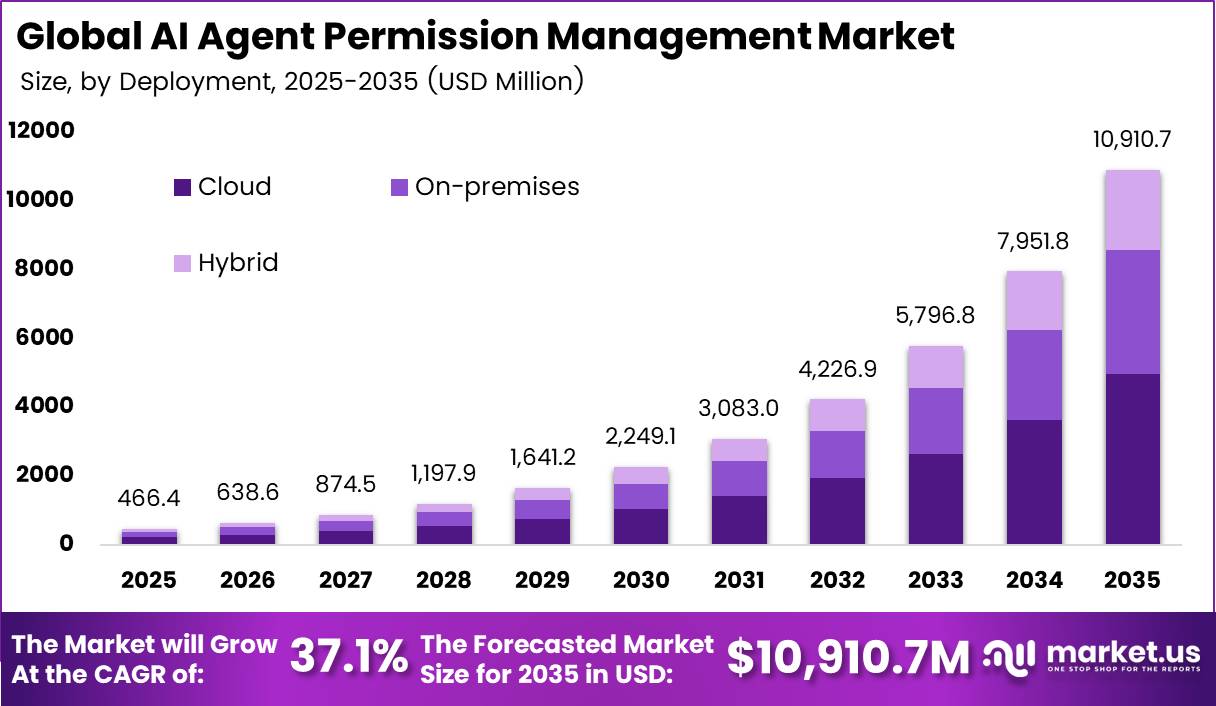
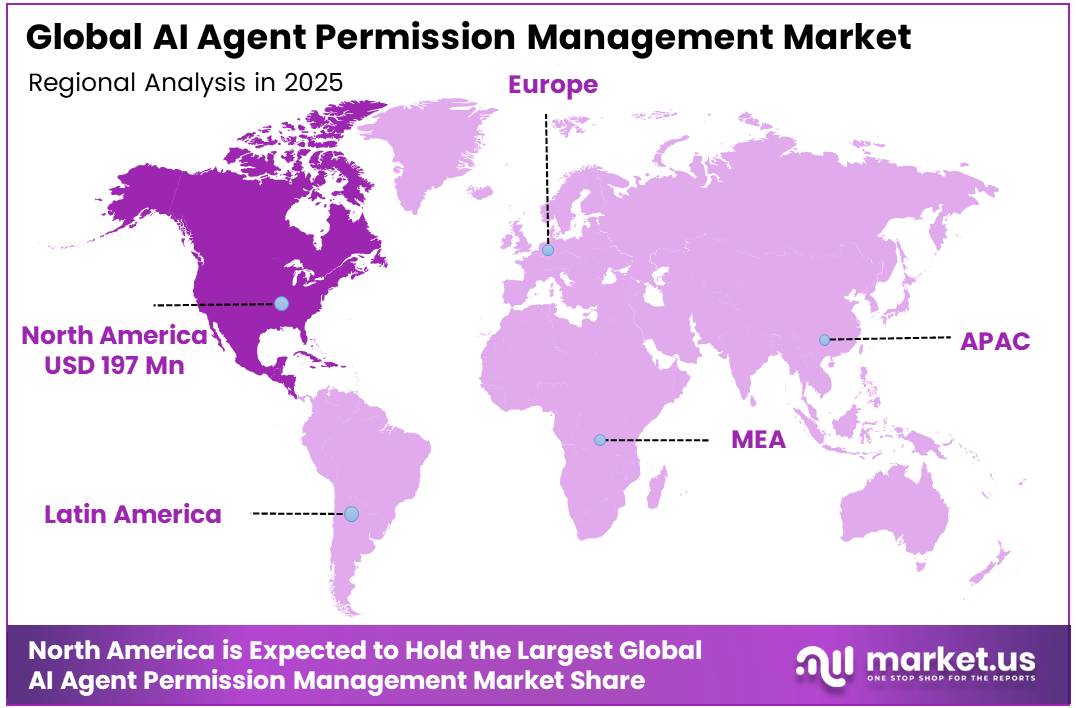
In 2025, the Global AI Agent Permission Management Market was valued at USD 466.4 million. The market is projected to grow at a CAGR of 37.1% during 2026–2035, reaching approximately USD 10,910.7 million by 2035. North America dominated the global market in 2025, accounting for more than 42.3% of the total market share and generating approximately USD 197.3 million in revenue.
A fast rise in AI workloads and digital users drives this growth. The ITU reported that 6 billion people used the Internet in 2025, up from 5.8 billion in 2024. That is 74% of the world’s people. More users mean more apps, APIs, and data that AI agents must reach on their behalf.
The IEA expects data centre power use to more than double, from about 415 TWh in 2024 to about 945 TWh by 2030, and it names AI as the main driver. Each new AI agent needs its own identity, scoped access rights, and an audit trail. Firms buy permission management tools to stop agents from reaching data or systems they should not touch.
North America region has a large base of enterprise AI users. The U.S. Census Bureau found that 37% of firms with at least 250 employees used AI in May 2026. AI use reached 39.7% in the Information sector and 33.9% in Finance and Insurance. These sectors hold sensitive customer and financial data, so they face strict access control rules. Big U.S. vendors also lead in agent identity tools, which keeps buying close to home.
Key Takeaways
- The Global AI Agent Permission Management Market reached USD 466.4 million in 2025 and will reach USD 10,910.7 million by 2035. at a CAGR of 37.1% from 2026 to 2035.
- By Offering, Agent identity platforms lead with a 24.0% share.
- By Deployment Mode, Cloud leads with a 56.0% share.
- By Organization Size, Large enterprises lead with a 70.0% share.
- By Application, Agent authentication and authorization lead with a 24.0% share.
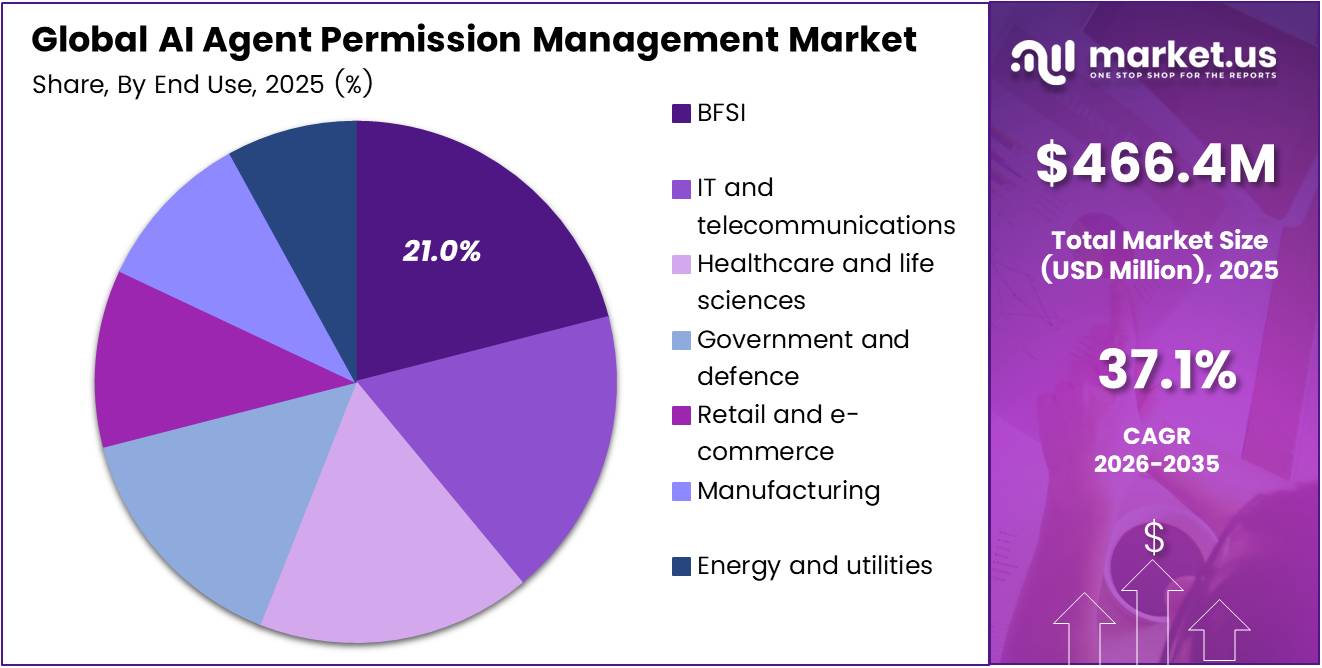
- By End-Use Industry, BFSI leads with a 21.0% share.
- North America leads with a 42.3% share and USD 197.3 million in revenue.
By Organization Size
Large enterprises dominate with 70.0% due to complex access needs across business systems.
Large enterprises lead the AI Agent Permission Management Market under the supplied share estimates because they manage broad networks of users, business systems, and sensitive records. As agents enter finance, sales, and support tasks, these companies need clear rules that control what each agent can read, change, or approve.
Eurostat reports that 55.03% of large EU enterprises used AI in 2025, compared with 17% of small enterprises and 30.36% of medium enterprises. These figures support a larger current customer base among major businesses, although they measure AI use rather than permission management spending.
By Application
Agent authentication and authorization dominates with 24.0% due to identity checks before sensitive system access.
Agent authentication and authorization holds the leading position in the supplied application split because businesses must verify an agent’s identity and check its rights before allowing access. These controls give other security functions a starting point: a company cannot safely manage data access or track actions without knowing which agent requested permission.
Microsoft’s 2025 Annual Report states that more than 230,000 organizations used Copilot Studio to extend Copilot or build their own agents. The report also lists more than 11,000 models in Azure AI Foundry, showing the broad range of AI tools that companies can bring into their operations. These figures indicate demand drivers, not direct measures of permission management sales.
By End-Use Industry
BFSI dominates with 21.0% due to sensitive transactions and strict access controls.
BFSI leads the supplied industry breakdown because banks, financial service firms, and insurers handle sensitive customer details and transactions that require careful access checks. AI agents can support account queries, fraud reviews, and internal tasks, but firms must limit their rights and maintain clear records of their actions.
The European Banking Authority reported in 2025 that 92% of EU banks deployed AI, while 55% of surveyed banks used general-purpose AI or agentic AI in consumer-facing processes. These adoption levels support the need for agent controls, although they do not establish permission management market shares.
Financial firms have strong reasons to invest in approval rules that stop agents from making unauthorized changes or exposing private records. IT and telecommunications offer a plausible fastest-growth pathway through wider AI use and frequent connections between software tools. Eurostat reports that 62.5% of EU information and communication enterprises used AI in 2025.
Key Market Segments
By Offering
- Agent identity platforms
- Authorization and policy management
- Identity governance and administration
- Privileged-access management
- Credential and secret management
- Audit, compliance, and monitoring services
By Deployment Mode
- Cloud
- On-premises
- Hybrid
By Organization Size
- Large enterprises
- Small and medium-sized enterprises
By Application
- Agent authentication and authorization
- API and tool-access management
- Data-access governance
- Privileged-access control
- Agent lifecycle and entitlement management
- Audit, compliance, and risk management
- Agentic workflow security
By End-Use Industry
- BFSI
- IT and telecommunications
- Healthcare and life sciences
- Government and defence
- Retail and e-commerce
- Manufacturing
- Energy and utilities
- Other
Geopolitical Impact Analysis
Trade tensions now shape the hardware that AI agents run on. The WTO reported that world goods trade grew 4.6% in 2025, and it set a baseline forecast of 1.9% for 2026. Tariffs, high energy prices, and choke points such as the Strait of Hormuz cause this slowdown. Permission platforms run on cloud servers, chips, and network gear, so supply pressure on these goods raises hosting costs for vendors.
AI hardware trade stays strong despite the strain. The WTO found that trade in AI-enabling goods rose 21.9% to US$4.18 trillion in 2025, from US$3.43 trillion in 2024. Most chips and data transmission equipment remain exempt from new tariffs. This exemption shields the data centre capacity that agent identity services need. In the first quarter of 2026, the value of this trade rose more than 40% year on year.
Trade rules have also become less open. The WTO reported that the share of world trade under most-favoured-nation terms fell from 80% in 2024 to about 72% in early 2026. Vendors face more country-specific rules and tariffs, which push them to build local data centres. Regional hosting raises costs, but it supports data residency rules that buyers in banking and government demand.
Shipping routes add further risk. UNCTAD found that rerouting ships around Africa adds about 12 days from Shanghai to Rotterdam, a roughly 30% rise in transit time. Delays slow server and hardware security module deliveries for on-premises and hybrid deployments. The WTO warns that a high energy price scenario from the Middle East war could cut 0.5 percentage points from 2026 trade growth.
Regional Analysis
North America dominates the AI Agent Permission Management Market, holding a 42.3% share and generating USD 197.3 million in revenue. The US drives most of this demand. Its firms deploy AI agents at scale across banking, software, and healthcare. A U.S. Census Bureau study found that 18% of firms used AI in a business function from November 2025 to January 2026.
Weighted by jobs, that share rises to 32%, which shows that large employers lead adoption. The Census Bureau expects firm-level use to reach 22% within six months. Each new deployment adds machine identities that need strict, least-privilege access.
Asia Pacific is the fastest-growing region in the AI Agent Permission Management Market. The region acts as the world hub for AI hardware. The WTO reports that Asia accounts for 62% of total AI-enabling goods trade. China, Japan, and South Korea build large AI and chip ecosystems that create many machine identities. India adds demand through its large IT services sector and fast digital payment growth.
Europe holds the second position, backed by strong digital use and strict data rules. The ITU reports that 88% to 93% of people in Europe, the CIS, and the Americas use the Internet. Germany, France, and the UK lead regional demand through banking, manufacturing, and public services. EU rules on data protection and AI push firms to prove who or what accessed data.
Key Regions and Countries
North America
- US
- Canada
Europe
- Germany
- France
- The UK
- Spain
- Italy
- Rest of Europe
Asia Pacific
- China
- Japan
- South Korea
- India
- Australia
- Rest of APAC
Latin America
- Brazil
- Mexico
- Rest of Latin America
Middle East and Africa
- GCC
- South Africa
- Rest of MEA
Market Dynamics
Drivers
| Driver | (~) % Impact on CAGR Forecast | Geographic Relevance | Impact Timeline |
|---|---|---|---|
| Autonomous workflow production deployment | +1.5% | Global; North America-led enterprise adoption | Short term (2 years or less) |
| Unsanctioned agent discovery demand | +1.0% | Global; decentralized enterprise environments | Short term (2 years or less) |
| Privileged service-account replacement | +0.8% | North America, Europe, developed Asia-Pacific | Medium term (2 to 4 years) |
| Agent ownership and offboarding requirements | +0.7% | Global; large enterprise buyers | Short term (2 years or less) |
| Internal audit evidence requirements | +0.6% | Global; regulated enterprises | Short term (2 years or less) |
| Business-unit agent chargeback adoption | +0.4% | North America, Europe, Asia-Pacific | Medium term (2 to 4 years) |
Autonomous workflow production deployment
According to Microsoft, autonomous-agent capabilities entered Copilot Studio public preview in November 2024, moving enterprise automation from user-prompted assistance toward independently executed workflows.
IBM’s 2025 breach study found that 13% of studied organizations reported breaches involving AI models or applications, and 97% of that subset lacked proper AI access controls. These figures describe a breached-organization sample, not enterprise-wide adoption or agent-specific incidence.
The commercial mechanism is recurring authorization demand as production agents perform actions. This supports subscriptions priced on governed identities and protected workflows rather than one-time implementation fees. The table’s +1.5-percentage-point contribution is an analyst scenario assumption, not a Microsoft or IBM forecast.
Across all tables, percentages are incremental percentage-point sensitivities around the user-supplied 37.1% baseline: drivers total +5.0 points, restraints -3.4 points, challenges -2.6 points, and conditional opportunities +3.0 points. Applying everything simultaneously gives 39.1%, while the positive-only and negative-only bounds are 45.1% and 31.1%, which are not independently validated forecasts.
Restraints
| Restraint | (~) % Impact on CAGR Forecast | Geographic Relevance | Impact Timeline |
|---|---|---|---|
| Native-platform substitution of standalone purchases | -1.2% | Global; cloud-concentrated enterprise buyers | Short term (2 years or less) |
| Denied production access for external enforcement | -0.7% | Global; security-sensitive enterprises | Short term (2 years or less) |
| Minimum contract commitments exceeding buyer budgets | -0.5% | Global; small and midsized organizations | Short term (2 years or less) |
| Closed application authorization interfaces | -0.4% | Global; proprietary application estates | Medium term (2 to 4 years) |
| Unavailable customer-required deployment configurations | -0.3% | Europe, Middle East, public-sector markets | Medium term (2 to 4 years) |
| Procurement exclusion of unqualified suppliers | -0.3% | Global; financial services and government | Short term (2 years or less) |
Native-platform substitution of standalone purchases
Native identity capabilities can remove a separate purchasing decision rather than merely delay implementation: Microsoft states that Entra Agent ID capabilities are included for agents managed through Agent 365, creating direct substitution pressure on standalone products offering equivalent controls.
Google Cloud’s May 2026 announcement states that agent identities are integrated into IAM and that agent-specific allow and deny policies are generally available, further reducing the need for an additional single-platform permission layer. The assigned -1.2-percentage-point drag is an analyst sensitivity estimate, not a measured cancellation rate or a forecast from these companies.
Challenges
| Challenge | (~) % CAGR Friction Drag | Geographic Relevance | Mitigation Horizon |
|---|---|---|---|
| Prompt-induced authorization context drift | -0.8% | Global; externally informed agent workflows | Medium term (2 to 4 years) |
| Fine-grained policy translation complexity | -0.5% | Global; heterogeneous application environments | Medium term (2 to 4 years) |
| Runtime authorization latency overhead | -0.4% | Global; high-frequency agent workflows | Short term (2 years or less) |
| Specialist identity engineering scarcity | -0.4% | North America, Europe, India | Medium term (2 to 4 years) |
| Delegation-chain attribution ambiguity | -0.3% | Global; multi-agent enterprise systems | Medium term (2 to 4 years) |
| Revocation propagation consistency gaps | -0.2% | Global; distributed agent infrastructure | Long term (4 years or more) |
Prompt-induced authorization context drift
The structural vulnerability is that an agent can retain valid credentials while untrusted content redirects its intended action: OWASP’s 2025 prompt-injection guidance identifies unauthorized access and manipulated tool behavior as potential consequences, making authentication alone insufficient.
OWASP’s separate system-prompt-leakage guidance states that privilege separation and authorization boundary checks must not be delegated to the language model, supporting deterministic enforcement outside the model. For planning, an explicitly analyst-designed workflow with 10 tool actions and 2 external authorization evaluations per action generates 20 policy evaluations; this is an illustration, not an institutional benchmark.
The assigned -0.8-percentage-point friction reflects additional validation, regression testing, and exception handling rather than an assumed cessation of sales. Vendors must invest in action-level permission checks, adversarial testing, and controlled escalation, accepting higher engineering expenditure to preserve reliable recurring deployments.
Opportunities
| Opportunity | (~) % Potential CAGR Upside | Geographic Relevance | Execution Window |
|---|---|---|---|
| Cross-enterprise agent permission clearinghouses | +0.9% | Global; intercompany commercial networks | Long term (4 years or more) |
| Managed permission services for smaller businesses | +0.6% | Global; underserved smaller enterprises | Medium term (2 to 4 years) |
| Industrial edge authorization appliances | +0.5% | Europe, North America, East Asia | Long term (4 years or more) |
| Insurance-linked permission assurance services | +0.4% | North America, Europe | Medium term (2 to 4 years) |
| Consumer personal-agent consent wallets | +0.3% | North America, Europe, developed Asia-Pacific | Long term (4 years or more) |
| Permission infrastructure acquisition roll-ups | +0.3% | Global; fragmented specialist supplier base | Medium term (2 to 4 years) |
Cross-enterprise agent permission clearinghouses
The white space is a shared commercial permission service between independent organizations, distinct from today’s internal enterprise identity deployments, the Model Context Protocol introduced provides standardized connections between AI systems and external tools and data, but that connectivity announcement does not establish a commercial cross-enterprise authorization clearinghouse.
Conditional analyst estimates assume reusable counterparty onboarding and shared policy infrastructure could reduce authorization administration cost per governed intercompany workflow by 10%–15% and improve supplier gross margins by 2–3 percentage points relative to bespoke delivery; neither range is reported by those institutions.
Monetization could combine counterparty subscriptions with usage-based permission services, capturing adjacent demand from supplier, distributor, and service-provider interactions. The assigned +0.9-percentage-point upside remains contingent on counterparty acceptance, enforceable contractual responsibilities, and repeatable integration economics, making it future potential rather than an active baseline driver.
Key Players Analysis
Tier 1 leaders compete through large platform deals. Palo Alto Networks closed its CyberArk deal in February 2026 for about $25 billion, the largest deal in security history. CyberArk shareholders received $45.00 in cash plus 2.2 Palo Alto shares per share. The deal makes privileged-access management a core part of the Palo Alto platform.
Microsoft made Entra Agent ID generally available, giving each AI agent its own identity, access policy, and audit trail. ServiceNow built an identity stack through two deals. It closed its Veza purchase, valued at over $1 billion. In April 2026, it closed the Armis deal for about $7.75 billion in cash. ServiceNow expects the pair to more than triple its addressable market for security and risk.
Tier 2 challengers hold strong niche positions. Okta posted fiscal 2026 revenue of $2.919 billion, up 12%, and spent about $639 million on R&D. SailPoint posted fiscal 2026 revenue of $1.071 billion, up 24%, with ARR of $1.125 billion. It spent $223.0 million on R&D, and its SaaS ARR grew 38%.
Other players add capacity through deals. CrowdStrike agreed to buy SGNL for about $740 million and reported total consideration of $637.1 million at closing. Cisco bought Astrix Security for about $400 million to add non-human identity security to Cisco Identity Intelligence.
Top Key Players in the Market
- Microsoft Corporation
- Okta, Inc.
- CyberArk / Palo Alto Networks
- SailPoint, Inc.
- IBM Corporation
- Amazon Web Services, Inc.
- Google LLC / Google Cloud
- Ping Identity Corporation
- Cisco Systems, Inc. / Astrix Security
- CrowdStrike Holdings, Inc.
- ServiceNow, Inc. / Veza
- Saviynt, Inc.
- Aembit, Inc.
- Ory Corp.
- Delinea, Inc.
Recent Developments
- In December 2025, ServiceNow signed a deal to buy Veza, an AI-native identity security firm, for over $1 billion to govern AI agent permissions inside its AI Control Tower. ServiceNow completed its purchase of Armis for about $7.75 billion in cash, joining it with Veza to map human, machine, and AI identities.
- In January 2026, CrowdStrike agreed to buy SGNL, a continuous identity firm, in a deal valued at about $740 million, paid mostly in cash. Palo Alto Networks completed its about $25 billion purchase of CyberArk after clearances in the US, EU, UK, and Israel.
- In June 2026, Cisco completed its purchase of Astrix Security, a non-human identity security firm, at a reported price of about $400 million.
Report Scope
| Report Features | Description |
|---|---|
| Market Value (2025) | USD 466.4 Million |
| Forecast Revenue (2035) | USD 10,910.7 Million |
| CAGR (2026-2035) | 37.1% |
| Base Year for Estimation | 2025 |
| Historic Period | 2020-2024 |
| Forecast Period | 2026-2035 |
| Report Coverage | Revenue Forecast, Market Dynamics, Competitive Landscape, Recent Developments |
| Segments Covered | By Offering (Agent Identity Platforms, Authorization and Policy Management, Identity Governance and Administration, Privileged-Access Management, Credential and Secret Management, Audit, Compliance, and Monitoring Services); By Deployment Mode (Cloud, On-premises, Hybrid); By Organization Size (Large Enterprises, Small and Medium-sized Enterprises); By Application (Agent Authentication and Authorization, API and Tool-Access Management, Data-Access Governance, Privileged-Access Control, Agent Lifecycle and Entitlement Management, Audit, Compliance, and Risk Management, Agentic Workflow Security); By End-Use Industry (BFSI, IT and Telecommunications, Healthcare and Life Sciences, Government and Defence, Retail and E-commerce, Manufacturing, Energy and Utilities, Other) |
| Regional Analysis | North America: US, Canada; Europe: Germany, France, The UK, Spain, Italy, Rest of Europe; Asia Pacific: China, Japan, South Korea, India, Australia, Singapore, Rest of APAC; Latin America: Brazil, Mexico, Rest of Latin America; Middle East & Africa: GCC, South Africa, Rest of MEA |
| Competitive Landscape | Microsoft Corporation, Okta, Inc., CyberArk / Palo Alto Networks, SailPoint, Inc., IBM Corporation, Amazon Web Services, Inc., Google LLC / Google Cloud, Ping Identity Corporation, Cisco Systems, Inc. / Astrix Security, CrowdStrike Holdings, Inc., ServiceNow, Inc. / Veza, Saviynt, Inc., Aembit, Inc., Ory Corp., Delinea, Inc. |
| Customization Scope | We will provide customization for segments and region/country levels. Moreover, additional customization can be done based on the requirements. |
| Purchase Options | We have three licenses to opt for: Single User License, Multi-User License (Up to 5 Users), Corporate Use License (Unlimited Users and Printable PDF) |