


Report Overview
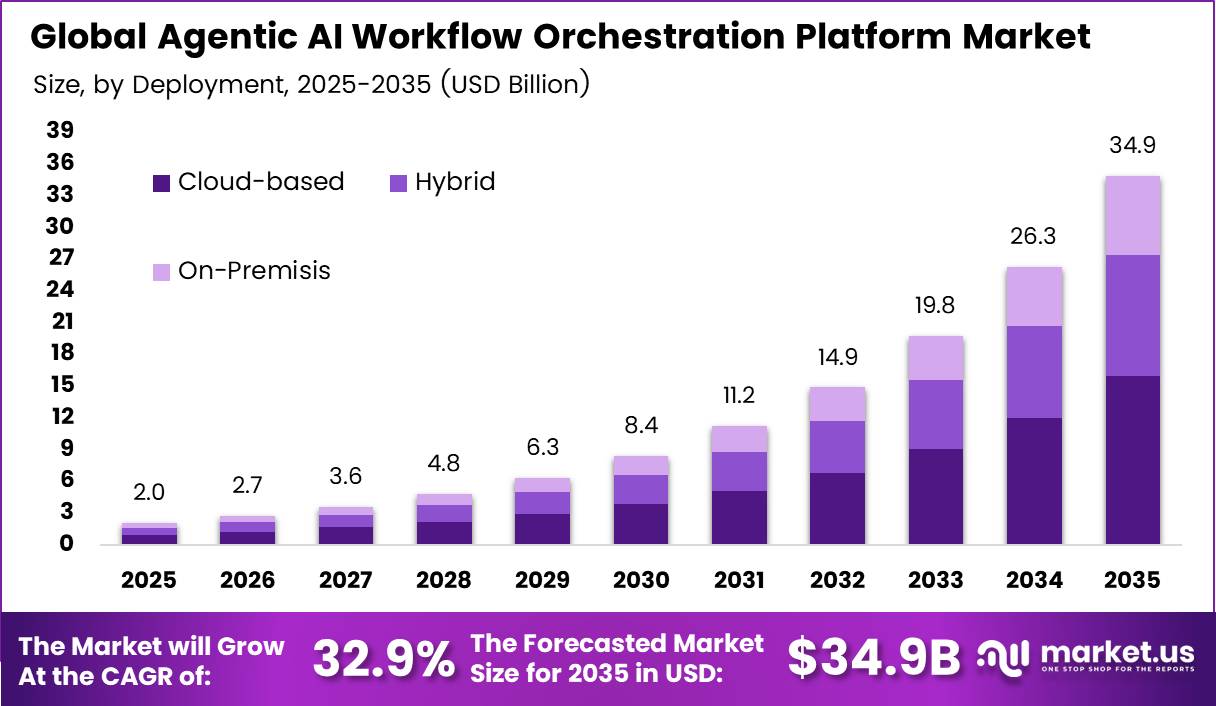
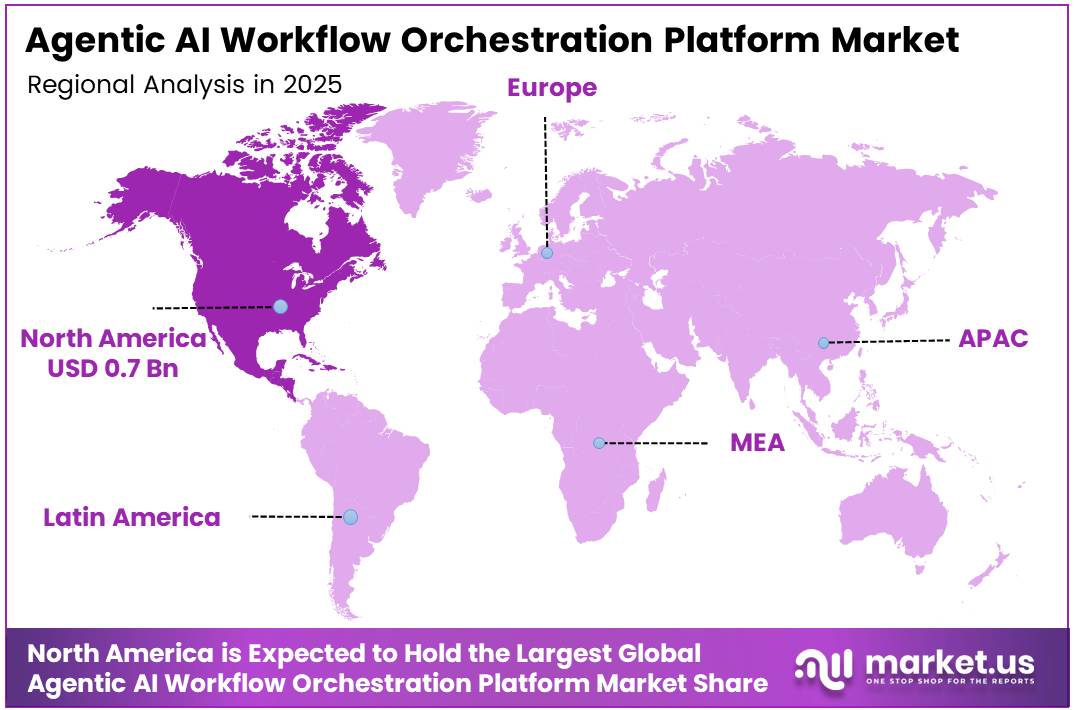
In 2025, the Global Agentic AI Workflow Orchestration Platform Market was valued at USD 2.0 billion. The market is projected to grow at a CAGR of 32.9% during 2026–2035, reaching approximately USD 34.9 billion by 2035. North America dominated the global market in 2025, accounting for more than 36.5% of the total market share and generating approximately USD 0.7 billion in revenue.
The main driver is fast AI adoption inside companies. The OECD reported that 20.2% of firms used AI in 2025. That figure was 14.2% in 2024 and 8.7% in 2023, so adoption more than doubled in two years. The ICT sector leads, with almost 45% of ICT firms using AI in 2024.
Large firms also move faster. The OECD found that 40% of firms with 250 or more staff used AI, while only 11.9% of small firms did. As firms move from single AI tools to many connected agents, they need platforms that route tasks, manage handoffs, and enforce controls.
North America region holds most of the world’s AI computing base. The IEA reported that the United States accounted for about 45% of global data centre electricity use in 2024. US software firms also set the pace for enterprise buyers. ServiceNow reported about 1,000 AI customers and more than USD 200 million in annual contract value for its Pro Plus AI tier.
Key Takeaways
- The Agentic AI Workflow Orchestration Platform Market was worth USD 2.0 billion in 2025 and should reach USD 34.9 billion by 2035. at a CAGR of 32.9% from 2026 to 2035.
- Agent Orchestration Platforms lead the Component segment with a 42.3% share.
- Cloud-based deployment leads the Deployment segment with a 74.8% share.
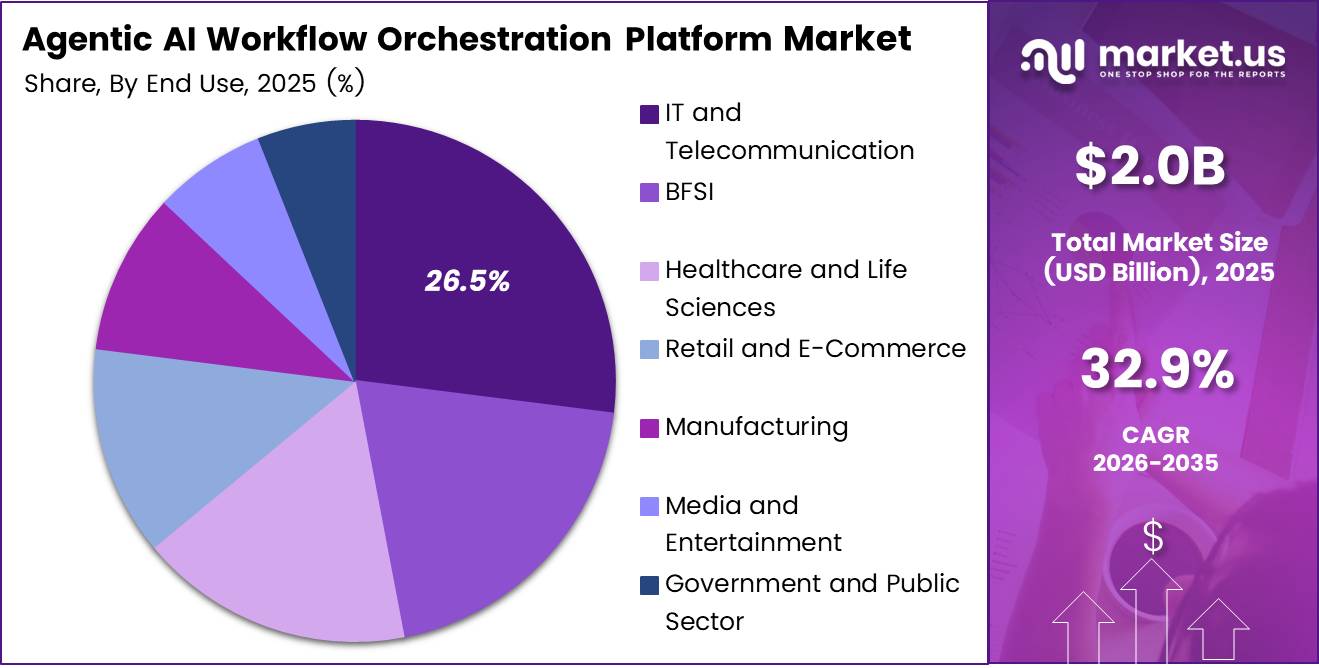
- IT and Telecommunications lead the End User Industry segment with a 26.5% share.
- North America leads with a 36.5% share and USD 0.7 billion in revenue.
By Component
Agent Orchestration Platforms dominate with 42.3% due to central control of multi-agent workflows.
Agent Orchestration Platforms lead because large firms need one control layer to plan, route, and track work across many AI agents. Salesforce shows how quickly buyers are moving to this model. The company reported Agentforce annual recurring revenue of $800 million in FY2026, up 169% year over year.
It has also closed more than 29,000 Agentforce deals since launch. Buyers often pick these platforms first because they plug into the CRM, ticketing, and data systems they already run. The EU AI Act allows fines of up to €35 million or 7% of global yearly turnover for banned AI practices. In the US, NIST’s AI Risk Management Framework tells firms how to map, measure, and manage AI risk.
By Deployment
Cloud-based dominates with 74.8% due to elastic compute for heavy AI workloads.
Cloud-based deployment holds the largest share because AI agents need a lot of on-demand computing power, and few firms can build that themselves. Microsoft reported that Azure revenue passed $100 billion for the first time in fiscal 2026. Azure and other cloud services grew 43% in the June quarter.
Hybrid deployment is growing fastest because firms want the speed of the cloud but must keep some data on their own systems. Banks, hospitals, and public agencies hold records that privacy laws protect. Under the EU GDPR, regulators can fine firms up to €20 million or 4% of global annual turnover for serious violations.
By End User Industry
IT and Telecommunications dominate with 26.5% due to early in-house automation of IT operations.
IT and Telecommunications lead because tech teams were the first to use AI agents on their own work, such as sorting support tickets, reviewing code, and checking networks. These firms already run cloud-native systems, so they can connect agents with little rework. Microsoft reported that Microsoft 365 Copilot passed 30 million paid seats.
Healthcare and Life Sciences is growing fastest as hospitals and drug makers connect their AI tools into shared workflows. The US FDA says it has authorized more than 1,600 AI-enabled medical devices as of September 2026. A study of the FDA’s list found 331 authorizations in 2025 alone, the most of any year on record.
Key Market Segments
By Component
- Agent Orchestration Platforms
- Agent Development and Runtime Frameworks
- Observability, Testing and Governance Platforms
- Professional and Managed Services
By Deployment
- Cloud-based
- Hybrid
- On-Premises
By End User Industry
- IT and Telecommunication
- BFSI
- Healthcare and Life Sciences
- Retail and E-Commerce
- Manufacturing
- Media and Entertainment
- Government and Public Sector
- Other
Geopolitical Impact Analysis
Agentic orchestration is software, but it runs on GPUs, servers, networking gear, and power. Trade friction hits all four. In April 2025, the United States set a baseline tariff of 10% on most imports, with much higher rates on Chinese goods for part of the year. The US also opened a Section 232 review of semiconductor imports.
Prices for these metals jumped sharply in Western markets after the controls began. The WTO cut its early 2025 forecast for world merchandise trade volume to minus 0.2% before raising it later in the year, as firms rushed shipments ahead of tariffs. That stop-and-start pattern made data centre buildouts harder to plan.
Shipping risk adds more pressure. UNCTAD reported that ships rerouting around the Cape of Good Hope to avoid the Red Sea add about 10 to 14 days per trip between Asia and Europe. That delays deliveries of servers and cooling units. Power is the next constraint.
The IEA expects data centre electricity demand to more than double to about 945 TWh by 2030, so energy price shocks from regional conflicts flow straight into cloud bills. Vendors pass these costs on through higher per-agent and per-token pricing. Buyers in regulated sectors respond by choosing hybrid setups that keep sensitive workloads on local or sovereign infrastructure.
Regional Analysis
North America dominates the Agentic AI Workflow Orchestration Platform Market, holding a 36.5% share and generating USD 0.7 billion in revenue. US hyperscalers keep adding AI capacity, which lowers latency and cost for agent workloads.
Banks, insurers, and telecom operators in the US run some of the biggest pilots that move into production. They use agents for claims, onboarding, fraud checks, and network operations. Federal policy also supports adoption. The US government’s AI Action Plan of July 2025 pushes agencies to adopt AI and speed up data centre permits. Buyers in the region also have a strong talent pool.
Asia Pacific is the fastest-growing region in this market. China, Japan, South Korea and India drive this growth. India has a deep IT services workforce that builds and runs agent systems for global clients. The IndiaAI Mission committed more than INR 10,000 crore to compute and models. Japan uses agents to offset labour shortages in an ageing workforce.
Key Regions and Countries
North America
- US
- Canada
Europe
- Germany
- France
- The UK
- Spain
- Italy
- Rest of Europe
Asia Pacific
- China
- Japan
- South Korea
- India
- Australia
- Rest of APAC
Latin America
- Brazil
- Mexico
- Rest of Latin America
Middle East and Africa
- GCC
- South Africa
- Rest of MEA
Market Dynamics
Drivers
| Driver | (~) % Impact on CAGR Forecast | Geographic Relevance | Impact Timeline |
|---|---|---|---|
| Enterprise Shift from Copilots to Autonomous Multi-Agent Workflows | +4.1% | North America, Western Europe | Short term (2 years or less) |
| Falling LLM Inference Cost per Token | +3.2% | Global | Short term (2 years or less) |
| Standardization of Agent Interoperability Protocols | +2.4% | Global | Medium term (2 to 4 years) |
| Hyperscaler Agent Runtime and Marketplace Bundling | +2.0% | North America, Asia Pacific | Short term (2 years or less) |
| Back-Office Labor Cost Pressure in Shared Services | +1.6% | India, Philippines, Eastern Europe | Medium term (2 to 4 years) |
| Embedded Agents in ERP, CRM & ITSM Suites | +1.4% | North America, Europe | Short term (2 years or less) |
Enterprise Shift from Copilots to Autonomous Multi-Agent Workflows
Company earnings calls from large SaaS providers showed this shift: Salesforce introduced consumption-priced autonomous agents in October 2024 at about $2 per conversation, and ServiceNow and Microsoft added agent-orchestration layers to their platform roadmaps over the following 12 months.
On the mechanics, per U.S. Bureau of Labor Statistics occupational wage data, a fully loaded Tier-1 support or accounts-payable task can cost $4 to $9 per transaction. Orchestrated agents can bring that down to roughly $0.50 to $1.50, a cost cut of 70% to 85%. That gap is large enough to pull budget from BPO contracts rather than from IT budgets alone.
Per OECD digital-adoption surveys, the share of large firms using AI rose sharply through 2025, which adds to the pool of buyers ready to move beyond single-agent pilots. This lifts net revenue retention for orchestration vendors toward 120% to 130%. It also lowers customer acquisition cost, because expansion now comes from more workflows inside existing accounts rather than from new logos. That combination adds about 4.1 percentage points on top of the 32.9% baseline.
Restraints
| Restraint | (~) % Impact on CAGR Forecast | Geographic Relevance | Impact Timeline |
|---|---|---|---|
| EU AI Act High-Risk Compliance Obligations | -2.6% | European Union | Short term (2 years or less) |
| GPU Compute Scarcity and Rationed Inference Capacity | -1.9% | Global | Short term (2 years or less) |
| Data Localization and Cross-Border Transfer Bans | -1.5% | China, India, Middle East | Medium term (2 to 4 years) |
| Sector Prohibitions on Autonomous Decisioning | -1.2% | North America, Europe | Short term (2 years or less) |
| Advanced Semiconductor Export Controls | -0.9% | China, Restricted Jurisdictions | Medium term (2 to 4 years) |
EU AI Act High-Risk Compliance Obligations
The root cause is Regulation (EU) 2024/1689. Per the Official Journal of the European Union, it has entered into force. Penalties can reach €35 million or 7% of global turnover. The bottleneck is concrete. European Commission impact-assessment estimates put compliance cost per high-risk system at roughly €6,000 to €7,500 for the quality management system alone, before third-party audits.
Per European Banking Authority supervisory observations, deployment cycles in regulated workflows can stretch by 6 to 9 months. The strategic impact is that EU buyers freeze or narrow procurement until compliant tooling is proven.
Vendors absorb 3 to 5 points of gross-margin compression from building governance features, while EU-headquartered enterprises push back CapEx on agentic programs into the 2027 budget cycle. Together, these effects take about 2.6 percentage points off the baseline.
Challenges
| Challenge | (~) % CAGR Friction Drag | Geographic Relevance | Mitigation Horizon |
|---|---|---|---|
| Agent Reliability and Hallucination Cascades | -1.8% | Global | Medium term (2 to 4 years) |
| Agentic AI Engineering Talent Deficit | -1.4% | North America, Europe, India | Medium term (2 to 4 years) |
| Prompt Injection Security Exposure | -1.2% | Global | Short term (2 years or less) |
| Legacy System Integration Debt | -1.0% | Europe, Japan, North America | Long term (4 years or more) |
| Unpredictable Consumption Cost Overruns | -0.7% | Global | Short term (2 years or less) |
Agent Reliability and Hallucination Cascades
The structural weakness is that errors compound. In a multi-step agent chain, overall reliability is the product of the reliability of each step. As a worked example, a workflow of 10 chained steps, each 95% accurate, finishes correctly only about 60% of the time.
Per published academic agent benchmarks such as those hosted by Stanford HAI and Carnegie Mellon University, leading agents complete well under 50% of realistic multi-application enterprise tasks on their own.
The friction appears as human-in-the-loop overhead. Exception-handling queues can claw back 20% to 35% of the projected labor savings, and pilot-to-production conversion stays limited, often described in CIO disclosures on company earnings calls as below one-third of pilots. Sales keep moving because buyers still deploy agents in bounded workflows.
The long-term corporate adjustments required are investment in evaluation harnesses, deterministic guardrail layers, step-level observability, and outcome-based SLAs. Vendors will also have to commit 15% to 20% of R&D budgets to reliability engineering rather than new features.
Opportunities
| Opportunity | (~) % Potential CAGR Upside | Geographic Relevance | Execution Window |
|---|---|---|---|
| Outcome-Based Agent-as-a-Service Pricing for SMBs | +2.3% | India, Southeast Asia, Latin America | Medium term (2 to 4 years) |
| BPO contracts | +1.9% | European Union, North America | Short term (2 years or less) |
| Sovereign and On-Premise Agent Orchestration | +1.5% | Middle East, Europe, India | Medium term (2 to 4 years) |
| Physical-World and Industrial Agent Orchestration | +1.2% | Germany, Japan, China, U.S. | Long term (4 years or more) |
| Agent-to-Agent Commerce and Payment Rails | +1.0% | North America, Asia Pacific | Long term (4 years or more) |
| Vertical Orchestration Platform M&A Roll-Ups | +0.8% | North America, Europe | Medium term (2 to 4 years) |
Outcome-Based Agent-as-a-Service Pricing for SMBs
This segment is still white space, not a current driver, because today’s adoption is concentrated in large enterprises with integration teams, data infrastructure, and procurement budgets for multi-year platform contracts. Small and mid-sized firms make up over 90% of businesses and roughly 50% of employment worldwide, per World Bank enterprise survey data, yet remain largely unserved.
India alone has more than 60 million registered and informal MSMEs, per the Ministry of MSME, and few can absorb implementation fees or seat-based licenses. The new monetization model is pre-packaged vertical agents for bookkeeping, GST reconciliation, collections, appointment scheduling, and customer support.
These would be priced per completed outcome, for example ₹10 to ₹50 per reconciled invoice. Distribution would run through accounting software, payment gateways, and digital public infrastructure, such as the rails described by the National Payments Corporation of India.
On unit economics, templated deployment could cut onboarding cost per customer by 60% to 75%, while inference cost per outcome is falling by an estimated 40% to 60% a year, per hyperscaler pricing disclosures in company annual reports. Together, these could lift vendor gross margins on outcome contracts from about 55% to above 70%.
Key Players Analysis
Tier 1 leaders combine large revenue bases with heavy AI spending. IBM reported revenue of USD 62.8 billion in 2024, with software at USD 27.1 billion, and spent about USD 7.5 billion on R&D. Oracle posted FY2025 revenue of USD 57.4 billion and raised capital spending to about USD 21.2 billion to build AI cloud capacity.
SAP reported 2024 revenue of EUR 34.2 billion, with cloud revenue of EUR 17.1 billion, and it embeds Joule agents across its ERP suite. ServiceNow paid USD 2.85 billion for Moveworks, the largest deal in its history, to add a front-end AI assistant and agentic reasoning to its platform.
Model makers sit at the core of the agent stack. OpenAI raised USD 40 billion in 2025 at a USD 300 billion valuation. Anthropic raised USD 13 billion at a USD 183 billion valuation. Accenture committed USD 3 billion to AI and reported about USD 5.9 billion in generative AI bookings in FY2025. Cognizant earned USD 19.7 billion in 2024 revenue and bought Belcan for about USD 1.3 billion.
Tier 2 challengers hold niche positions. UiPath reported FY2025 revenue of USD 1.43 billion and ARR of USD 1.67 billion, and it is moving from RPA to agentic automation. Neurons Lab, BotsCrew, and Winder.AI are small specialists that build custom agent systems for regulated and mid-market clients.
Top Key Players in the Market
- Neurons Lab
- BotsCrew
- Winder.AI
- OpenAI, L.L.C.
- Anthropic PBC
- Cognizant
- ServiceNow, Inc.
- International Business Machines Corporation
- Oracle Corporation
- SAP SE
- UiPath, Inc.
- Accenture
Recent Developments
- In March 2025, ServiceNow agreed to buy Moveworks for USD 2.85 billion in cash and stock to strengthen its agentic AI and enterprise search tools. ServiceNow agreed to buy cybersecurity firm Armis for about USD 7.75 billion to extend its AI control tower into asset security.
- In February 2026, Anthropic raised USD 30 billion in a Series G round at a USD 380 billion post-money valuation to scale Claude agent products. Anthropic closed a USD 13 billion Series F round at a USD 183 billion post-money valuation to expand enterprise and agent capacity.
Report Scope
| Report Features | Description |
|---|---|
| Market Value (2025) | USD 2.0 Billion |
| Forecast Revenue (2035) | USD 34.9 Billion |
| CAGR (2026-2035) | 32.9% |
| Base Year for Estimation | 2025 |
| Historic Period | 2020-2024 |
| Forecast Period | 2026-2035 |
| Report Coverage | Revenue Forecast, Market Dynamics, Competitive Landscape, Recent Developments |
| Segments Covered | By Component (Agent Orchestration Platforms, Agent Development and Runtime Frameworks, Observability, Testing and Governance Platforms, Professional and Managed Services); By Deployment (Cloud-based, Hybrid, On-Premises); By End User Industry (IT and Telecommunication, BFSI, Healthcare and Life Sciences, Retail and E-Commerce, Manufacturing, Media and Entertainment, Government and Public Sector, Other) |
| Regional Analysis | North America – US, Canada; Europe – Germany, France, The UK, Spain, Italy, Rest of Europe; Asia Pacific – China, Japan, South Korea, India, Australia, Singapore, Rest of APAC; Latin America – Brazil, Mexico, Rest of Latin America; Middle East & Africa – GCC, South Africa, Rest of MEA |
| Competitive Landscape | Neurons Lab, BotsCrew, Winder.AI, OpenAI, L.L.C., Anthropic PBC, Cognizant, ServiceNow, Inc., International Business Machines Corporation, Oracle Corporation, SAP SE, UiPath, Inc., Accenture |
| Customization Scope | Customization for segments, region/country-level will be provided. Moreover, additional customization can be done based on the requirements. |
| Purchase Options | We have three licenses to opt for: Single User License, Multi-User License (Up to 5 Users), Corporate Use License (Unlimited Users and Printable PDF) |





























