


Overview
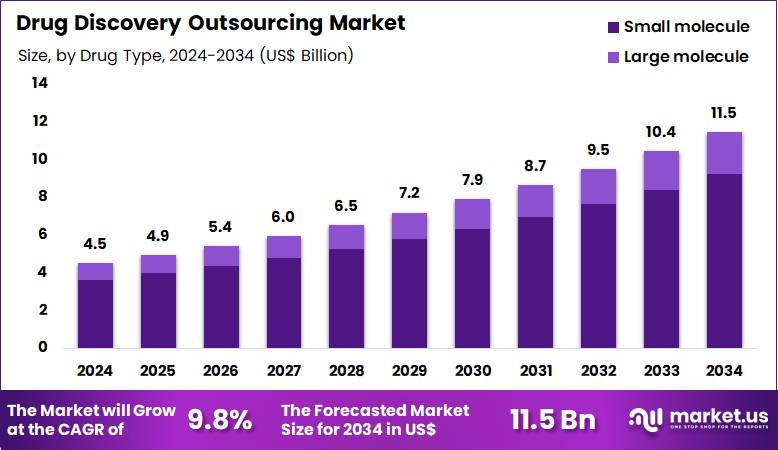
The Global Drug Discovery Outsourcing Market size is expected to be worth around US$ 11.5 Billion by 2034 from US$ 4.5 Billion in 2024, growing at a CAGR of 9.8% during the forecast period 2025 to 2034. In 2024, North America led the market, achieving over 42.3% share with a revenue of US$ 1.9 Billion.
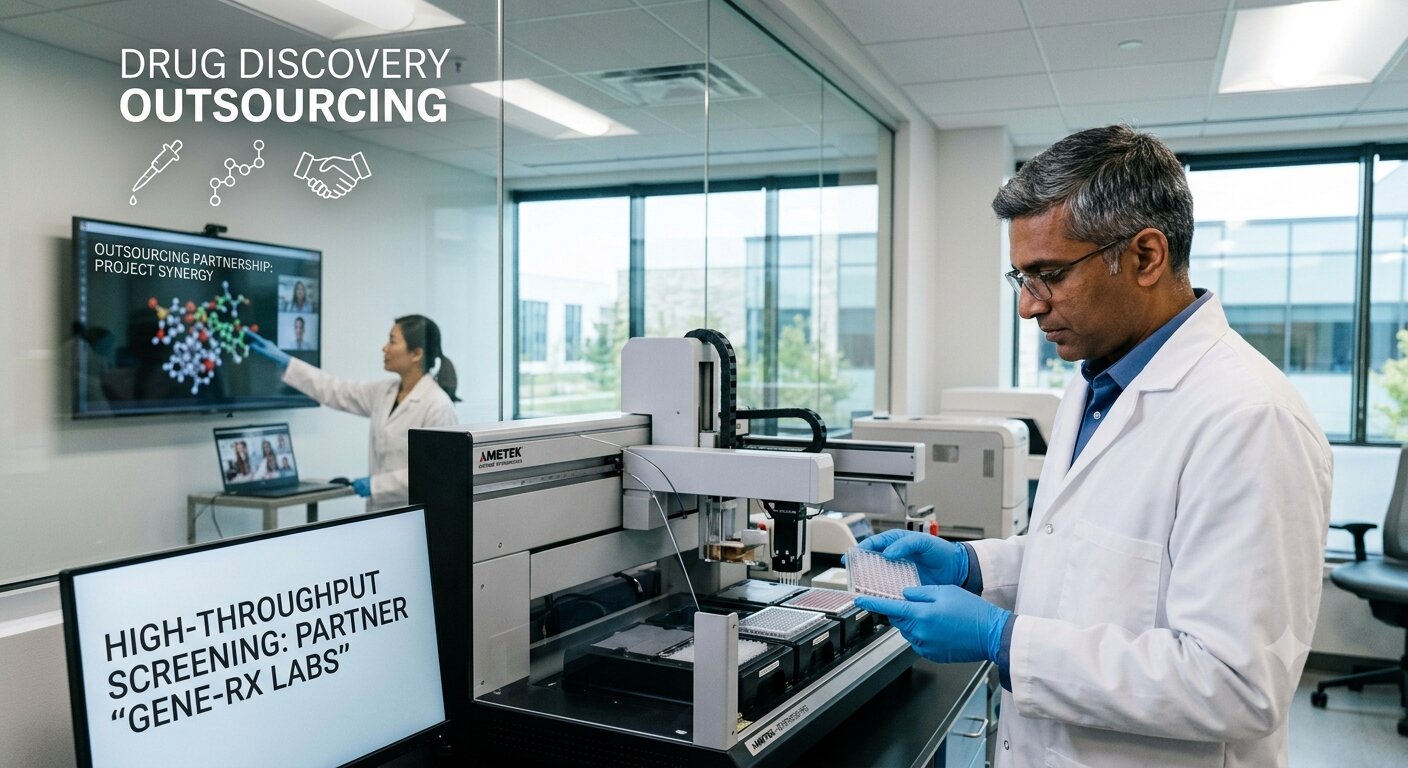
Drug discovery outsourcing has become an essential strategy for pharmaceutical and biotechnology companies seeking to accelerate research, optimize development costs, and access specialized scientific expertise. Contract research organizations (CROs) now play a critical role in supporting target identification, lead optimization, preclinical testing, medicinal chemistry, bioinformatics, and regulatory research.
Increasing demand for innovative therapies targeting cancer, rare diseases, neurological disorders, and infectious diseases continues to encourage pharmaceutical companies to collaborate with external research partners that offer advanced technologies and scalable capabilities.
Government and public health organizations are also strengthening the innovation ecosystem that supports outsourced drug discovery. According to the U.S. National Center for Advancing Translational Sciences (NCATS), developing a new medicine can take up to 15 years, highlighting the need for collaborative research models that improve efficiency.
NCATS also reports that its translational science initiatives have helped advance more than 45 promising drug candidates into clinical trials through partnerships with academia, industry, and patient organizations.
In addition, the U.S. Food and Drug Administration (FDA) and the National Institutes of Health (NIH) continue to expand collaborative programs aimed at improving translational and regulatory science, supporting the development of safer and more effective medicines through joint research initiatives and scientific partnerships.
These efforts promote innovation, strengthen regulatory science, and encourage greater collaboration across public and private research organizations, creating a favorable environment for drug discovery outsourcing services.
Key Takeaways
- In 2024, the global drug discovery outsourcing market generated US$ 4.5 billion in revenue and is projected to reach US$ 11.5 billion by 2034, growing at a CAGR of 9.8% during the forecast period.
- By drug type, the market is segmented into small molecules and large molecules. The small molecule segment dominated in 2024, accounting for 80.4% of the market due to its broad application in drug development.
- Based on service type, the market includes target identification & screening, target discovery & validation, hit identification/high-throughput screening, hit-to-lead development, lead optimization, preclinical testing services, and others. Among these, lead optimization held the largest share at 30.1% in 2024.
- By therapeutic area, the market is categorized into oncology, neurology/CNS disorders, infectious diseases, cardiovascular diseases, immunology & inflammatory disorders, metabolic & endocrine disorders, respiratory diseases, gastrointestinal disorders, rare/orphan diseases, ophthalmology diseases, dermatology diseases, and others. Oncology led the segment with a 27.9% market share.
- Based on end user, the market is divided into pharmaceutical & biotechnology companies and academic & research institutes. The pharmaceutical & biotechnology companies segment accounted for the largest revenue share of 83.1% in 2024.
- Regionally, North America dominated the global drug discovery outsourcing market in 2024, securing a 42.3% market share and maintaining its leadership position.
Statistical Information
- In 2024, the U.S. FDA approved 50 novel drugs, reflecting sustained innovation across oncology, rare diseases, neurology, and metabolic disorders. The steady pace of approvals continues to increase demand for outsourced discovery, screening, and preclinical research services.
- 26 of the 50 novel drugs (52%) approved by the FDA in 2024 received Orphan Drug designation, demonstrating the industry’s growing focus on rare disease therapies. These complex programs frequently require specialized contract research organizations (CROs) for advanced discovery and translational research.
- The FDA reported that 33 of the 50 novel drugs (66%) approved in 2024 benefited from at least one expedited development or review program, highlighting the increasing emphasis on accelerating drug development through collaborative research and regulatory support.
- Priority Review was granted to 28 of the 50 novel drugs (56%) approved in 2024, indicating a strong pipeline of therapies addressing serious diseases and unmet medical needs. Faster review timelines encourage greater investment in outsourced discovery and development activities.
- In 2024, the FDA designated 18 of the 50 novel drugs (36%) as Breakthrough Therapies, recognizing medicines that may provide substantial improvements over existing treatments. Such innovative programs often rely on specialized external expertise during early-stage drug discovery.
- The FDA approved 37 of 50 novel drugs (74%) during the first review cycle in 2024, reflecting high-quality regulatory submissions and efficient development strategies. Improved first-cycle success supports the growing use of experienced outsourcing partners throughout the drug development process.
- The FDA achieved 94% on-time review performance in 2024 by meeting or exceeding PDUFA goal dates for 47 of the 50 novel drug approvals. This efficient regulatory performance helps accelerate commercialization and reinforces demand for high-quality outsourced research services.
- 7 of the 50 novel drugs (14%) approved by the FDA in 2024 received Accelerated Approval, enabling earlier patient access to therapies for serious or life-threatening diseases. The pathway continues to support innovation while increasing the need for specialized preclinical and clinical research capabilities.
Regional Analysis
North America Analysis
North America dominated the drug discovery outsourcing market in 2024, supported by its strong pharmaceutical and biotechnology ecosystem, advanced research infrastructure, and widespread adoption of outsourced R&D services.
Companies increasingly partner with contract research organizations (CROs) to accelerate early-stage drug discovery, improve operational efficiency, and gain access to specialized technologies such as AI-driven drug design, high-throughput screening, and computational biology. The region also benefits from substantial investments in biomedical research from government agencies and private organizations.
The U.S. Food and Drug Administration (FDA) approved 50 novel drugs in 2024, reflecting sustained innovation and a robust pipeline that continues to drive demand for outsourced discovery services. Close collaboration between pharmaceutical companies, academic institutions, and CROs further strengthens the region’s leadership by enabling faster development of therapies across oncology, rare diseases, and other complex indications.
Asia Pacific Analysis
Asia Pacific is expected to register the fastest growth during the forecast period, driven by expanding pharmaceutical manufacturing capabilities, skilled scientific talent, and cost-efficient research services. Countries including China, India, South Korea, and Singapore continue to attract global outsourcing projects through investments in research infrastructure, digital technologies, and regulatory improvements. Growing adoption of automation, bioinformatics, and advanced laboratory platforms enables regional CROs to deliver high-quality discovery services for international clients.
Supportive government initiatives promoting biotechnology innovation and increasing clinical research activities are further strengthening the regional ecosystem. As multinational pharmaceutical companies expand strategic collaborations across Asia Pacific, the region is emerging as a preferred destination for outsourced drug discovery, offering scalable research capabilities, faster project execution, and competitive operating costs.
Emerging Trends
- AI is becoming a core part of drug discovery workflows. The U.S. FDA released its first draft guidance on using artificial intelligence to support regulatory decisions for drug and biological products in 2025, encouraging companies and outsourcing partners to adopt AI responsibly across discovery and development activities.
- Human-based laboratory models are gaining preference over traditional animal testing. In 2025, the U.S. FDA announced plans to expand the use of New Approach Methodologies (NAMs), including AI models and laboratory-grown human tissues, creating new opportunities for CROs specializing in advanced preclinical research.
- Rare disease drug discovery is becoming a major outsourcing focus. According to NCATS, nearly 10,000 rare diseases have been identified, yet only about 5% currently have approved treatments. This is driving demand for specialized screening platforms, biomarker discovery, and translational research services.
- Drug repurposing is expanding as a cost- and time-saving strategy. NCATS has developed a pharmaceutical collection containing nearly every FDA-approved medicine and has helped move more than 45 promising drug candidates into clinical trials through collaborative research programs, encouraging greater outsourcing of discovery activities.
- Digital technologies are transforming outsourced discovery services. High-throughput automation, computational biology, AI-driven molecular design, and advanced data analytics are enabling contract research organizations to deliver faster target identification, lead optimization, and predictive safety assessments for global pharmaceutical companies.
Use Cases
- Pharmaceutical companies increasingly outsource early-stage screening. Contract research organizations provide target identification, assay development, medicinal chemistry, and lead optimization services, allowing drug developers to shorten research timelines while accessing highly specialized scientific expertise.
- AI-supported molecule discovery is becoming a practical outsourcing application. The FDA has reported a significant increase in regulatory submissions incorporating AI across nonclinical and clinical development, encouraging research partners to integrate AI into drug discovery projects.
- Biotechnology firms are outsourcing rare disease research programs. NCATS estimates that nearly 90% of treatment candidates entering clinical trials ultimately fail, increasing the need for predictive preclinical models and specialized external research capabilities to improve success rates.
- Academic-industry collaborations are expanding outsourced translational research. NCATS works with universities, industry, and patient organizations to accelerate therapeutic development, enabling external laboratories and CROs to contribute advanced technologies throughout the discovery process.
- Advanced laboratory technologies are creating new outsourcing opportunities. Organizations are increasingly using patient-derived cell models, CRISPR-edited cells, AI-assisted safety prediction, and physiologically relevant tissue models to improve drug candidate selection before clinical testing, reducing development risks and improving efficiency.
Frequently Asked Questions About Drug Discovery Outsourcing
- Why is the drug discovery outsourcing market growing?
The market is expanding as pharmaceutical companies seek faster drug development, improved research efficiency, and access to specialized technologies. Increasing investments in biologics, precision medicine, and AI-enabled drug discovery are also driving demand for outsourced research services. - Which services are commonly outsourced in drug discovery?
Companies commonly outsource target identification, assay development, hit identification, medicinal chemistry, lead optimization, bioinformatics, and preclinical testing. These services allow sponsors to reduce infrastructure costs while benefiting from experienced scientific teams and advanced laboratory capabilities. - Who are the major end users of drug discovery outsourcing services?
Pharmaceutical companies, biotechnology firms, academic institutions, and research organizations are the primary users of drug discovery outsourcing. These organizations collaborate with CROs to accelerate innovation, improve development efficiency, and expand research capacity without significantly increasing internal resources. - Why are contract research organizations (CROs) important?
CROs provide specialized expertise, regulatory knowledge, advanced laboratory technologies, and flexible research capacity. Their services help pharmaceutical companies improve productivity, shorten discovery timelines, manage research costs, and advance promising drug candidates more efficiently. - What technologies are shaping the drug discovery outsourcing market?
Artificial intelligence, machine learning, automation, computational biology, and high-throughput screening are transforming outsourced drug discovery. These technologies improve target identification, optimize lead compounds, and enable faster, data-driven decisions throughout early-stage drug development. - Which region dominates the drug discovery outsourcing market?
North America remains the leading regional market because of its strong pharmaceutical industry, advanced research infrastructure, established CRO network, and supportive regulatory environment. Continuous investments in biomedical innovation further strengthen the region’s leadership in outsourced drug discovery. - What is the future outlook for the drug discovery outsourcing market?
The market is expected to witness steady growth as pharmaceutical companies increasingly rely on external research partners to improve efficiency and reduce development timelines. Growing adoption of AI, precision medicine, and biologics is expected to create new opportunities for outsourcing providers.
Conclusion
The global drug discovery outsourcing market is poised for strong growth as pharmaceutical and biotechnology companies increasingly rely on external research partners to accelerate innovation, improve efficiency, and manage development costs. Rising demand for precision medicine, biologics, rare disease therapies, and AI-enabled drug discovery is expanding opportunities for contract research organizations (CROs).
Supportive initiatives from organizations such as the U.S. FDA, NIH, and NCATS continue to strengthen translational research and regulatory collaboration, fostering a favorable environment for outsourced drug development. As advanced technologies, specialized expertise, and global research partnerships become more important, outsourcing is expected to remain a strategic approach for accelerating drug discovery and bringing safe, effective therapies to patients more efficiently worldwide.




















