



Overview
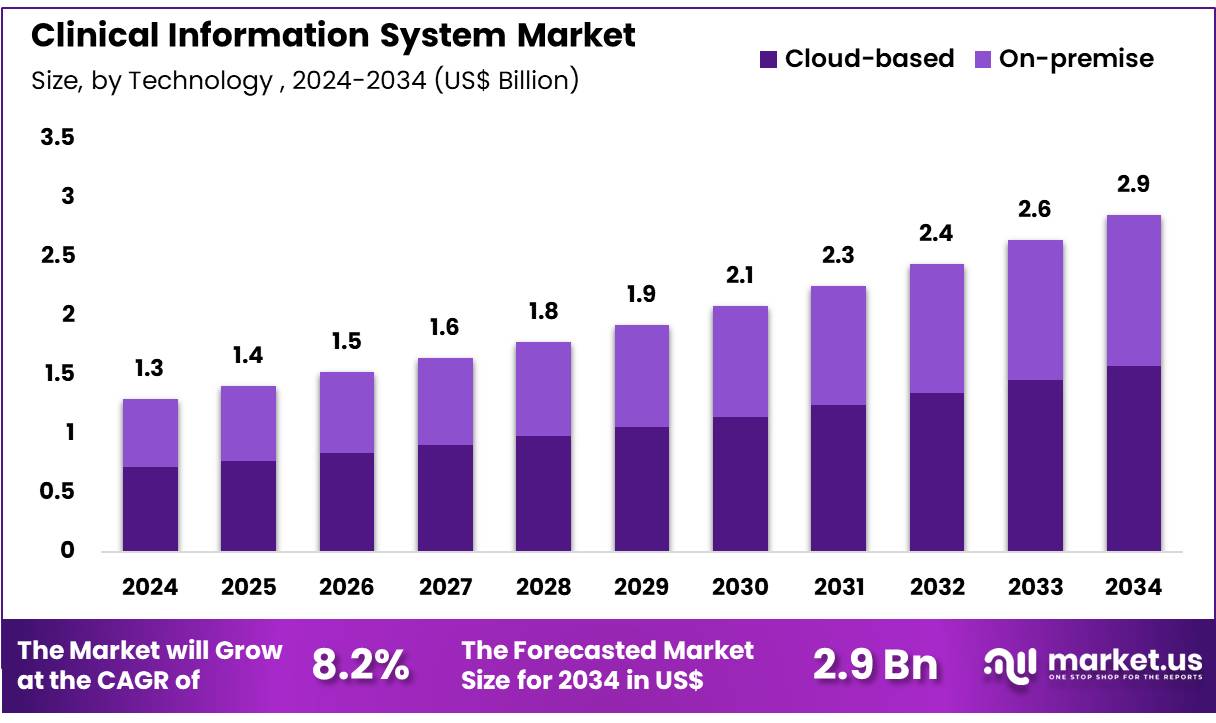
The Global Clinical Information System Market size is expected to be worth around US$ 2.9 Billion by 2034 from US$ 1.3 Billion in 2024, growing at a CAGR of 8.2% during the forecast period 2025 to 2034. In 2024, North America led the market, achieving over 39.9% share with a revenue of US$ 0.5 Billion.
The growing adoption of digital healthcare infrastructure and interoperable patient data platforms is creating strong momentum for the Clinical Information System (CIS) market. Hospitals and healthcare networks are increasingly investing in clinical information systems to improve care coordination, reduce medical errors, and streamline clinical workflows.
Governments and healthcare organizations are also prioritizing digital transformation initiatives to strengthen health system resilience and enable data-driven decision-making. According to the World Health Organization (WHO), digital health technologies support better quality, accessibility, and efficiency of healthcare services by promoting interoperable health information systems and standardized data exchange.
The expansion of electronic health records (EHRs) continues to accelerate worldwide, creating sustained demand for advanced clinical information systems. According to the OECD, 24 of 27 surveyed countries have adopted standardized minimum datasets for electronic health records, while 15 countries have implemented nationally unified EHR systems, reflecting increasing investments in interoperable clinical information infrastructure. These advancements are improving continuity of care, supporting clinical decision-making, and enabling more effective healthcare delivery across hospitals and outpatient settings.
Furthermore, WHO’s Global Strategy on Digital Health encourages member states to strengthen digital health ecosystems through secure, interoperable, and patient-centered information systems. As healthcare providers continue integrating artificial intelligence, clinical decision support, and real-time patient monitoring into clinical workflows, the demand for modern clinical information systems is expected to remain strong, supporting better patient outcomes, operational efficiency, and long-term healthcare sustainability.
Key Takeaways
- In 2024, the market generated US$ 1.3 Billion in revenue and is projected to reach US$ 2.9 Billion by 2034, registering a CAGR of 8.2% during the forecast period.
- By product type, the market is segmented into outpatient clinical information systems, specialty clinical information systems, inpatient clinical information systems, and ancillary information systems. Outpatient clinical information systems dominated the segment in 2023, accounting for a 38.5% market share.
- Based on technology, the market is categorized into cloud-based and on-premise solutions. Cloud-based solutions held the dominant position, capturing a significant 55.0% market share.
- By services, the market is segmented into managed services and consulting services. Managed services accounted for the largest share, representing 61.3% of the market revenue.
- Based on access/platform, the market is divided into mobiles/smartphones and desktops/laptops. Mobiles/smartphones led the segment with a 51.8% revenue share.
- By end-user, the market is segmented into healthcare facilities and payers. Healthcare facilities dominated the market, accounting for a significant 72.6% share.
- North America led the global market in 2023, accounting for 39.9% of the overall market share.
Regional Analysis
North America Leads the Clinical Information System Market
North America accounted for the largest share of the Clinical Information System market in 2024, supported by advanced healthcare IT infrastructure, widespread adoption of electronic health records (EHRs), and strong regulatory initiatives promoting interoperability.
The United States continues to modernize clinical data exchange through the Office of the National Coordinator for Health Information Technology (ONC) and the Centers for Medicare & Medicaid Services (CMS), which encourage standardized, secure sharing of patient information using FHIR-based APIs. These policies have accelerated the deployment of integrated clinical platforms that improve care coordination, clinical decision-making, and operational efficiency.
The region is also witnessing increasing adoption of AI-powered clinical documentation, predictive analytics, and cloud-based healthcare solutions. According to CMS, U.S. national health expenditures reached US$ 4.9 trillion in 2023, increasing 7.5% from 2022, highlighting continued investment in healthcare infrastructure and digital technologies. These developments are expected to sustain North America’s leadership in the Clinical Information System market.
Asia Pacific to Register the Fastest Growth
Asia Pacific is expected to record the highest CAGR during the forecast period, driven by rapid healthcare digitalization, expanding hospital infrastructure, and government initiatives to strengthen national health information systems. Countries such as China, Japan, India, South Korea, and Australia are investing in interoperable electronic medical records, cloud-based clinical platforms, and AI-enabled healthcare solutions to improve patient outcomes and healthcare efficiency.
The World Health Organization notes that more than 70% of countries now have national digital health strategies, with significant progress occurring across Asia-Pacific through investments in digital public infrastructure and interoperable health information systems.
Governments are also promoting secure data exchange, telehealth integration, and standardized clinical workflows to enhance care delivery. These initiatives, combined with rising healthcare spending and growing demand for connected care, are expected to drive strong adoption of clinical information systems across the region throughout the forecast period.
Emerging Trends
- AI is becoming part of everyday clinical workflows: Healthcare providers are increasingly integrating artificial intelligence into clinical information systems to automate documentation, summarize patient records, and support clinical decisions. In 2026, the WHO launched new initiatives on AI in health to encourage safe and responsible adoption, strengthening confidence in AI-enabled clinical platforms.
- Interoperability is improving through national data exchange: Healthcare organizations are focusing on seamless data exchange between hospitals, clinics, and laboratories. According to the U.S. ONC, health information exchanged through TEFCA grew from approximately 10 million documents before 2025 to 464 million documents by the end of 2025, demonstrating rapid adoption of interoperable clinical information systems.
- Routine health information systems are being modernized: Governments are strengthening routine health information systems to improve healthcare planning and service delivery. In 2025, WHO introduced a global strategy emphasizing integrated and interoperable health information systems, encouraging countries to improve data quality, reporting accuracy, and evidence-based clinical management.
- Cloud-based clinical platforms are expanding: Healthcare organizations are moving clinical information systems to secure cloud environments for better scalability and remote access. WHO continues to support digital health ecosystems that enable standardized data sharing, secure information management, and improved collaboration between healthcare providers across different care settings.
- Digital health strategies are accelerating worldwide: Many countries are implementing national digital health programs that rely on clinical information systems as core infrastructure. WHO’s updated Global Strategy on Digital Health (2020–2027) encourages member states to build interoperable digital health systems, improve patient data availability, and support universal access to quality healthcare services.
Use Cases
- Electronic health record management: Clinical information systems are widely used to maintain complete digital patient records, helping physicians access medical histories, prescriptions, laboratory results, and treatment plans. According to the CDC, 95.0% of U.S. office-based physicians had adopted electronic health record systems in 2024, highlighting widespread digital record management.
- Clinical decision support for physicians: Hospitals use clinical information systems to deliver alerts, treatment recommendations, and medication safety checks during patient care. These tools reduce manual work, improve diagnostic accuracy, and help clinicians make evidence-based decisions using integrated patient information and standardized clinical guidelines.
- Secure health information exchange: Healthcare providers use clinical information systems to exchange patient information securely across different organizations. TEFCA enables trusted nationwide data sharing, allowing hospitals, specialists, and laboratories to access updated patient records quickly, improving care coordination and reducing unnecessary duplicate testing.
- Population health management: Healthcare systems analyze clinical information collected from multiple facilities to monitor disease patterns, evaluate treatment outcomes, and support preventive healthcare programs. Integrated clinical information systems help governments and providers allocate healthcare resources efficiently while improving public health surveillance and service planning.
- Patient-centered digital healthcare services: Clinical information systems support patient portals, appointment scheduling, online access to medical records, and communication with healthcare providers. According to the OECD, at least 95% of primary care practices in 13 of 17 countries use electronic medical records, strengthening digital patient engagement and coordinated healthcare delivery
Frequently Asked Questions About Clinical Information System
- What is a Clinical Information System (CIS)?
A Clinical Information System (CIS) is a digital platform that helps healthcare providers collect, store, manage, and share patient information securely. It combines clinical data, laboratory results, medical imaging, medication records, and physician notes into a single system, enabling faster and more informed clinical decision-making while improving care coordination. - What is the Clinical Information System Market?
The Clinical Information System Market includes software and digital solutions used by hospitals, clinics, and healthcare organizations to manage patient information and clinical workflows. Market growth is supported by increasing healthcare digitalization, interoperability initiatives, AI integration, and expanding investments in connected healthcare infrastructure worldwide. - What factors are driving the Clinical Information System Market?
The market is expanding due to growing adoption of electronic health records, government support for digital health, increasing demand for interoperable healthcare systems, and rising use of cloud-based technologies. Healthcare providers are also investing in AI-powered clinical decision support and secure health information exchange to improve efficiency and patient outcomes. - Which healthcare settings use Clinical Information Systems?
Clinical Information Systems are widely used in hospitals, specialty clinics, ambulatory surgical centers, diagnostic laboratories, and community healthcare facilities. These systems support patient registration, medication management, laboratory reporting, radiology integration, and clinical documentation while enabling healthcare professionals to access complete patient records from a unified platform. - How does a Clinical Information System improve patient care?
Clincal Information Systems improve patient care by providing healthcare professionals with real-time access to accurate medical records, reducing duplicate tests, minimizing medication errors, and supporting evidence-based clinical decisions. Integrated digital records also improve communication among care teams, resulting in better treatment coordination and enhanced patient safety. - Why is interoperability important in Clinical Information Systems?
Interoperability enables different healthcare systems and organizations to exchange patient information securely and efficiently. It supports continuity of care, reduces administrative burden, and improves healthcare quality by ensuring clinicians have access to complete patient information regardless of where treatment was previously provided. - How is artificial intelligence influencing the Clinical Information System Market?
Artificial intelligence is transforming Clinical Information Systems by automating clinical documentation, supporting diagnosis, identifying health risks, and improving workflow efficiency. AI also helps healthcare organizations analyze large clinical datasets, enabling faster decision-making, personalized treatment planning, and more effective management of healthcare resources. - What is the future outlook for the Clinical Information System Market?
The Clinical Information System Market is expected to experience steady growth as healthcare organizations continue adopting digital health technologies, cloud computing, interoperable platforms, and AI-driven solutions. Government initiatives promoting standardized health information exchange and digital transformation are expected to create long-term opportunities for technology providers and healthcare institutions.
Conclusion
The Clinical Information System market is expected to witness sustained growth as healthcare providers continue prioritizing digital transformation, interoperable health information exchange, and data-driven clinical decision-making. Increasing adoption of electronic health records, cloud-based platforms, artificial intelligence, and clinical decision support systems is improving care quality, operational efficiency, and patient safety.
Government initiatives promoting standardized data exchange and secure digital health ecosystems are further accelerating market adoption across developed and emerging economies. As hospitals and healthcare organizations modernize their IT infrastructure and integrate advanced analytics into clinical workflows, clinical information systems will play an increasingly important role in supporting coordinated care, reducing administrative burden, enhancing patient outcomes, and building resilient, connected, and efficient healthcare systems worldwide.




















