


Overview
Global Healthcare Digital Experience Platform Market size is expected to be worth around US$ 4.8 Billion by 2034 from US$ 1.5 Billion in 2024, growing at a CAGR of 12.4% during the forecast period 2025 to 2034. In 2024, North America led the market, achieving over 39.8% share with a revenue of US$ 0.6 Billion.
Healthcare organizations are increasingly investing in digital experience platforms to improve patient engagement, simplify care delivery, and enable seamless access to healthcare services across web, mobile, and connected devices.
The growing emphasis on interoperability, digital health records, and personalized patient interactions is encouraging hospitals and healthcare providers to modernize their digital infrastructure. Governments and public health agencies are also supporting secure data exchange and patient-centered care through nationwide digital health initiatives, creating favorable conditions for wider adoption of healthcare digital experience platforms.
According to the U.S. Office of the National Coordinator for Health Information Technology (ONC), 96% of U.S. non-federal acute care hospitals electronically send patient care records, while 65% of individuals accessed or were offered access to their online medical records in 2024, reflecting the increasing reliance on digital tools for patient engagement and information sharing.
The Centers for Medicare & Medicaid Services (CMS) has further accelerated digital healthcare transformation by launching its HealthTech Ecosystem initiative to promote secure interoperability, patient-controlled health information, and digital applications that improve healthcare access and reduce administrative burden. More than 700 organizations have pledged support for the initiative, demonstrating broad industry collaboration toward a connected digital health ecosystem.
As healthcare systems continue prioritizing patient-centric experiences, digital accessibility, and connected care, healthcare digital experience platforms are expected to play an increasingly important role in enhancing care coordination, improving operational efficiency, and delivering more personalized healthcare services across diverse clinical settings.

Key Takeaways
- The global Healthcare Digital Experience Platform market generated US$ 1.5 billion in revenue in 2024 and is projected to reach US$ 4.8 billion by 2034, expanding at a CAGR of 12.4% during the forecast period.
- By product type, the market is segmented into platform and services, with the platform segment emerging as the leading category, accounting for 62.2% of the market share in 2023 due to its ability to deliver integrated digital engagement and patient experience solutions.
- Based on application, the market is categorized into business-to-consumer (B2C), business-to-business (B2B), and others. Among these, the business-to-consumer (B2C) segment dominated the market, capturing 68.9% of the total share in 2023, driven by the growing adoption of patient-centric digital healthcare services.
- In terms of delivery mode, the market is divided into cloud-based and on-premises solutions. The cloud-based segment held the largest market share of 77.5% in 2023, supported by increasing demand for scalable, secure, and remotely accessible healthcare platforms.
- Regionally, North America maintained its leading position in the Healthcare Digital Experience Platform market, accounting for 39.8% of the global market share in 2023, driven by advanced healthcare IT infrastructure and widespread adoption of digital health technologies.
Statistical Information
- 95.0% of U.S. office-based physicians had adopted an Electronic Health Record (EHR) system in 2024, while 83.6% were using a certified EHR, highlighting the maturity of digital healthcare infrastructure that supports healthcare digital experience platforms.
- In 2024, 89% of individuals who were offered a patient portal said their healthcare provider encouraged them to use it, demonstrating the growing emphasis on digital patient engagement by providers.
- 87% of patients encouraged by their healthcare provider accessed their patient portal, compared with 57% of those who were not encouraged, showing the significant influence of provider engagement on digital platform adoption.
- Among patients encouraged to use patient portals, 92% viewed laboratory test results, while 82% reviewed clinical notes, indicating strong consumer engagement with digital healthcare services.
- 81% of people living with at least one chronic condition were offered online access to their medical records in 2024, and 69% accessed those records during the year, reflecting higher digital healthcare utilization among chronic disease patients.
- 86% of individuals diagnosed with cancer within the previous five years were offered online access to their medical records, and 76% used their patient portal during 2024, illustrating the importance of digital platforms in complex care management.
- 68% of consumers had an online medical record or patient portal through their primary care provider in 2024, making primary care the most common access point for digital healthcare experiences.
- 30% of individuals maintained an online patient portal with their health insurer, reflecting increasing payer participation in digital engagement and self-service healthcare experiences.
- 29% of consumers reported having an online portal with a clinical laboratory, indicating expanding digital access beyond hospitals and physician practices.
Regional Analysis
North America dominated the Healthcare Digital Experience Platform market in 2024, driven by high adoption of electronic health records (EHRs), patient engagement technologies, and cloud-based healthcare solutions. The region continues to benefit from strong government initiatives promoting interoperability and secure health information exchange.
The U.S. Office of the National Coordinator for Health Information Technology (ONC) is advancing nationwide interoperability through the Trusted Exchange Framework and Common Agreement (TEFCA) and the LEAP in Health IT program, which supports standards-based digital health innovation and AI-enabled healthcare solutions.
These initiatives are enabling healthcare providers to improve care coordination, enhance patient experiences, and strengthen digital workflows across hospitals and health systems.
Asia Pacific is expected to register the fastest CAGR during the forecast period owing to rapid healthcare digitalization, expanding internet connectivity, and rising government investments in digital health infrastructure. Singapore’s Ministry of Health has committed $ 200 million over five years through the Health Innovation Fund to accelerate AI and digital health innovation.
Meanwhile, India’s Ayushman Bharat Digital Mission continues to expand digital health records and interoperability, supporting wider adoption of connected healthcare services across the country. These government-led initiatives are expected to accelerate deployment of healthcare digital experience platforms throughout the region.
Emerging Trends
- Patient-controlled health data is becoming a major trend. In 2025, CMS launched its Health Technology Ecosystem initiative, enabling patients to securely access and share health records across providers through modern digital identity, FHIR standards, and interoperable applications, reducing dependence on paper-based processes.
- Healthcare providers are rapidly adopting interoperable digital platforms. According to ONC, 80% of U.S. non-federal acute care hospitals either participate or plan to participate in TEFCA, supporting nationwide exchange of patient information and driving demand for unified digital experience platforms.
- Artificial intelligence is becoming a standard feature in patient engagement. CMS is encouraging conversational AI, digital health assistants, and personalized patient-facing applications that help users understand health records, prepare for appointments, and navigate care through connected digital platforms.
- Healthcare organizations are replacing fragmented digital systems with integrated ecosystems. CMS is expanding services such as Blue Button 2.0 APIs, national provider directories, and trusted data exchange to improve patient access while reducing administrative workload across healthcare organizations.
- Cloud-enabled interoperability is accelerating ecosystem partnerships. By 2026, CMS had attracted hundreds of healthcare organizations across providers, EHR vendors, payers, government agencies, and patient application developers to collaborate on a standardized digital healthcare ecosystem focused on connected patient experiences.
Use Cases
- Digital appointment and registration platforms are simplifying patient intake by allowing users to verify identity, complete registration, share health records, and exchange information securely through QR codes and FHIR-enabled applications before arriving at healthcare facilities.
- AI-powered patient assistants are helping patients understand laboratory reports, summarize medical histories, answer health questions, and prepare for clinical visits, improving patient engagement while reducing provider administrative burden through personalized digital interactions.
- Digital care coordination platforms enable healthcare providers to receive appointment notifications, encounter updates, and patient records within 24 hours, improving communication among care teams and supporting faster clinical decision-making across multiple care settings.
- Patient-authorized health record sharing allows individuals to retrieve medical information from providers, payers, and health networks using secure digital credentials, eliminating repeated paperwork and improving continuity of care across different healthcare organizations.
- Connected healthcare applications integrate wearable devices, electronic health records, insurance information, and remote monitoring data into a single digital interface, enabling personalized care management and supporting continuous engagement between patients and healthcare providers.
Frequently Asked Questions About Healthcare Digital Experience Platform.
- What is a Healthcare Digital Experience Platform (DXP)?
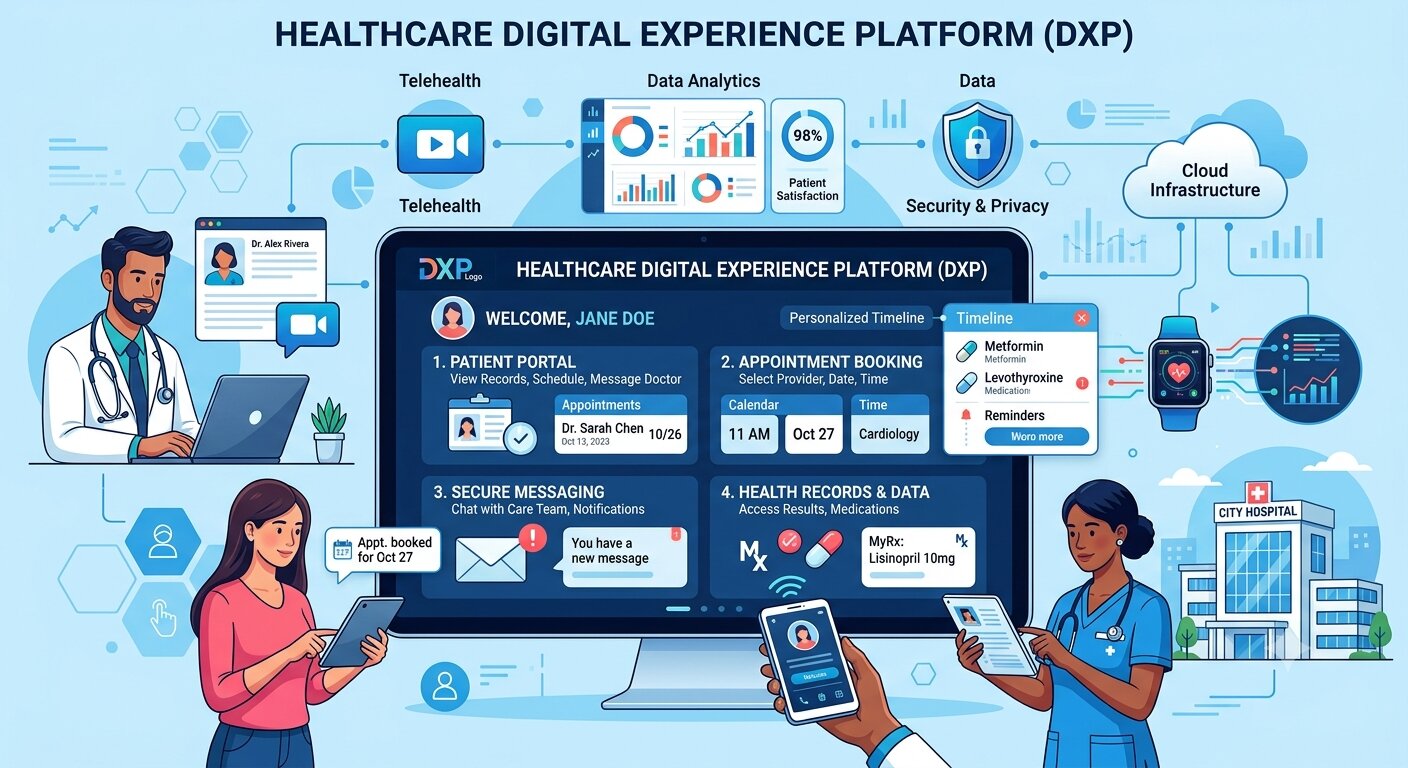
A Healthcare Digital Experience Platform is a technology solution that helps healthcare organizations deliver personalized digital services through websites, mobile apps, patient portals, and other channels. It improves communication, simplifies access to health information, and supports better patient engagement using integrated digital tools. - Why is the Healthcare Digital Experience Platform market growing?
The market is expanding because healthcare providers are investing in digital technologies that improve patient access, interoperability, and care coordination. Government initiatives promoting secure health information exchange and modern digital infrastructure are further accelerating adoption across hospitals, clinics, and health systems. - Which healthcare organizations benefit the most from Digital Experience Platforms?
Hospitals, multi-specialty clinics, physician groups, health insurers, telehealth providers, and integrated delivery networks benefit significantly. These platforms help streamline patient communication, automate administrative tasks, improve digital engagement, and provide consistent experiences across multiple healthcare touchpoints. - What are the main features of a Healthcare Digital Experience Platform?
Healthcare DXPs commonly include patient portals, appointment scheduling, personalized content, secure messaging, electronic forms, analytics, mobile access, interoperability, and AI-powered support. These capabilities create connected digital experiences while improving operational efficiency and patient satisfaction. - How does a Healthcare Digital Experience Platform improve patient engagement?
These platforms enable patients to schedule appointments, access medical records, communicate securely with providers, receive personalized reminders, and manage their healthcare digitally. Easy access to information encourages active participation in treatment and supports better long-term health outcomes. - How is artificial intelligence influencing Healthcare Digital Experience Platforms?
Artificial intelligence is helping healthcare organizations deliver personalized health guidance, conversational assistants, symptom support, and automated administrative services. AI also improves workflow efficiency by assisting patients before, during, and after clinical visits through connected digital applications. - Why is interoperability important for the Healthcare Digital Experience Platform market?
Interoperability allows healthcare providers, payers, and patients to securely exchange health information across different systems. This reduces duplicate paperwork, improves clinical decision-making, enhances care coordination, and enables patients to access their health data from multiple organizations. - What opportunities are shaping the future of the Healthcare Digital Experience Platform market?
Future opportunities include AI-enabled patient engagement, cloud-based digital platforms, connected wearable integration, virtual care services, personalized health applications, and nationwide digital health ecosystems. These innovations are expected to improve healthcare accessibility while supporting more efficient and patient-centered care delivery.
Conclusion
The Healthcare Digital Experience Platform market is poised for sustained growth as healthcare organizations accelerate digital transformation to improve patient engagement, interoperability, and care delivery. Increasing adoption of cloud-based platforms, AI-powered patient support, and secure health data exchange is reshaping the healthcare experience while reducing administrative burden.
Government initiatives led by organizations such as CMS and ONC continue to strengthen digital health infrastructure and promote nationwide interoperability, encouraging broader adoption of connected healthcare solutions.
As providers focus on personalized, patient-centric services and seamless digital interactions, Healthcare Digital Experience Platforms are expected to become an essential component of modern healthcare systems, driving operational efficiency, improving clinical outcomes, and enabling more accessible, connected, and data-driven care worldwide.




















