


Overview
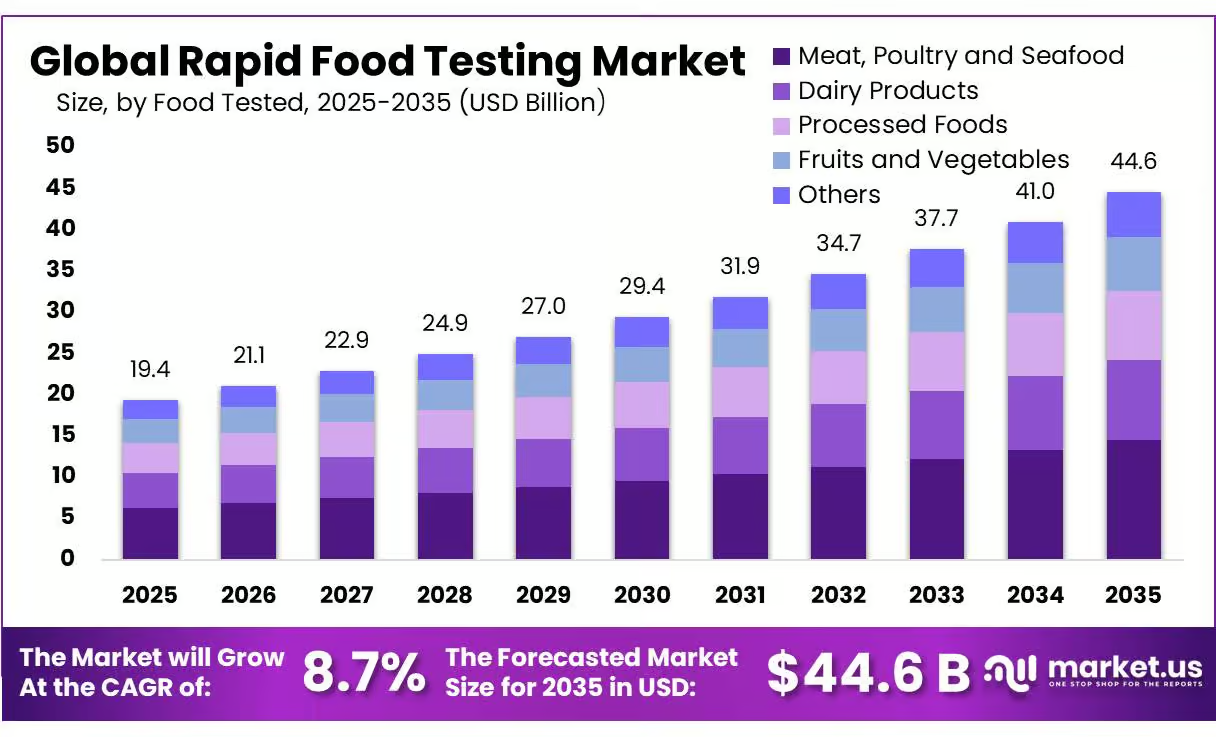
New York, NY – Oct 06, 2026 – The global Rapid Food Testing Market is expanding as food manufacturers, laboratories, retailers, and regulators seek faster ways to identify pathogens, toxins, pesticide residues, veterinary drug residues, GMOs, and other contaminants. The market was valued at USD 19.4 billion in 2025 and is projected to reach approximately USD 44.6 billion by 2035, expanding at a 8.7% CAGR during 2026–2035.
Rapid food testing uses technologies such as PCR, immunoassays, chromatography, spectrometry, biosensors, and convenience-based testing systems. These methods help food companies shorten testing cycles, improve product-release decisions, verify sanitation programs, and identify contamination earlier.
Pathogen testing remains particularly important across meat, poultry, seafood, dairy, produce, and processed foods. USDA’s Food Safety and Inspection Service maintains guidance covering independently validated test kits for Salmonella, Campylobacter, Listeria, E. coli O157, and non-O157 STEC.
Regulatory changes are also encouraging stronger preventive testing. FDA’s agricultural-water requirements require covered farms to evaluate contamination hazards and apply corrective or mitigation measures when necessary. As food supply chains become larger and more interconnected, rapid testing is becoming an important tool for production control, regulatory compliance, and consumer protection.
Key Takeaways
- The Rapid Food Testing Market was valued at USD 19.4 billion in 2025 and is projected to reach USD 44.6 billion by 2035, expanding at a 8.7% CAGR.
- By target tested, Pathogens dominated the market in 2025 with more than a 42.30% share.
- By food tested, Meat, Poultry and Seafood held more than a 32.50% share.
- By technology, PCR-Based Testing captured more than a 38.00% share during 2025.
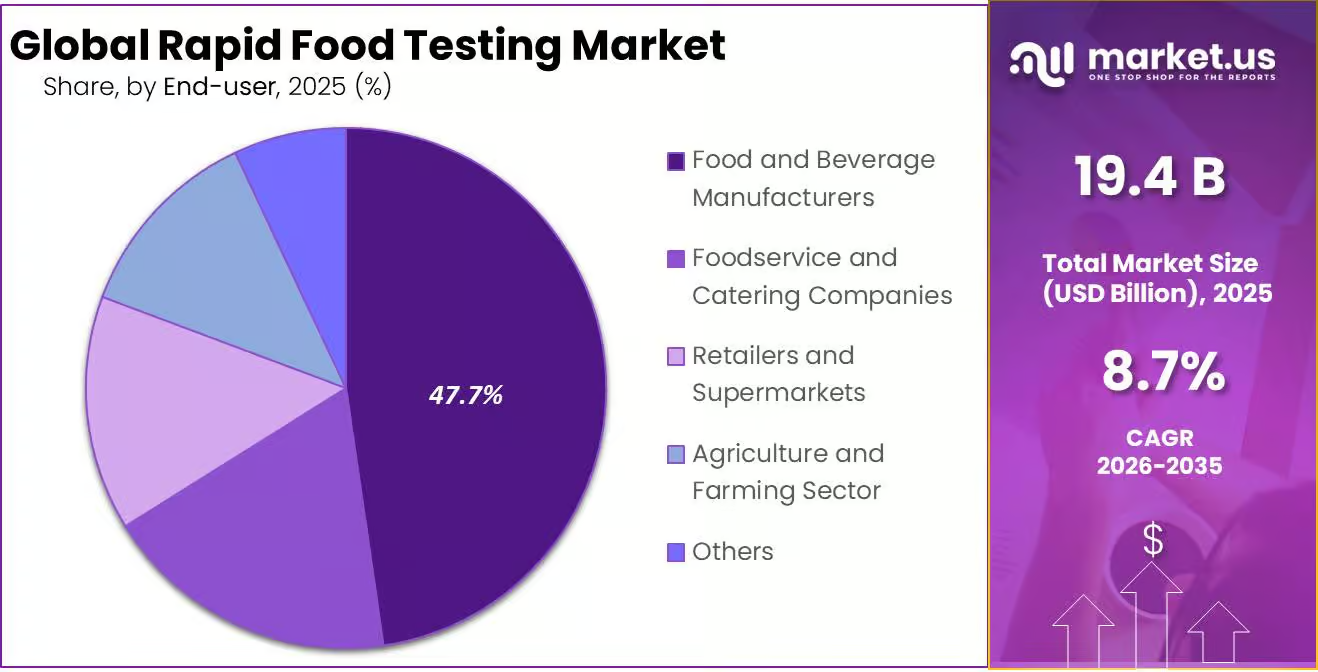
- By end user, Food and Beverage Manufacturers accounted for more than a 47.00% share.
- North America dominated the market with more than a 47.50% share, representing approximately USD 9.2 billion in 2025.
Regional Analysis
North America Leads with 47.50% Share and USD 9.2 Billion Revenue
In 2025, North America held a dominant position in the Rapid Food Testing Market, capturing more than a 47.50% share and generating approximately USD 9.2 billion in revenue.
The region benefits from a large food-processing sector, established testing laboratories, regulatory oversight, and strong adoption of PCR, immunoassays, chromatography, and rapid microbial detection technologies.
Food manufacturers regularly test raw materials, processing environments, production lines, finished products, and sanitation controls. USDA guidance recognizes independently validated pathogen test kits covering organisms such as Salmonella, Campylobacter, Listeria species, Listeria monocytogenes, E. coli O157, and non-O157 STEC.
FDA rules covering produce safety are also encouraging more preventive testing. Agricultural-water requirements require covered farms to conduct risk-based assessments and determine whether corrective or mitigation measures are needed to prevent contamination.
Together, regulatory oversight, high food-production volumes, imported-food monitoring, and demand for faster product-release decisions continue to support North America’s leading position.
Market Dynamics
Driver – Growing Demand for Faster Pathogen Detection
Food manufacturers increasingly need quicker contamination results before products enter distribution. Pathogens represented more than 42.30% of Rapid Food Testing Market demand in 2025, making them the largest target-tested category. USDA guidance recognizes validated test kits for Salmonella, Campylobacter, Listeria, E. coli O157, and non-O157 STEC, demonstrating the operational importance of dependable pathogen screening.
Rapid testing can reduce the time between sampling and corrective action, allowing manufacturers to isolate affected material earlier. Demand is particularly strong in meat, poultry, seafood, dairy, ready-to-eat foods, and fresh produce where microbial contamination can create significant safety and operational risks.
Trend – Rising Adoption of PCR-Based Testing
Molecular testing is becoming an important part of modern food-safety laboratories because it can detect specific microbial DNA with high sensitivity and support faster decisions than many conventional workflows. PCR-Based Testing accounted for more than 38.00% of the market in 2025, making it the leading technology category.
USDA’s validated-kit guidance covers molecular detection approaches for important foodborne pathogens, strengthening confidence in rapid testing systems. PCR technology is increasingly combined with automated sample preparation, digital reporting, and laboratory information systems. This trend is helping food processors shorten product-hold periods while strengthening environmental, raw-material, and finished-product monitoring.
Restraint – Validation and Confirmation Requirements
Rapid methods can reduce testing time, but food companies must ensure that methods perform consistently across different food matrices. Meat, dairy, seafood, vegetables, spices, processed foods, and high-fat products can produce different analytical challenges. USDA therefore advises establishments to consider independently validated pathogen test kits when using rapid systems for regulatory purposes.
Validation requirements can increase laboratory workload, technician training, equipment qualification, and confirmatory testing needs. These challenges are especially relevant as PCR-Based Testing already holds 38.00% of the market. Smaller processors may find sophisticated molecular platforms harder to implement because they require controlled workflows and dependable quality-management practices.
Opportunity – Testing Across Food Manufacturing Operations
Food manufacturers offer a significant growth opportunity because rapid analysis can be used at multiple control points, including incoming materials, processing equipment, sanitation checks, production lines, finished products, and warehouse release. Food and Beverage Manufacturers represented more than 47.00% of market demand in 2025, making them the largest end-user category.
FDA’s preventive food-safety framework also emphasizes identifying and managing contamination risks before unsafe products reach consumers. Agricultural-water requirements similarly support risk-based assessment and corrective action within produce operations. This creates opportunities for portable tests, automated PCR platforms, rapid immunoassays, environmental monitoring systems, and digitally connected laboratory solutions.
Key Market Segments
By Target Tested Pathogens – 42.30% Share
In 2025, Pathogens held a dominant market position, capturing more than a 42.30% share. Pathogen testing remains essential for detecting Salmonella, Listeria, E. coli, Campylobacter, and other microorganisms before contaminated products enter distribution.
By Food Tested Meat, Poultry and Seafood – 32.50% Share
In 2025, Meat, Poultry and Seafood held a dominant market position, capturing more than a 32.50% share. These foods require regular microbial, residue, sanitation, and quality testing throughout processing and distribution.
By Technology PCR-Based Testing – 38.00% Share
In 2025, PCR-Based Testing held a dominant market position, capturing more than a 38.00% share. PCR is widely used for sensitive DNA-based detection of Salmonella, Listeria, pathogenic E. coli, Campylobacter, and other microorganisms.
By End User Food and Beverage Manufacturers – 47.00% Share
In 2025, Food and Beverage Manufacturers held a dominant market position, capturing more than a 47.00% share. Manufacturers use rapid tests across raw-material intake, sanitation, processing, packaging, and finished-product release.
Emerging Trends
1. Expansion of PCR Testing
PCR-based technology represented more than 38.00% of the market in 2025. Its ability to identify pathogen DNA is encouraging adoption across food-processing laboratories, especially for Salmonella, Listeria, pathogenic E. coli, and Campylobacter screening.
2. Stronger Focus on Pathogen Screening
Pathogens accounted for more than 42.30% of market demand in 2025. Food processors are increasing rapid screening across ingredients, production lines, environmental surfaces, and finished products to identify contamination before distribution.
3. Faster Testing in Meat and Seafood
Meat, poultry, and seafood represented more than 32.50% of the food-tested market in 2025. Rapid microbial and residue screening is becoming increasingly important for animal proteins requiring strict processing, sanitation, storage, and distribution controls.
4. Manufacturer-Led Testing Programs
Food and beverage manufacturers accounted for more than 47.00% of market demand in 2025. Testing is moving closer to manufacturing lines as companies seek faster raw-material approval, environmental verification, corrective action, and final-product release.
5. Growing North American Testing Adoption
North America represented more than 47.50% of the market and approximately USD 9.2 billion in 2025. Established food-safety oversight and laboratory infrastructure continue to support rapid molecular and microbiological testing adoption.
Use Cases
1. Pathogen Screening in Processing Plants
Processors use rapid testing to detect Salmonella, Listeria, pathogenic E. coli, and other microorganisms before product release. Pathogen testing accounted for more than 42.30% of market demand in 2025, making this the leading testing application.
2. Meat and Poultry Quality Control
Rapid testing supports contamination control from slaughter and processing through packaging. Meat, poultry, and seafood represented more than 32.50% of food-tested demand in 2025, reflecting the strong requirement for frequent microbial and residue verification.
3. PCR-Based Product Release
Manufacturers use molecular methods to make quicker product-release decisions following pathogen screening. PCR represented more than 38.00% of rapid food-testing technology demand in 2025, supporting its growing role in routine production laboratories.
4. Manufacturing Sanitation Verification
Food manufacturers test equipment, surfaces, ingredients, and processing environments to identify contamination early. Manufacturers represented more than 47.00% of market demand in 2025, making plant-level food-safety programs an important rapid-testing use case.
5. North American Food-Supply Monitoring
Rapid methods support manufacturers, retailers, laboratories, and regulators across North America’s food supply. The region held more than 47.50% market share and approximately USD 9.2 billion in revenue during 2025.
Key Players Analysis
Thermo Fisher Scientific Inc.
Thermo Fisher Scientific maintains a strong position in rapid food testing through molecular detection systems, PCR technology, microbiology products, sample-preparation tools, and analytical instruments. According to the supplied market report, the company generated USD 44.56 billion in total revenue in 2025, strengthening its ability to support food-testing laboratories and large manufacturing operations.
bioMérieux SA
bioMérieux participates in rapid food testing through industrial microbiology and microorganism-detection solutions used by food manufacturers and laboratories. Its systems support pathogen detection and quality-control workflows. The Market.us report states that company sales reached EUR 4.07 billion in 2025, supporting continued investment in industrial microbiology capabilities.
Neogen Corporation
Neogen has a focused food-safety portfolio covering pathogens, allergens, sanitation, natural toxins, spoilage organisms, residues, and related contaminants. According to the supplied report, Neogen generated USD 894.7 million in fiscal 2025 revenue, including USD 638.1 million from its Food Safety business.
3M Company
3M remains relevant through food-safety and microbiological testing technologies developed for manufacturers and laboratory environments. The supplied Market.us report notes USD 24.948 billion in 2025 net sales and highlights continued research investment, supporting the company’s broader ability to develop analytical and quality-control solutions.
Merck KGaA / MilliporeSigma
Merck KGaA, operating as MilliporeSigma in the United States and Canada, supports food laboratories through microbiology, analytical chemistry, sample preparation, culture media, reagents, and laboratory workflow technologies. Its capabilities are relevant to food manufacturers seeking reliable microbial, chemical, and contaminant-testing systems.
Bio-Rad Laboratories, Inc.
Bio-Rad provides PCR, molecular detection, quality-control, and laboratory technologies applicable to food-safety testing. The supplied report states that the company recorded USD 2.583 billion in 2025 revenue, including USD 1.021 billion from its Life Science business, supporting its molecular-testing capabilities.
QIAGEN N.V.
QIAGEN participates in rapid food analysis through molecular sample preparation, nucleic-acid purification, PCR technologies, and analytical workflows. These capabilities can support pathogen identification and molecular food-testing laboratories where fast, sensitive detection is needed for production and quality-control decisions.
Hygiena LLC
Hygiena specializes in rapid food-safety and hygiene-monitoring technologies. Its portfolio includes molecular pathogen testing, ATP sanitation monitoring, allergen tests, indicator-organism testing, and environmental monitoring tools, giving manufacturers options for both production-line hygiene assessment and laboratory contamination detection.
Agilent Technologies, Inc.
Agilent supports food analysis through chromatography, mass spectrometry, spectroscopy, sample preparation, and analytical software. These technologies are particularly relevant for pesticide residues, veterinary drugs, toxins, chemical contaminants, authenticity testing, and other applications requiring detailed compound identification.
PerkinElmer Inc.
PerkinElmer-related analytical technologies support food and environmental laboratories through spectroscopy, chromatography, mass spectrometry, sample preparation, and contaminant-analysis workflows. These tools are suitable for chemical residues, elemental analysis, toxins, and broader food-quality applications requiring laboratory confirmation.
Eurofins Scientific SE
Eurofins provides food and feed testing services covering microbiology, pathogens, contaminants, allergens, authenticity, and chemical analysis. Its laboratory network uses conventional and rapid methods, including PCR and sequencing approaches, to support manufacturers, retailers, and foodservice companies.
SGS S.A.
SGS provides rapid food microbiology testing using PCR, immunological methods, LAMP, chromogenic media, and other laboratory approaches. Its services support food manufacturers, distributors, and retailers seeking faster pathogen detection, regulatory compliance, and production-release decisions.
Mérieux NutriSciences
Mérieux NutriSciences supports food manufacturers through microbiology, chemistry, contaminants, environmental monitoring, nutritional testing, and food-safety consulting. Its laboratory services help businesses evaluate ingredients, production environments, finished foods, and regulatory compliance across complex supply chains.
Charm Sciences, Inc.
Charm Sciences develops rapid diagnostic technologies for food-safety and sanitation testing. Its products are used for microbial screening, antibiotic residues, allergens, toxins, ATP hygiene monitoring, and other applications where processors require quick results near production or laboratory environments.
Romer Labs Diagnostic GmbH
Romer Labs focuses on diagnostic solutions for mycotoxins, food allergens, GMOs, and microbial contaminants. Its portfolio includes rapid test kits and laboratory solutions for food, beverages, grains, feed, dairy, poultry, and seafood, supporting both on-site screening and confirmatory analysis.
Conclusion
The Rapid Food Testing Market is gaining importance as food companies seek faster and more reliable contamination decisions. The market was valued at USD 19.4 billion in 2025 and is projected to reach USD 44.6 billion by 2035, expanding at a 8.7% CAGR. Pathogens lead with 42.30%, while meat, poultry and seafood hold 32.50%.
PCR-based testing accounts for 38.00%, and food manufacturers represent 47.00% of end-user demand. North America leads with 47.50% and USD 9.2 billion. Increasing pathogen surveillance, manufacturing quality controls, molecular testing, agricultural-water management, and faster product-release requirements should continue supporting market expansion.




















