



Overview
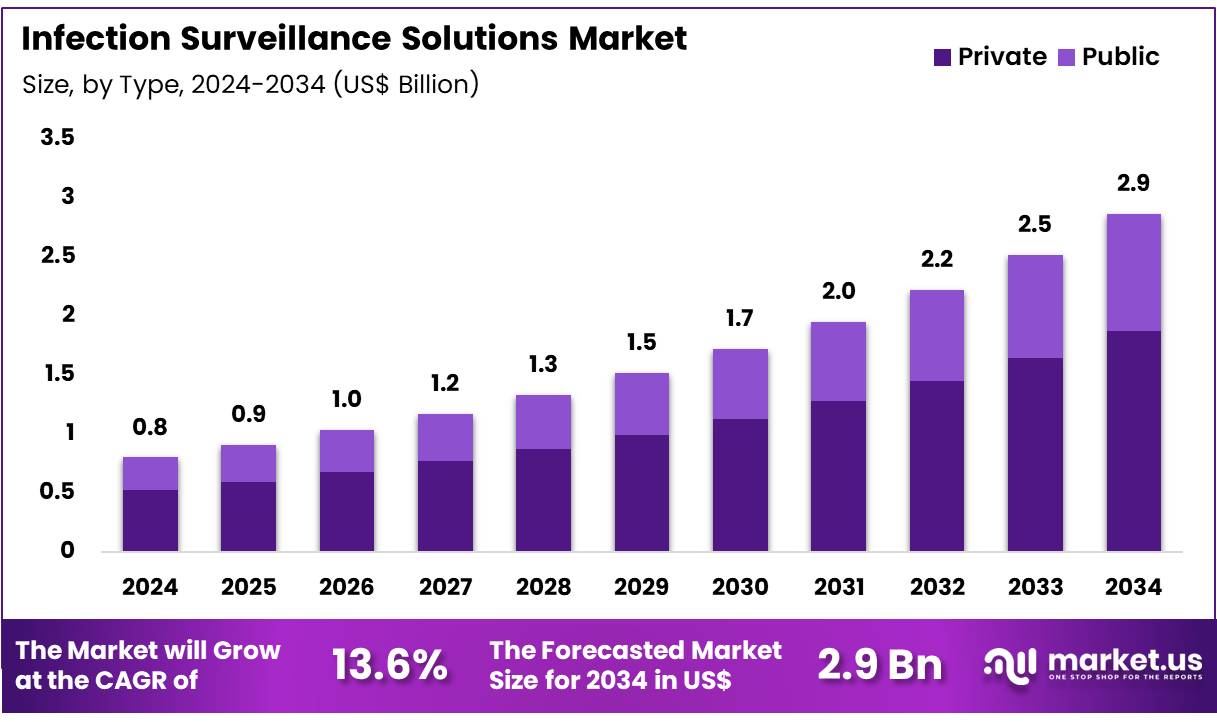
The Global Infection Surveillance Solutions Market size is expected to be worth around US$ 2.9 Billion by 2034 from US$ 0.8 Billion in 2024, growing at a CAGR of 13.6% during the forecast period 2025 to 2034. In 2024, North America led the market, achieving over 46.2% share with a revenue of US$ 0.1 Billion.
The growing emphasis on patient safety, infection prevention, and antimicrobial stewardship is driving demand for advanced infection surveillance solutions across healthcare systems. Hospitals and public health agencies are increasingly adopting real-time surveillance platforms integrated with electronic health records (EHRs), artificial intelligence, and predictive analytics to identify healthcare-associated infections (HAIs), monitor antimicrobial resistance (AMR), and strengthen outbreak response.
Government initiatives supporting digital health infrastructure and standardized infection reporting are further accelerating implementation of surveillance technologies. The World Health Organization (WHO) has also introduced updated practical guidance for national and facility-level HAI surveillance, encouraging countries to strengthen infection prevention and control (IPC) programs through standardized monitoring and reporting.
The increasing burden of HAIs and antimicrobial resistance continues to highlight the importance of robust surveillance systems. According to the U.S. Centers for Disease Control and Prevention (CDC), approximately 1 in 31 hospital patients has at least one healthcare-associated infection on any given day.
Additionally, the CDC estimates that more than 2.8 million antimicrobial-resistant infections occur annually in the United States, reinforcing the need for advanced surveillance solutions that enable early detection, timely intervention, and improved infection control across healthcare facilities. These trends are expected to support sustained investment in infection surveillance technologies over the coming years.
Key Takeaways
- In 2024, the infection surveillance solutions market generated revenue of US$ 0.8 billion and is projected to reach US$ 2.9 billion by 2034, expanding at a CAGR of 13.6% during the forecast period.
- Based on type, the market is segmented into private and public solutions. Among these, the private segment dominated the market in 2023, accounting for 65.3% of the total market share.
- By component, the market is categorized into software and services. The software segment held the leading position, capturing a significant 70.4% share of the market.
- In terms of infection type, the market is segmented into surgical site infections (SSI), bloodstream infections (BSI), urinary tract infections (UTI), respiratory/pulmonary infections, and others. The surgical site infections (SSI) segment emerged as the largest contributor, accounting for 35.9% of the overall market revenue.
- Based on end user, the market is divided into hospitals, long-term care facilities, specialty centers, clinics/outpatient facilities, and others. Among these, the hospitals segment led the market with a 48.3% revenue share.
- Regionally, North America dominated the global infection surveillance solutions market, securing a 46.2% market share in 2024.
Statistical Information
- About 1 in 31 hospitalized patients in the United States has at least one healthcare-associated infection (HAI) on any given day.
- Clostridioides difficile infections (CDI) declined by 11% in U.S. acute care hospitals between 2023 and 2024, reflecting continued improvements in infection surveillance and prevention.
- Catheter-associated urinary tract infections (CAUTIs) decreased by 10% in U.S. acute care hospitals from 2023 to 2024.
- Central line-associated bloodstream infections (CLABSIs) fell by 9% across U.S. acute care hospitals between 2023 and 2024.
- Hospital-onset MRSA bloodstream infections dropped by 7% in U.S. acute care hospitals during 2023–2024.
- Ventilator-associated events (VAEs) declined by 2% in U.S. acute care hospitals between 2023 and 2024, according to CDC surveillance data.
- Inpatient rehabilitation facilities reported an 18% reduction in hospital-onset Clostridioides difficile infections during 2024 compared with 2023.
- Long-term acute care hospitals achieved a 23% reduction in ventilator-associated events (VAEs) between 2023 and 2024, highlighting improvements in infection surveillance and prevention practices.
- The World Health Organization (WHO) reported that the South-East Asia and Western Pacific regions collectively recorded more than one million dengue cases in 2024, underscoring the growing demand for real-time surveillance platforms.
- Singapore’s National Environment Agency also reported over 13,600 dengue cases in 2024, reflecting the increasing importance of integrated surveillance, predictive analytics, and rapid response systems across the region.
Regional Analysis
North America dominated the global infection surveillance solutions market in 2024, accounting for 46.2% of total revenue. The region benefits from advanced healthcare infrastructure, widespread adoption of electronic health records (EHRs), and strong government support for infection prevention and antimicrobial stewardship.
Healthcare providers are increasingly implementing AI-powered surveillance platforms to identify healthcare-associated infections (HAIs), monitor antimicrobial resistance (AMR), and improve outbreak response through real-time data analytics.
The U.S. Centers for Disease Control and Prevention (CDC) continues to strengthen national surveillance through programs such as the National Healthcare Safety Network (NHSN), enabling hospitals to benchmark infection rates and improve patient safety. These initiatives, combined with increasing investments in digital health and interoperability, continue to support the region’s market leadership.
Asia Pacific is projected to register the fastest CAGR during the forecast period, driven by rising investments in public health surveillance, laboratory modernization, and infectious disease preparedness. Governments across China, India, Singapore, Australia, and Southeast Asia are expanding digital disease monitoring systems to strengthen early outbreak detection and response capabilities.
According to the World Health Organization (WHO), over 7.6 million dengue cases were reported globally by April 2024, with the South-East Asia and Western Pacific regions experiencing substantial increases, reinforcing the need for real-time surveillance systems and integrated public health data platforms. These developments are expected to accelerate the adoption of infection surveillance solutions across the region.
Emerging Trends
- Automation through EHR integration is becoming a major trend. The CDC is expanding NHSN with FHIR-based automated reporting, allowing hospitals to transfer infection surveillance data directly from electronic health records. This reduces manual reporting, improves data quality, and enables faster clinical decision-making.
- Antimicrobial stewardship is driving surveillance adoption. As of January 1, 2025, 4,362 U.S. acute care hospitals had submitted antimicrobial use data to the CDC’s NHSN Antimicrobial Use Option. Healthcare providers are increasingly using surveillance platforms to benchmark antibiotic prescribing and reduce inappropriate antibiotic use.
- AI and digital quality measures are reshaping infection monitoring. The CDC is developing automated digital measures within NHSN to improve patient safety surveillance, enabling hospitals to detect bloodstream infections and other healthcare-associated infections more quickly through algorithm-based analytics.
- Global genomic surveillance is expanding rapidly. The WHO’s GLASS program collected standardized antimicrobial resistance data from 104 countries in 2023 and 110 countries between 2016 and 2023, supporting broader adoption of genomic surveillance platforms for infection monitoring and resistance tracking.
- Healthcare systems are focusing on surveillance interoperability. NHSNCoLab promotes automated connectivity between hospitals and CDC using standardized APIs, supporting real-world testing of surveillance measures for sepsis, respiratory pathogens, neonatal infections, antimicrobial use, and bloodstream infections while reducing reporting burden.
Use Cases
- Hospital infection prevention programs use surveillance software to identify healthcare-associated infections early, benchmark infection rates, and evaluate infection control performance. The CDC states that NHSN is the most widely used HAI surveillance system in the United States, supporting national patient safety initiatives.
- Antibiotic stewardship teams rely on infection surveillance platforms to monitor prescribing patterns. The CDC estimates that about 30% of antibiotics prescribed in U.S. acute care hospitals are unnecessary or suboptimal, making surveillance tools essential for improving prescribing practices.
- Long-term care facilities use surveillance systems to monitor antibiotic consumption and resistance trends. According to the CDC, approximately 50% of long-term care facility residents receive at least one antibiotic each year, increasing the need for continuous antimicrobial surveillance and stewardship programs.
- Regional public health agencies use integrated surveillance data to detect outbreaks, monitor disease patterns, and coordinate responses across healthcare facilities. NHSN enables standardized reporting that supports state, regional, and national monitoring of healthcare-associated infections and patient safety indicators.
- Healthcare organizations increasingly deploy automated surveillance systems to support quality reporting and regulatory compliance. CDC’s NHSN supports CMS quality programs while enabling electronic reporting of bloodstream infections, antimicrobial use, respiratory pathogens, and other patient safety events through standardized digital workflows.
Frequently Asked Questions About Infection Surveillance Solutions
- What are infection surveillance solutions?
Infection surveillance solutions are digital platforms that help hospitals and public health organizations detect, monitor, and prevent healthcare-associated infections (HAIs). They collect data from laboratories, electronic health records, and clinical systems to identify infection trends, generate alerts, and support faster infection control decisions while improving patient safety. - What is driving the growth of the infection surveillance solutions market?
The market is growing due to the increasing prevalence of healthcare-associated infections, rising antimicrobial resistance, greater adoption of electronic health records, and stricter government reporting requirements. Healthcare providers are also investing in AI-powered analytics and automated surveillance systems to improve infection prevention and outbreak response. - Which healthcare facilities benefit the most from infection surveillance solutions?
Hospitals are the largest users because they manage high patient volumes and follow strict infection reporting standards. Long-term care facilities, specialty centers, outpatient clinics, and public health agencies also use these solutions to monitor infection trends, improve patient outcomes, and strengthen antimicrobial stewardship programs. - How does artificial intelligence improve infection surveillance?
Artificial intelligence analyzes large volumes of clinical and laboratory data in real time, enabling earlier detection of unusual infection patterns and potential outbreaks. AI also reduces manual review, enhances predictive analytics, and helps infection prevention teams make faster and more informed clinical decisions. - What role do electronic health records play in infection surveillance?
Electronic health records provide continuous clinical data that integrates with infection surveillance software for automated monitoring. This improves reporting accuracy, reduces administrative workload, enables earlier identification of infection risks, and supports regulatory compliance as well as healthcare quality improvement initiatives. - Which infections are commonly monitored using infection surveillance solutions?
These platforms commonly monitor surgical site infections, bloodstream infections, catheter-associated urinary tract infections, respiratory infections, Clostridioides difficile infections, and antimicrobial-resistant organisms. Continuous monitoring enables healthcare facilities to detect outbreaks early and implement timely infection prevention measures. - What is the future outlook for the infection surveillance solutions market?
The market is expected to experience steady growth as healthcare systems increasingly adopt cloud-based platforms, AI-driven analytics, genomic surveillance, and interoperable digital health systems. Rising investments in pandemic preparedness and antimicrobial resistance monitoring will continue creating long-term growth opportunities.
Conclusion
The global infection surveillance solutions market is poised for significant growth as healthcare providers prioritize patient safety, infection prevention, and antimicrobial stewardship. The increasing adoption of AI-enabled analytics, electronic health record integration, and automated surveillance platforms is improving the early detection and management of healthcare-associated infections.
Government initiatives promoting standardized reporting, digital health infrastructure, and antimicrobial resistance monitoring continue to strengthen market expansion. North America remains the leading regional market, while Asia Pacific is expected to witness the fastest growth due to rising investments in public health surveillance.
Continuous technological advancements and stronger regulatory support are expected to create substantial opportunities for infection surveillance solution providers throughout the forecast period.




















