



Overview
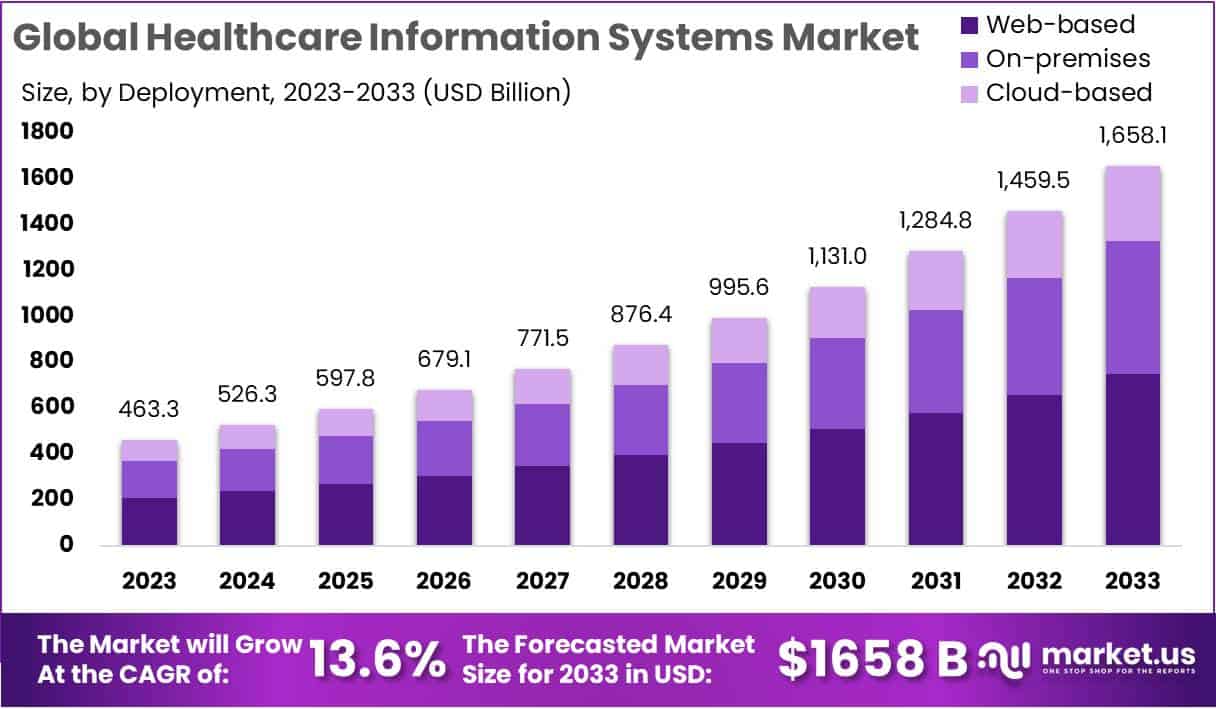
The Global Healthcare Information Systems Market Size is expected to be worth around US$ 1658.1 Billion by 2033, from US$ 463.3 Billion in 2023, growing at a CAGR of 13.6% during the forecast period from 2024 to 2033.
Healthcare information systems are becoming a cornerstone of modern healthcare by enabling hospitals, clinics, laboratories, pharmacies, and public health agencies to securely capture, manage, and exchange patient information. The growing demand for connected care, electronic health records (EHRs), telehealth, and data-driven clinical decision-making is encouraging healthcare providers to modernize their digital infrastructure.
Governments and healthcare organizations are also prioritizing interoperability and standardized data exchange to improve care coordination, reduce administrative burden, and strengthen patient safety.
The widespread adoption of certified electronic health record systems continues to accelerate digital transformation. According to the U.S. Centers for Disease Control and Prevention (CDC), 95.0% of office-based physicians had adopted an electronic health record system in 2024, with 83.6% using a certified EHR system, reflecting the maturity of digital health adoption across clinical practices.
Healthcare information systems are further evolving through cloud computing, artificial intelligence, cybersecurity enhancements, and application programming interfaces (APIs) that allow seamless communication between healthcare platforms.
The U.S. Office of the National Coordinator for Health Information Technology (ONC) reported that over 99% of non-federal acute care hospitals had adopted certified EHRs by 2024, while approximately 9 in 10 hospitals enabled patient electronic access to health information through APIs, improving patient engagement and secure information sharing.
As healthcare systems worldwide continue investing in interoperability, digital records, and real-time data exchange, healthcare information systems are expected to play a critical role in improving operational efficiency, supporting value-based care, and delivering more personalized patient experiences.
Key Takeaways
- The Healthcare Information Systems Market is projected to reach US$ 1,658.1 billion by 2033, expanding at a CAGR of 13.6% during the forecast period from 2024 to 2033.
- Web-based deployment accounted for the largest share of 45.1%, driven by its accessibility, ease of use, and ability to streamline healthcare workflows.
- The Services segment led the market with a 48.0% share, supported by strong demand for implementation, consulting, training, maintenance, and technical support services.
- Hospitals emerged as the leading end-user segment, capturing 77.4% of the market due to their increasing reliance on advanced healthcare information systems for efficient patient care and operational management.
- North America held the largest regional market share of 54.8% in 2023, supported by widespread digital health adoption, advanced healthcare infrastructure, and ongoing technological innovation.
Statistical Information
- More than 99% of U.S. non-federal acute care hospitals had adopted certified Electronic Health Records (EHRs) by 2024, demonstrating the near-universal implementation of digital patient record systems across hospitals.
- Approximately 90% of U.S. hospitals enabled patients to access their health information through an API in 2024, reflecting strong progress toward patient-centered digital healthcare and secure data sharing.
- 71% of U.S. hospitals used standards-based APIs (FHIR) to provide patient access to health information in 2024, supporting greater interoperability between healthcare providers and third-party health applications.
- About 67% of hospitals allowed patients to electronically submit patient-generated health data (PGHD) into EHR systems in 2024, expanding the use of remote monitoring and connected care.
- 48% of all U.S. hospitals enabled patient-generated health data submission using standards-based APIs in 2024, highlighting the increasing integration of wearable devices and digital health applications into clinical workflows.
- 74% of hospitals using one of the top three EHR platforms supported standards-based APIs for patient access, compared with 48% of hospitals using other EHR systems, illustrating the influence of leading EHR vendors on interoperability.
- 75% of medium and large hospitals implemented standards-based APIs for patient access, compared with 67% of smaller hospitals, indicating stronger digital infrastructure among larger healthcare organizations.
- 53% of medium and large hospitals supported standards-based API submission of patient-generated health data, while the figure was 45% among small hospitals in 2024.
- The CMS Interoperability and Prior Authorization Final Rule requires affected U.S. health insurers to implement three FHIR-based APIs Provider Access, Payer-to-Payer, and Prior Authorization APIs to improve secure health information exchange and automate prior authorization processes.
- Certified EHR adoption in U.S. hospitals has increased more than tenfold over the past 15 years, rising from fewer than 10% of hospitals using fully electronic records to over 99% in 2024.
Regional Analysis
In 2023, North America accounted for the largest share of the Healthcare Information Systems Market at 54.8%, representing a market value of US$ 253.8 billion. The region’s leadership is supported by its advanced healthcare infrastructure, widespread adoption of electronic health records (EHRs), and continued investments in digital health technologies.
Government initiatives promoting interoperability, secure health information exchange, and standardized health IT have accelerated the implementation of healthcare information systems across hospitals and clinical settings. The U.S. Office of the National Coordinator for Health Information Technology (ONC) continues to advance nationwide health information exchange and the adoption of certified health IT, further strengthening the region’s digital healthcare ecosystem.
Asia Pacific is projected to register the fastest growth during the forecast period, driven by expanding healthcare infrastructure, rising healthcare expenditures, and strong government-led digital health initiatives across emerging economies. Increasing investments in hospital modernization, cloud-based healthcare platforms, telehealth services, and electronic medical records are fueling market expansion.
According to the World Health Organization (WHO), countries across the region are actively implementing national digital health strategies to improve healthcare accessibility, interoperability, and data-driven decision-making, creating significant opportunities for healthcare information system providers.
Emerging Trends
- Nationwide health data exchange is expanding rapidly. The U.S. Trusted Exchange Framework and Common Agreement (TEFCA) exchanged 464 million health documents during 2025, up from approximately 10 million documents before 2025. This reflects accelerating demand for interoperable healthcare information systems that securely connect hospitals, clinics, laboratories, and payers.
- Healthcare organizations are adopting unified interoperability networks. TEFCA now supports standardized exchange across providers, payers, public health agencies, and patients through a single nationwide framework instead of multiple point-to-point connections. This trend is reducing integration complexity while improving secure access to patient records across healthcare settings.
- FHIR-based APIs are becoming the preferred standard for healthcare systems. Government interoperability initiatives increasingly promote Fast Healthcare Interoperability Resources (FHIR) to enable secure, real-time exchange of clinical data. The shift is helping healthcare providers modernize digital infrastructure while improving system compatibility and patient information accessibility.
- Hospitals are preparing for broader nationwide interoperability participation. According to a 2025 American Hospital Association survey, more than 40% of U.S. hospitals are already aware of and participating in TEFCA, indicating growing confidence in standardized health information exchange networks.
- Government policies are driving secure digital healthcare ecosystems. Recent interoperability initiatives emphasize secure information sharing, stronger privacy controls, and common technology standards. These efforts are encouraging healthcare providers to upgrade information systems that support coordinated care, public health reporting, and digital patient services.
Use Cases
- Cross-hospital patient record sharing is becoming more efficient. Healthcare information systems now enable physicians to securely retrieve patient records from different healthcare organizations, reducing duplicate diagnostic tests, improving treatment continuity, and helping clinicians make faster decisions during emergency and routine care.
- Healthcare providers are improving care coordination through interoperable networks. Modern information systems allow hospitals, specialists, laboratories, pharmacies, and insurers to exchange clinical information using standardized formats, supporting faster referrals, smoother transitions of care, and better patient outcomes across healthcare organizations.
- Public health agencies are using connected healthcare systems for faster response. Interoperable healthcare information systems simplify electronic reporting of diseases, laboratory results, and public health data, enabling authorities to monitor health events more efficiently and respond quickly to emerging public health challenges.
- Digital patient access is becoming a core healthcare service. Modern healthcare information systems allow individuals to securely view, access, and share their medical information electronically through standardized digital platforms, improving patient engagement while supporting informed healthcare decisions and long-term disease management.
- Administrative workflows are becoming more automated. Healthcare information systems increasingly support digital processing of payment activities, healthcare operations, government benefit determinations, and authorization workflows, reducing paperwork while improving operational efficiency and data accuracy throughout healthcare organizations.
Frequently Asked Questions About Healthcare Information Systems.
- What factors are driving the Healthcare Information Systems Market?
The market is expanding due to rising adoption of electronic health records (EHRs), increasing healthcare digitization, stronger government support for interoperability, growing cloud adoption, and the need for secure health data exchange. Hospitals are also investing heavily in modern information systems to improve patient outcomes and operational performance. - What are the major components of a Healthcare Information System?
A Healthcare Information System typically includes electronic health records, hospital information systems, laboratory information systems, pharmacy management, radiology information systems, billing platforms, and clinical decision support tools. Together, these components improve data accuracy, workflow efficiency, and communication among healthcare professionals. - Why are hospitals investing in Healthcare Information Systems?
Hospitals use healthcare information systems to streamline clinical workflows, reduce paperwork, improve patient safety, manage healthcare resources, and enhance communication across departments. Digital systems also help providers deliver faster diagnoses, support evidence-based treatment decisions, and comply with healthcare regulations. - How does cloud technology benefit Healthcare Information Systems?
Cloud-based healthcare information systems provide healthcare organizations with scalable infrastructure, lower maintenance costs, improved data accessibility, automatic software updates, and secure remote access. These advantages enable providers to manage growing healthcare data efficiently while supporting digital transformation initiatives. - What role does interoperability play in Healthcare Information Systems?
Interoperability enables different healthcare applications and organizations to securely exchange patient information using standardized formats. This improves care coordination, reduces duplicate testing, enhances clinical decision-making, and allows healthcare professionals to access accurate patient records across multiple healthcare settings. - What is the future outlook for the Healthcare Information Systems Market?
The market is expected to experience sustained growth as healthcare providers increase investments in artificial intelligence, cloud computing, digital health platforms, interoperability, and real-time data exchange. Continued government initiatives supporting health IT modernization will further accelerate adoption across global healthcare systems.
Conclusion
Healthcare information systems are transforming the global healthcare sector by improving patient data management, interoperability, clinical workflows, and operational efficiency. Growing adoption of electronic health records, cloud-based platforms, APIs, and digital health technologies is enabling healthcare providers to deliver more connected and patient-centered care.
Government initiatives promoting secure health information exchange and healthcare digitization continue to strengthen market growth, while hospitals remain the primary adopters of advanced information systems. As investments in artificial intelligence, cybersecurity, and interoperable healthcare infrastructure increase, the market is expected to witness sustained expansion, supporting better clinical outcomes, enhanced decision-making, and more efficient healthcare delivery worldwide.




















