


Report Overview
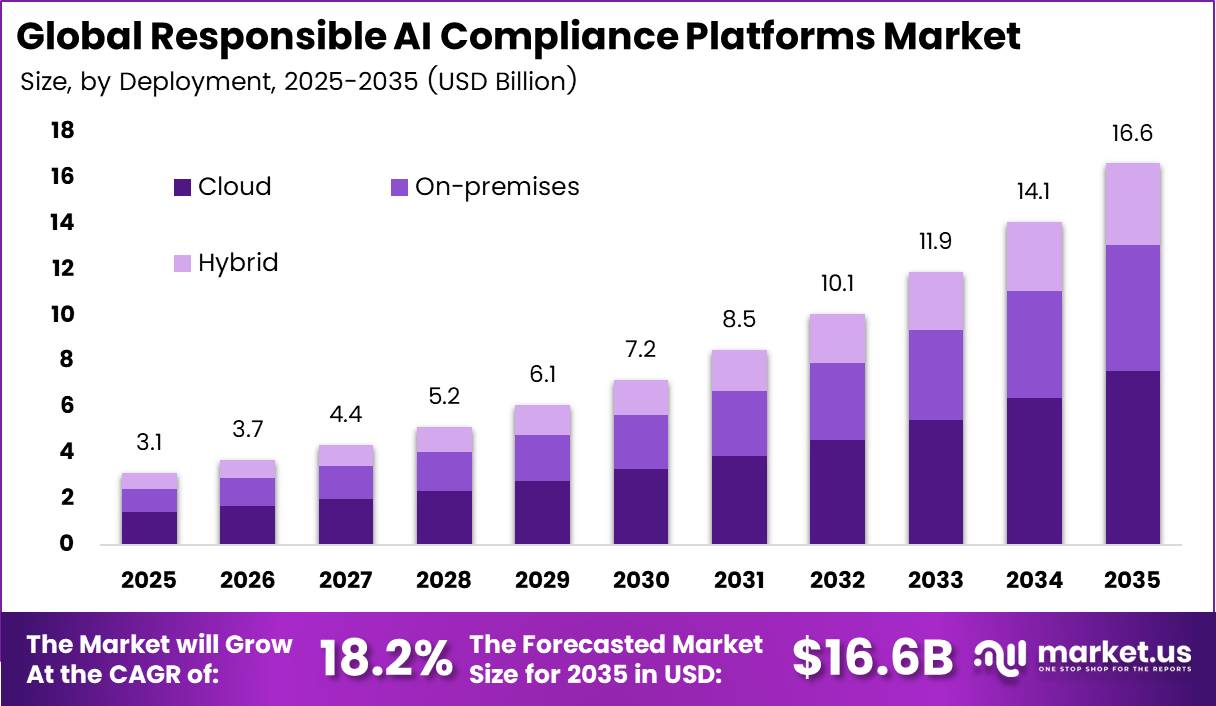
In 2025, the Global Responsible AI Compliance Platforms Market was valued at USD 3.1 billion. The market is projected to grow at a CAGR of 18.2% during 2026–2035, reaching approximately USD 16.6 billion by 2035. North America dominated the global market in 2025, accounting for more than 43.0% of the total market share and generating approximately USD 3.1 billion in revenue.
Fast AI use in big companies drives this growth. According to the WTO, AI-related goods such as chips, servers, and telecom gear grew 20% year on year in early 2025. They drove nearly half of all trade growth. Every new AI system adds risk that firms must track, test, and report. ServiceNow’s SEC-reported subscription revenue rose 21% to USD 12.88 billion in 2025.
North America region holds the world’s biggest AI build-out. The IEA reported that US data centers used 183 TWh of power in 2024, more than 4% of national demand. The IEA expects this to reach 426 TWh by 2030. The US also held 45% of global data center power use in 2024. Large R&D budgets add to this lead. Microsoft’s 10-K shows R&D of USD 32.49 billion in FY2025, or 12% of revenue.
Key Takeaways
- The Responsible AI Compliance Platforms Market stood at USD 3.1 billion in 2025 and will reach USD 16.6 billion by 2035. The market will grow at a CAGR of 18.2% during the forecast period.
- In Component, Software/Platform leads with a 68.0% share.
- In Deployment Mode, Cloud-Based leads with a 72.0% share.
- In Functionality, AI Governance and Policy Management lead with a 23.0% share.
- In AI Technology, Generative AI and Large Language Models lead with a 34.0% share.
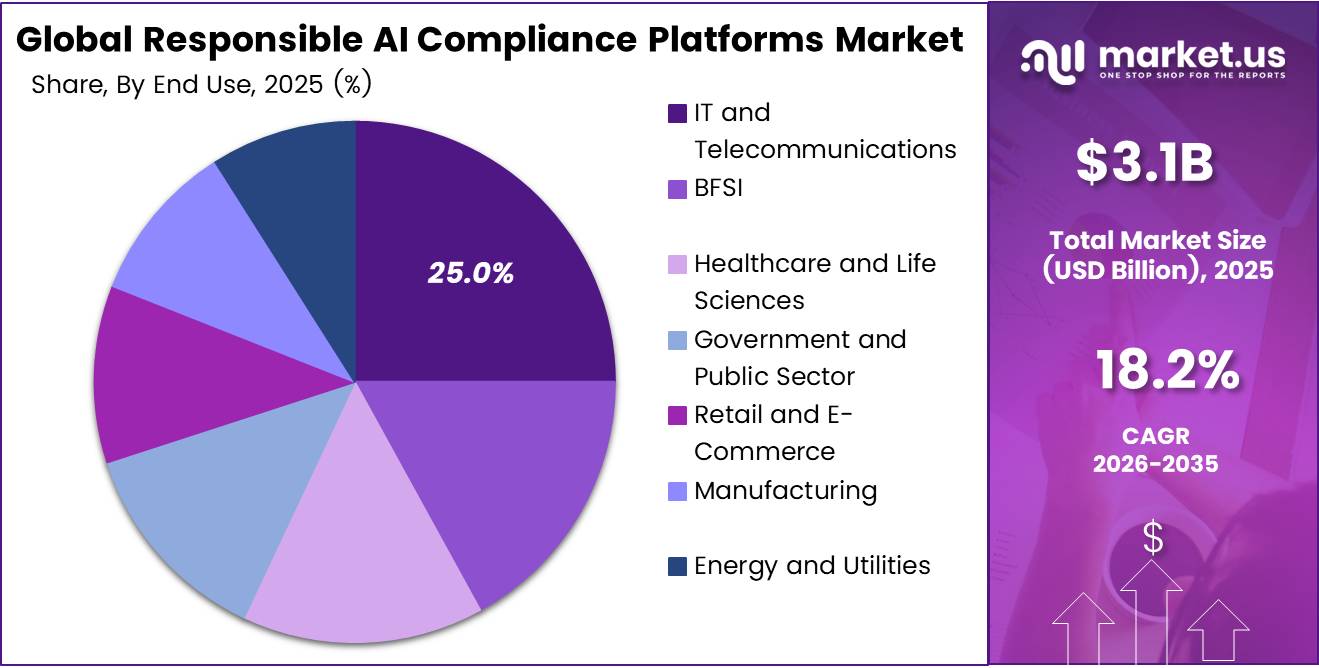
- In End-Use Industry, Information Technology and Telecommunications lead with a 25.0% share.
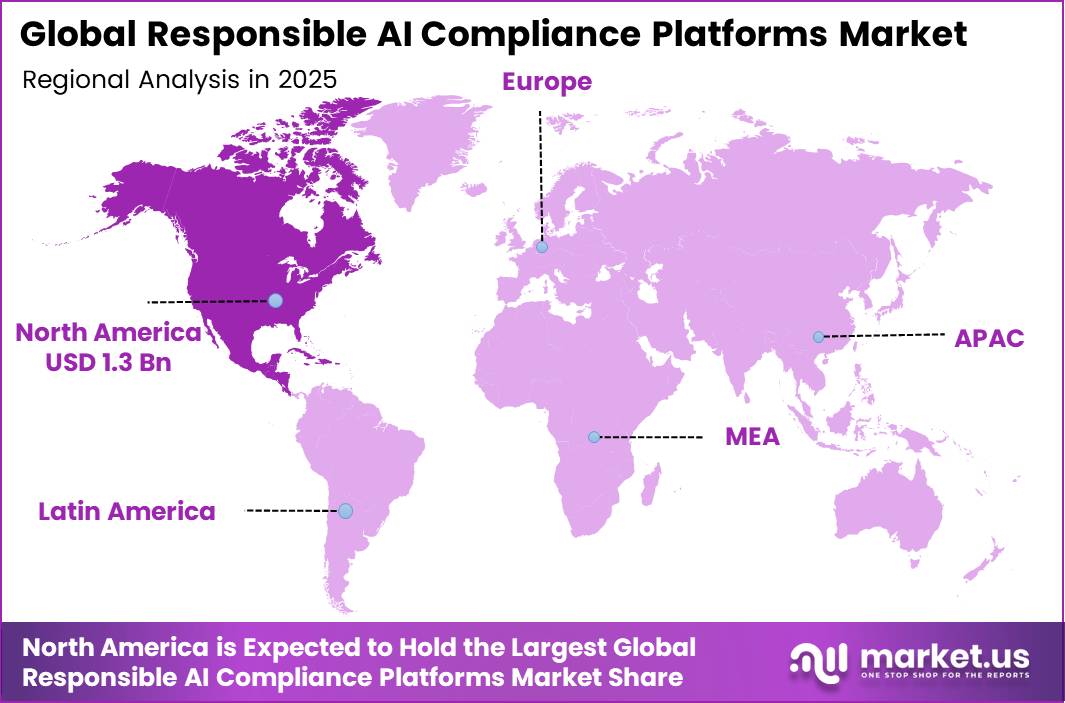
- North America leads with a 43.0% share and USD 1.3 billion in revenue.
By Component
Software/Platform dominates with 68.0% due to shared controls and repeatable compliance checks.
Software/Platform leads the supplied component split because buyers need a central place to track AI systems, assign owners, and record approvals. A shared platform can replace scattered spreadsheets and help legal, risk, and technical teams follow consistent rules.
IAPP’s 2025 report found that 50% of AI governance professionals typically worked within ethics, compliance, privacy, or legal teams. That structure strengthens the case for software that links business oversight with technical reviews.
Services offer a plausible fastest-growth opportunity, although the available evidence does not establish a growth ranking. IAPP found that 23.5% of respondents viewed finding qualified AI professionals as a challenge when delivering AI.
By Deployment Mode
Cloud-Based dominates with 72.0% due to faster setup and shared remote access.
Cloud-Based leads the supplied deployment mix because organizations can introduce common controls without installing a separate platform at every location. Teams can access shared records, review approvals, and manage policy changes across offices.
Eurostat reports that 52.7% of EU enterprises purchased cloud computing services in 2025. Adoption increased by 7.4 percentage points compared with 2023. These figures measure broader business cloud use, not responsible AI platform demand. However, they show a growing base of organizations that already buy cloud services and could add compliance tools through familiar purchasing and operating models.
Hybrid presents a credible fastest-growing candidate, rather than a verified leader. Its appeal comes from combining shared oversight with local control over sensitive records. A buyer could retain confidential model data internally while sharing approval status through a central service.
By Functionality
AI Governance and Policy Management dominates with 23.0% due to clear ownership and common approval rules.
AI Governance and Policy Management leads the supplied functionality split because organizations need clear rules before they can apply detailed technical checks. Managers must identify who owns each AI system, which uses they permit, and when teams need further approval.
The EU AI Act strengthens the financial case for organized oversight. For prohibited practices, its general corporate penalty ceiling reaches €35 million or 7% of worldwide annual turnover from the preceding financial year, whichever is higher. Smaller businesses receive a different ceiling rule.
By AI Technology
Generative AI and Large Language Models dominate with 34.0% due to widespread assistants and varied output risks.
Generative AI and Large Language Models lead the supplied technology split because businesses can apply them across writing, coding, search, and customer support. That broad use creates a strong case for controls that check access, review outputs, and record approvals.
Microsoft’s 2025 annual report states that GitHub Copilot had more than 20 million users. This product-level figure illustrates adoption scale; it does not measure spending on responsible AI compliance platforms.
AI Agents and Autonomous Systems stand out as a potential fastest-growing category, not a confirmed growth leader. Microsoft reported more than 230,000 organizations using Copilot Studio to extend its workplace assistant or build agents. As agents take actions rather than only suggest answers, buyers may need clearer permissions, action records, and human approval points.
By End-Use Industry
Information Technology and Telecommunications dominate with 25.0% due to extensive AI development and service delivery.
Information Technology and Telecommunications lead the supplied industry split because these businesses both develop AI services and use AI within their own operations. Their oversight needs can cover product development, customer support, software tools, and external model suppliers.
Eurostat found that 62.52% of EU enterprises in the broader information and communication sector used AI in 2025. This high adoption level supports a substantial need for organized oversight, although it does not establish compliance platform market share.
Technology providers also need repeatable reviews when they release updates or serve customers with different requirements. Shared model records and approval processes can help teams answer buyer questions without rebuilding the evidence for each contract.
Key Market Segments
By Component
- Software/Platform
- Services
By Deployment Mode
- Cloud-Based
- On-Premises
- Hybrid
By Functionality
- AI Governance and Policy Management
- AI Risk Assessment and Impact Assessment
- Regulatory Compliance Management
- AI Model Inventory and Lifecycle Management
- AI Audit, Documentation, and Reporting
- AI Monitoring, Testing, and Validation
- Others
By AI Technology
- Generative AI and Large Language Models
- Machine Learning Models
- AI Agents and Autonomous Systems
- Natural Language Processing Models
- Computer Vision Models
- Predictive Analytics and Decision Intelligence Models
- Others
By End-Use Industry
- Information Technology and Telecommunications
- Banking, Financial Services, and Insurance (BFSI)
- Healthcare and Life Sciences
- Government and Public Sector
- Retail and E-Commerce
- Manufacturing
- Energy and Utilities
- Other
Geopolitical Impact Analysis
These platforms are software, but they run on cloud capacity built from traded chips and servers. The WTO reports that world merchandise trade grew 4.6% in 2025, almost double its earlier forecast. AI-enabling goods made up about 42% of that growth. Hardware shocks therefore pass quickly into cloud hosting costs for compliance vendors.
Supply is highly concentrated. The WTO notes that Asia handles 62% of all AI-enabling trade. These goods rose from about 13% of world trade in 2023 to nearly 17% by the end of 2025. Tariffs or export rules on Asian chips and servers raise the cost of GPU capacity. Vendors that test and monitor large language models feel this first.
Pressure on trade and energy keeps rising. The WTO cut its 2026 goods trade forecast to 1.9%, citing tariffs, high energy prices, and choke points such as the Strait of Hormuz. Real first-quarter 2026 growth still ran at 3.2%, helped by AI demand. Higher energy prices raise data center running costs. Platform providers then pass these costs on through subscription prices.
Regulatory splits add a further cost. Each country builds its own AI rules, so global firms must map controls country by country. This pushes demand toward regulatory compliance modules. It also lifts on-premises and hybrid deployments where data must stay inside national borders.
Regional Analysis
North America dominates the Responsible AI Compliance Platforms Market, holding a 43.0% share and generating USD 1.3 billion in revenue. The US hosts most global AI model builders and cloud providers, and the IEA estimates that the US holds about half of global installed data center capacity.
Berkeley Lab projects that US data centers could use 11.8% of all US electricity by 2030, or 649 TWh in its reference case. That scale of AI use creates many models that need inventory, testing and audit trails. US vendors also lead platform spending.
Asia Pacific is the fastest-growing region, with an estimated USD 0.6 billion in revenue. China, Japan, and South Korea all have AI rules or guidelines. India’s IndiaAI Mission has a budget of 10,372 crore rupees. Large IT service firms in India also build governance practices for global clients. Australia adds demand through its voluntary AI safety standard.
Europe ranks second, with an estimated USD 0.8 billion in revenue. The EU AI Act creates the world’s first broad AI law. It allows fines of up to 7% of global turnover for banned AI practices. Germany, France, and the UK lead adoption in banking, cars, and public services. SAP and Saidot give the region strong local vendors.
Key Regions and Countries
North America
- US
- Canada
Europe
- Germany
- France
- The UK
- Spain
- Italy
- Rest of Europe
Asia Pacific
- China
- Japan
- South Korea
- India
- Australia
- Rest of APAC
Latin America
- Brazil
- Mexico
- Rest of Latin America
Middle East and Africa
- GCC
- South Africa
- Rest of MEA
Market Dynamics
Drivers
| Driver | (~) % Impact on CAGR Forecast | Geographic Relevance | Impact Timeline |
|---|---|---|---|
| Binding AI compliance obligations | +1.8% | European Union-led; global spillover | Short term (2 years or less) |
| Enterprise AI deployment growth | +1.4% | Global; strongest in North America and Europe | Short term (2 years or less) |
| Escalating AI incident exposure | +1.1% | Global regulated industries | Short term (2 years or less) |
| AI procurement control requirements | +1.0% | North America, Europe and Asia-Pacific | Medium term (2 to 4 years) |
| Governance standard convergence | +0.8% | Global multinational enterprises | Medium term (2 to 4 years) |
| Multi-model estate expansion | +0.7% | Global cloud-intensive economies | Medium term (2 to 4 years) |
Binding AI compliance obligations
The primary demand catalyst is the conversion of responsible-AI governance from discretionary policy work into recurring evidence, monitoring and disclosure workflows: the European Commission records that the EU AI Act entered into force on 1 August 2024.
Eurostat reports that enterprise AI adoption rose from 13.5% in 2024 to 20.0% in 2025, a 6.5-percentage-point increase that enlarged the installed base requiring governance without assuming universal readiness to purchase.
Stanford HAI recorded 59 AI-related regulations issued by United States federal agencies during 2024, more than twice the prior-year count, while reported AI incidents reached 233, up 56.4%; together, these milestones support an estimated +1.8-percentage-point contribution to the 18.2% baseline CAGR through higher recurring revenue.
Restraints
| Restraint | (~) % Impact on CAGR Forecast | Geographic Relevance | Impact Timeline |
|---|---|---|---|
| Fragmented budgets and uncertain ROI | -1.4% | Global midmarket and public sector | Short term (2 years or less) |
| Incumbent GRC suite consolidation | -0.9% | North America and Europe | Medium term (2 to 4 years) |
| Data-residency deployment barriers | -0.7% | Europe, Middle East and Asia-Pacific | Short term (2 years or less) |
| Lengthy enterprise procurement cycles | -0.6% | Global regulated industries | Short term (2 years or less) |
| Platform lock-in concerns | -0.5% | Global multi-cloud enterprises | Medium term (2 to 4 years) |
| Vendor funding constraints | -0.4% | Emerging markets and early-stage ecosystems | Short term (2 years or less) |
Fragmented budgets and uncertain ROI
The principal restraint is the absence of a consistently funded buying centre: compliance, legal, security, data, and model-risk teams frequently recognize the requirement but cannot assign ownership before production-scale AI deployment, freezing platform purchases at the pilot or request-for-proposal stage.
Eurostat found that only 20.0% of eligible EU enterprises used AI in 2025, leaving roughly four-fifths without the operational maturity that normally precedes dedicated governance-platform spending. IBM found that 63% of breached organizations lacked an implemented AI-governance policy or were still developing one, while the World Economic Forum reported that 63% of surveyed employers considered skills gaps a major transformation barrier and 85% planned workforce upskilling.
The resulting approval delays, smaller initial deployments, and pressure to bundle responsible-AI controls into existing risk suites produce an estimated -1.4-percentage-point deduction from the 18.2% baseline CAGR, with the sharpest margin pressure among standalone vendors serving cost-sensitive midmarket accounts.
Challenges
| Challenge | (~) % CAGR Friction Drag | Geographic Relevance | Mitigation Horizon |
|---|---|---|---|
| Cross-functional talent scarcity | -1.2% | Global; acute outside major technology hubs | Medium term (2 to 4 years) |
| Continuous model evaluation drift | -0.7% | Global generative-AI deployments | Long term (4 years or more) |
| Fragmented data lineage | -0.6% | Global legacy enterprises | Medium term (2 to 4 years) |
| Benchmark interoperability gaps | -0.5% | Global multi-model environments | Medium term (2 to 4 years) |
| Third-party observability limits | -0.4% | Cloud-dependent enterprises worldwide | Long term (4 years or more) |
| Evidence integrity maintenance | -0.3% | Highly regulated global sectors | Medium term (2 to 4 years) |
Cross-functional talent scarcity
Responsible-AI platforms require personnel who can translate legal duties into machine-readable controls, validate model behavior, and preserve defensible evidence, yet these combined legal, risk, data-science, and cybersecurity capabilities remain scarce.
The World Economic Forum found that 63% of employers identified skills gaps as a major transformation barrier and that approximately 39% of workers’ core skills could change by 2030. ISC2 reported in 2025 that AI was the most pressing cybersecurity skill need for 41% of respondents, while governance, risk, and compliance skills were needed by 27%.
Its 2024 workforce assessment separately identified a cybersecurity staffing gap of approximately 4.8 million people. NIST’s generative-AI working process involved more than 2,500 contributors and generated over 400 proposed risk-management actions across governance, provenance, testing, and incident disclosure, illustrating the breadth of expertise that customers must operationalize.
This vulnerability creates an estimated -1.2-percentage-point friction drag by extending implementation, increasing services dependency, and forcing vendors to invest in guided workflows, training academies, and preconfigured control mappings before software gross margins can fully scale.
Opportunities
| Opportunity | (~) % Potential CAGR Upside | Geographic Relevance | Execution Window |
|---|---|---|---|
| Agentic AI control planes | +1.3% | North America, Europe and advanced Asia-Pacific | Medium term (2 to 4 years) |
| Embedded compliance APIs | +0.9% | Global software-development ecosystems | Medium term (2 to 4 years) |
| Sector-specific assurance packages | +0.8% | Healthcare, finance, government and infrastructure | Medium term (2 to 4 years) |
| Managed midmarket compliance | +0.6% | Europe, North America and developed Asia-Pacific | Medium term (2 to 4 years) |
| AI supply-chain attestations | +0.5% | Global multinational supply networks | Long term (4 years or more) |
| Insurance-linked risk scoring | +0.3% | North America, Europe and selected financial hubs | Long term (4 years or more) |
Agentic AI control planes
Agentic-AI governance remains an opportunity rather than a current driver because most compliance deployments still catalogue applications and models, whereas autonomous agents require real-time authorization, tool-use restrictions, memory controls, delegation tracing, and intervention policies across every action.
ISO states that ISO/IEC 42001 applies to organizations developing, integrating, using, or managing third-party AI and requires continual performance evaluation and improvement, creating a standards foundation for agent-level policy orchestration.
IBM found that only 34% of organizations with AI-governance policies regularly audited unsanctioned AI, and that 97% of organizations suffering AI-related breaches lacked proper AI access controls, demonstrating substantial white space for runtime enforcement rather than static documentation.
Under a scaled usage-based model, consolidating agent discovery, policy enforcement, and evidence generation into one control plane could plausibly reduce marginal assurance effort by approximately 25%–35%, expand software gross margin by roughly 5–8 percentage points after implementation scale is reached, and add up to +1.3 percentage points above the 18.2% baseline CAGR without assuming any specific market-size figure.
Key Players Analysis
Tier 1 leaders include IBM, Microsoft, ServiceNow, SAP, and Google. They combine large cloud reach with built-in AI governance tools. IBM reported 2025 revenue of USD 67.5 billion and software revenue of USD 29.96 billion. Software now makes up about 45% of IBM’s sales. IBM spent USD 8.32 billion on R&D in 2025, about 12% of revenue, focused on AI, hybrid cloud, and quantum.
Microsoft spent USD 32.49 billion on R&D in FY2025, up 10%, or 12% of revenue. This funds Azure AI safety and Purview compliance tools. ServiceNow grew 2025 total revenue 21% to USD 13.28 billion, with subscription revenue of USD 12.88 billion. Its AI Control Tower places governance inside daily workflows.
Tier 1 players are using large deals to secure data and security layers. ServiceNow paid USD 2.85 billion for Moveworks and USD 7.75 billion in cash for Armis. IBM bought Confluent for an enterprise value of about USD 11 billion. It now links real-time data to its watsonx governance stack.
Tier 2 challengers include OneTrust, Credo AI, Holistic AI, ModelOp, Monitaur, Truyo, Airia, Cranium AI, Relyance AI and Saidot. These firms win with specialist AI risk, audit, and model inventory tools. Credo AI has raised USD 41.3 million in total, including a USD 21 million round. These vendors compete on speed to EU AI Act readiness and depth of policy libraries.
Top Key Players in the Market
- IBM Corporation
- ServiceNow, Inc.
- Truyo, Inc.
- Microsoft Corporation
- OneTrust LLC
- Credo AI, Inc.
- Holistic AI Ltd.
- ModelOp, Inc.
- SAP SE
- Monitaur, Inc.
- Airia, Inc.
- Cranium AI, Inc.
- Relyance AI, Inc.
- Saidot Oy
- Google LLC (Alphabet Inc.)
Recent Developments
- In March 2025, ServiceNow signed a deal to buy Moveworks for USD 2.85 billion in cash and stock, adding an agentic AI assistant and enterprise search to its platform. ServiceNow completed its USD 7.75 billion Armis deal, funded with cash on hand and debt. ServiceNow agreed to buy Armis for about USD 7.75 billion in cash, expanding its cyber exposure and risk workflows.
- In December 2025, IBM agreed to buy Confluent for USD 31 per share, an enterprise value of USD 11 billion, to build a governed data platform for generative AI. IBM completed its USD 11 billion Confluent deal, linking a platform used by more than 6,500 enterprises to watsonx. data.
Report Scope
| Report Features | Description |
|---|---|
| Market Value (2025) | USD 3.1 Billion |
| Forecast Revenue (2035) | USD 16.6 Billion |
| CAGR (2026-2035) | 18.2% |
| Base Year for Estimation | 2025 |
| Historic Period | 2020-2024 |
| Forecast Period | 2026-2035 |
| Report Coverage | Revenue Forecast, Market Dynamics, Competitive Landscape, Recent Developments |
| Segments Covered | By Component (Software/Platform, Services); By Deployment Mode (Cloud-Based, On-Premises, Hybrid); By Functionality (AI Governance and Policy Management, AI Risk Assessment and Impact Assessment, Regulatory Compliance Management, AI Model Inventory and Lifecycle Management, AI Audit, Documentation, and Reporting, AI Monitoring, Testing, and Validation, Others); By AI Technology (Generative AI and Large Language Models, Machine Learning Models, AI Agents and Autonomous Systems, Natural Language Processing Models, Computer Vision Models, Predictive Analytics and Decision Intelligence Models, Others); By End-Use Industry (Information Technology and Telecommunications, Banking, Financial Services, and Insurance (BFSI), Healthcare and Life Sciences, Government and Public Sector, Retail and E-Commerce, Manufacturing, Energy and Utilities, Other) |
| Regional Analysis | North America – US, Canada; Europe – Germany, France, The UK, Spain, Italy, Rest of Europe; Asia Pacific – China, Japan, South Korea, India, Australia, Singapore, Rest of APAC; Latin America – Brazil, Mexico, Rest of Latin America; Middle East & Africa – GCC, South Africa, Rest of MEA |
| Competitive Landscape | IBM Corporation, ServiceNow, Inc., Truyo, Inc., Microsoft Corporation, OneTrust LLC, Credo AI, Inc., Holistic AI Ltd., ModelOp, Inc., SAP SE, Monitaur, Inc., Airia, Inc., Cranium AI, Inc., Relyance AI, Inc., Saidot Oy, Google LLC (Alphabet Inc.) |
| Customization Scope | Customization for segments, region/country-level will be provided. Moreover, additional customization can be done based on the requirements. |
| Purchase Options | We have three licenses to opt for: Single User License, Multi-User License (Up to 5 Users), Corporate Use License (Unlimited Users and Printable PDF) |





























