


Overview
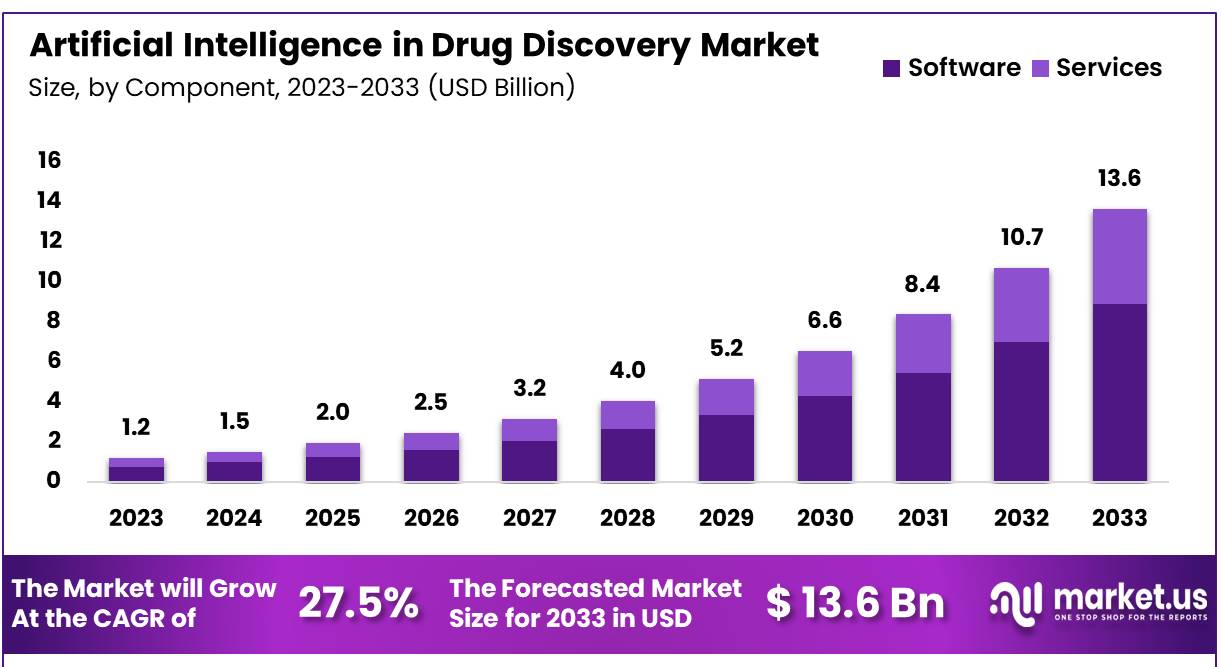
In 2023, the Global Artificial Intelligence in Drug Discovery Market was valued at USD 1.2 Billion. Between 2024 and 2033, this market is estimated to register the highest CAGR of 27.5%. It is expected to reach USD 13.6 Billion by 2033.
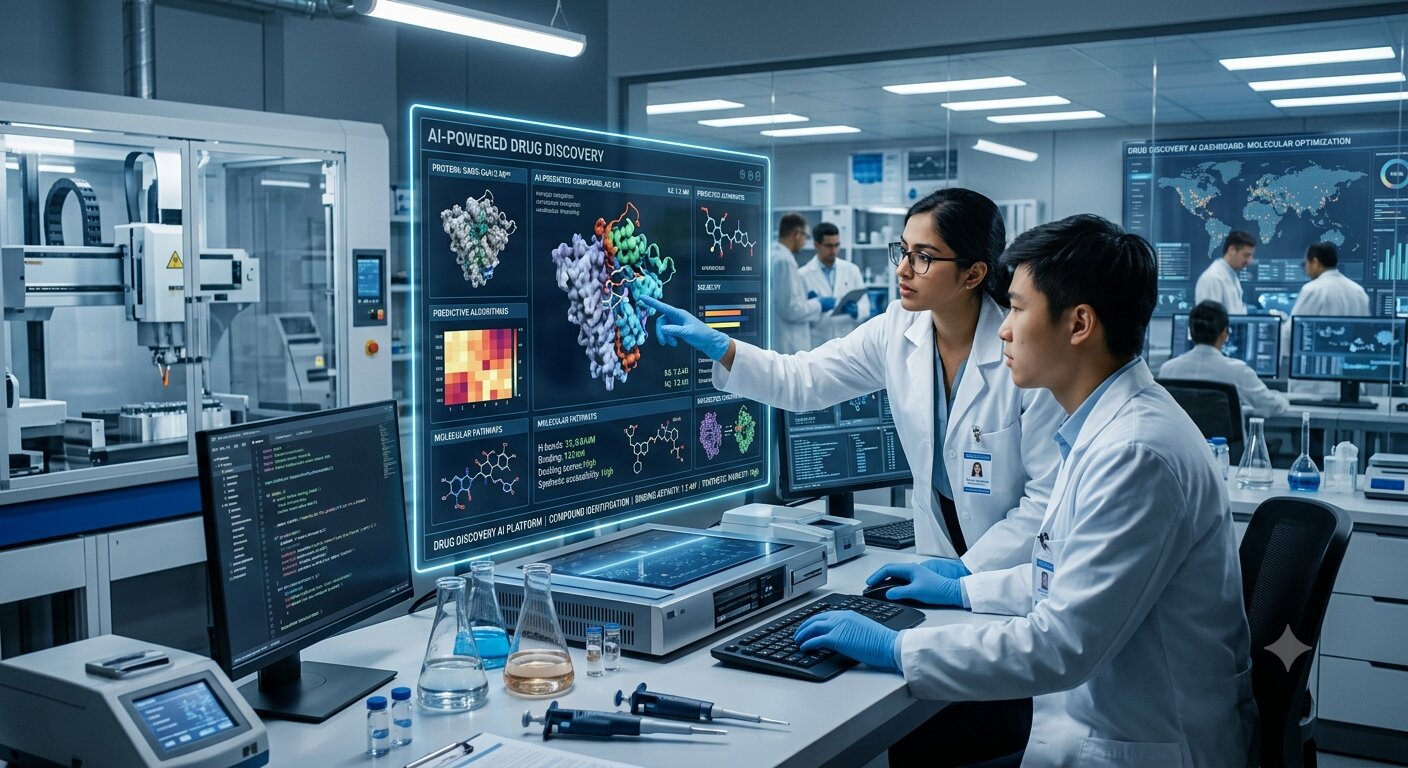
The growing adoption of artificial intelligence (AI) in pharmaceutical research is transforming traditional drug discovery methods by enabling faster analysis of complex biological information, improving candidate identification, and supporting more efficient development of innovative therapies.
AI technologies are increasingly used for molecular design, drug-target prediction, toxicity assessment, and clinical research optimization. The U.S. Food and Drug Administration (FDA) recognizes that AI is being integrated across different stages of the drug development lifecycle, including nonclinical studies, clinical trials, manufacturing, and post-market monitoring.
Pharmaceutical researchers are leveraging AI with genomic, molecular, imaging, and real-world healthcare data to discover new therapeutic opportunities. The National Institutes of Health (NIH) is supporting AI-based biomedical research by making large-scale datasets available for advanced analytics and machine learning applications.
A key development in this field is the NIH Bridge2AI program, which received an investment commitment of $130 million over 4 years to accelerate the use of artificial intelligence in biomedical and behavioral research. Regulatory organizations are also focusing on responsible AI adoption, with the FDA and international partners promoting principles related to transparency, data governance, and patient safety in drug development.
With continued progress in computational biology and data-driven research, AI is expected to play a significant role in improving drug discovery efficiency, reducing research challenges, and supporting the development of advanced medicines.
Key Takeaways
- The Global Artificial Intelligence in Drug Discovery Market was valued at USD 1.2 Billion, and it is projected to grow significantly between 2024 and 2033 with a CAGR of 27.5%, reaching USD 13.6 Billion by 2033.
- Software solutions dominated the AI in drug discovery market, accounting for a 65.4% share due to their increasing adoption for improving research efficiency, data analysis, and drug development processes.
- Machine learning led the technology segment with a 52.7% market share, supported by its ability to analyze complex biological data, identify patterns, and accelerate drug discovery activities.
- Neurodegenerative diseases accounted for a 43.8% market share in 2023, driven by rising research efforts focused on developing advanced treatments for neurological disorders.
- Pharmaceutical and biotechnology companies held a leading position with a 68.4% market share, as these organizations increasingly adopt AI-based solutions to enhance drug discovery and therapeutic development.
- North America dominated the global artificial intelligence in drug discovery market with a 60.1% revenue share, supported by advanced healthcare infrastructure, strong research capabilities, and increased investments in AI-driven pharmaceutical innovation.
Statistical Information
- The NIH Bridge2AI program received $130 million in funding over 4 years to accelerate the development of AI-ready biomedical datasets and support artificial intelligence applications in biomedical research.
- A study analyzing NIH contributions found that 354 out of 356 FDA-approved drugs (99.4%) between 2010 and 2019 received NIH-supported research contributions, highlighting the importance of data-driven biomedical innovation.
- The average research and development investment required to bring a new medicine to market was estimated at approximately $1.34 billion, including costs associated with unsuccessful trials and development activities.
- A review of venture capital activity identified 28,269 biopharmaceutical investment deals from 2010 to 2024, with 1,679 deals (5.93%) linked to companies focused on AI applications.
- Among AI-focused biopharmaceutical investment deals, drug discovery represented 639 deals (38.06%), making it the largest AI application area compared with other AI-related biotech segments.
- The median investment size for AI-focused drug discovery venture capital deals was approximately $9 million, indicating strong investor interest in AI-based therapeutic development platforms.
- Pharmaceutical industry research and development spending in the United States reached approximately $83 billion in 2019, reflecting continued investment in technologies that improve drug development efficiency, including AI-enabled approaches.
- A recent AI drug discovery partnership between GSK and Relation Therapeutics was valued at up to $110 million, focusing on AI models and human cellular datasets to identify new drug targets.
Regional Analysis
North America Leads the Artificial Intelligence in Drug Discovery Market with Strong Adoption and Innovation
North America holds a leading position in the global artificial intelligence in drug discovery market, supported by advanced healthcare infrastructure, strong pharmaceutical research capabilities, and significant investments in artificial intelligence technologies. The United States plays a major role due to the presence of leading biotechnology companies, research institutions, and government-backed AI initiatives focused on accelerating scientific discovery.
The U.S. National Science Foundation (NSF) supports AI research infrastructure through initiatives such as the National Artificial Intelligence Research Resource (NAIRR), which provides access to computing resources, datasets, and AI tools for researchers. Canada is also strengthening AI-driven healthcare innovation through national strategies focused on improving access to health data for AI research and discovery.
Meanwhile, Asia Pacific is expected to witness rapid growth during the forecast period due to increasing AI adoption in pharmaceutical research, expanding healthcare technology investments, and growing collaborations between technology providers and drug developers. Countries such as China, Japan, and Australia are increasingly integrating AI solutions to improve drug development efficiency and accelerate therapeutic innovation.
Emerging Trends
- Generative AI for Drug Design and Molecule Creation: Generative AI is becoming a major trend in pharmaceutical research by helping scientists design new molecules, optimize drug candidates, and predict chemical properties. Advanced AI models are improving small-molecule discovery, lead optimization, and safety prediction processes. Research indicates AI is expanding across target discovery, molecular design, and clinical development stages.
- Integration of Real-World Data and Biomedical Datasets: Pharmaceutical companies are increasingly using AI to analyze large-scale biological, genomic, and clinical datasets. FDA highlights growing AI adoption in drug development submissions involving nonclinical studies, clinical trials, manufacturing, and post-market activities. Real-world data analytics is becoming an important area for improving drug research decisions.
- AI Agents and Autonomous Research Platforms: AI agents are emerging as next-generation tools that can support automated research workflows, including literature analysis, experiment planning, hypothesis generation, and drug candidate evaluation. These systems combine large language models with computational tools to improve research speed and scalability in pharmaceutical discovery.
- Regulatory Acceptance of AI-Based Drug Development Tools: Regulatory agencies are increasing their focus on trustworthy AI applications in medicine. FDA released guidance in 2025 on using AI models to support regulatory decisions related to drug safety, effectiveness, and quality, encouraging transparent and reliable AI implementation.
- Strategic AI Partnerships Between Pharma and Technology Companies: Collaboration between pharmaceutical companies and AI firms is accelerating innovation in drug discovery. For example, GSK and Relation Therapeutics announced a collaboration valued at up to $110 million to develop AI models and human cellular datasets for identifying new drug targets.
Use Cases
- Target Identification and Validation: AI is being used to identify potential disease targets by analyzing genetic, molecular, and biological information. These systems help researchers understand disease mechanisms and prioritize promising targets before laboratory testing, improving early-stage drug discovery efficiency.
- Virtual Screening of Drug Candidates: AI-powered virtual screening enables researchers to evaluate thousands of compounds digitally and identify molecules with higher therapeutic potential. This approach reduces dependence on traditional trial-and-error methods and supports faster selection of promising drug candidates.
- Predicting Drug Safety and Toxicity: AI models are increasingly applied to predict possible safety risks, adverse reactions, and toxicity profiles before clinical testing. These capabilities help researchers improve candidate selection and reduce failures during later stages of drug development.
- Clinical Trial Optimization: AI is being applied to improve patient selection, biomarker identification, trial design, and outcome prediction. Research shows AI can support better population stratification and help optimize clinical development strategies by analyzing complex patient and disease data.
- Drug Repurposing and New Therapeutic Discovery: AI systems can analyze existing medicines, biological pathways, and disease relationships to identify new treatment opportunities. This approach supports faster discovery by finding alternative uses for approved or previously studied compounds.
Frequently Asked Questions About Artificial Intelligence in Drug Discovery
- How does AI improve the drug discovery process?
AI improves drug discovery by analyzing large datasets, identifying patterns, predicting molecular behavior, and supporting faster research decisions. It helps scientists prioritize promising compounds, optimize experiments, and reduce challenges associated with traditional discovery methods. - What are the major applications of AI in drug discovery?
Major AI applications include target identification, molecular design, virtual screening, toxicity prediction, biomarker discovery, drug repurposing, and clinical trial optimization. These applications support researchers in improving accuracy and efficiency throughout the drug development lifecycle. - Why is artificial intelligence important for pharmaceutical research?
Artificial intelligence is important because pharmaceutical research produces large volumes of complex biological information. AI helps researchers analyze this data efficiently, improve predictions, discover relationships, and develop innovative approaches for identifying potential therapies. - What technologies are used in AI-based drug discovery?
AI-based drug discovery uses technologies such as machine learning, deep learning, natural language processing, generative AI, and predictive analytics. These technologies enable researchers to analyze complex datasets, identify patterns, and support improved drug development strategies. - How does AI help in drug molecule development?
AI supports molecule development by predicting chemical properties, evaluating possible drug interactions, and generating potential candidates. These capabilities allow researchers to focus on compounds with higher potential and improve early-stage pharmaceutical research efficiency. - What role does AI play in personalized medicine?
AI supports personalized medicine by analyzing genomic, clinical, and biological information to identify disease patterns and potential treatment responses. These capabilities help researchers develop targeted therapies and improve understanding of complex diseases through data-driven approaches. - What factors are driving the artificial intelligence in drug discovery market?
The growth of AI in drug discovery is supported by increasing pharmaceutical data availability, improved computing capabilities, rising demand for efficient research methods, and greater adoption of AI throughout drug development processes. Regulatory support is also encouraging responsible implementation.
Conclusion
The Artificial Intelligence in Drug Discovery Market is experiencing rapid transformation as AI technologies improve drug research, molecular analysis, and therapeutic development. The integration of machine learning, generative AI, and advanced data analytics is enabling pharmaceutical companies to accelerate discovery processes and improve decision-making.
Government initiatives, regulatory frameworks, and collaborations between technology providers and healthcare organizations are further supporting responsible AI adoption. FDA continues to recognize AI’s growing role across the drug development lifecycle while emphasizing transparency, reliability, and patient safety. With continued advancements in computational biology and biomedical data availability, AI is expected to become a key technology for developing innovative medicines and improving future healthcare outcomes.




















