


Overview
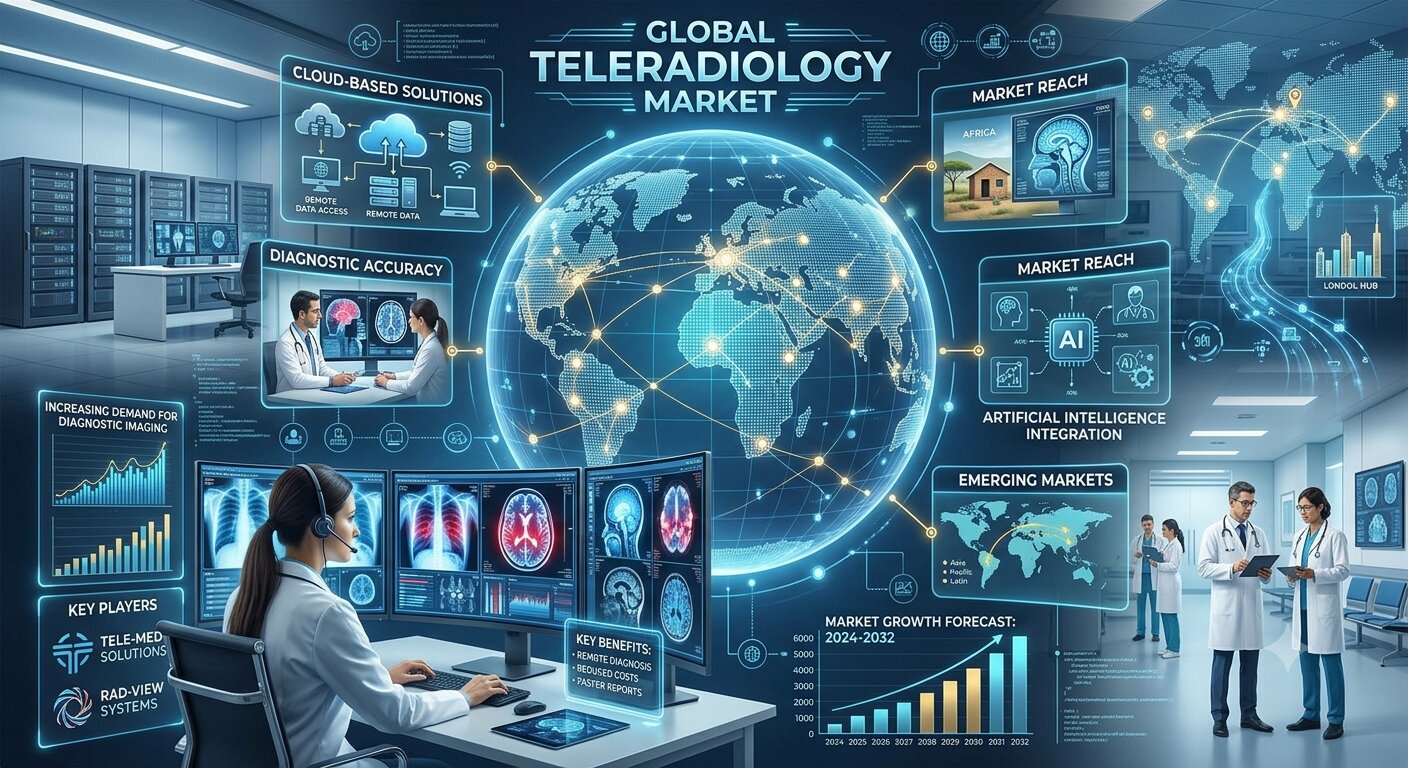
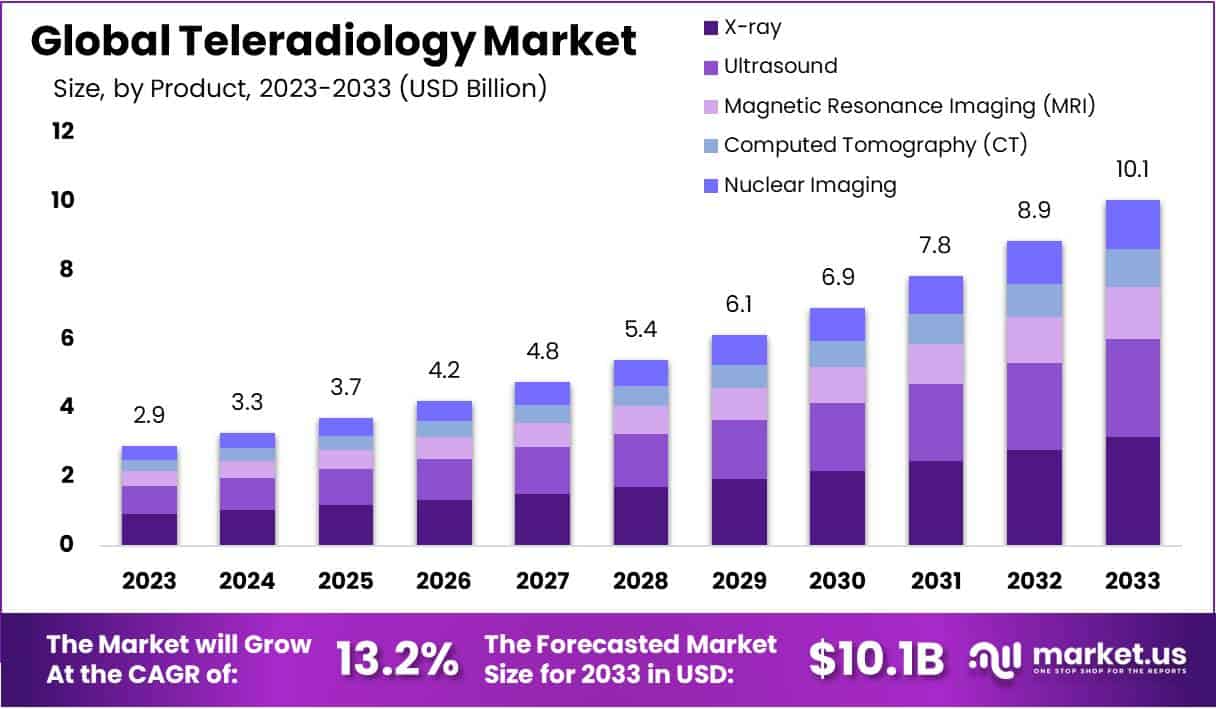
The Global Teleradiology Market size is expected to be worth around US$ 10.1 Billion by 2033, from US$ 2.9 Billion in 2023, growing at a CAGR of 13.2% during the forecast period from 2024 to 2033.
The global teleradiology market is witnessing sustained growth as healthcare providers increasingly rely on remote diagnostic imaging to improve access to specialist expertise, reduce reporting delays, and strengthen healthcare delivery in underserved regions. Rising adoption of digital health platforms, expanding broadband connectivity, and growing demand for 24/7 radiology services are encouraging hospitals and diagnostic centers to integrate teleradiology into routine clinical practice.
Artificial intelligence-assisted image analysis, cloud-based Picture Archiving and Communication Systems (PACS), and secure data-sharing technologies are further improving workflow efficiency and diagnostic accuracy. The increasing burden of chronic diseases, trauma cases, and aging populations continues to drive the need for timely imaging interpretation across both developed and emerging healthcare systems. According to the World Health Organization (WHO), digital health technologies play a crucial role in expanding access to quality healthcare and supporting informed clinical decision-making.
In 2026, the World Health Assembly also adopted a resolution to strengthen equitable access to diagnostic imaging through teleradiology, recognizing its importance in addressing radiologist shortages and improving healthcare access in remote and underserved regions. The digital transformation of healthcare is further supporting long-term demand for teleradiology services.
According to the OECD Health at a Glance 2025, the average availability of online digital health services across reporting countries reached 82% in 2024, up from 79% in 2023, reflecting continued investments in digital healthcare infrastructure that facilitate remote imaging interpretation and integrated patient care. These advancements are expected to accelerate adoption of teleradiology solutions across hospitals, imaging centers, and emergency care networks worldwide.
Key Takeaways
- The global Teleradiology Market is anticipated to grow from USD 2.9 billion in 2023 to USD 10.1 billion by 2033, registering a CAGR of 13.2% during the forecast period.
- In 2023, X-ray technology emerged as the leading imaging modality, capturing 31.5% of the global market, while ultrasound and MRI continued to gain momentum due to their expanding clinical applications.
- Preliminary Reports represented the largest report type segment in 2023, accounting for 63.9% of the market, with X-ray and Final Reports also contributing significantly to overall market demand.
- North America dominated the global teleradiology market in 2023, securing a 41.51% revenue share, driven by well-established healthcare infrastructure, widespread adoption of digital imaging technologies, and a strong presence of leading healthcare providers.
Statistical Information
- The combined use of CT, MRI, and PET examinations exceeded 370 exams per 1,000 population in 2023 in countries including Luxembourg, Korea, Austria, France, and Portugal, highlighting the increasing demand for diagnostic imaging and remote reporting solutions.
- Between 2013 and 2023, CT examinations more than doubled in Korea and increased by over 50% in Australia and Latvia, demonstrating the rapid rise in imaging volumes that is driving the need for scalable teleradiology services.
- MRI examinations more than doubled between 2013 and 2023 in Korea and Latvia, while France recorded around a 70% increase, reflecting sustained growth in advanced imaging procedures requiring specialist interpretation.
- A Swedish study evaluating 13,075 CT and MRI examinations found that 76% of MRI scans and 63% of CT scans met appropriateness guidelines, emphasizing the growing importance of standardized imaging quality and expert radiology review.
- The United States ranks second among OECD countries for MRI units and PET scanners per capita, providing a strong technological foundation for cloud-based imaging, AI integration, and teleradiology expansion.
- In January 2026, the U.S. Office of the National Coordinator for Health Information Technology (ONC) launched a Request for Information on diagnostic imaging interoperability, aiming to improve secure access, exchange, and use of imaging data across healthcare systems.
- The ONC recognizes X-rays, CT scans, MRI scans, and ultrasound images as essential components of electronic health records, reinforcing the importance of interoperable imaging systems for faster clinical decision-making and remote radiology services.
- The OECD’s 2026 report on healthcare AI identifies medical imaging as one of the leading areas for artificial intelligence implementation, with governments and healthcare organizations scaling AI to improve diagnostic accuracy, workflow efficiency, and clinical decision support.
Regional Analysis
North America accounted for the largest share of the global teleradiology market in 2023, representing 41.51% of total revenue and reaching a market value of USD 1.2 billion. The region’s leadership is supported by its advanced healthcare infrastructure, widespread use of digital imaging systems, and strong adoption of telehealth technologies across hospitals and diagnostic centers.
Healthcare providers continue to integrate cloud-based Picture Archiving and Communication Systems (PACS), electronic health records (EHRs), and AI-enabled imaging workflows to improve diagnostic efficiency and accelerate clinical decision-making.
The U.S. Office of the National Coordinator for Health Information Technology (ONC) is promoting nationwide interoperability and secure diagnostic image exchange, strengthening the foundation for remote radiology services. Additionally, North America benefits from a high volume of CT, MRI, and PET imaging procedures, reflecting strong demand for advanced diagnostic services across the region.
The growing need for after-hours reporting, specialist consultations, and improved access to radiology expertise in rural and underserved communities continues to drive teleradiology adoption, positioning North America to maintain its leading role in the global market.
Emerging Trends
- AI-powered radiology workflows: Healthcare providers are integrating artificial intelligence with teleradiology to prioritize urgent scans, improve reporting accuracy, and reduce turnaround time. In 2025, the American College of Radiology (ACR) reported that its ARCH-AI program expanded to 29 organizations, while ACR Connect supports more than 2,500 healthcare facilities, reflecting growing AI adoption in imaging services.
- Expansion of digital health ecosystems: Governments and healthcare organizations are investing in interoperable digital health systems that enable secure image sharing and remote diagnosis. The OECD highlights that telemedicine and AI are becoming central to healthcare modernization, improving access to specialist imaging services while strengthening healthcare delivery across regions.
- Greater focus on imaging quality and safety: Healthcare providers are emphasizing standardized imaging protocols, cybersecurity, and quality assurance as remote diagnostics expand. The World Health Organization estimates that more than 3.6 billion diagnostic radiology examinations are performed globally every year, increasing the need for secure and high-quality teleradiology services.
- Growing adoption of cloud-based imaging platforms: Hospitals are increasingly implementing cloud-enabled PACS and enterprise imaging solutions that allow radiologists to securely access medical images from multiple locations. These platforms improve collaboration, reduce reporting delays, and support continuous diagnostic services across integrated healthcare networks.
- Rising use of AI in underserved regions: AI-supported teleradiology is expanding access to diagnostic imaging in resource-limited settings through portable digital imaging systems and remote interpretation. The WHO highlights that AI-assisted image analysis is helping improve radiology capacity where specialist availability remains limited.
Use Cases
- Emergency imaging support: Hospitals use teleradiology to provide immediate interpretation of CT, MRI, and X-ray scans for trauma, stroke, and emergency cases. Around-the-clock remote reporting helps clinicians make faster treatment decisions while improving patient care in time-critical situations.
- Rural healthcare access: Rural hospitals and community health centers connect with remote radiologists to obtain specialist interpretations without transferring patients. This improves diagnostic access, shortens waiting times, and supports healthcare facilities that do not have full-time radiology specialists.
- After-hours reporting services: Healthcare organizations rely on teleradiology for overnight, weekend, and holiday imaging interpretation. This ensures uninterrupted radiology coverage, reduces reporting backlogs, and enables emergency departments to receive timely diagnostic reports throughout the year.
- AI-assisted diagnostic review: Radiologists use AI to identify suspected abnormalities, prioritize urgent examinations, and support clinical decision-making. OECD reports that AI can detect conditions such as stroke within seconds, helping radiologists review critical cases more efficiently while maintaining expert oversight.
- Multi-hospital specialist collaboration: Large healthcare systems share diagnostic images between hospitals and subspecialty radiologists through teleradiology networks. This enables faster second opinions, improves workflow efficiency, balances reporting workloads, and enhances care for complex clinical cases across multiple facilities.
Frequently Asked Questions About Teleradiology
- How does teleradiology work?
Medical images are captured at hospitals or diagnostic centers and securely transmitted through digital networks to remote radiologists. After reviewing the images using specialized software, the radiologist prepares a diagnostic report and sends it back to the treating physician for clinical decision-making. - What are the major benefits of teleradiology?
Teleradiology improves access to specialist expertise, reduces report turnaround times, supports 24/7 radiology coverage, and enables hospitals in rural or underserved areas to obtain timely diagnostic interpretations. It also enhances collaboration between healthcare providers across different locations. - Which imaging modalities are commonly used in teleradiology?
Teleradiology supports multiple imaging modalities, including X-ray, computed tomography (CT), magnetic resonance imaging (MRI), ultrasound, mammography, and nuclear medicine. These modalities are routinely transmitted digitally to support remote diagnosis across hospitals and imaging centers. - Who uses teleradiology services?
Teleradiology is widely used by hospitals, emergency departments, diagnostic imaging centers, outpatient clinics, and community healthcare facilities. It is especially valuable for organizations requiring after-hours reporting, subspecialty consultations, or radiology services where on-site radiologists are unavailable. - What is driving the growth of the teleradiology market?
The market is expanding due to increasing demand for remote diagnostic services, shortages of radiologists, wider adoption of telehealth, growth in digital imaging technologies, and rising healthcare investments in secure image-sharing platforms that improve access to specialist radiology expertise. - Which healthcare settings generate the highest demand for teleradiology?
Emergency departments, trauma centers, multispecialty hospitals, cancer centers, and rural healthcare facilities are among the largest users of teleradiology. These organizations depend on rapid image interpretation to improve clinical decisions and maintain continuous patient care throughout the day. - What is the future outlook for the teleradiology market?
The market is expected to benefit from continued digital healthcare transformation, greater cloud adoption, expanding telemedicine services, and increased demand for specialist radiology support. Ongoing improvements in interoperability and imaging technologies are likely to strengthen long-term market opportunities.
Conclusion
The global teleradiology market is evolving as healthcare systems continue to prioritize faster, more accessible, and technology-enabled diagnostic services. Growth is supported by increasing adoption of digital health platforms, AI-assisted imaging, cloud-based PACS, and secure image-sharing solutions that improve clinical efficiency and expand access to radiology expertise.
North America remains the leading regional market due to its mature healthcare infrastructure and strong digital health ecosystem, while demand is also increasing in underserved and rural areas worldwide. Continued government support for interoperability, telehealth, and digital transformation, together with rising imaging volumes and the need for 24/7 radiology services, is expected to strengthen the long-term adoption of teleradiology across hospitals, diagnostic centers, and integrated healthcare networks.




















