


Overview
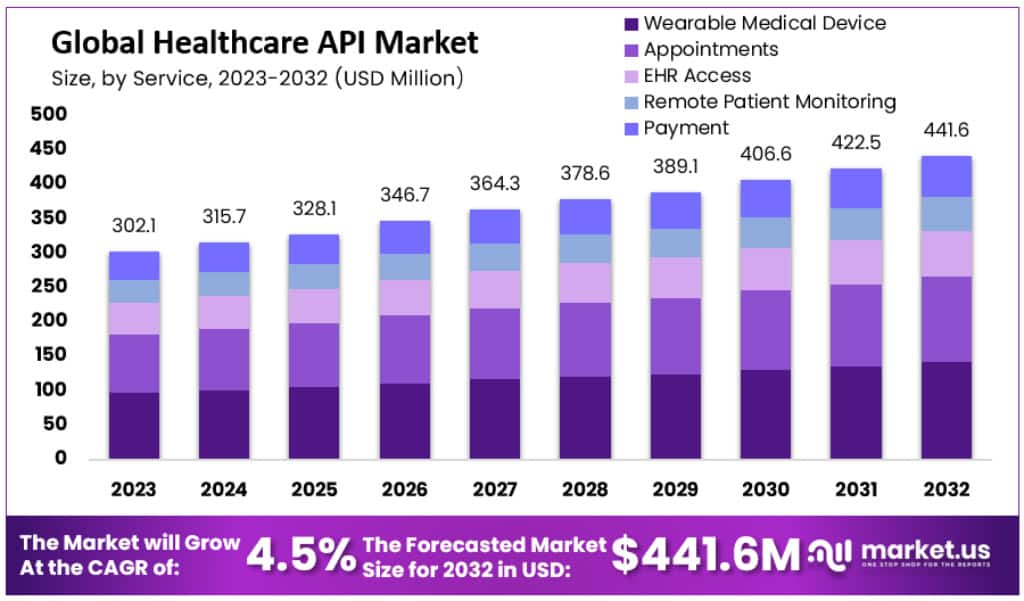
The Global Healthcare API Market size is expected to be worth around USD 441.6 Million by 2032, from USD 302.1 Million in 2023, growing at a CAGR of 4.5% during the forecast period from 2023 to 2033.
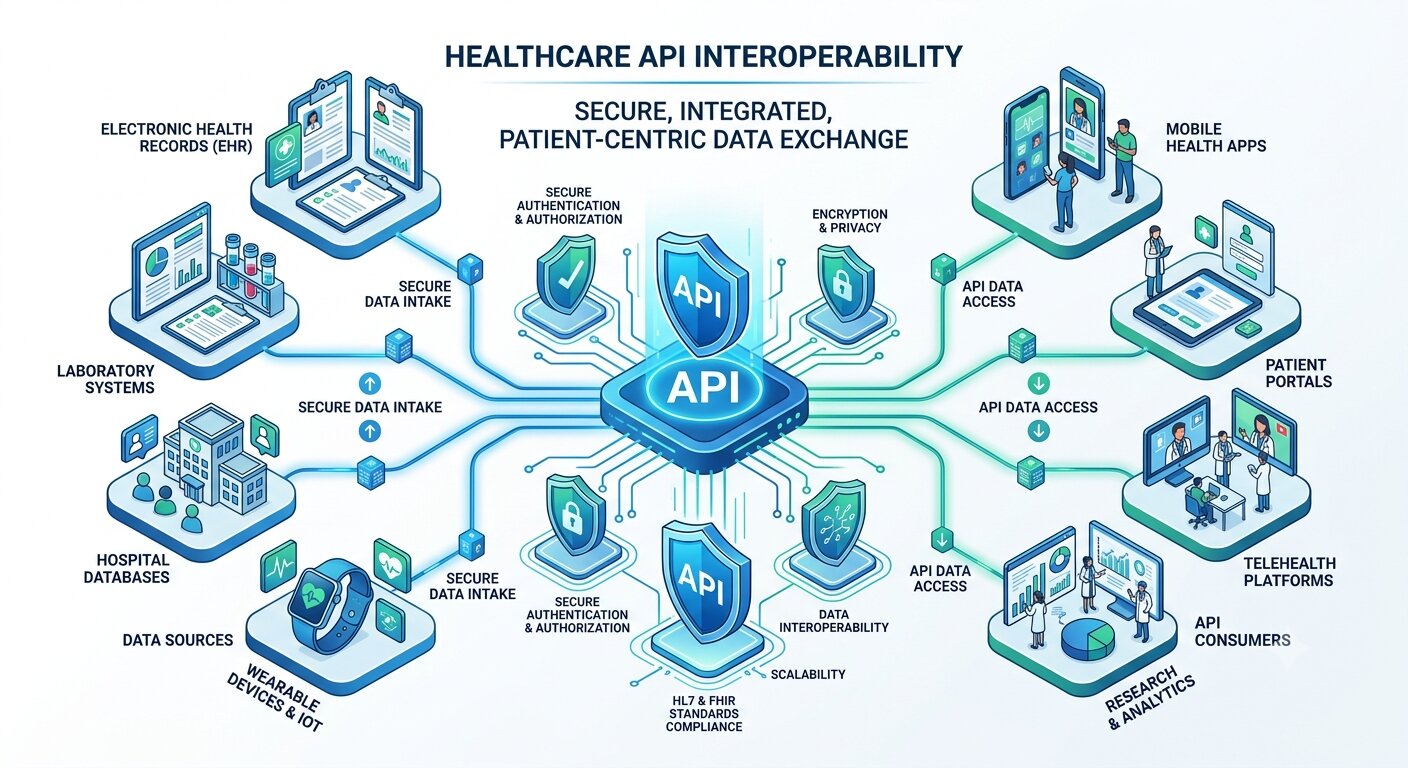
The healthcare API market is gaining momentum as healthcare systems increasingly prioritize secure interoperability, real-time data exchange, and patient-centered digital services. Application Programming Interfaces (APIs) have become a critical component of modern healthcare infrastructure by enabling seamless communication between electronic health records (EHRs), payer systems, laboratories, pharmacies, telehealth platforms, and mobile health applications.
Government initiatives promoting standardized data sharing, combined with the rapid adoption of cloud-based healthcare technologies, are encouraging providers and technology vendors to invest in API-driven ecosystems.
The widespread implementation of HL7 FHIR standards is further improving interoperability, supporting better clinical workflows, care coordination, and patient access to health information. Healthcare organizations are also leveraging APIs to accelerate innovation, strengthen cybersecurity through standardized frameworks, and simplify integration with third-party digital health solutions. As healthcare continues its digital transformation, APIs are expected to play a central role in improving operational efficiency and enhancing patient experiences across the care continuum.
According to the U.S. Office of the National Coordinator for Health Information Technology (ONC), approximately 9 in 10 U.S. hospitals enabled patients to electronically access their health information through APIs in 2024, demonstrating the widespread adoption of API-enabled interoperability.
Additionally, ONC reported that around 7 in 10 hospitals used standards-based APIs such as HL7 FHIR for patient access, highlighting the industry’s transition toward standardized data exchange.
Meanwhile, the U.S. Centers for Medicare & Medicaid Services (CMS) continues to require FHIR-based APIs to improve patient access, provider interoperability, and prior authorization processes, further accelerating API adoption across the healthcare ecosystem.
Key Takeaways
- The global Healthcare API Market is expected to grow from USD 302.1 million in 2023 to approximately USD 441.6 million by 2032.
- The market is anticipated to register a compound annual growth rate (CAGR) of 4.5% during the forecast period from 2023 to 2033.
- In 2023, the Electronic Health Records (EHR) access segment accounted for more than 32% of the global Healthcare API Market.
- Cloud-based deployment emerged as the leading deployment model in 2023, capturing over 71% of the total market share.
- North America dominated the global Healthcare API Market in 2023, securing a 36.4% market share and generating approximately USD 109.9 million in revenue.
- Among end users, healthcare providers held the largest market position in 2023, accounting for more than 47% of the overall Healthcare API Market.
Statistical Information
- Since January 1, 2023, all ONC-certified health IT products in the U.S. are required to support standardized HL7 FHIR APIs for patient and population services under the 21st Century Cures Act Final Rule, making API-based interoperability a baseline capability for certified EHR systems.
- About 50% of U.S. hospitals enabled patients to electronically submit patient-generated health data (PGHD) into their EHRs through standards-based APIs in 2024, expanding remote monitoring and patient engagement capabilities.
- Four out of five U.S. hospitals reported using APIs that allow clinical applications to both read from and write data to electronic health records in 2022, demonstrating widespread adoption of application integration across provider systems.
- Approximately 50% of U.S. hospitals had implemented APIs capable of reading data from non-EHR systems in 2022, supporting integration with laboratories, imaging systems, medical devices, and other external healthcare applications.
- CMS’s 2024 Interoperability and Prior Authorization Final Rule requires impacted payers to implement three new FHIR-based APIs Provider Access, Payer-to-Payer, and Prior Authorization APIs to improve healthcare data exchange and streamline administrative workflows.
- Beginning in 2026, impacted U.S. health plans must report the number of unique patients using the Patient Access API and the number accessing their records multiple times, reflecting increasing measurement of consumer adoption of healthcare APIs.
- Hospitals using one of the three leading EHR platforms reported a 74% rate of standards-based API implementation for patient access in 2024, compared with 48% among hospitals using other EHR systems, highlighting the influence of mature digital health platforms on interoperability adoption.
- Among medium and large U.S. hospitals, 53% supported patient-generated health data submission through standards-based APIs in 2024, indicating stronger API adoption for connected care and remote health monitoring in larger healthcare organizations.
Regional Analysis
North America accounted for the largest share of the Healthcare API Market in 2023, capturing 36.4% of global revenue, equivalent to USD 109.9 million. The region’s leadership is supported by widespread adoption of electronic health records (EHRs), advanced digital health infrastructure, and strong government initiatives promoting healthcare interoperability.
The U.S. Office of the National Coordinator for Health Information Technology (ONC) has accelerated API adoption through the 21st Century Cures Act and FHIR-based interoperability requirements.
Europe is expected to register the fastest growth during the forecast period, driven by increasing investments in digital health, cross-border health data exchange, and strict data privacy regulations under the General Data Protection Regulation (GDPR). The region is also advancing healthcare interoperability through standardized electronic health record initiatives and secure API frameworks.
Growing public and private investments in connected healthcare platforms and regulatory support for digital transformation are expected to further strengthen Healthcare API adoption across European healthcare systems.
Emerging Trends
- FHIR-based nationwide health data exchange is accelerating across the U.S. Through the Trusted Exchange Framework and Common Agreement (TEFCA), health information sharing has expanded rapidly. The number of exchanged health documents increased from about 10 million before 2025 to 464 million by the end of 2025, reflecting growing reliance on API-driven interoperability between providers, payers, and patients.
- Healthcare APIs are becoming the foundation of digital healthcare modernization. In 2025, the U.S. Centers for Medicare & Medicaid Services (CMS) announced plans to expand Blue Button 2.0 APIs, create a national provider directory, strengthen identity verification, and broaden trusted data exchange, highlighting the increasing role of APIs in improving patient access and reducing administrative burden.
- Bulk data exchange is emerging as a major interoperability trend. CMS now recommends that healthcare networks implement FHIR Bulk Data Exchange alongside USCDI standards to transfer complete patient records more efficiently. This approach supports population health management, value-based care, and large-scale clinical analytics while reducing system workload.
- Healthcare organizations are expanding APIs beyond clinical records. Modern healthcare APIs increasingly support appointment notifications, telehealth encounters, laboratory reports, radiology documents, and clinical attachments using standardized FHIR formats. This trend enables more connected healthcare workflows and improves communication across healthcare organizations.
- National interoperability frameworks are creating secure API ecosystems. TEFCA now supports multiple exchange purposes beyond treatment, including payment, healthcare operations, public health, government benefit determination, and patient access. Expanding these standardized API use cases is encouraging broader healthcare collaboration while strengthening privacy and security.
Use Cases
- Patient access to digital health records is one of the fastest-growing API applications. APIs allow patients to securely retrieve medical records through mobile applications and patient portals. Government interoperability programs continue to promote standardized access, helping patients manage their healthcare information more efficiently across different providers.
- Healthcare APIs are simplifying electronic prior authorization. CMS requires impacted healthcare organizations to implement FHIR-based APIs that automate prior authorization requests and responses. This reduces paperwork, shortens approval times, improves communication between providers and payers, and supports faster patient access to necessary treatments.
- Public health reporting is increasingly supported through standardized APIs. Healthcare organizations are using FHIR APIs for electronic case reporting, immunization data exchange, and public health reporting. These API-enabled workflows improve reporting speed, data accuracy, and collaboration between healthcare providers and public health agencies.
- Healthcare providers are integrating third-party digital health applications through APIs. APIs connect electronic health records with remote monitoring platforms, clinical decision support tools, pharmacy systems, and laboratory services. This enables clinicians to access comprehensive patient information without switching between multiple software platforms.
- Provider-payer data exchange is becoming a key operational use case. Modern healthcare APIs enable secure exchange of eligibility information, claims data, clinical documentation, and care coordination records between providers and insurers. Standardized APIs help improve operational efficiency while supporting value-based healthcare delivery and reimbursement processes.
Frequently Asked Questions About Healthcare API
- Why are Healthcare APIs important?
Healthcare APIs improve interoperability by allowing authorized healthcare organizations to share patient information securely across different systems. They help reduce administrative burden, support better clinical decision-making, improve patient experiences, and enable faster access to healthcare data through standardized formats such as HL7 FHIR. - What is driving the Healthcare API Market?
The Healthcare API Market is growing due to increasing adoption of electronic health records, government interoperability initiatives, expansion of digital health platforms, and rising demand for secure data exchange. Regulatory programs promoting standardized APIs are encouraging healthcare providers and payers to modernize their digital infrastructure. - Which industries use Healthcare APIs?
Healthcare APIs are widely used by hospitals, physician practices, health insurance companies, pharmacies, diagnostic laboratories, telehealth providers, and digital health application developers. These organizations use APIs to exchange patient records, automate workflows, support remote care, and improve communication across healthcare ecosystems. - What are the major benefits of Healthcare APIs?
Healthcare APIs simplify secure data sharing, reduce duplicate testing, improve workflow efficiency, support patient access to medical records, and enable integration between multiple healthcare applications. They also accelerate innovation by allowing developers to build interoperable healthcare solutions using standardized data exchange methods. - What technologies are commonly used in Healthcare APIs?
Most modern Healthcare APIs are built using the HL7 Fast Healthcare Interoperability Resources (FHIR) standard along with the United States Core Data for Interoperability (USCDI). These technologies enable secure, consistent, and scalable healthcare information exchange across organizations. - What is the future outlook for the Healthcare API Market?
The Healthcare API Market is expected to continue expanding as healthcare organizations invest in digital transformation, cloud technologies, AI-enabled healthcare applications, and nationwide interoperability initiatives. Growing adoption of standardized APIs is expected to strengthen connected care, operational efficiency, and patient-centered healthcare delivery.
Conclusion
The Healthcare API Market is steadily expanding as healthcare organizations prioritize secure interoperability, digital transformation, and patient-centered care. Growing adoption of HL7 FHIR standards, cloud-based platforms, and regulatory initiatives from agencies such as CMS and ONC are accelerating the integration of APIs across healthcare ecosystems. APIs are improving connectivity between providers, payers, laboratories, pharmacies, and digital health applications while supporting efficient data exchange and streamlined clinical workflows.
As investments in electronic health records, telehealth, and AI-enabled healthcare continue to increase, Healthcare APIs are expected to become an essential foundation for connected healthcare, enabling better patient outcomes, improved operational efficiency, enhanced data accessibility, and more coordinated healthcare delivery worldwide.




















