


Overview
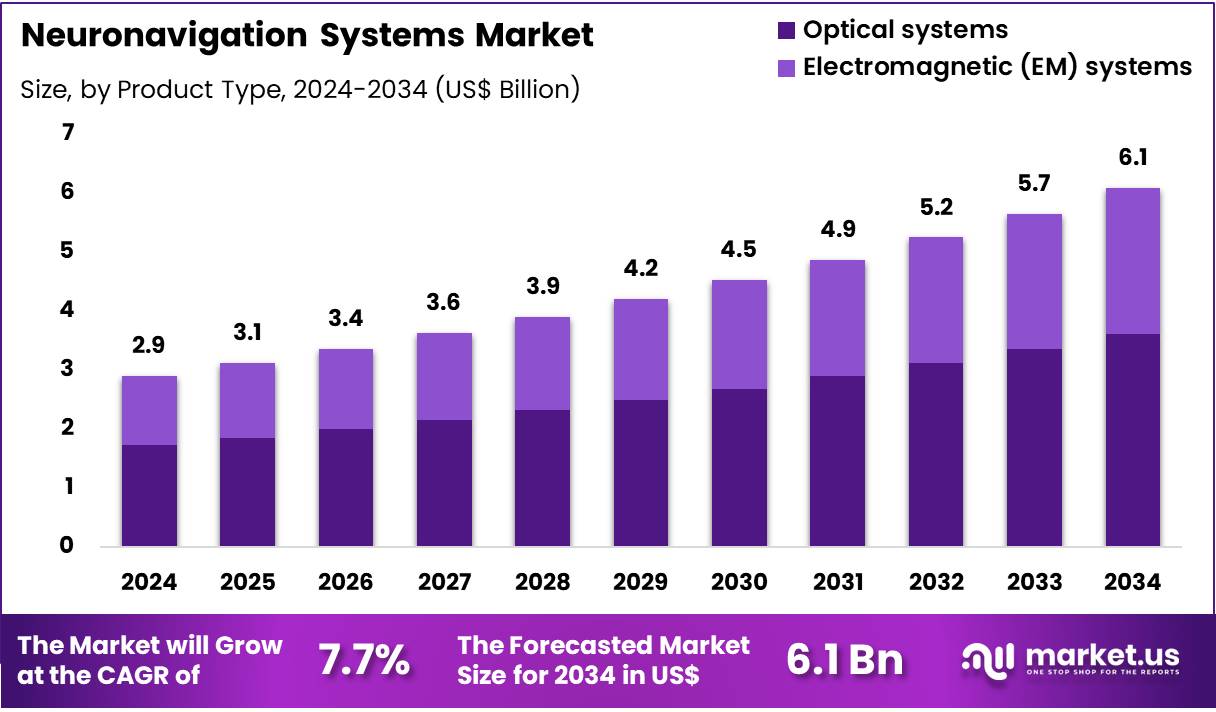
Global Neuronavigation Systems Market size is expected to be worth around US$ 6.1 Billion by 2034 from US$ 2.9 Billion in 2024, growing at a CAGR of 7.7% during the forecast period from 2025 to 2034. In 2024, North America led the market, achieving over 42.8% share with a revenue of US$ 1.2 Billion.
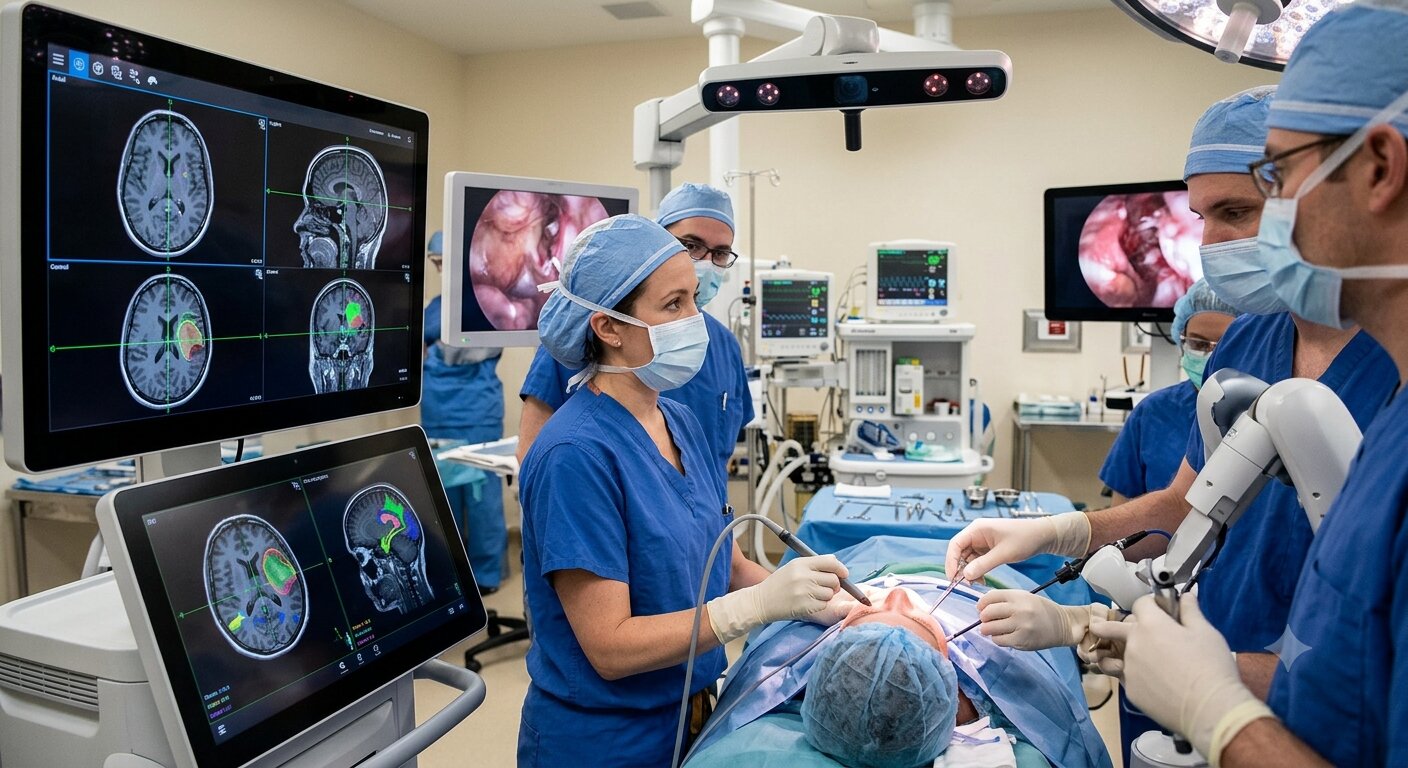
The rising burden of neurological disorders and increasing demand for precision-guided brain and spine surgeries are driving greater adoption of neuronavigation systems across modern healthcare facilities. These systems provide real-time image guidance during neurosurgical procedures, helping surgeons improve accuracy while minimizing damage to surrounding healthy tissue.
Their growing use in tumor resections, epilepsy surgery, deep brain stimulation, and spinal procedures is supported by continuous advances in imaging integration, artificial intelligence, and intraoperative visualization technologies. Governments, academic hospitals, and healthcare institutions are also investing in advanced neurosurgical infrastructure to improve patient outcomes and expand access to specialized neurological care.
According to the World Health Organization (WHO), neurological conditions affect more than 3 billion people worldwide and are now the leading cause of illness and disability globally, highlighting the growing need for advanced diagnostic and surgical technologies. Additionally, WHO reports that neurological disorders are responsible for approximately 11 million deaths each year, reinforcing the importance of strengthening neurology and neurosurgery services worldwide.
The National Institute of Neurological Disorders and Stroke (NINDS), part of the U.S. National Institutes of Health (NIH), continues to support research aimed at improving brain imaging, surgical navigation, and innovative treatment approaches for neurological diseases.
As healthcare providers increasingly prioritize minimally invasive procedures and precision medicine, neuronavigation technologies are expected to play a vital role in enhancing surgical safety, reducing complications, and improving long-term neurological outcomes.
Key Takeaways
- The global Neuronavigation Systems Market is projected to reach approximately US$ 6.1 billion by 2034, rising from US$ 2.9 billion in 2024.
- The market is anticipated to expand at a compound annual growth rate (CAGR) of 7.7% during the forecast period from 2025 to 2034.
- By product type, optical systems emerged as the leading segment in 2024, accounting for 59.3% of the global market share.
- Based on application, brain tumor surgeries held the largest share of the market, representing 35.1% of the global revenue in 2024.
- Among end users, the hospital segment dominated the neuronavigation systems market, capturing 72.6% of the total market share in 2024.
- Regionally, North America maintained its leading position in 2024, securing 42.8% of the global market share and generating approximately US$ 1.2 billion in revenue.
Statistical Information
- More than 3 billion people worldwide are living with a neurological condition, making neurological disorders the leading cause of illness and disability globally.
- According to the U.S. National Cancer Institute (NCI), an estimated 24,820 new cases of brain and other nervous system tumors were expected in the United States in 2025, highlighting the increasing need for advanced neurosurgical technologies such as neuronavigation systems.
- The NIH BRAIN Initiative received US$ 402 million in federal appropriations for FY2024 to accelerate the development of innovative neurotechnologies and brain-mapping research.
- The FDA granted 510(k) clearance for Medtronic’s Stealth AXiS Cranial Navigation System on March 26, 2026, supporting continued innovation in neuronavigation technologies.
- The Central Brain Tumor Registry of the United States (CBTRUS) represents 100% of the U.S. population, making it the nation’s most comprehensive database for primary brain and central nervous system tumors.
- A peer-reviewed clinical evaluation of neuronavigation reported successful use in 51 neurosurgical procedures with a mean registration error of just 2.1 mm, demonstrating high surgical accuracy.
- The FDA Breakthrough Devices Program had achieved 198 marketing authorizations for breakthrough medical devices as of March 31, 2026, reflecting continued regulatory support for advanced medical technologies.
- Glioblastoma, the most aggressive primary brain cancer in adults, has an average survival of less than 18 months after diagnosis, emphasizing the importance of precision-guided neurosurgical technologies.
Regional Analysis
In 2024, North America accounted for more than 42.8% of the global neuronavigation systems market, generating approximately US$ 1.2 billion in revenue. The region’s leadership is supported by a highly developed healthcare infrastructure, widespread availability of advanced imaging technologies, and strong adoption of image-guided neurosurgical procedures.
Leading academic medical centers and specialized neurosurgery hospitals continue to integrate neuronavigation systems to improve surgical precision, particularly for brain tumor, epilepsy, and spinal procedures. Studies published through the U.S. National Library of Medicine indicate that neuronavigation enhances surgical accuracy and supports minimally invasive approaches, contributing to better clinical outcomes.
North America also benefits from substantial investments in neurological research, favorable reimbursement systems, and continuous innovation in intraoperative imaging and digital operating rooms. The presence of major medical device manufacturers and extensive clinical training programs has further accelerated technology adoption.
In addition, the World Health Organization highlights the growing importance of neurotechnology in addressing the increasing burden of neurological disorders, reinforcing demand for advanced navigation platforms in developed healthcare systems. These factors are expected to help North America maintain its leading position in the neuronavigation systems market over the coming years.
Emerging Trends
- AI Integration in Neuronavigation: Artificial intelligence is becoming an important part of neuronavigation systems by supporting tumor detection, surgical planning, and real-time guidance. A 2025 systematic review evaluated 181 neurosurgical studies, including 13 focused specifically on neuronavigation, showing growing adoption of AI-assisted navigation technologies in modern neurosurgery.
- Growth in Scientific Research: Global research on neuronavigation continues to expand as hospitals and universities invest in image-guided surgery. A bibliometric analysis identified 3,896 scientific publications, including 1,727 neuronavigation-related articles, with research output increasing by approximately 80% between 1999–2009 and 2010–2020, indicating sustained technological progress.
- Augmented Reality Navigation: Hospitals are increasingly exploring augmented reality (AR) for neurosurgical navigation. A systematic review screened 3,586 records and found that AR neuronavigation systems can achieve a target registration error of approximately 2.5 mm, supporting more accurate visualization during complex brain procedures.
- Advanced Brain Tumor Mapping: New neuronavigation platforms are being combined with functional brain mapping before surgery. A 2025 systematic review covering 11 clinical studies found that integrating multiple mapping techniques helps surgeons better identify critical brain regions while improving surgical planning for complex brain tumor operations.
- AI-Based Surgical Planning: Artificial intelligence is increasingly supporting surgical planning for glioma treatment. A recent systematic review screened 677 publications and included 8 high-quality studies, showing that AI-assisted neuronavigation and imaging tools are improving tumor visualization and helping surgeons make more informed treatment decisions.
Use Cases
- Brain Tumor Surgery: Neuronavigation is widely used during brain tumor removal to guide surgeons with real-time imaging and improve surgical precision. Advanced navigation systems help identify tumor boundaries while protecting healthy brain tissue, leading to safer and more effective neurosurgical procedures.
- Deep Brain Stimulation: Neuronavigation plays an important role in deep brain stimulation by accurately targeting brain structures. A 2025 review found 24 studies focused on AI-assisted localization of the subthalamic and thalamic nuclei, demonstrating increasing use of navigation technologies for movement disorder treatment.
- Spinal Navigation Procedures: Hospitals are expanding the use of neuronavigation in spinal surgeries to improve screw placement and reduce complications. Image-guided navigation allows surgeons to visualize anatomy more accurately, supporting safer minimally invasive spinal procedures and improving overall surgical confidence.
- Neurosurgical Education and Simulation: Medical institutions are using neuronavigation software for surgical simulation and physician training. Digital planning platforms enable neurosurgeons to practice complex procedures before surgery, improving technical skills and supporting better preparation for challenging clinical cases.
- Multimodal Image-Guided Surgery: Modern neuronavigation systems combine MRI, CT, ultrasound, and functional imaging into a single platform for real-time guidance. This integrated approach helps neurosurgeons make faster clinical decisions and improves accuracy during complex cranial and spinal operations
- How does a neuronavigation system work?
The system registers the patient’s anatomy with medical imaging and tracks surgical instruments using optical or electromagnetic technology. This allows surgeons to view the instrument position in real time on a 3D image, supporting accurate navigation during complex neurosurgical procedures. - What are the major applications of neuronavigation systems?
Neuronavigation systems are commonly used for brain tumor surgery, epilepsy surgery, deep brain stimulation, stereotactic biopsy, spinal surgery, and skull base procedures. They help improve surgical planning, target localization, and preservation of healthy tissue during operations. - Why are hospitals adopting neuronavigation systems?
Hospitals are increasingly adopting neuronavigation systems because they improve surgical accuracy, support minimally invasive procedures, and integrate with advanced imaging technologies. Their ability to enhance clinical outcomes and operating room efficiency has made them valuable in modern neurosurgical practice. - Are neuronavigation systems approved by regulators?
Yes. Neuronavigation systems are regulated as medical devices and require regulatory clearance before commercialization. In the United States, several neuronavigation platforms have received FDA 510(k) clearance after demonstrating substantial equivalence to legally marketed devices. - What is driving the growth of the neuronavigation systems market?
The market is expanding because of the increasing burden of neurological disorders, growing demand for minimally invasive neurosurgery, advances in medical imaging, and continuous investment in digital operating rooms. These factors are encouraging healthcare providers to adopt navigation-assisted surgical technologies. - What technologies are shaping the future of the neuronavigation systems market?
Artificial intelligence, augmented reality, robotics, intraoperative imaging, and advanced surgical software are transforming the market. These technologies are improving navigation accuracy, workflow efficiency, and clinical decision-making while supporting more personalized neurosurgical care. - What opportunities exist for companies in the neuronavigation systems market?
Manufacturers have opportunities to develop AI-enabled navigation platforms, integrate robotic surgery solutions, improve real-time imaging capabilities, and expand into emerging healthcare systems where demand for precision neurosurgery and advanced operating room technologies continues to grow.
Conclusion
The global neuronavigation systems market is poised for steady growth as healthcare providers increasingly adopt precision-guided technologies to improve outcomes in complex brain and spine surgeries. Rising neurological disease burden, expanding use of minimally invasive procedures, and continuous advancements in artificial intelligence, intraoperative imaging, and digital operating rooms are strengthening market demand.
Ongoing investments by governments, research institutions, and medical device manufacturers are accelerating innovation and clinical adoption. Furthermore, favorable regulatory support and increasing integration of advanced imaging modalities are expected to enhance surgical accuracy and patient safety. These factors position neuronavigation systems as an essential component of the future of modern neurosurgical care.




















