



Overview
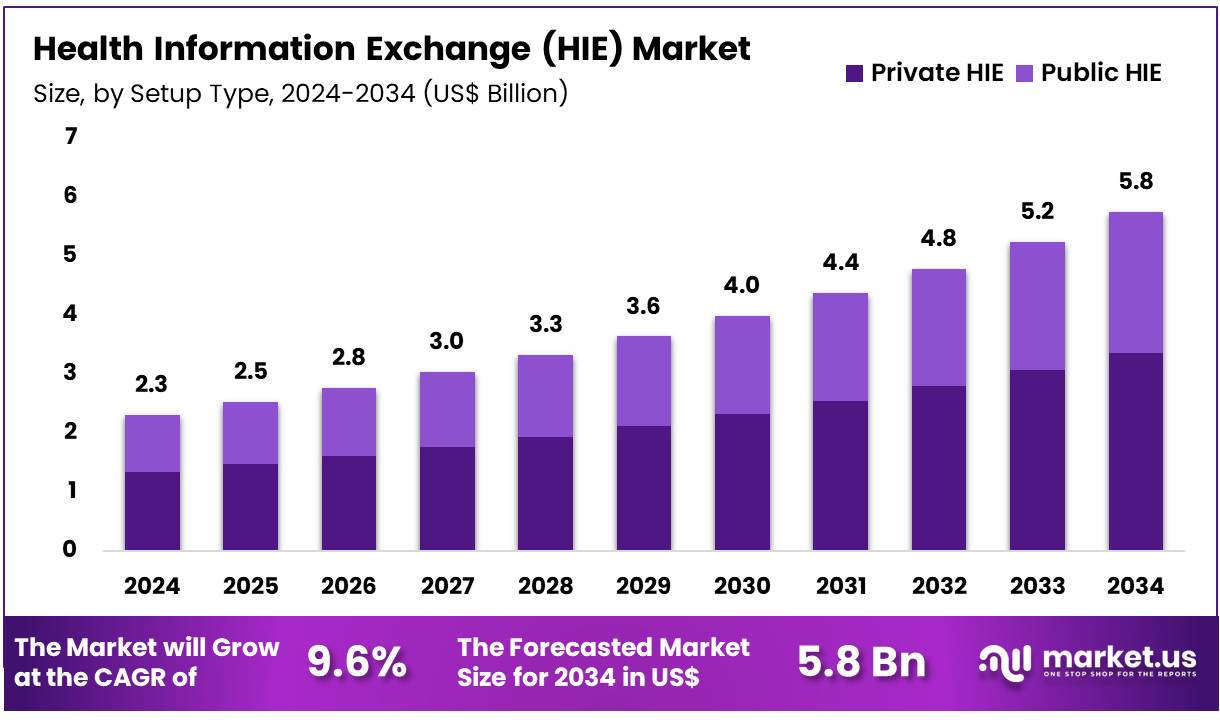
Global Health Information Exchange (HIE) Market size is expected to be worth around US$ 5.8 Billion by 2034 from US$ 2.3 Billion in 2024, growing at a CAGR of 9.6% during the forecast period 2025 to 2034. In 2024, North America led the market, achieving over 37.9% share with a revenue of US$ 0.9 Billion.
Health Information Exchange (HIE) is becoming a fundamental component of modern healthcare by enabling the secure electronic sharing of patient information among hospitals, clinics, laboratories, pharmacies, and public health agencies.
As healthcare systems continue to digitize medical records, HIE platforms help improve care coordination, reduce administrative burden, and support informed clinical decision-making. Trusted frameworks such as the Trusted Exchange Framework and Common Agreement (TEFCA) are accelerating nationwide interoperability by establishing common technical and governance standards for secure data exchange.
Healthcare providers are increasingly adopting interoperable technologies to improve patient outcomes while minimizing duplicate diagnostic procedures and medication errors. According to the U.S. Office of the National Coordinator for Health Information Technology (ONC), electronic health information exchange enables clinicians to securely access a patient’s medical history, laboratory results, medications, and discharge summaries, resulting in more coordinated and efficient care. The agency also highlights that standardized data exchange supports public health reporting, emergency response, and patient access to personal health records.
Government-led interoperability initiatives continue to strengthen HIE adoption across healthcare organizations. In 2025, 88% of Health Information Organizations (HIOs) reported connectivity with at least one state, local, or tribal public health agency, demonstrating the expanding role of HIE networks in public health reporting and surveillance. Additionally, more than 60% of connected HIOs provided syndromic surveillance and immunization registry reporting services, reinforcing their importance in disease monitoring and healthcare preparedness.
Growing investments in secure data-sharing infrastructure, interoperability standards, and digital health modernization are expected to support broader HIE implementation worldwide, helping healthcare organizations deliver more connected, efficient, and patient-centered care.
Key Takeaways
- In 2024, the global Health Information Exchange (HIE) market was valued at US$ 2.3 billion and is projected to reach US$ 5.8 billion by 2034, expanding at a CAGR of 9.6% during the forecast period.
- Based on type, the market is categorized into directed exchange, consumer-mediated exchange, and query-based exchange. Among these, directed exchange emerged as the leading segment, accounting for 47.6% of the market share in 2024.
- By setup type, the market is segmented into private HIE and public HIE, with private HIE dominating the market by capturing a 58.3% share in 2024.
- In terms of application, the market includes internal interfacing, workflow management, web portal development, secure messaging, patient safety, and others. The web portal development segment led the market with the largest 36.2% revenue share in 2024.
- Based on the implementation model, the market is classified into hybrid, decentralized, and centralized models. The hybrid model held the dominant position, securing a 52.8% revenue share in 2024.
- North America dominated the global Health Information Exchange (HIE) market in 2024, accounting for a 37.9% market share.
Statistical Information
- 76% of U.S. hospitals engaged in all four key interoperability domains (sending, receiving, finding, and integrating electronic health information) by 2025, demonstrating continued progress in nationwide health information exchange.
- In 2023, 43% of U.S. hospitals routinely exchanged and integrated electronic health information across all four interoperability domains, while 27% were partially interoperable.
- 53% of system-affiliated hospitals routinely achieved full interoperability in 2023, compared with only 22% of independent hospitals, highlighting the impact of integrated healthcare networks on HIE adoption.
- Among large hospitals, 53% routinely participated in interoperable data exchange, compared with 38% of small hospitals, reflecting greater digital infrastructure investment by larger providers.
- Urban hospitals reported a 47% rate of routine interoperability in 2023, while rural hospitals recorded 36%, indicating ongoing disparities in health information exchange capabilities.
- Approximately 41% of rural and Critical Access Hospitals were still not fully interoperable in 2023, emphasizing continued opportunities for HIE infrastructure expansion in underserved regions.
- 79% of routinely interoperable hospitals planned to participate in the Trusted Exchange Framework and Common Agreement (TEFCA) in 2023, reflecting strong confidence in nationwide interoperability initiatives.
- Hospitals participating in at least one national health information network showed 75% planned participation in TEFCA, compared with 39% among hospitals not connected to any exchange network.
- Awareness of TEFCA among hospitals not connected to exchange networks increased by 13 percentage points between 2022 and 2023, indicating growing industry recognition of standardized nationwide data sharing.
- Hospitals with partial interoperability recorded a 26-percentage-point increase in plans to join TEFCA between 2022 and 2023, demonstrating accelerating adoption of national exchange frameworks.
Regional Analysis
North America dominated the Health Information Exchange (HIE) market in 2024, accounting for 37.9% of the global market share. The region’s leadership is supported by strong government initiatives promoting healthcare interoperability and secure data exchange. In the United States, the Office of the National Coordinator for Health Information Technology (ONC) continues to implement interoperability policies under the 21st Century Cures Act, encouraging the use of standardized APIs and seamless electronic health information sharing across healthcare organizations.
These initiatives have improved care coordination, reduced duplicate testing, and enhanced clinical decision-making by enabling providers to securely access patient records across different care settings. Ongoing investments in digital health infrastructure and expanding adoption of electronic health records (EHRs) continue to strengthen the regional HIE ecosystem.
The Asia Pacific region is projected to register the fastest CAGR during the forecast period, driven by accelerating digital health transformation and government-backed interoperability programs. Countries including Australia and Singapore are expanding national electronic health record platforms to facilitate secure patient data exchange across public and private healthcare providers.
Australia’s My Health Record program continues to enhance nationwide information sharing, while Singapore has expanded participation in its National Electronic Health Record (NEHR) system to improve continuity of care. Growing investments in healthcare digitization, increasing EHR adoption, and supportive government policies are expected to drive strong demand for HIE solutions across the region.
Emerging Trends
- Nationwide interoperability through TEFCA is accelerating. By the end of 2025, more than 464 million health documents had been exchanged through the TEFCA framework, up from approximately 10 million before 2025. This rapid growth is encouraging hospitals and healthcare networks to adopt standardized data-sharing practices across the U.S.
- FHIR-based APIs are becoming the industry standard. The U.S. Centers for Medicare & Medicaid Services (CMS) continues expanding interoperability requirements through FHIR-enabled APIs and electronic prior authorization rules, allowing faster and more secure exchange of clinical information between providers, payers, and digital health applications.
- Public health agencies are increasing interoperability investments. The CDC is funding implementation centers that help health departments adopt FHIR and USCDI standards, improving disease surveillance, laboratory reporting, and emergency preparedness through standardized electronic health information exchange.
- Physician practices continue expanding electronic record connectivity. The CDC’s National Electronic Health Records Survey monitors nationwide adoption of interoperable EHR systems, reflecting increasing demand among office-based physicians for seamless patient information exchange across different healthcare organizations.
- Patient-controlled digital health records are gaining importance. Government interoperability initiatives increasingly emphasize giving patients secure electronic access to their complete health records, enabling easier sharing of medical information across hospitals, specialists, and healthcare providers while improving care coordination.
Use Cases
- Care coordination across multiple providers is one of the largest HIE use cases. Through TEFCA, healthcare providers can securely retrieve patient records from different organizations, reducing duplicate medical tests and enabling clinicians to make faster treatment decisions using comprehensive health information.
- Electronic prior authorization is becoming more automated. CMS interoperability initiatives encourage healthcare organizations to exchange authorization requests electronically using standardized APIs, reducing paperwork, shortening approval times, and improving operational efficiency across healthcare systems.
- Public health reporting is becoming more efficient. The CDC promotes standardized electronic exchange of laboratory, immunization, and disease surveillance data through FHIR-based infrastructure, allowing public health agencies to receive higher-quality information more quickly during routine operations and emergencies.
- Cross-network patient record access is expanding rapidly. TEFCA enables healthcare organizations connected through different health information networks to securely exchange patient records without creating separate interfaces, simplifying nationwide interoperability and improving continuity of care.
- Healthcare organizations are modernizing legacy systems with interoperable standards. CMS encourages networks to support USCDI Version 3, standardized FHIR APIs, secure identity verification, and digital consent management, creating a more connected ecosystem for hospitals, payers, providers, and digital health platforms.
Conclusion
The Health Information Exchange (HIE) market is evolving as healthcare providers increasingly prioritize secure, interoperable, and patient-centered data sharing. Government initiatives, including TEFCA, FHIR-based standards, and interoperability regulations, are accelerating the adoption of connected healthcare systems while improving care coordination and operational efficiency.
Rising implementation of electronic health records, cloud technologies, and standardized APIs is enabling seamless information exchange across hospitals, clinics, laboratories, and public health agencies. As healthcare organizations continue investing in digital transformation and regulatory compliance, HIE solutions are expected to play an increasingly vital role in enhancing clinical outcomes, supporting public health reporting, reducing administrative burden, and strengthening healthcare delivery worldwide.




















