


Overview
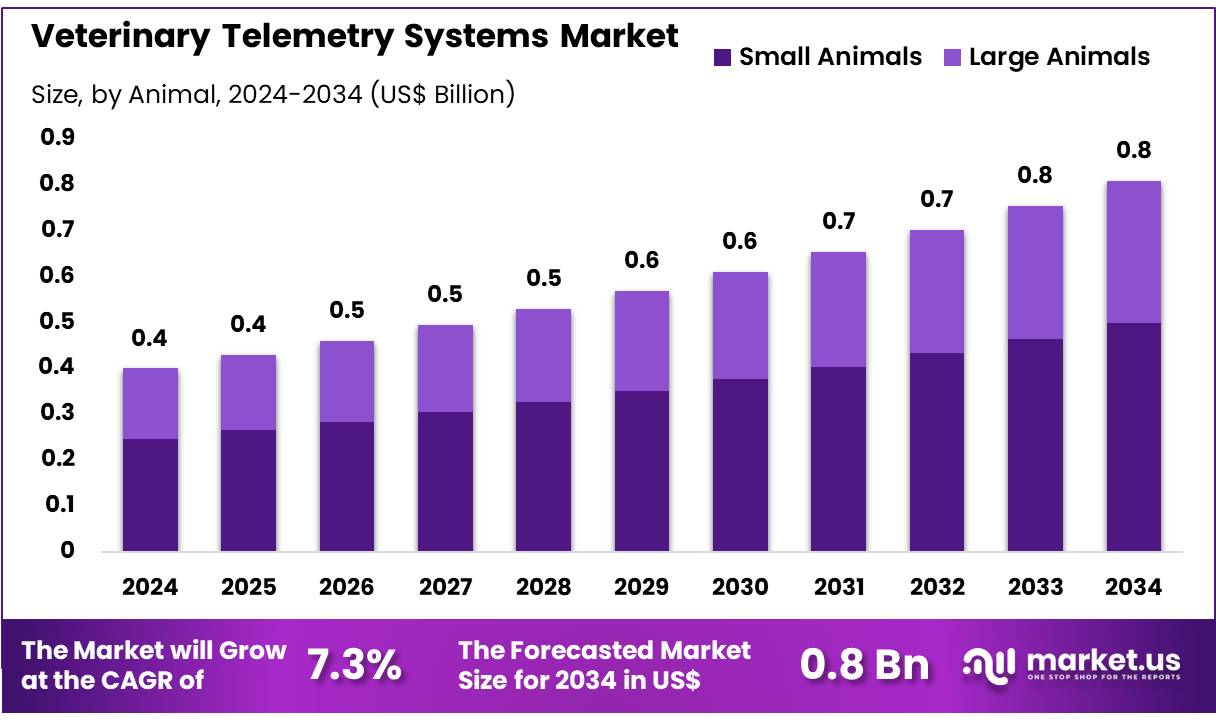
Global Veterinary Telemetry Systems Market size is expected to be worth around US$ 0.8 Billion by 2034 from US$ 0.4 Billion in 2024, growing at a CAGR of 7.3% during the forecast period 2025 to 2034. In 2024, North America led the market, achieving over 38.9% share with a revenue of US$ 0.2 Billion.
The global veterinary telemetry systems market is gaining momentum as veterinary hospitals, research institutions, universities, and animal health organizations increasingly adopt continuous physiological monitoring technologies.
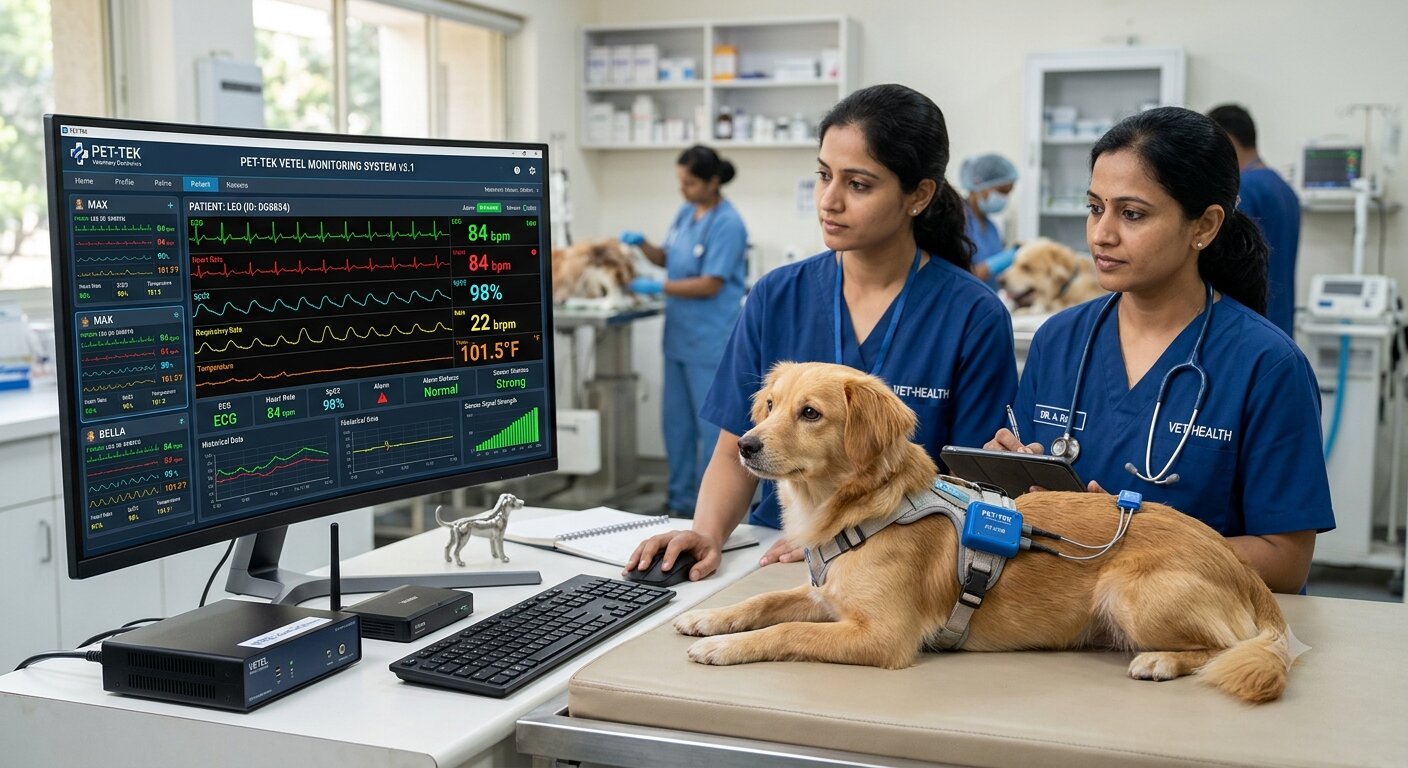
Veterinary telemetry systems enable veterinarians and researchers to remotely monitor heart rate, blood pressure, electrocardiograms (ECG), body temperature, respiratory rate, and other vital parameters in animals without restricting their movement. These systems improve animal welfare by reducing stress during monitoring while providing more accurate physiological data for diagnosis, treatment evaluation, and biomedical research.
The growing emphasis on animal health surveillance and precision veterinary care is supporting wider adoption of telemetry technologies. According to the U.S. Department of Agriculture (USDA) Animal and Plant Health Inspection Service (APHIS), comprehensive surveillance is the foundation of animal health, public health, food safety, and environmental protection.
APHIS works with an extensive national network of veterinary partners to detect emerging diseases, monitor endemic conditions, and strengthen livestock health programs, creating increased demand for advanced monitoring technologies capable of delivering real-time physiological data.
The use of telemetry is also expanding in veterinary and agricultural research. The USDA National Agricultural Library has supported the development of advanced telemetry systems capable of collecting GPS and physiological sensor data for early disease detection and continuous animal monitoring. These technologies improve disease surveillance while reducing manual observation.
In addition, the USDA National Animal Health Monitoring System (NAHMS) conducts nationwide studies covering livestock, poultry, equine, and aquaculture populations, generating valuable health data that supports evidence-based veterinary management and encourages adoption of digital monitoring solutions.
Key Takeaways
- In 2024, the global veterinary telemetry systems market was valued at US$ 0.4 billion and is projected to reach US$ 0.8 billion by 2034, expanding at a CAGR of 7.3% during the forecast period.
- By product type, the market is segmented into Vital Signs Monitors, Wearables, ECG/EKG Monitors, Anesthesia Machines, Accessories, and Others. Among these, the Vital Signs Monitors segment dominated the market in 2024, accounting for 31.3% of the total market share.
- Based on technology, the market is categorized into Compact/Tabletop, Floor Standing, and Portable systems. The Compact/Tabletop segment held the leading position in 2024, capturing 43.1% of the market share.
- By application, the market includes Respiratory, Neurology, Cardiology, and Others. The Respiratory segment emerged as the largest contributor, representing 36.4% of the global market revenue in 2024.
- Based on animal type, the market is divided into Small Animals and Large Animals. The Small Animals segment led the market, accounting for 61.7% of the total revenue share in 2024.
- By end user, the market is segmented into Veterinary Hospitals/Clinics and Others. The Veterinary Hospitals/Clinics segment maintained the largest share, holding 68.9% of the market revenue in 2024.
- North America dominated the global veterinary telemetry systems market in 2024, accounting for 38.9% of the overall market share.
Statistical Information
- The World Bank’s Global Findex 2025 is based on nationally representative surveys of about 148,000 adults in 141 economies, fielded during 2024.
- The Global Findex is the world’s only demand-side survey on financial inclusion and measures how adults use financial services such as payments, savings, borrowing, and digital safety.
- The database includes nearly 300 indicators covering mobile phone ownership, internet use, digital safety, account ownership, payments, saving, credit, and financial resilience.
- GPSS covers infrastructure, legal and regulatory environments, technological and business-model innovations, international remittances, oversight frameworks, reforms, fintech, mobile money operators, cybersecurity, and central bank digital currencies.
- The GPSS has been running since 2007 and has been updated over time to capture emerging payment-sector trends.
- The World Bank says the Global Consumption Database shows that roughly 4.5 billion low-income people in developing countries collectively spend more than $5 trillion a year.
- That same source says those low-income groups spend $2.3 trillion a year on food and beverages alone.
- The World Bank also says lower consumption segments spend more than the middle and higher consumption segments combined in food and beverages, while the higher segments combined outspend the lower segments in transport, financial services, and ICT.
Regional Analysis
North America dominated the veterinary telemetry systems market in 2024 due to its advanced veterinary healthcare infrastructure, widespread adoption of digital animal monitoring technologies, and strong regulatory oversight. The U.S. Food and Drug Administration (FDA) Center for Veterinary Medicine (CVM) regulates animal medical devices and monitors their safety and performance, helping ensure the reliability of veterinary monitoring equipment used in clinical settings.
The FDA also encourages veterinarians and manufacturers to report product issues and adverse events, supporting continuous improvements in animal monitoring technologies. In addition, the FDA’s Animal and Veterinary Innovation Agenda (AVIA) promotes the development of innovative veterinary technologies, further accelerating adoption of advanced telemetry systems across veterinary hospitals, research institutions, and specialty animal care centers.
Asia Pacific is expected to register the fastest CAGR during the forecast period, supported by expanding livestock production, growing companion animal care, and stronger animal disease surveillance programs. The World Organization for Animal Health (WOAH) continues to strengthen veterinary services across Asia and the Pacific by promoting disease surveillance, regional collaboration, and improved animal health systems. These initiatives, together with increasing investment in digital veterinary infrastructure and precision livestock management, are encouraging wider adoption of veterinary telemetry systems throughout the region.
Emerging Trends
- AI-powered veterinary technologies are gaining momentum. The U.S. FDA’s Animal and Veterinary Innovation Agenda (AVIA), launched in 2023, is accelerating the adoption of advanced digital technologies, data analytics, and innovative monitoring solutions to improve animal healthcare and regulatory efficiency.
- Innovation centers are driving next-generation veterinary devices. In 2024, the FDA established Animal and Veterinary Innovation Centers (AVIC) to collaborate with academic institutions on developing advanced veterinary technologies, supporting innovations such as connected monitoring devices, wearable sensors, and telemetry-enabled health solutions.
- Data modernization is becoming a major industry focus. The FDA is building secure enterprise data platforms capable of integrating multiple internal and external data sources, enabling faster analysis of animal health information and supporting real-time monitoring technologies used in veterinary telemetry systems.
- Regulators are expanding fast-track support for innovative products. Through the enhanced Veterinary Innovation Program (VIP Plus), the FDA provides accelerated regulatory pathways, advanced computational tools, and streamlined scientific reviews for novel veterinary technologies, encouraging faster commercialization of digital monitoring devices.
- One Health initiatives are increasing demand for connected monitoring. The World Organization for Animal Health (WOAH) adopted its 8th Strategic Plan in 2026 to strengthen global veterinary services, disease surveillance, and digital animal health systems, encouraging wider implementation of smart telemetry technologies.
Use Cases
- Continuous monitoring in veterinary hospitals. Veterinary telemetry systems enable clinicians to continuously track ECG, respiratory rate, body temperature, blood pressure, and oxygen saturation without restraining animals, improving clinical decision-making for critically ill patients and post-operative recovery in hospitals and specialty veterinary centers.
- Remote monitoring of livestock health. Livestock producers increasingly use wireless telemetry devices to monitor animal health, detect disease symptoms early, and improve welfare. Digital monitoring supports faster intervention during disease outbreaks while reducing manual observation across large herds.
- Biomedical and veterinary research applications. Universities and research organizations use telemetry systems to collect continuous physiological data from research animals, reducing handling stress and improving the quality of cardiovascular, neurological, respiratory, and behavioral studies while supporting animal welfare standards.
- Post-surgical recovery monitoring. Veterinary specialists use telemetry to observe animals after surgery by continuously measuring heart rate, respiration, and other vital signs. Real-time alerts help clinicians identify complications earlier and improve treatment outcomes during recovery.
- Disease surveillance and emergency response. Government animal health agencies are adopting advanced digital monitoring and connected data systems to improve surveillance, detect emerging diseases more rapidly, and support coordinated responses during animal health emergencies, strengthening biosecurity and veterinary public health programs.
Conclusion
The veterinary telemetry systems market is expected to witness sustained growth as veterinary healthcare providers increasingly adopt digital monitoring technologies to improve animal welfare, clinical outcomes, and operational efficiency. Continuous advancements in wireless telemetry, wearable sensors, artificial intelligence, and remote patient monitoring are transforming veterinary diagnostics and post-treatment care.
Regulatory initiatives led by organizations such as the U.S. FDA, USDA, and WOAH continue to encourage innovation, strengthen disease surveillance, and support the development of advanced veterinary technologies. As companion animal ownership rises and livestock health management becomes more data-driven, veterinary telemetry systems will play an increasingly important role in precision veterinary medicine, research, and proactive animal health management.




















