


Overview
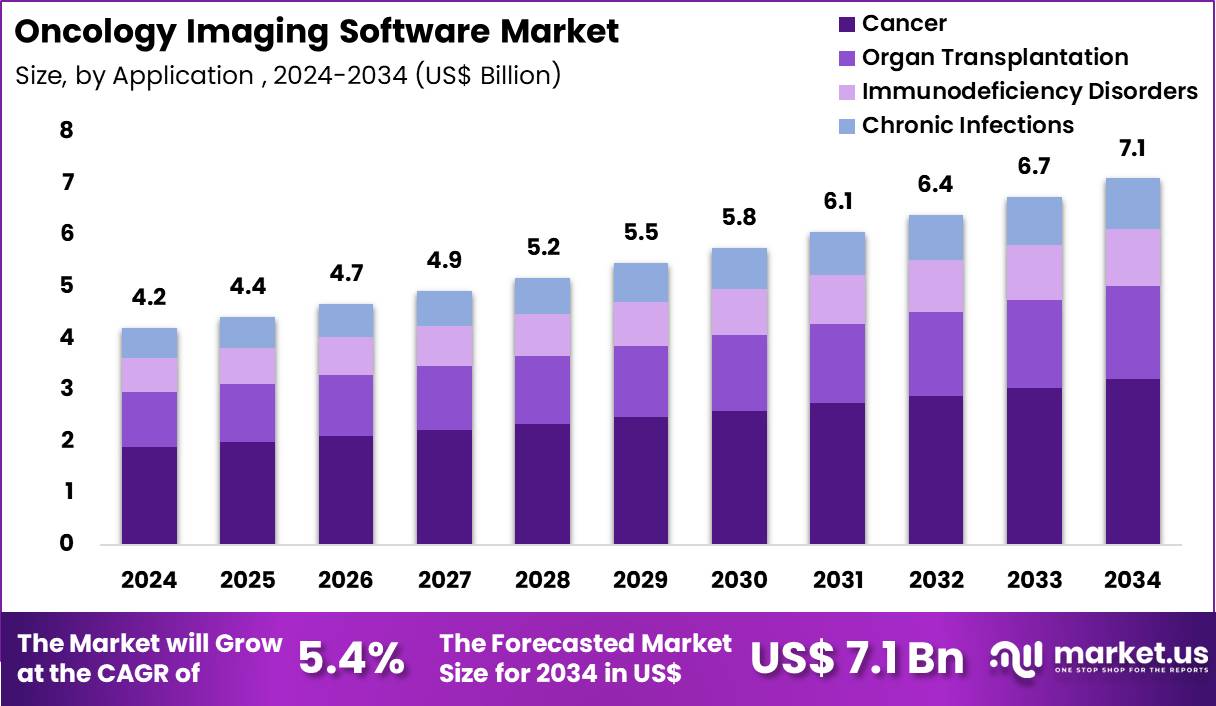
Global Oncology Imaging Software Market size is expected to be worth around US$ 7.1 Billion by 2034 from US$ 4.2 Billion in 2024, growing at a CAGR of 5.4% during the forecast period 2025 to 2034. In 2024, North America led the market, achieving over 42.7% share with a revenue of US$ 1.8 Billion.
The growing burden of cancer worldwide is increasing the demand for advanced oncology imaging software that enables faster diagnosis, accurate tumor assessment, treatment planning, and disease monitoring. Healthcare providers are increasingly adopting artificial intelligence (AI), image analytics, and cloud-based imaging platforms to improve clinical workflows and support precision oncology.
Government agencies and leading healthcare organizations continue to promote the integration of digital technologies into cancer care, encouraging innovation in imaging software used across hospitals, diagnostic centers, and cancer research institutes.
According to the World Health Organization (WHO), approximately 20 million new cancer cases and 9.7 million cancer-related deaths were recorded globally in 2022, highlighting the growing need for efficient imaging technologies that support early detection and personalized treatment.
Additionally, the U.S. National Cancer Institute (NCI) emphasizes that AI-assisted medical imaging is improving cancer detection, risk prediction, and clinical decision-making by enabling radiologists to identify subtle imaging patterns more effectively.
The U.S. Food and Drug Administration (FDA) is also advancing the safe adoption of AI-enabled imaging software through dedicated regulatory initiatives and updated guidance for medical imaging devices. The agency supports software that assists clinicians in detecting and characterizing suspicious cancer lesions from CT, MRI, mammography, ultrasound, and other imaging modalities while maintaining physician oversight in clinical decision-making.
As healthcare systems continue investing in precision medicine and digital oncology infrastructure, oncology imaging software is expected to play an increasingly important role in improving diagnostic accuracy, treatment planning, and long-term patient outcomes.
Key Takeaways
- In 2024, the global oncology imaging software market was valued at US$ 4.2 billion and is projected to reach US$ 7.1 billion by 2034, expanding at a CAGR of 5.4% during the forecast period.
- Based on active molecules, the market is categorized into thymosins, lipopolysaccharides, levamisole, isoprinosine, interleukins, interferons, and glucan. Among these, the thymosins segment accounted for the largest share, representing 30.5% of the market in 2023.
- By application, the market is segmented into cancer, organ transplantation, immunodeficiency disorders, and chronic infections. The cancer segment emerged as the leading application, capturing 45.2% of the total market share.
- In terms of distribution channels, the market comprises hospital pharmacies, retail pharmacies, online pharmacies, and drug stores. Hospital pharmacies dominated this segment, accounting for the highest revenue share of 50.3%.
- Regionally, North America maintained its leading position in the global market, accounting for 42.7% of the overall market share in 2023.
Statistical Information
- The FDA Oncology Center of Excellence (OCE) facilitated 89 oncology drug and biologic approvals in 2024, including 19 new molecular entities/biologics and 34 new indications for previously approved therapies, increasing the need for advanced imaging and response assessment tools.
- Project Orbis, led by the FDA, collaborated with international regulators on 23 oncology product approvals in 2024, including 5 new products and 18 indication extensions, supporting global harmonization of cancer treatment development.
- The FDA’s Project Facilitate handled 364 patient inquiries and processed 761 single-patient Expanded Access applications for investigational cancer therapies in 2024, highlighting growing demand for precise imaging to monitor treatment outcomes.
- In 2024, the FDA’s Precision Oncology Program reported 32 precision oncology therapeutic approvals, reflecting the increasing use of biomarker-guided therapies that depend on advanced diagnostic imaging throughout patient care.
- The FDA approved 17 novel cancer drugs and biologics through its Center for Drug Evaluation and Research (CDER) in 2024, spanning lung, breast, gastrointestinal, thyroid, hematologic, and other cancers that routinely require imaging for diagnosis and follow-up.
- The FDA authorized 11 new companion diagnostic claims for four newly approved in vitro diagnostic devices in 2024, strengthening precision oncology workflows that integrate imaging with molecular diagnostics.
- In 2024, the FDA also cleared nine expanded companion diagnostic indications covering six previously authorized diagnostic devices, broadening patient eligibility for targeted cancer therapies supported by diagnostic imaging.
- The FDA’s 2024 Oncology Research and Development Program released three new educational “Bench-to-Bedside Chats” to help accelerate oncology innovation and support academic researchers and emerging life-science companies developing next-generation cancer technologies.
Regional Analysis
North America dominated the oncology imaging software market in 2024, supported by its advanced healthcare infrastructure, widespread adoption of artificial intelligence (AI), and strong regulatory framework for digital health technologies.
The region continues to benefit from significant investments in precision oncology, medical imaging, and cancer research. The U.S. Food and Drug Administration (FDA) expanded its focus on AI-enabled oncology solutions through the Oncology Center of Excellence, while authorizing 76 oncology devices in 2024, including 40 radiation oncology and diagnostic imaging devices that enhance cancer detection, treatment planning, and clinical workflow efficiency.
These developments have accelerated the integration of AI-powered imaging software across hospitals and cancer centers. Furthermore, the rising incidence of cancer and continued adoption of cloud-based imaging platforms are strengthening regional market growth.
Asia Pacific is expected to register the fastest CAGR during the forecast period, driven by increasing cancer prevalence, expanding healthcare infrastructure, and government initiatives to improve early cancer diagnosis. Countries such as China, Japan, South Korea, and India are investing in AI-assisted imaging, digital pathology, and precision medicine to improve diagnostic accuracy and treatment outcomes.
Australia has also strengthened cancer research through government funding, with 15 collaborative research grants worth more than US$ 5.7 million announced in 2024 to support innovative oncology research. Growing adoption of advanced CT, MRI, and PET imaging technologies, together with expanding digital health programs, is expected to accelerate demand for oncology imaging software across the region.
Emerging Trends
- AI-assisted whole-body cancer imaging is becoming a major trend: Healthcare organizations are expanding the use of AI to analyze whole-body MRI and CT scans for earlier cancer detection and treatment monitoring. In 2025, the U.S. National Cancer Institute (NCI) highlighted AI-assisted whole-body imaging for identifying rare cancers and improving personalized treatment planning across high-risk patient groups.
- Open cancer imaging databases are accelerating software innovation: Developers are increasingly training oncology imaging software using large public datasets instead of isolated hospital data. The National Cancer Institute’s Cancer Imaging Archive now provides 287 curated imaging datasets, supporting AI development, radiomics research, and validation of new oncology imaging applications worldwide.
- Multi-modal imaging with clinical data is gaining momentum: Modern oncology imaging software is moving beyond image viewing by combining CT, MRI, pathology, genomics, and treatment information. This integrated approach helps clinicians make faster and more informed treatment decisions while supporting precision medicine initiatives across cancer centers.
- Regulatory support for AI in oncology continues to expand: The FDA established its Oncology Artificial Intelligence Program to strengthen AI adoption in cancer drug development and clinical evaluation. The program provides reviewer training, advances regulatory science, and supports companies developing AI-enabled oncology technologies for future clinical use.
- AI is increasingly used as a radiologist support tool: Recent NCI research found AI performs rapid and consistent tumor measurements, making it valuable for initial screening and routine image analysis. Rather than replacing radiologists, AI is improving workflow efficiency and allowing specialists to focus on more complex cancer cases.
Use Cases
- Large-scale cancer imaging research and algorithm development: Research organizations use oncology imaging software to build and validate AI models using shared medical images. Since its launch in 2011, the Cancer Imaging Archive has supported researchers by providing de-identified cancer imaging linked with pathology, genomics, treatment details, and patient outcomes.
- Automated tumor segmentation for treatment planning: Hospitals are deploying AI-enabled imaging software to automatically identify and outline tumors before radiation therapy. This reduces manual workload, improves contour consistency, and helps clinicians prepare personalized treatment plans more efficiently for cancer patients.
- Cross-institutional collaboration through cloud imaging platforms: Cancer centers increasingly use cloud-enabled oncology imaging software to securely share imaging studies with multidisciplinary teams. This enables radiologists, oncologists, surgeons, and researchers from different institutions to review cases together and improve treatment decisions.
- AI-powered radiomics for precision oncology: Healthcare institutions are using radiomics software to extract hundreds of quantitative features from CT and MRI scans that are not visible during routine interpretation. These imaging biomarkers support personalized treatment selection and disease monitoring without additional invasive procedures.
- Building imaging tools for rare cancer detection: Researchers are applying AI to whole-body imaging for identifying rare and unexpected cancers that may be overlooked during conventional image review. The National Cancer Institute reported this approach can strengthen early detection while improving long-term monitoring and treatment management.
Frequently Asked Questions On Oncology Imaging Software
- Why is oncology imaging software important in cancer care?
The software improves diagnostic accuracy by providing advanced visualization, image measurements, tumor segmentation, and longitudinal comparison of scans. It also helps clinicians monitor treatment response, detect disease progression earlier, and make more informed decisions for personalized cancer management. - Which healthcare facilities use oncology imaging software?
Oncology imaging software is widely used in hospitals, cancer centers, diagnostic imaging facilities, academic research institutes, and pharmaceutical companies. These organizations use it for diagnosis, radiation therapy planning, clinical trials, imaging research, and patient follow-up across multiple cancer types. - What technologies are driving the oncology imaging software market?
Artificial intelligence, machine learning, cloud computing, radiomics, 3D visualization, multimodality image fusion, and DICOM interoperability are transforming oncology imaging software. These technologies improve workflow efficiency, automate image analysis, and enable more accurate cancer diagnosis and treatment planning. - How does artificial intelligence improve oncology imaging software?
AI helps identify suspicious lesions, automatically segment tumors, quantify imaging biomarkers, and prioritize complex cases for radiologists. It reduces manual work, improves consistency in image interpretation, and supports clinicians with faster and more reliable cancer assessment. - What factors are driving the growth of the oncology imaging software market?
Growing cancer incidence, increasing adoption of precision medicine, expanding use of AI in medical imaging, rising demand for digital healthcare infrastructure, and continuous investments in oncology research are supporting market expansion across developed and emerging healthcare systems. - What challenges does the oncology imaging software market face?
The market faces challenges such as integration with existing hospital information systems, cybersecurity concerns, high implementation costs, data privacy requirements, and the need for standardized imaging data across different healthcare organizations and imaging platforms. - What is the future outlook for the oncology imaging software market?
The market is expected to benefit from broader AI adoption, cloud-based image management, advanced radiomics, and integrated cancer data platforms. Increasing collaboration among healthcare providers, researchers, and technology developers is expected to accelerate innovation and improve patient outcomes.
Conclusion
The global oncology imaging software market is poised for steady growth as healthcare providers increasingly adopt AI-driven technologies to improve cancer diagnosis, treatment planning, and patient monitoring.
Rising cancer incidence, expanding precision oncology programs, and continued investments in digital healthcare infrastructure are creating strong demand for advanced imaging solutions.
Regulatory support from organizations such as the FDA and research initiatives led by the National Cancer Institute are accelerating innovation in AI-enabled imaging, cloud-based platforms, and multimodal data integration.
As hospitals and cancer centers prioritize accurate, data-driven clinical decisions, oncology imaging software will continue to play a vital role in enhancing workflow efficiency, enabling personalized cancer care, and improving long-term patient outcomes across global healthcare systems.




















