


Introduction
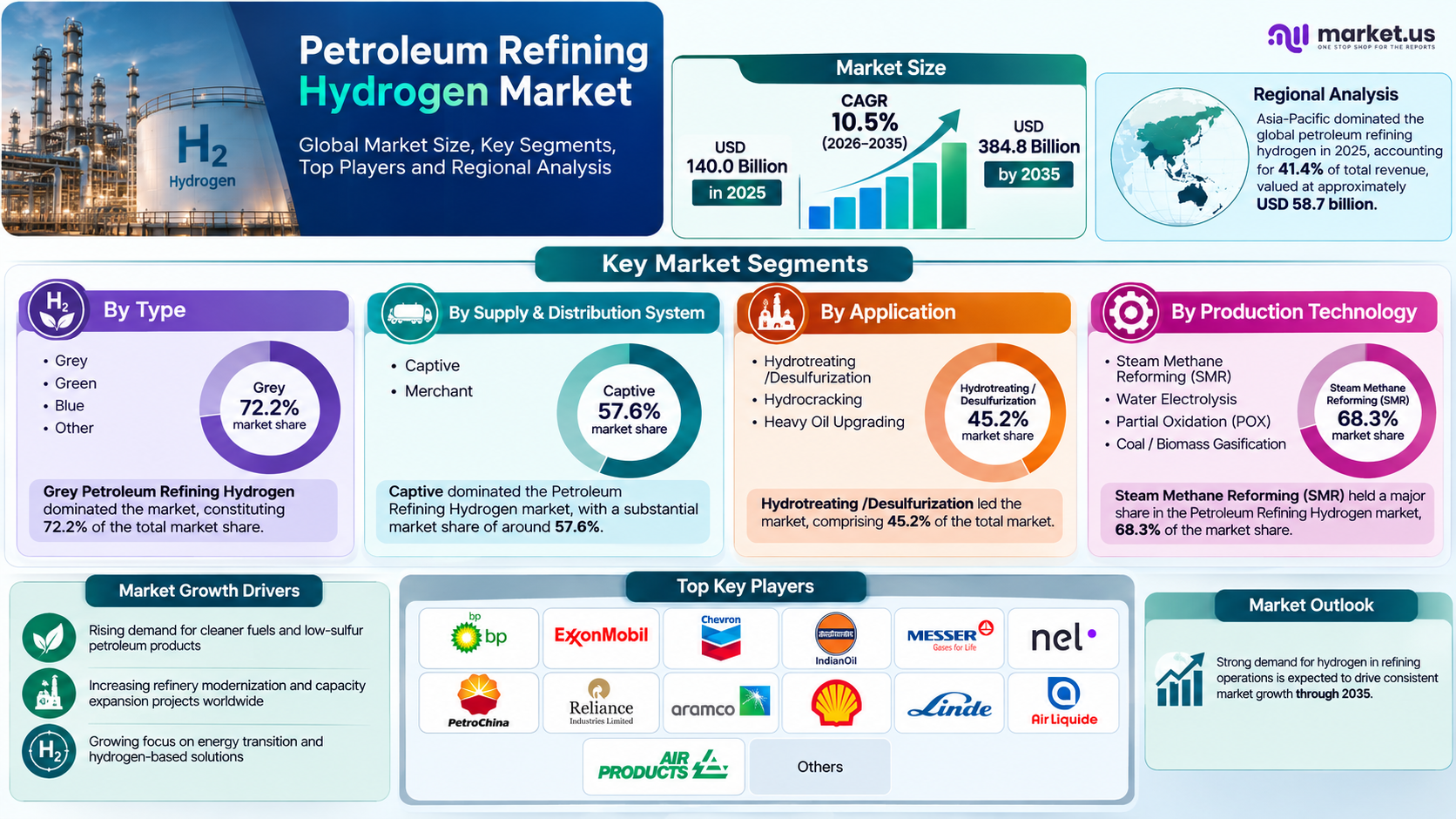
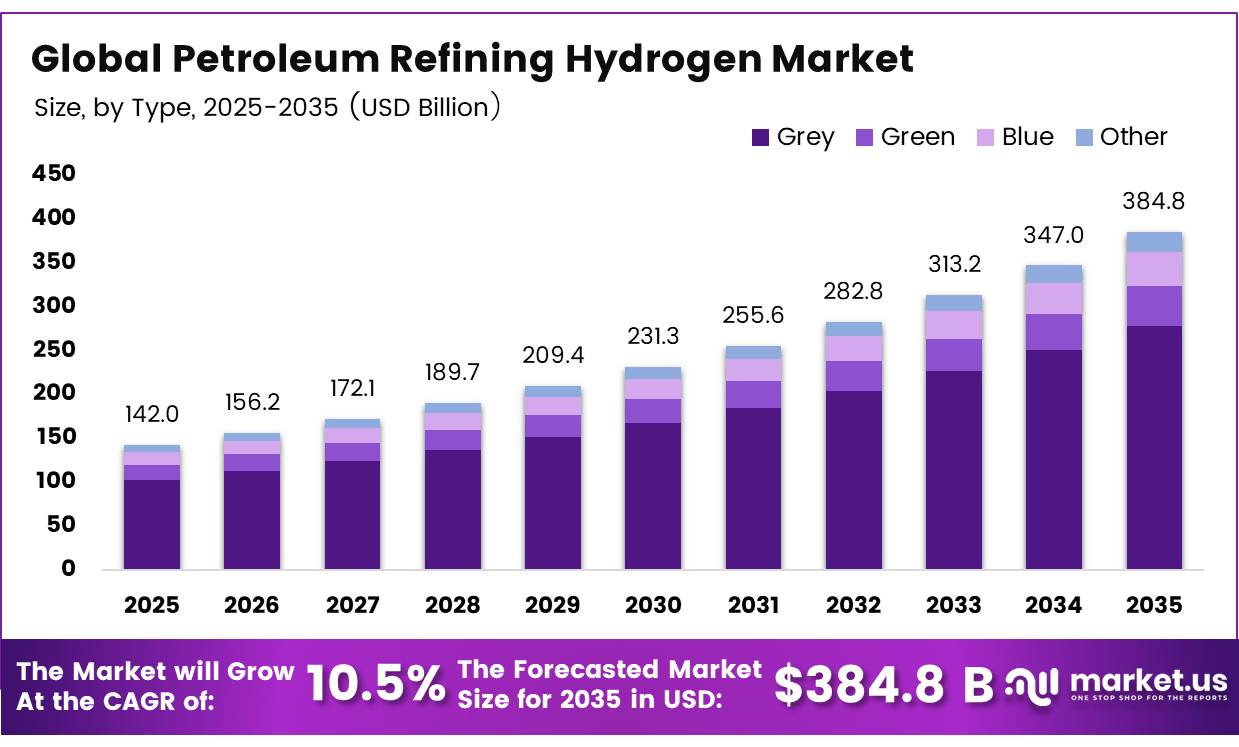
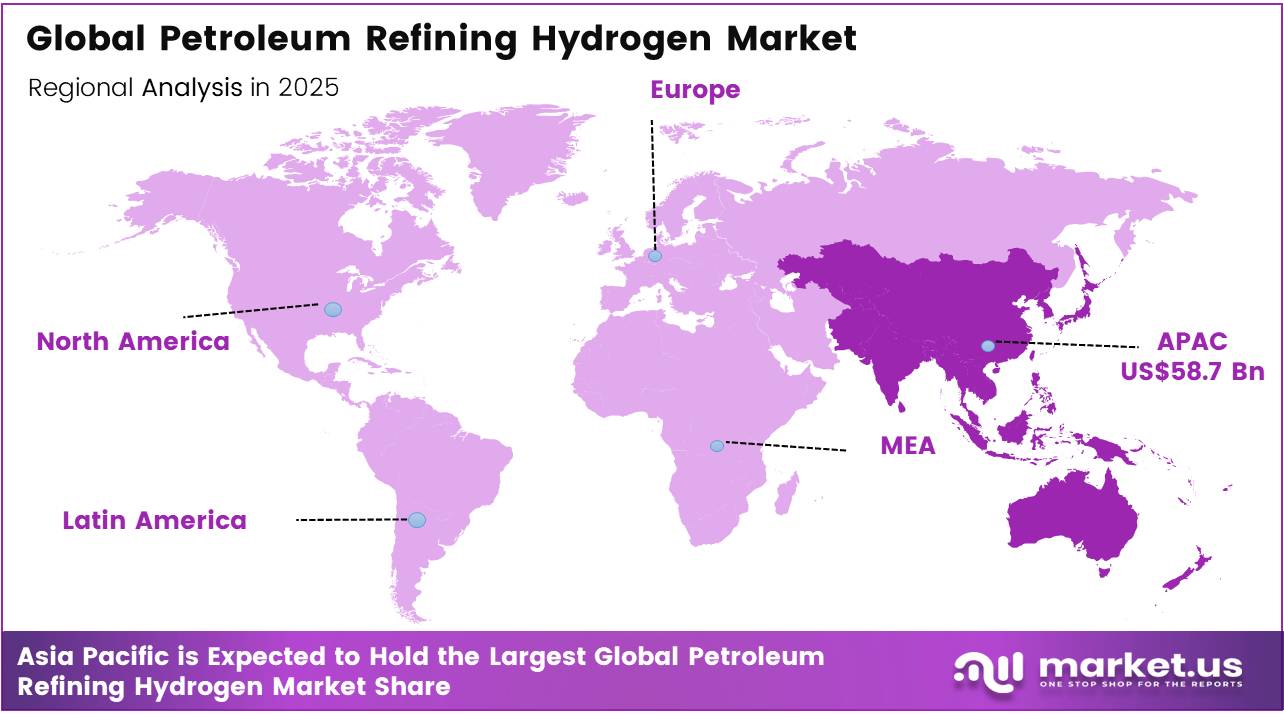
In 2025, the Global Petroleum Refining Hydrogen Market was valued at USD 140.0 billion, and between 2026 and 2035, this market is estimated to register a CAGR of 10.5%, reaching about USD 384.8 billion by 2035. In 2025, Asia Pacific held a dominant market position, capturing more than a 41.4% share, holding USD 58.7 Billion revenue.
Petroleum refining hydrogen supports hydrocracking, hydrotreating and sulphur removal, enabling refineries to process crude and produce fuels. In 2025, hydrogen demand grew almost 3% and exceeded 100 million tonnes. Refining and industry accounted for all consumption, while low-emissions hydrogen demand rose 20% to almost 1 million tonnes.
- On January 1, 2026, U.S. refinery distillation capacity stood at 18.2 million barrels per calendar day, down more than 250,000 barrels per day, or about 1%, from 2025. Hydrogen production capacity fell from 3,022 million cubic feet per day in 2025 to 2,767 million cubic feet per day in 2026. Refineries consumed 156,248 million cubic feet of natural gas in 2025.
Growth will centre on renewable electrolysis, carbon capture and refinery-linked offtake. Agreements reached 1.7 million tonnes annually in 2025, but one-fifth were firm. Committed projects could supply 2.5 million tonnes by 2030. EU rules require renewable hydrogen to represent at least 42% of industrial hydrogen use by 2030 and 60% by 2035.
Key Takeaways
- The global Petroleum Refining Hydrogen market was valued at USD 142.0 billion in 2025.
- The market is projected to expand at a CAGR of 10.50%, reaching approximately USD 384.8 billion by 2035.
- By type, Grey Petroleum Refining Hydrogen led the market, accounting for 72.2% of the total market share.
- By supply and distribution system, the Captive segment dominated the market with a share of approximately 57.6%.
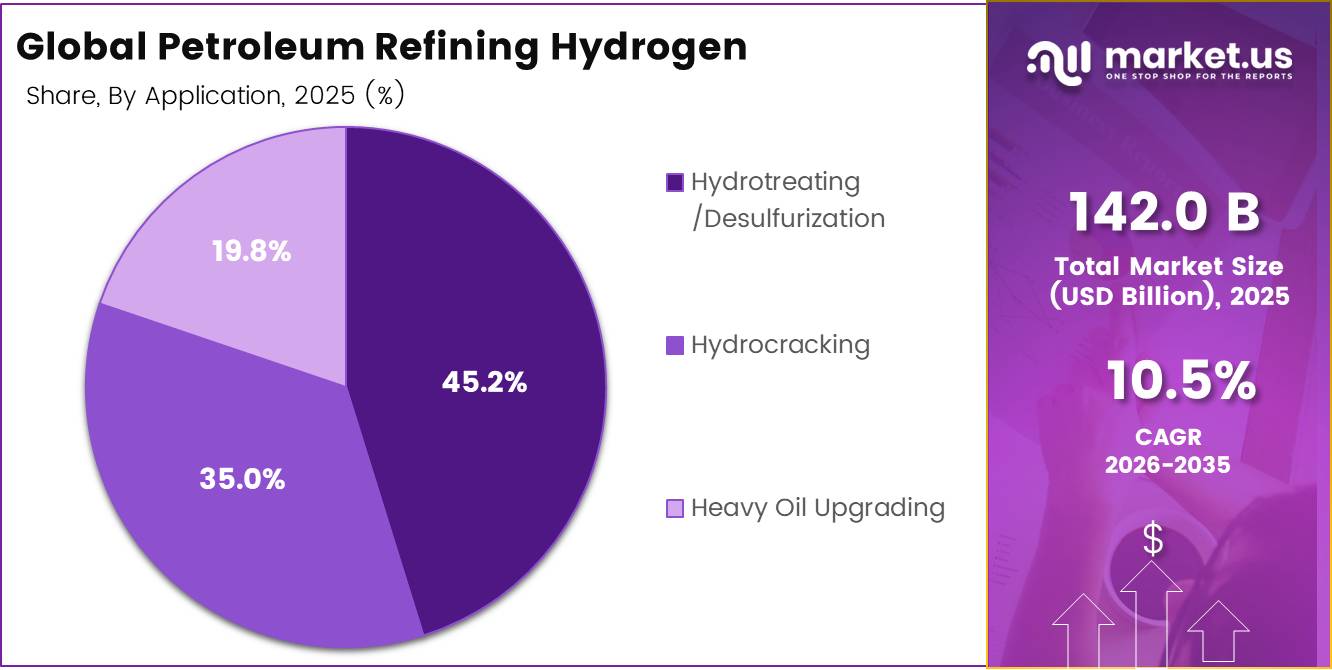
- By application, Hydrotreating/Desulfurization emerged as the leading segment, representing 45.2% of the overall market.
- By production technology, Steam Methane Reforming (SMR) held the largest market share at 68.3%.
- In 2025, Asia Pacific remained the leading regional market, accounting for 41.4% of total global consumption.
Market Segmentation Overview
Type Analysis
Grey Hydrogen Remains the Dominant Type Segment
Grey hydrogen dominated the petroleum refining hydrogen market with a 72.2% share, supported by the extensive use of steam methane reforming systems across conventional refinery sites. Its established production infrastructure, steady access to natural gas and ability to meet continuous refinery demand make it the preferred hydrogen type for hydrotreating, hydrocracking and sulphur-removal operations. The scale of hydrogen-dependent refining activity remains substantial, as the U.S. Energy Information Administration reported 17,002,116 barrels per calendar day of catalytic hydrotreating and desulphurisation capacity as of January 1, 2026, while catalytic hydrocracking capacity stood at 2,342,770 barrels per calendar day.
Supply and Distribution System Analysis
Captive Supply Holds a Significant Market Position
Captive hydrogen supply accounted for 57.6% of the petroleum refining hydrogen market, as refineries increasingly rely on onsite production to maintain a reliable and uninterrupted hydrogen flow. Producing hydrogen within refinery premises allows operators to control supply, reduce transportation risks and support continuous hydrotreating, hydrocracking and sulphur-removal activities. In 2026, refinery-operated hydrogen production capacity reached 1,063 million cubic feet per day in the U.S. West Coast refining district, while East Coast facilities recorded 109 million cubic feet per day, reflecting the strong presence of refinery-owned captive hydrogen infrastructure.
Application Analysis
Hydrotreating and Desulfurization Lead Refinery Applications
Hydrotreating and desulfurization led the petroleum refining hydrogen market with a 45.2% share, driven by their essential role in removing sulphur and other impurities from transportation fuels. Refineries use these processes to improve diesel, gasoline, kerosene and aviation-fuel quality while protecting catalysts and downstream processing equipment. As of January 1, 2026, U.S. distillate hydrotreating capacity reached 6,268,465 barrels per stream day, including 4,430,224 barrels per stream day for diesel treatment and 1,635,341 barrels per stream day for kerosene and jet-fuel processing.
Production Technology Analysis
Steam Methane Reforming Leads Hydrogen Production Technology
Steam methane reforming remained the leading production technology with a 68.3% share of the petroleum refining hydrogen market, owing to its proven operating performance, large production capacity and compatibility with existing natural gas infrastructure. The technology is widely used by refineries that require a continuous and high-volume hydrogen supply for fuel upgrading and contaminant removal. The United States produces around 10 million metric tons of hydrogen annually, with approximately 95% generated through natural gas reforming. SMR plants generally operate at temperatures between 700°C and 1,000°C and pressures ranging from 3 to 25 bar.
Drivers Analysis
Ultra‑low sulfur & cleaner fuel regulations in transport fuels
Ultra-low sulfur fuel regulations are increasing hydrogen use across petroleum refineries. Since 2020, standards such as the IMO 0.5% sulfur cap, Euro VI and Tier 3 have pushed refiners to operate hydrotreating units at higher severity, particularly when processing heavier and higher-sulfur crude. In 2026, wider adoption of road-fuel limits of ≤10–15 ppm sulfur is raising hydrogen consumption per barrel for gasoline, diesel and marine fuels. This trend is encouraging investment in larger SMR units, hydrogen recovery systems and merchant supply, while fuel can represent 45–75% of conventional SMR production costs. Between 2026 and 2030, tighter standards across APAC and Latin America could add low-single-digit growth above refined-product demand and support an estimated +2.3% uplift in market CAGR.
Major Challenges
Hydrogen system reliability risk
Hydrogen system reliability remains a major operational risk for refineries. A 2–6-hour outage in an SMR unit or pipeline can reduce processing rates by 10–30%, while a 200–300 kb/d refinery may face losses of USD 1–3 million per incident. Integrating electrolyser-based hydrogen adds further pressure, as renewable output can fluctuate by ±10–20%, affecting hydrogen pressure and purity. Although digital twins, storage and redundant systems can improve reliability within 2–4 years, recurring disruptions currently reduce potential market growth by an estimated 1.3 percentage points.
Business Opportunities
Surplus blue/green hydrogen export from refineries
Refineries can create a new revenue stream by producing blue or green hydrogen beyond onsite requirements and selling the surplus to transport, industrial and power users. This model could raise hydrogen revenue per refinery by 15–30% compared with desulfurization-only operations. A large refinery producing an additional 50–150 kt/year and selling hydrogen at USD 2.0–2.5/kg could generate approximately USD 100–375 million in annual revenue. With low-emissions hydrogen demand in refineries and industrial facilities expected to exceed 2 million tonnes per year by 2030, facilities across North America, Europe, GCC and APAC could become regional supply hubs. If 10–15% of large refineries adopt surplus-export models, refinery-linked hydrogen volumes could increase by 10–20%, supporting an estimated 2.4 percentage-point uplift in market CAGR.
Use Cases
Renewable Diesel and Biofuel Upgrading
Hydrogen is increasingly used to convert vegetable oils, animal fats and waste oils into hydrotreated vegetable oil, commonly marketed as renewable diesel. It removes oxygen from biological feedstocks and improves the fuel’s stability, storage performance and compatibility with conventional diesel infrastructure. The U.S. Energy Information Administration reported 19 renewable diesel and other biofuel plants with a combined production capacity of 4,719 million gallons per year, or approximately 308,000 barrels per day, as of January 1, 2025. Gulf Coast facilities accounted for 2,129 million gallons per year, while West Coast plants represented 1,799 million gallons per year, creating an additional industrial use for refinery-grade hydrogen.
Captive Hydrogen Production and Refinery Network Supply
Large refineries commonly operate onsite hydrogen plants to maintain a continuous supply for hydrotreating and hydrocracking units. Captive production reduces dependence on external transportation and allows refinery operators to balance hydrogen between production units, recovery systems and high-consumption processes. U.S. refinery-operated hydrogen production capacity stood at 2,767 million cubic feet per day in 2026, compared with 3,022 million cubic feet per day in 2025. Refineries used 156,248 million cubic feet of natural gas as hydrogen-production feedstock during 2025. The United States produces approximately 10 million metric tons of hydrogen annually, and around 95% is produced through natural gas reforming.
Hydrocracking Heavy Oil into Valuable Fuels
Hydrogen is combined with catalysts, heat and pressure in hydrocracking units to break heavy hydrocarbons into lighter and more valuable products. These products include diesel, jet fuel, gasoline blending components and high-quality fuel oil. This use case is particularly important when refineries process heavy or high-sulfur crude that cannot be converted efficiently through simpler refining methods. U.S. catalytic hydrocracking capacity reached 2,342,770 barrels per stream day in 2026. Gas oil represented 1,468,600 barrels per day, distillate feed accounted for 787,170 barrels per day, and residual fuel oil capacity stood at 87,000 barrels per day. These figures demonstrate the large hydrogen requirement associated with upgrading difficult refinery feedstocks.
Regional Analysis
Asia Pacific led the global petroleum refining hydrogen market with a 41.4% share, supported by extensive refinery capacity, higher crude-processing volumes and growing demand for cleaner transport fuels. In 2025, China’s refineries processed 737.59 million tonnes of crude oil, representing a 4.1% year-on-year increase. Processing volume reached 62.46 million tonnes in December alone, up 5.0% from the previous year, sustaining strong hydrogen consumption across desulfurization, hydrocracking and heavy-feed upgrading operations.
Recent Developments
- In November 2025, Shell secured two renewable power agreements for its 100 MW REFHYNE 2 electrolyser at the Rheinland site. Expected to begin operations in 2027, the facility could produce up to 16,000 tonnes of low-carbon hydrogen annually for refinery and chemical applications.
- In May 2025, Saudi Aramco acquired a 50% stake in Blue Hydrogen Industrial Gases Company, expanding its lower-carbon hydrogen portfolio and strengthening regional hydrogen supply capabilities for industrial users.
Conclusion
The Petroleum Refining Hydrogen Market is expected to expand steadily as refineries produce cleaner fuels, process heavier crude oils and reduce the emissions associated with conventional hydrogen production. The market, valued at USD 142.0 billion in 2025, is projected to reach USD 384.8 billion by 2035, growing at a 10.50% CAGR. Global hydrogen demand surpassed 100 million tonnes in 2025, while low-emissions hydrogen production increased by 20% to almost 1 million tonnes, showing early progress toward cleaner refinery operations. Committed projects could supply 2.5 million tonnes of low-emissions hydrogen to refineries and industrial facilities by 2030. However, high production costs, limited infrastructure and uncertain purchase commitments may slow adoption. Overall, tighter fuel standards, carbon-reduction policies and investments in electrolysis, carbon capture and hydrogen recovery systems will support long-term market development.
Looking for data tailored to your specific market, region, or business need? Request a custom report or consultation — write to us at [email protected]




















