


Introduction
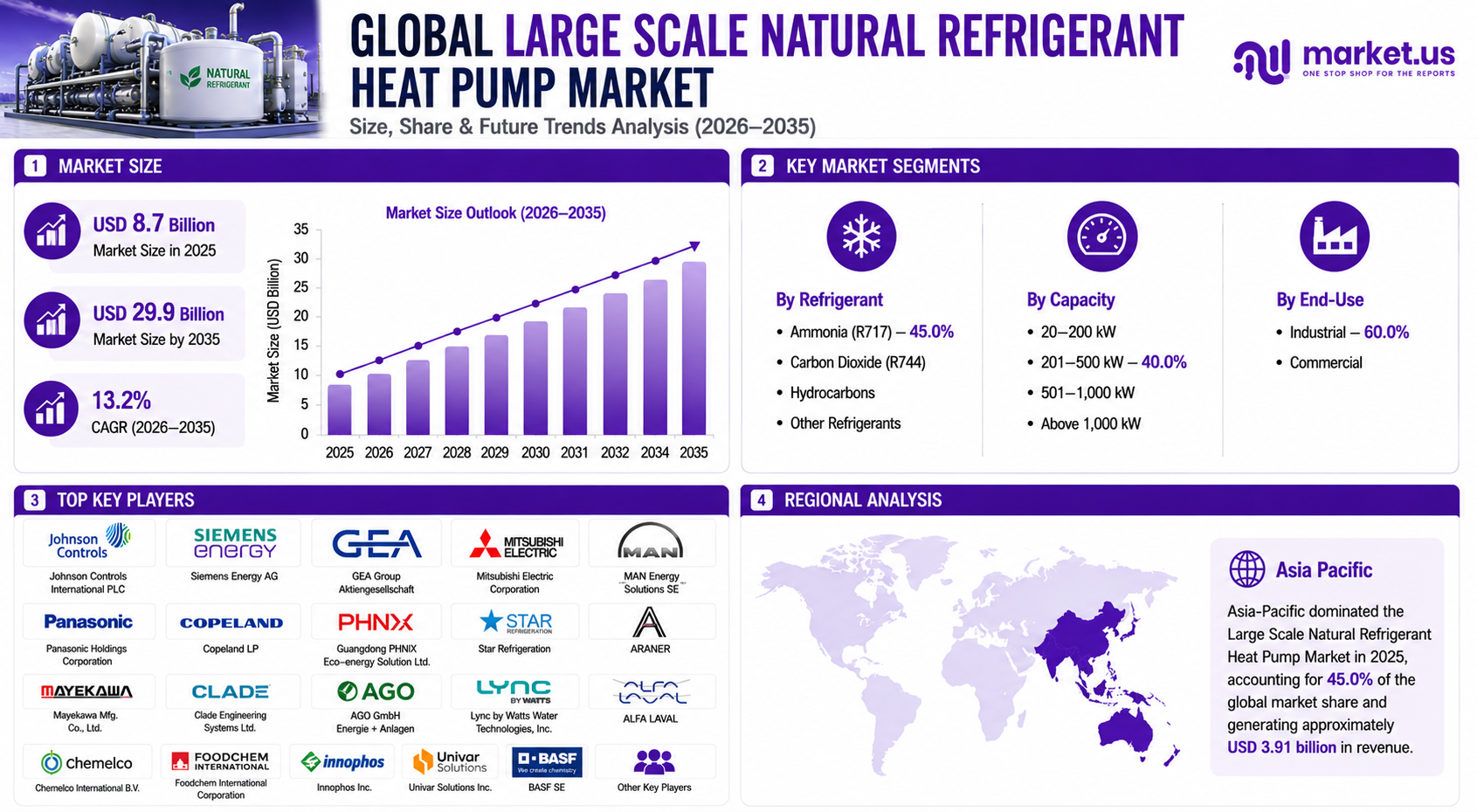
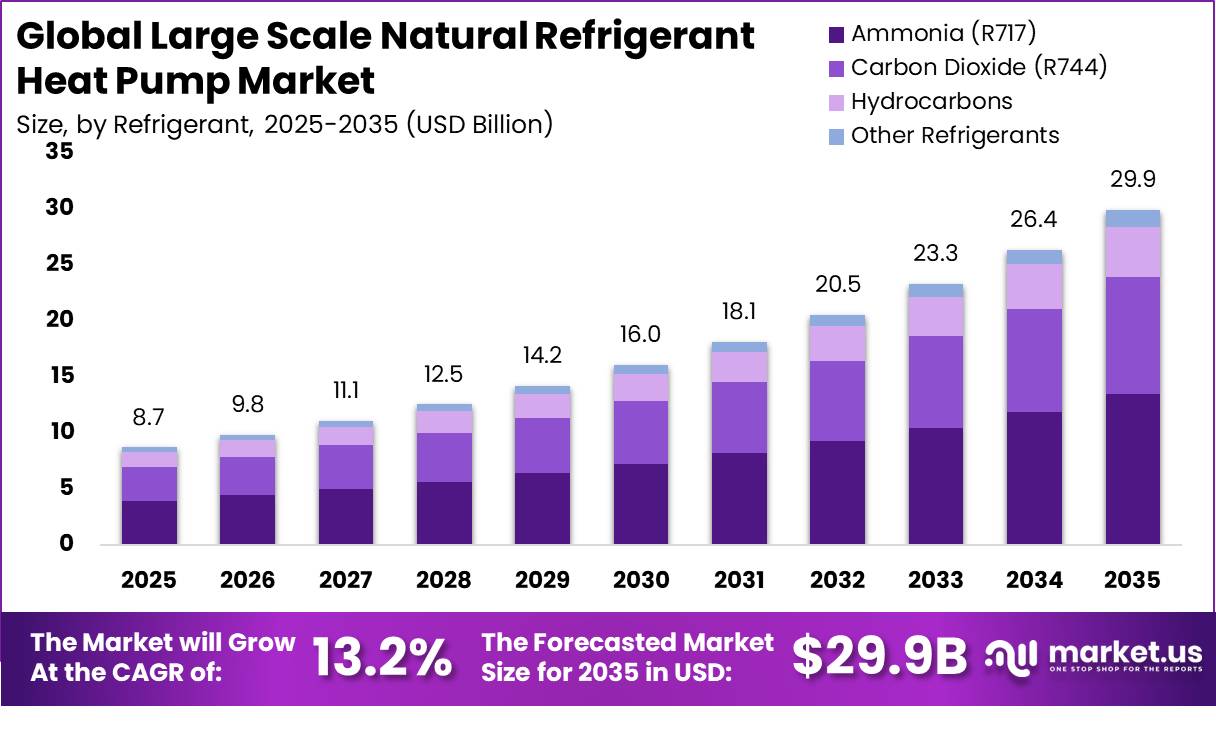
In 2025, the Global Large-Scale Natural Refrigerant Heat Pump Market reached a value of USD 8.7 billion. The market is projected to grow at a CAGR of 13.2% between 2026 and 2035, reaching approximately USD 29.9 billion by 2035. Asia Pacific maintained the leading position in 2025, accounting for more than 45.0% of the global market and generating nearly USD 3.91 billion in revenue.
Large-scale natural refrigerant heat pumps are becoming an important part of the global transition toward cleaner and more efficient energy systems. These systems are widely used for industrial and commercial heating and rely on natural refrigerants such as ammonia (R717), carbon dioxide (R744), and hydrocarbons. Compared with conventional synthetic refrigerants, these substances have significantly lower global warming potential and support stricter environmental and emissions-reduction targets.
Government policies are also encouraging the adoption of clean heating technologies. In May 2022, the European Union introduced the REPowerEU Plan to reduce dependence on fossil fuels and accelerate the deployment of renewable energy solutions. Under this initiative, the European Commission established a target to install 10 million additional heat pumps by 2027. This policy support is encouraging industries to replace conventional boilers and fossil-fuel-based heating equipment with electricity-powered heat pump systems.
Demand is expanding across food processing, chemicals, pharmaceuticals, paper production, district heating, and general manufacturing. These industries are increasingly adopting large-scale heat pumps to improve energy efficiency, lower operating emissions, and utilize renewable electricity for process heating. According to the International Renewable Energy Agency, global renewable power capacity increased by 585 GW in 2024, providing a stronger foundation for the wider electrification of industrial heating.
Continued improvements in high-temperature heat pump technology are making these systems suitable for a broader range of industrial processes. Supportive regulations, growing renewable electricity availability, and corporate decarbonization commitments are expected to strengthen market adoption. As industries pursue long-term energy efficiency and carbon-reduction goals, large-scale natural refrigerant heat pumps are likely to become an increasingly important part of the global sustainable heating landscape.
Key Takeaways
- In 2025, the Global Large Scale Natural Refrigerant Heat Pump Market was valued at USD 8.7 billion.
- The global market is projected to grow at a CAGR of 13.2% and is estimated to reach USD 29.9 billion by 2035.
- In 2025, the Ammonia (R717) segment dominated the market by refrigerant, accounting for 45.0% of the total market share.
- In 2025, the 201–500 kW segment held the leading position in the market by capacity, capturing 40.0% of the total share.
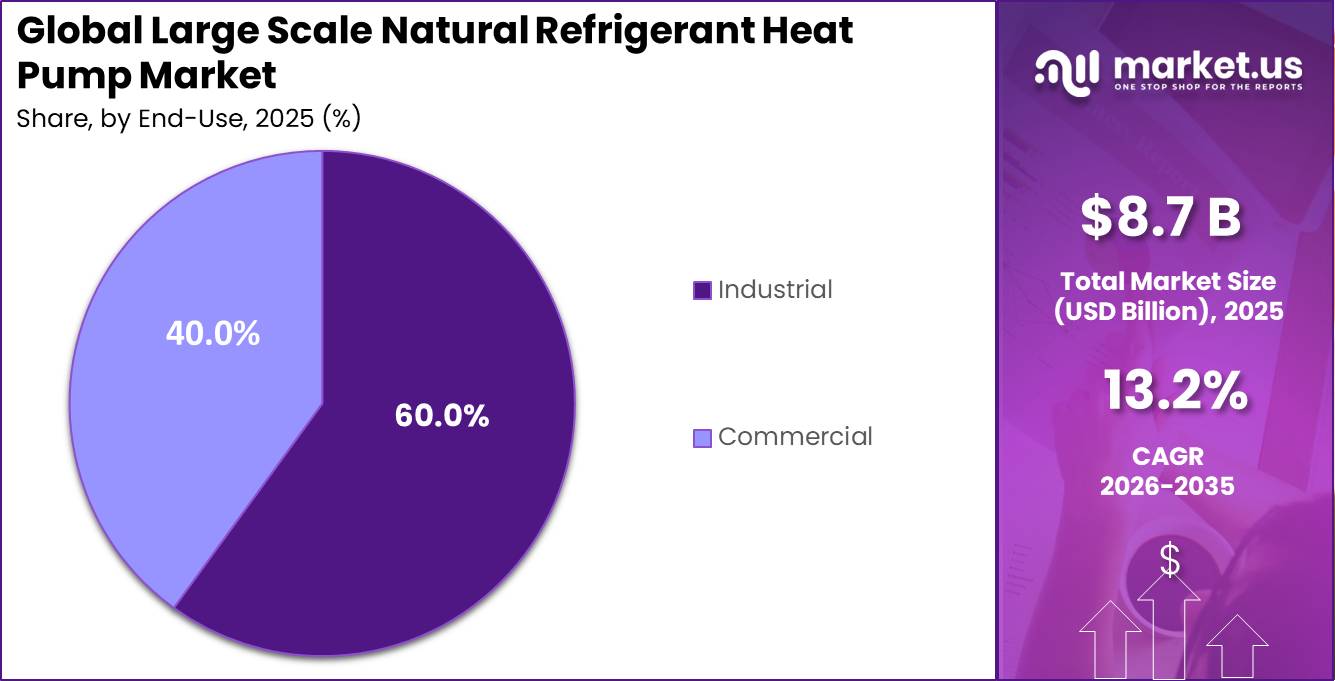
- In 2025, the Industrial segment emerged as the dominant end-use category, representing 60.0% of the market.
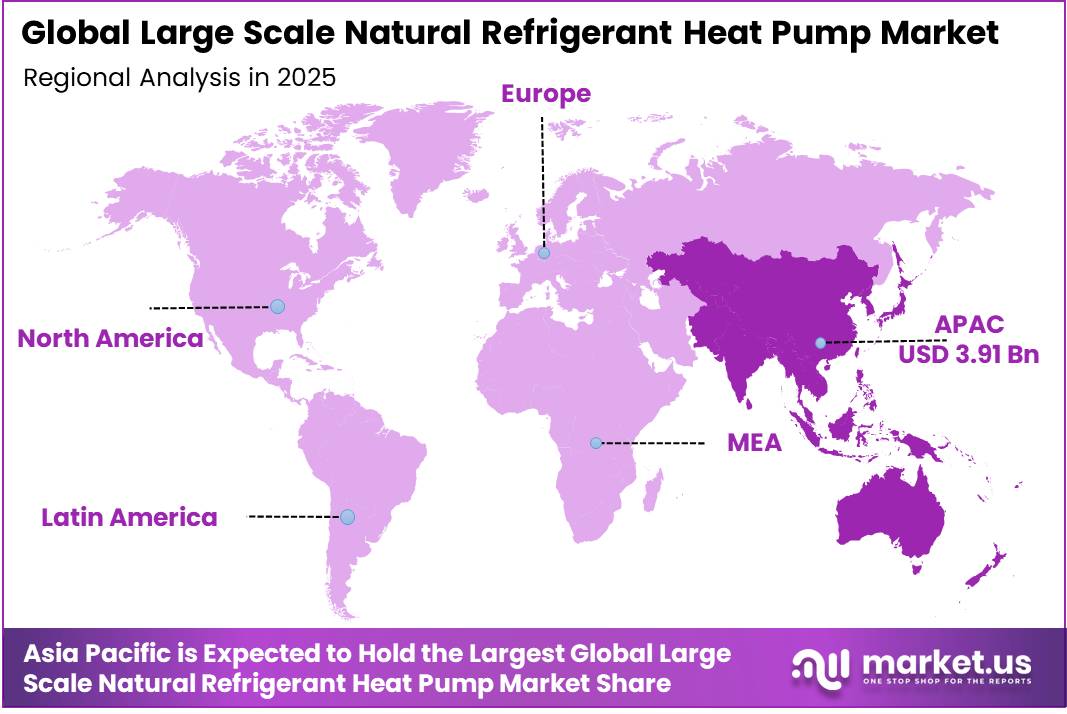
- In 2025, Asia Pacific led the global market, securing 45.0% of the total market share and generating approximately US$3.91 billion in revenue.
Market Segmentation Overview
Refrigerant Analysis
Ammonia (R717) dominates due to its strong efficiency in large-scale industrial heating systems.
In 2025, Ammonia (R717) held a dominant position in the Large-Scale Natural Refrigerant Heat Pump Market by refrigerant, accounting for more than a 45.0% share. Its leadership was supported by excellent thermodynamic properties, high energy efficiency, and reliable performance in large-capacity heating operations. Ammonia-based heat pumps are widely used in food processing, chemical production, manufacturing, and other industries requiring continuous heat generation. Their ability to deliver high-temperature heat while controlling energy consumption and operating costs made them a preferred option for large industrial installations.
Capacity Analysis
The 201–500 kW segment dominates by offering a practical balance between heating capacity and efficiency.
In 2025, the 201–500 kW segment held a dominant market position, capturing more than a 40.0% share of the Large-Scale Natural Refrigerant Heat Pump Market by capacity. Systems in this range provide sufficient heating output for manufacturing plants, food processing facilities, district heating networks, and large commercial buildings. They also offer manageable installation costs, reliable operation, and efficient energy performance. As businesses increased their focus on lowering emissions and replacing fossil-fuel-based heating systems, the 201–500 kW category remained a preferred choice for medium- and large-scale heating projects.
End-Use Analysis
The industrial segment dominates as manufacturers increase the use of sustainable process-heating technologies.
In 2025, the Industrial segment held a dominant position in the Large-Scale Natural Refrigerant Heat Pump Market by end use, accounting for more than a 60.00% share. Its leadership was supported by growing adoption across food processing, chemicals, paper production, manufacturing, and other energy-intensive industries. Large-scale natural refrigerant heat pumps help industrial facilities reduce energy consumption, lower carbon emissions, and decrease dependence on fossil-fuel-based boilers. Their ability to recover waste heat and provide efficient process heating also strengthened their role in industrial sustainability and decarbonization strategies.
Drivers
Industrial Decarbonization Drives Natural Refrigerant Heat Pump Adoption
Industrial decarbonization is a major force behind demand for large-scale natural refrigerant heat pumps. Heavy industries still require large amounts of heat for washing, drying, evaporation, sterilization, and other production steps. The International Energy Agency reported in 2026 that commercially available heat pumps could technically supply around 20% of global industrial heat demand, mainly across low- and medium-temperature processes. Japan had nearly 650 MW of installed industrial heat pump capacity in 2024, enough to meet about 1% of its light-industrial heat demand.
The rapid expansion of renewable electricity is strengthening this transition. IRENA reported that the world added 585 GW of renewable power capacity in 2024, taking total installed renewable capacity to 4,448 GW. Renewables represented 92.5% of all new power capacity added during the year, while annual renewable capacity growth reached 15.1%. This larger supply of clean electricity improves the environmental value of industrial heat pumps and helps facilities reduce direct fuel consumption.
Government action is creating another strong reason for investment. The European Union’s REPowerEU framework aims to double the deployment rate of heat pumps and support at least 10 million additional hydronic installations by 2027. These policies improve project confidence, encourage equipment development, and support upgrades across district heating, food processing, chemicals, pharmaceuticals, paper, and manufacturing.
Business Opportunities
Waste Heat Recovery Opens Large Industrial Heating Opportunities
Waste heat recovery creates a major growth opportunity for the Large-Scale Natural Refrigerant Heat Pump Market. Factories, data centres, wastewater plants, power stations, and commercial facilities release low-temperature heat that cannot be used directly. Large heat pumps can capture this energy, raise its temperature, and supply process heat or district heating. Natural refrigerants such as ammonia and carbon dioxide make these systems suitable for large-capacity projects while supporting tighter environmental rules.
The International Energy Agency reported in its Heat Pump Monitor 2026 that commercially available heat pumps could technically meet around 20% of global industrial heat demand, mainly across low- and medium-temperature processes. The agency also stated that district energy networks already provide heat to around 600 million people worldwide. This customer base gives equipment suppliers an opportunity to connect industrial waste heat with cities, hospitals, universities, and commercial buildings through heating networks.
China illustrates the scale of the unused resource. According to the IEA’s analysis of heat pumps in China, nearly 20 EJ of waste heat from industries, thermal power plants, wastewater facilities, and data centres could be available by 2050. Around two-thirds of this resource may be suitable for heat pump integration, representing approximately 650 GW of potential heat pump capacity. This shows how waste heat recovery can create a pipeline of large projects rather than only small building installations.
Emerging Trends
High-Temperature Heat Pumps Expand Across Industrial Process Heating
High-temperature natural refrigerant systems are becoming an important trend in large-scale industrial heating. Earlier heat pumps were mainly used for space heating, hot water, and lower-temperature processes. New compressor designs, improved heat exchangers, and better integration are allowing ammonia and carbon dioxide heat pumps to serve demanding production lines. The International Energy Agency’s Heat Pump Monitor 2026 states that industrial heat pumps operating below 120°C have entered commercial service, while systems supplying temperatures below 160°C are beginning commercial operation. Technologies for the 201°C to 400°C range remain at demonstration, prototype, or concept stages.
This progress creates a wider market across food processing, paper, chemicals, pharmaceuticals, textiles, drying, and district heating. The IEA estimates that commercially available heat pumps could technically supply around 20% of industrial heat demand, mainly in low-temperature and medium-temperature processes. Japan had nearly 650 MW of installed industrial heat pump capacity in 2024, sufficient to cover around 1% of its light-industrial heat requirement and more than double the level recorded a decade earlier. These figures show that high-temperature applications are moving beyond pilot projects.
Use Cases
Seawater-Based District Heating Networks: Large CO₂ heat pumps can extract low-temperature energy from seawater and supply it to city heating networks. In Esbjerg, Denmark, a 70 MW CO₂-based seawater heat pump is expected to produce around 280,000 MWh of heat annually. The system can meet the heating requirements of approximately 25,000 households and reduce carbon dioxide emissions by nearly 120,000 tonnes per year. For every 1 MWh of electricity consumed, the facility can generate around 3 MWh of usable heat. This model is suitable for coastal cities seeking to replace coal or gas-based district heating.
Cold-Climate Air-To-Water District Heating: Ambient air can also serve as a heat source, even in regions with severe winters. Helsinki’s Patola project uses a CO₂ heat pump with a heating capacity ranging from 20 MW to 33 MW. The unit is designed to operate at outdoor temperatures as low as -20°C and can deliver water at up to 90°C. Once operational, it is expected to supply around 200 GWh of heat annually to approximately 30,000 households, while lowering emissions by nearly 26,000 tonnes per year. The Finnish government has supported the project through an energy subsidy.
Wastewater Heat Recovery for Urban Heating: Wastewater treatment plants release stable low-temperature heat throughout the year, making them suitable for large heat pump installations. In Malmö, Sweden, four ammonia heat pumps provide a combined heating capacity of 40 MW. The system captures heat from sewage water at between 8°C and 14°C and supplies district heating water at between 55°C and 65°C. It provides around 8% of the energy delivered to nearly 100,000 homes and contributes to approximately 50,000 tonnes of annual carbon dioxide savings. Its coefficient of performance is above 3.5, meaning each unit of electricity produces more than 3.5 units of heat.
Mine-Water Heating for Buildings and Communities: Abandoned mines can become long-term sources of low-carbon heat. Gateshead in the United Kingdom uses two 3 MW ammonia heat pumps to raise mine-water temperature from approximately 15°C to 80°C. The water is collected from former coal mines located about 150 metres below the town centre. The project adds around 12 GWh of heat to the local network and can support up to 1,250 new homes, alongside public buildings, a care facility, and properties already connected to the network. This use case converts former fossil-fuel infrastructure into a useful renewable heating resource.
Food Processing Heating and Refrigeration Integration: Food processing plants require refrigeration, freezing, cleaning water, air conditioning, and process heating at the same location. At the Wipasz poultry processing facility in Poland, an ammonia system provides 5.3 MW of cooling and supports an overall heating demand of 3.9 MW. The plant can process up to 14,500 chickens per hour and uses around 500 cubic metres of hot water each day. Recovered refrigeration heat is upgraded to temperatures of up to 55°C, covering hot water and building-heating requirements while reducing the need for boilers. Integrated heating and cooling systems can lower energy costs by 30% or more under suitable operating conditions.
Regional Analysis
Asia-Pacific Leads Through Industrial Expansion and Clean Heating
Asia-Pacific held the leading position in the Large-Scale Natural Refrigerant Heat Pump Market in 2025, accounting for 45.0% of the global market and generating around USD 3.91 billion in revenue. The region’s dominance was supported by its large industrial base, expanding commercial infrastructure, and growing demand for energy-efficient heating technologies. Food processing plants, chemical facilities, manufacturing units, refrigeration operations, and district heating networks increasingly adopted natural refrigerant heat pumps to reduce energy consumption and lower operational emissions.
Europe remained an important regional market due to its strong focus on decarbonization, energy efficiency, and the replacement of fossil-fuel-based heating systems. Natural refrigerant heat pumps gained wider use across industrial plants, district heating networks, and large commercial buildings. Supportive environmental policies, clean heating programs, and stricter refrigerant regulations further encouraged investment in efficient and low-emission heating technologies.
Recent Developments
In May 2026, Siemens Energy strengthened its involvement in large-scale sustainable heating and industrial decarbonization projects. The company supported high-temperature heat pump systems capable of supplying heat above 90°C for industrial processes and district energy networks. It also continued developing electrified heating and energy-efficiency solutions to help industries reduce dependence on fossil fuels. Siemens Energy generated EUR 39.1 billion in revenue during FY2025 and served customers across more than 90 countries.
In April 2026, Alfa Laval expanded its participation in the energy transition by supporting large heat pump installations for district heating and industrial process applications. The company used its heat-transfer equipment and energy-efficiency technologies to improve system performance and support lower-emission heating operations. Alfa Laval recorded SEK 69.7 billion in net sales during FY2025, operated in more than 100 countries, and employed over 22,000 people worldwide.
Conclusion
The Large-Scale Natural Refrigerant Heat Pump Market is positioned for strong long-term expansion as industries and cities replace fossil-fuel heating with cleaner electric systems. Natural refrigerants such as ammonia and carbon dioxide offer high energy efficiency while helping users avoid synthetic gases with high global warming potential.
The International Energy Agency reported that commercially available heat pumps could technically meet around 20% of global industrial heat demand, particularly across low- and medium-temperature processes. Systems operating below 120°C are already commercially available, while equipment supplying temperatures below 160°C is beginning to enter wider commercial use. This progress will increase adoption in food processing, chemicals, paper, pharmaceuticals, manufacturing, wastewater treatment, and district heating.
Renewable power growth will further improve the business case for electrified heating. IRENA reported that global renewable capacity increased by 585 GW in 2024 to reach 4,448 GW, with renewables representing 92.5% of total power-capacity additions. Government programs are also supporting market development. The European Commission’s Heat Pump Accelerator Platform promotes deployment across buildings, industry, and district heating, while 2.34 million new heat pumps were installed across 13 European countries in 2025.
Looking for data tailored to your specific market, region, or business need? Request a custom report or consultation — write to us at [email protected]




















