


Overview
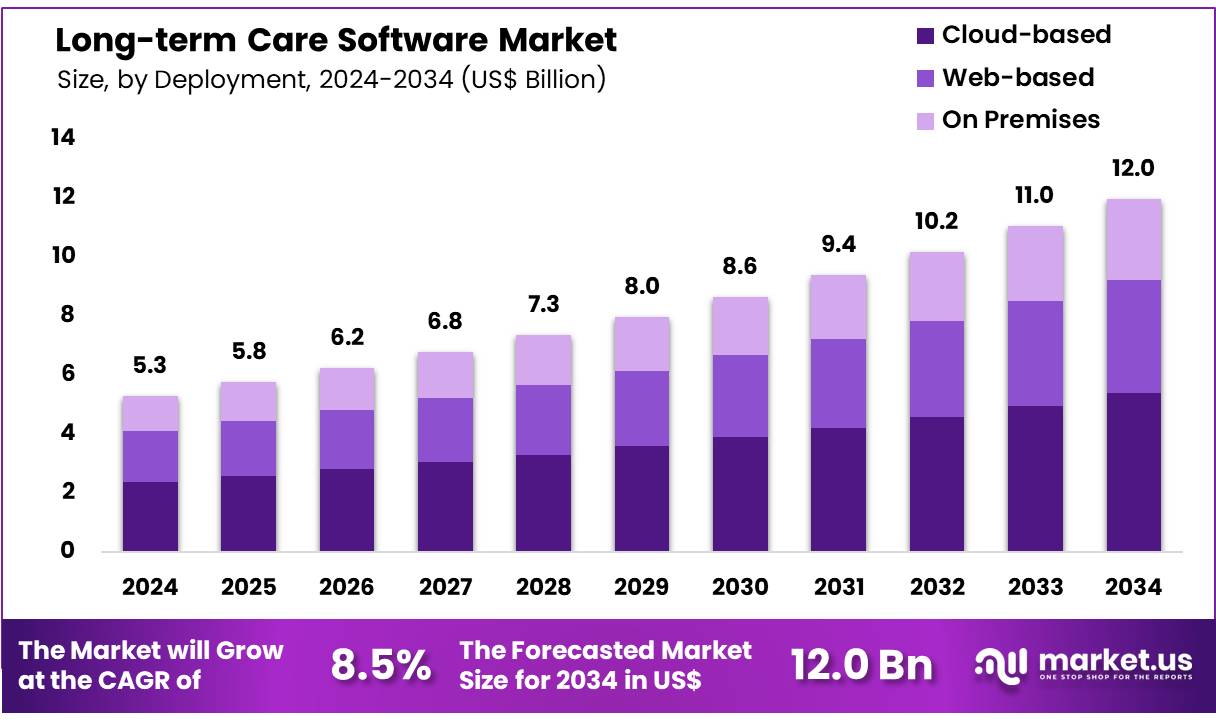
Global Long-term Care Software Market is expected to reach a value of US$ 12.0 Billion by 2034, growing from US$ 5.3 Billion in 2024, with a compound annual growth rate (CAGR) of 8.5% during the forecast period from 2025 to 2034. In 2024, North America led the market, achieving over 52.0% share with a revenue of US$ 2.8 Billion.
The long-term care software market is gaining momentum as healthcare systems, nursing homes, assisted living facilities, and home healthcare providers increasingly adopt digital technologies to improve care quality, reduce administrative workload, and comply with evolving regulations. Rising global aging populations and the growing prevalence of chronic diseases are creating sustained demand for software solutions that support patient records, medication management, scheduling, billing, and regulatory reporting.
According to the World Health Organization (WHO), by 2030, one in every six people worldwide will be aged 60 years or older, increasing the global population in this age group from 1 billion in 2020 to 1.4 billion. By 2050, the number of people aged 60 years and above is projected to reach 2.1 billion, while those aged 80 years and older are expected to reach 426 million, significantly increasing the need for long-term care services and digital care management systems.
The U.S. Census Bureau also projects that the number of Americans aged 65 years and older will increase from 58 million in 2022 to approximately 82 million by 2050, representing nearly 23% of the total U.S. population. This demographic shift is encouraging healthcare providers to invest in software platforms that improve operational efficiency and coordinate long-term patient care.
Government initiatives continue to accelerate digital adoption across healthcare. The Office of the National Coordinator for Health Information Technology (ONC) reported that 96% of non-federal acute care hospitals and nearly 78% of office-based physicians in the United States had adopted certified electronic health record (EHR) systems, demonstrating the widespread acceptance of digital health infrastructure that supports long-term care integration.
Artificial intelligence, cloud computing, remote patient monitoring, and interoperability standards are further transforming long-term care software. Trusted healthcare organizations, including the Centers for Medicare & Medicaid Services (CMS), continue promoting electronic data exchange and quality reporting programs, encouraging providers to implement modern digital solutions that enhance patient safety, improve care coordination, and streamline reimbursement processes across long-term care settings.
Key Takeaways
- In 2024, the long-term care software market generated revenue of US$ 5.3 billion and, at a CAGR of 8.5%, is projected to reach US$ 12.0 billion by 2034.
- By application, the market is divided into Electronic Health Records (EHR), Electronic Medication Administration Record (eMAR), Revenue Cycle Management (RCM), Resident Care, Staff Management, Remote Patient Monitoring System, Clinical Decision Support System, E-Prescribing, Real-Time Location System, Billing, Invoicing, Scheduling Software, and Others; EHR led in 2024 with a 28.4% market share.
- By deployment, the market is split into cloud-based, web-based, and on-premises solutions; cloud-based held a significant 44.9% share in 2024.
- By end-user, the market is segmented into Home Care Agencies, Hospice Care Facilities, Nursing Homes, Assisted Living Facilities, and Others; Home Care Agencies accounted for the largest share at 31.1% in 2024.
- By region, North America led the market with a 52.0% share in 2024.
Statistical Information
- Around 80% of U.S. nursing homes and home health agencies had adopted an EHR system by 2018, despite not being eligible for federal EHR incentive payments.
- Residential care communities in the U.S. had EHR adoption of 19% in 2014. Larger communities (>100 beds) had 37% adoption, compared with 9% for communities with 4-10 beds.
- U.S. residential care communities’ EHR use increased from 36% in 2018 to 48% in 2022, with EHR use higher in larger bed‑size categories across all years.
- Office of the National Coordinator (ONC) analyses report that LTPAC providers have adopted electronic health records to support clinical and business needs, but interoperable exchange of health information is “not routine or widely used.”
- Federal reports describe “thin operating margins” and lack of dedicated incentives as key reasons modernization of long‑term care health IT remains slow.
- Interoperability functions such as “find,” “send,” and “integrate” of external patient data are used much less frequently than basic documentation features in U.S. skilled nursing facilities and other LTPAC settings.
- Among U.S. residential care communities, larger facilities consistently show higher EHR adoption rates than smaller ones, indicating scale strongly influences long‑term care software uptake.
- LTPAC organizations commonly use EHRs for demographics, problem lists, vital signs, orders, medication lists, electronic notes, assessments, and reporting, but usage of advanced interoperability and analytics features is highly variable.
Regional Analysis
North America led the long-term care software market in 2024 due to its advanced healthcare ecosystem, widespread adoption of digital technologies, and strong focus on improving long-term patient care. The region benefits from well-established healthcare infrastructure, favorable reimbursement systems, and continuous investments in healthcare information technology. Healthcare providers are increasingly adopting software platforms to streamline clinical documentation, care planning, medication management, billing, and regulatory compliance.
The United States remains the primary contributor to regional growth, supported by ongoing government efforts to promote electronic health records, health information exchange, and interoperability across healthcare settings. Regulatory initiatives encouraging value-based care and quality reporting have further accelerated the implementation of digital solutions in long-term care facilities. The presence of leading healthcare IT companies, continuous technological innovation, and growing integration of cloud computing, artificial intelligence, and remote patient monitoring are strengthening the market.
Increasing collaboration among healthcare organizations, software developers, and public agencies is also improving care coordination, operational efficiency, and patient outcomes, reinforcing North America’s leadership in the long-term care software market.
Emerging Trends
- AI is becoming part of quality management: Healthcare providers are increasingly adopting AI-enabled quality measurement tools to identify patient safety risks earlier and automate quality reporting. CMS is expanding AI-supported digital quality measures to reduce manual documentation while improving care quality and compliance across healthcare settings.
- Faster interoperability through FHIR standards: Long-term care software vendors are increasingly designing solutions around HL7 FHIR standards. CMS has established an interoperability framework encouraging healthcare providers, EHR vendors, payers, and digital health companies to exchange patient information securely and in near real time.
- Greater focus on cybersecurity and resilient EHRs: Healthcare organizations are strengthening security within long-term care software. CMS now places greater emphasis on security risk management, annual EHR resilience assessments, and secure health information exchange, encouraging vendors to deliver more secure and reliable digital platforms.
- Public quality reporting is becoming more transparent: CMS regularly refreshes public quality reporting for long-term care hospitals, making provider performance more visible. Software platforms are increasingly integrating automated reporting capabilities to help facilities meet quality reporting requirements and improve transparency.
- Digital health ecosystem partnerships are expanding: More than 60 healthcare organizations and technology companies have joined CMS’s interoperability initiative to improve nationwide health data exchange. This collaboration is expected to accelerate innovation in long-term care software and patient-centered digital services.
Use Cases
- Automated resident assessment management: Long-term care software helps facilities manage resident assessments covering cognitive status, medications, nutrition, mobility, skin conditions, diagnoses, and care planning. CMS updates these assessment datasets quarterly, supporting continuous clinical monitoring and regulatory compliance.
- Nursing home quality performance monitoring: Healthcare organizations use software to monitor ownership, staffing, and quality indicators. CMS publishes 51 performance data fields for 636 nursing home chains, enabling administrators to benchmark quality and improve operational performance.
- Digital staffing management: Long-term care providers use workforce management software to monitor nurse staffing, scheduling, payroll, and compliance. CMS publicly releases Payroll-Based Journal staffing datasets, encouraging facilities to improve workforce planning using digital tools.
- Facility operations and compliance reporting: Software platforms help administrators manage operational records for certified facilities. CMS maintains quarterly information on 14,701 long-term care facilities across 33 operational data fields, supporting regulatory reporting and informed management decisions.
- Patient outcome tracking and quality improvement: Long-term care software supports continuous monitoring of clinical quality indicators, including falls, depression, weight loss, vaccinations, medication use, and other resident outcomes. CMS publicly reports these measures, encouraging providers to improve care quality through data-driven decision-making.
Conclusion
The long-term care software market is witnessing steady growth as healthcare organizations continue their shift toward digital care management and operational efficiency. Increasing demand for coordinated patient care, electronic documentation, cloud-based platforms, and interoperable health information systems is accelerating software adoption across nursing homes, assisted living facilities, hospice centers, and home care agencies.
Supportive government initiatives, advancements in artificial intelligence, remote patient monitoring, and cybersecurity are further strengthening market development. As providers focus on improving care quality, regulatory compliance, and workflow automation, long-term care software will remain a critical component of modern healthcare infrastructure, creating significant opportunities for technology vendors and healthcare organizations over the coming decade.




















