


Overview
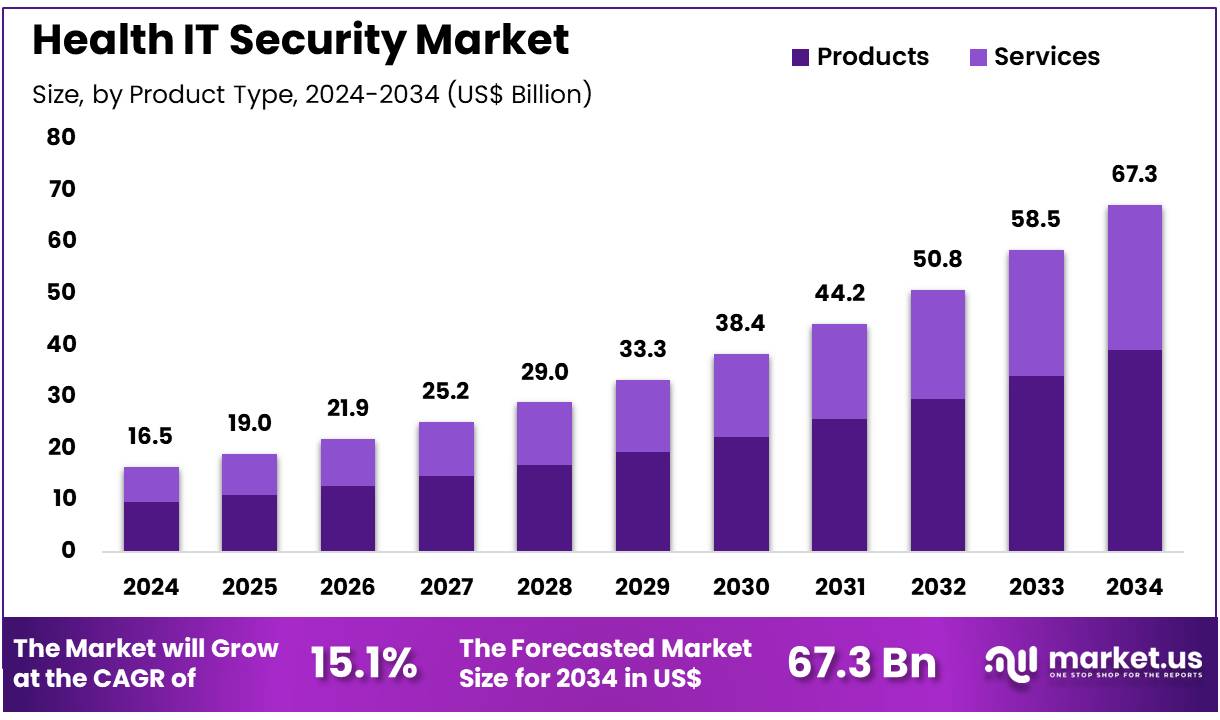
Global Health IT Security Market size is expected to be worth around US$ 67.3 Billion by 2034 from US$ 16.5 Billion in 2024, growing at a CAGR of 15.1% during the forecast period 2025 to 2034. In 2024, North America led the market, achieving over 39.9% share with a revenue of US$ 6.6 Billion.
The growing use of electronic health records (EHRs), cloud-based healthcare systems, connected medical devices, and telehealth platforms has significantly increased the need for advanced health IT security solutions. Healthcare organizations are strengthening cybersecurity strategies to protect sensitive patient information, maintain clinical operations, and comply with evolving privacy regulations. Increasing ransomware attacks, phishing campaigns, and data breaches have made cybersecurity a top investment priority for hospitals, clinics, insurers, and public health agencies.
According to the U.S. Department of Health and Human Services (HHS) Office for Civil Rights, 725 large healthcare data breaches affecting 500 or more individuals were reported in 2024, exposing the protected health information of more than 275 million individuals, making it one of the most significant years for healthcare cybersecurity incidents. These events have accelerated investments in identity management, endpoint protection, encryption, and continuous network monitoring.
The Cybersecurity and Infrastructure Security Agency (CISA) identifies the Healthcare and Public Health sector as one of the nation’s 16 critical infrastructure sectors, emphasizing the need for stronger cyber resilience against increasingly sophisticated threats. Similarly, the World Health Organization (WHO) has highlighted that cyberattacks on healthcare facilities can disrupt patient care, delay emergency services, and threaten public health by interrupting access to critical medical systems.
Government initiatives continue to support stronger digital security. The HHS 405(d) Program, developed under the Cybersecurity Act, publishes healthcare-specific cybersecurity practices that help organizations reduce cyber risks. In addition, the National Institute of Standards and Technology (NIST) Cybersecurity Framework 2.0, released in 2024, provides updated guidance for managing cybersecurity risks across healthcare organizations, including governance, risk assessment, incident response, and recovery planning.
These frameworks are encouraging healthcare providers to adopt zero-trust architectures, multi-factor authentication, artificial intelligence-based threat detection, and secure cloud infrastructures to improve protection against evolving cyber threats.
Key Takeaways
- In 2024, the global Health IT Security Market was valued at US$ 16.5 billion and is projected to reach US$ 67.3 billion by 2034, expanding at a CAGR of 15.1% during the forecast period.
- By product type, the market is segmented into products and services, with the products segment dominating in 2024, accounting for 58.2% of the total market share.
- Based on deployment mode, the market is classified into on-cloud and on-premises, with the on-cloud segment leading the market by capturing 62.5% of the revenue share in 2024.
- In terms of application, the market includes application security, network security, endpoint security, and content security. Among these, network security emerged as the leading segment, representing 44.5% of the market revenue in 2024.
- By end user, the market is categorized into healthcare facility providers and healthcare payers. The healthcare facility providers segment held the largest share, contributing 59.3% of total market revenue in 2024.
- North America remained the leading regional market in 2024, accounting for 39.9% of the global Health IT Security market share.
Statistical Information
- The 2024 Change Healthcare ransomware attack resulted in an estimated US$ 874 million financial impact to UnitedHealth Group, highlighting the growing need for advanced cybersecurity products across the healthcare industry.
- The U.S. Department of Health and Human Services (HHS) launched its 2024–2025 HIPAA Audit Program, increasing its focus on technical safeguards and cybersecurity compliance for healthcare organizations handling electronic protected health information (ePHI).
- According to HHS Cyber Gateway, cloud exploitations increased by 95% compared with 2021, reflecting the growing importance of cloud security solutions as healthcare organizations continue migrating digital workloads to cloud environments.
- An HHS cybersecurity assessment evaluated 371 U.S. hospitals using the NIST Cybersecurity Framework, demonstrating the increasing adoption of standardized cybersecurity practices across healthcare providers.
- Human-directed attacks account for 71% of cyberattacks targeting healthcare organizations, emphasizing the need for stronger network monitoring, threat detection, and security analytics.
- The February 2024 Change Healthcare cyberattack disrupted claims processing, pharmacy services, and healthcare operations across the United States, demonstrating the operational risks associated with healthcare cyber incidents.
- Government cybersecurity guidance indicates that ransomware attacks now average approximately 4,000 incidents per day, representing a 300% increase compared with about 1,000 daily attacks reported in 2015.
- Cybersecurity analyses show that attackers can move laterally through compromised healthcare networks in an average of 1 hour and 28 minutes, reinforcing the need for rapid detection and incident response capabilities.
Regional Analysis
North America dominated the Health IT Security market in 2024 due to its advanced healthcare digital infrastructure, stringent cybersecurity regulations, and high adoption of electronic health technologies. According to the U.S. Office of the National Coordinator for Health Information Technology (ONC), 96% of non-federal acute care hospitals have adopted certified electronic health record (EHR) systems, increasing the need for robust cybersecurity solutions.
The U.S. Department of Health and Human Services (HHS) is strengthening healthcare cybersecurity through proposed HIPAA Security Rule updates and sector-specific guidance. Meanwhile, Asia Pacific is expected to witness the fastest growth during the forecast period, supported by rapid digital transformation and expanding government-led digital health initiatives.
Countries including Japan, Australia, Singapore, and South Korea are investing in secure health information exchange, cloud-based healthcare systems, and cybersecurity frameworks. The World Health Organization (WHO) continues promoting digital health implementation across the Western Pacific Region, encouraging secure data governance.
Rising telehealth adoption, connected medical devices, and stronger privacy regulations are expected to further accelerate demand for Health IT security solutions across Asia Pacific.
Emerging Trends
- Zero Trust security is becoming the new healthcare standard: Healthcare organizations are increasingly adopting Zero Trust architectures that continuously verify users and devices instead of trusting internal networks. In 2025, NIST published guidance featuring 19 reference Zero Trust architectures developed with 24 technology collaborators, helping healthcare organizations strengthen cyber resilience.
- AI is strengthening healthcare cybersecurity operations: Artificial intelligence is being used to detect threats, automate security monitoring, and improve incident response. The U.S. Department of Health and Human Services (HHS) maintains an inventory of hundreds of AI use cases across its agencies, reflecting the growing role of AI in secure healthcare operations and digital services.
- Telehealth security is expanding beyond hospitals: Healthcare providers are protecting connected medical devices used in patients’ homes as telehealth adoption grows. In 2025, NIST released new guidance addressing cybersecurity risks associated with Hospital-at-Home, smart home devices, and remote patient monitoring technologies.
- Cloud and hybrid security models are accelerating: Healthcare organizations are increasingly securing applications that operate across both on-premises and multiple cloud environments. NIST’s latest Zero Trust guidance specifically supports secure access for hybrid workforces, multi-cloud systems, and distributed healthcare resources.
- Identity-first cybersecurity is becoming a priority: Healthcare organizations are investing in stronger authentication and least-privilege access to reduce unauthorized system access. The Centers for Medicare & Medicaid Services (CMS) now recommends continuous identity verification under its Zero Trust security program instead of relying only on initial login authentication.
Use Cases
- Securing Electronic Health Records (EHRs): Healthcare providers deploy encryption, identity management, and access controls to protect electronic health records from unauthorized access while maintaining compliance with HIPAA and other healthcare privacy regulations. NIST continues developing security standards specifically for Health IT systems.
- Protecting remote patient monitoring systems: Health IT security solutions safeguard wearable devices, home monitoring equipment, and connected medical sensors by encrypting transmitted patient data and continuously monitoring device communications to prevent cyber intrusions.
- Securing cloud-based healthcare platforms: Hospitals use advanced cybersecurity solutions to protect cloud-hosted clinical applications, medical imaging, laboratory systems, and patient portals while allowing authorized staff to securely access information from multiple locations.
- Supporting secure AI-powered healthcare applications: Healthcare organizations implement cybersecurity controls to protect AI systems used in clinical decision support, research, and administrative operations. HHS continues expanding secure AI implementation through its department-wide AI strategy and use case inventory.
- Strengthening hospital cybersecurity operations: Hospitals use Health IT security platforms to continuously monitor networks, identify suspicious activity, automate incident response, and reduce disruption to patient care through centralized security operations and real-time threat intelligence.
Conclusion
The Health IT Security market is poised for substantial growth as healthcare organizations accelerate digital transformation while facing increasingly sophisticated cyber threats. Rising adoption of electronic health records, cloud computing, telehealth, connected medical devices, and AI-driven healthcare applications is driving demand for comprehensive cybersecurity solutions. Government initiatives, evolving regulatory frameworks, and updated cybersecurity standards are encouraging providers and payers to strengthen data protection, network security, and incident response capabilities.
With North America maintaining market leadership and Asia Pacific emerging as the fastest-growing region, continued investments in zero-trust security, cloud protection, identity management, and advanced threat detection are expected to shape the future of the global Health IT Security market.




















