


Overview
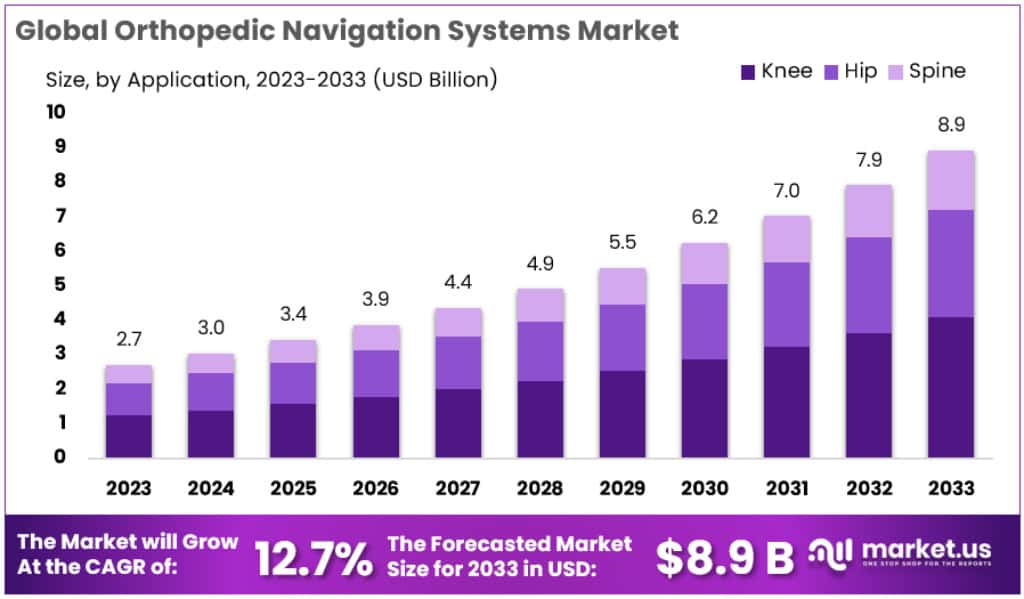
The Global Orthopedic Navigation Systems Market size is expected to be worth around USD 8.9 Billion by 2033, from USD 2.7 Billion in 2023, growing at a CAGR of 12.7% during the forecast period from 2023 to 2033.
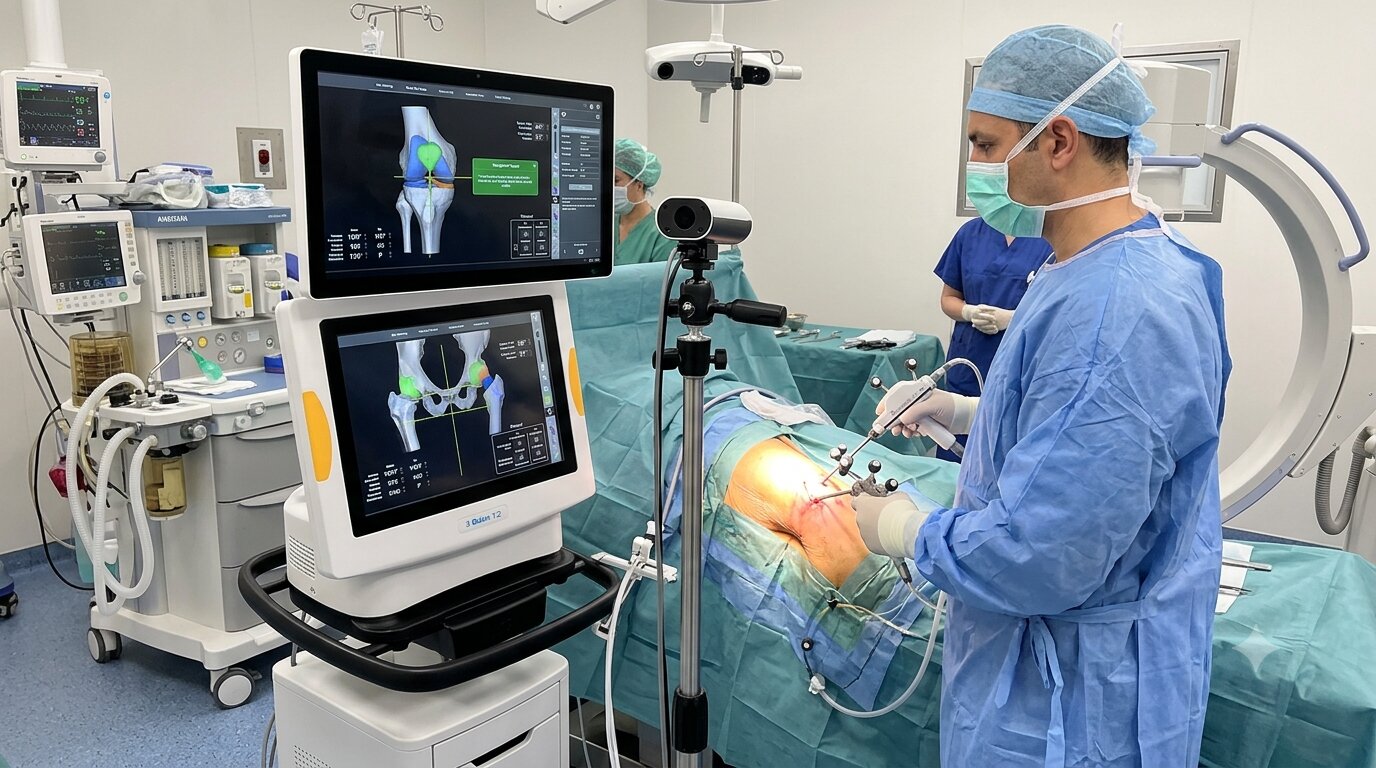
The global orthopedic navigation systems market is witnessing strong momentum as healthcare providers increasingly adopt advanced technologies to improve surgical precision, reduce complications, and support better patient outcomes.
Navigation-assisted orthopedic procedures are becoming more common in joint replacement and spine surgeries, where accurate implant positioning is essential for long-term clinical success. The growing use of computer-assisted surgery, artificial intelligence, and augmented reality is further strengthening demand for these systems across hospitals and specialized orthopedic centers.
Healthcare systems are also investing in digital operating rooms and image-guided surgical technologies to improve workflow efficiency and enhance procedural consistency. As the number of orthopedic procedures continues to rise due to aging populations and increasing cases of musculoskeletal disorders, demand for navigation-enabled surgical platforms is expected to expand steadily.
The U.S. Food and Drug Administration (FDA) classifies orthopedic stereotaxic and navigation instruments as regulated Class II medical devices, reflecting the importance of safety and performance standards in this field.
According to the World Health Organization, approximately 1.71 billion people worldwide are affected by musculoskeletal conditions, making them one of the leading causes of disability globally. In addition, the FDA continues to clear new orthopedic navigation technologies, including augmented reality-assisted systems designed to support accurate implant alignment and intraoperative guidance during orthopedic procedures.
Key Takeaways
- The global Orthopedic Navigation Systems Market is projected to increase from USD 2.7 billion in 2023 to nearly USD 8.9 billion by 2033.
- The market is anticipated to register a compound annual growth rate (CAGR) of 12.7% throughout the forecast period from 2023 to 2033.
- In 2023, knee navigation systems accounted for the largest product segment, capturing more than 45.9% of the market, supported by the rising number of knee replacement procedures.
- Hospitals emerged as the leading end-user segment in 2023, representing over 56.2% of the market, owing to their advanced surgical capabilities and comprehensive healthcare services.
- North America dominated the global market in 2023 with a 45.1% revenue share, supported by well-established healthcare infrastructure and widespread adoption of advanced orthopedic technologies.
Statistical Information
- Around 1.71 billion people worldwide are living with musculoskeletal conditions, making them the leading cause of disability globally and increasing the demand for orthopedic care and advanced surgical technologies.
- Approximately 528 million people worldwide have symptomatic osteoarthritis, representing a 113% increase since 1990, according to WHO estimates reported by the OECD.
- In 2023, OECD countries recorded an average of 198 hip replacement procedures per 100,000 population, reflecting sustained demand for orthopedic surgical interventions.
- The average knee replacement rate reached 156 procedures per 100,000 population across OECD countries in 2023, highlighting continued growth in orthopedic surgery volumes.
- Germany, Switzerland, Australia, Finland, and Denmark recorded the highest rates of hip and knee replacement procedures among OECD countries in 2023.
- Over the past decade, the number of hip and knee replacements increased across all OECD countries, with the exception of New Zealand and Mexico, driven by aging populations and rising osteoarthritis prevalence.
- Lithuania, Slovenia, and Poland experienced increases of 90 or more hip replacement procedures per 100,000 population over the past decade, reflecting rapid growth in orthopedic surgical activity.
- Switzerland, Poland, Germany, and Australia recorded increases of 70 or more knee replacement procedures per 100,000 population over the past decade, demonstrating expanding demand for advanced orthopedic procedures.
Regional Analysis
North America dominated the orthopedic navigation systems market in 2023, capturing 45.1% of the global market. The region’s leadership is supported by advanced healthcare infrastructure, widespread adoption of computer-assisted surgery, and strong regulatory oversight for innovative orthopedic technologies.
The U.S. Food and Drug Administration (FDA) continues to evaluate and clear new orthopedic navigation and augmented reality-based surgical systems, enabling hospitals to adopt advanced image-guided procedures with greater confidence. Ongoing investments in digital operating rooms, skilled orthopedic surgeons, and the increasing number of joint replacement procedures further strengthen regional demand.
Asia Pacific is expected to witness the fastest growth during the forecast period, driven by rapidly expanding healthcare infrastructure, aging populations, and rising cases of musculoskeletal disorders. Governments across the region are investing in healthcare modernization and improving access to advanced medical technologies, supporting the adoption of navigation-assisted orthopedic surgery.
Growing demand for minimally invasive procedures, together with increasing availability of specialized orthopedic care and medical device innovation, is expected to create substantial opportunities for market expansion across China, Japan, South Korea, and other emerging economies.
Emerging Trends
- Artificial intelligence (AI) is becoming a core part of orthopedic navigation systems. A 2026 review identified 70 FDA-cleared AI-enabled orthopedic medical devices as of February 2025, with the 3-year average of FDA clearances increasing from 3.0 devices per year (2017–2019) to 16.6 devices per year (2022–2024), reflecting rapid innovation in navigation-assisted surgery.
- Augmented reality (AR) is gaining traction in orthopedic procedures. The U.S. FDA now classifies orthopedic AR navigation devices as Class II medical devices, supporting their use for real-time visualization and image-guided surgical navigation during orthopedic procedures while ensuring regulatory oversight for safety and performance.
- Navigation systems are increasingly integrated with robotic-assisted surgery. A 2026 systematic review evaluated 39 peer-reviewed studies published between 2015 and 2025, showing that computer navigation, robotics, and AR consistently improve implant positioning accuracy across hip, knee, spine, trauma, and oncology surgeries.
- Advanced imaging and 3D surgical planning are becoming standard features. AI-powered software now supports automated image segmentation, three-dimensional reconstruction, implant identification, and surgical planning, helping surgeons improve precision while reducing manual planning time before complex orthopedic procedures.
- Clinical validation is becoming more rigorous for navigation technologies. Among the 70 FDA-cleared orthopedic AI devices, the proportion without clinical testing declined from 62.2% (2017–2019) to 19.7% (2022–2024), demonstrating stronger evidence requirements before commercialization.
Use Cases
- Navigation systems are increasingly used in total hip replacement surgery. Data from the Australian Orthopaedic Association National Joint Replacement Registry covering 6,912 navigated hip replacement procedures showed lower revision rates for dislocation compared with conventional surgery over a 10-year follow-up period.
- Spine surgery is a major application for AI-enabled navigation. Among the 70 FDA-cleared orthopedic AI devices, 42.9% were designed for spine surgery, making it the largest orthopedic specialty adopting AI-assisted navigation technologies.
- Hip and knee surgery continue to expand as navigation use cases. FDA-cleared AI devices showed that 20.0% were developed specifically for hip and knee applications, supporting accurate implant positioning and surgical planning in joint reconstruction procedures.
- Orthopedic navigation is improving trauma and fracture management. AI-assisted navigation platforms are increasingly being used for fracture identification, surgical guidance, and implant placement, helping surgeons perform complex trauma procedures with improved anatomical visualization and planning.
- Navigation technologies are supporting orthopedic education and surgical training. Recent research highlights that AI and augmented reality systems are increasingly used for surgical simulation, preoperative planning, and surgeon training, helping improve procedural consistency and reduce learning curves for advanced orthopedic techniques.
Frequently Asked Questions About
- What factors are driving the orthopedic navigation systems market?
The market is expanding because of the rising number of orthopedic procedures, increasing prevalence of musculoskeletal disorders, demand for greater surgical accuracy, and continuous technological innovation. Regulatory support for advanced navigation and augmented reality devices is also encouraging hospitals to adopt these systems. - Which orthopedic procedures commonly use navigation systems?
Navigation systems are widely used in knee replacement, hip replacement, spine surgery, trauma surgery, and complex orthopedic reconstruction. These technologies help surgeons visualize patient anatomy in real time, improve implant alignment, and enhance procedural accuracy during both primary and revision surgeries. - Why are hospitals the leading users of orthopedic navigation systems?
Hospitals perform a high volume of orthopedic surgeries and invest in advanced operating room technologies to improve patient care. Their access to specialized surgeons, diagnostic imaging, and integrated surgical infrastructure makes them the primary adopters of navigation-assisted orthopedic procedures. - How does augmented reality improve orthopedic navigation?
Augmented reality overlays digital surgical guidance onto the surgeon’s view of the patient, enabling more accurate instrument positioning and implant placement. The U.S. FDA recognizes orthopedic augmented reality navigation devices as regulated medical devices designed to support stereotaxic guidance during orthopedic procedures. - What challenges does the orthopedic navigation systems market face?
The market faces challenges including high equipment costs, integration with existing operating room workflows, surgeon training requirements, and regulatory compliance. Healthcare providers must also evaluate clinical evidence and long-term benefits before making significant investments in navigation technologies. - What is the future outlook for the orthopedic navigation systems market?
The market is expected to benefit from ongoing advances in artificial intelligence, robotics, augmented reality, and patient-specific surgical planning. Continued regulatory approvals, digital healthcare investments, and increasing demand for precision orthopedic surgery are expected to support long-term market expansion.
Conclusion
The orthopedic navigation systems market is poised for sustained growth as healthcare providers increasingly prioritize precision, safety, and efficiency in orthopedic procedures. Rising cases of musculoskeletal disorders, expanding joint replacement volumes, and continued advancements in artificial intelligence, robotics, and augmented reality are accelerating technology adoption worldwide.
Supportive regulatory initiatives from the U.S. FDA, growing investments in digital operating rooms, and increasing acceptance of minimally invasive surgery are further strengthening market prospects. As hospitals continue integrating image-guided and computer-assisted surgical platforms into clinical practice, orthopedic navigation systems are expected to play a vital role in improving surgical accuracy, enhancing patient outcomes, and driving long-term innovation across the global orthopedic care landscape.




















