


Overview
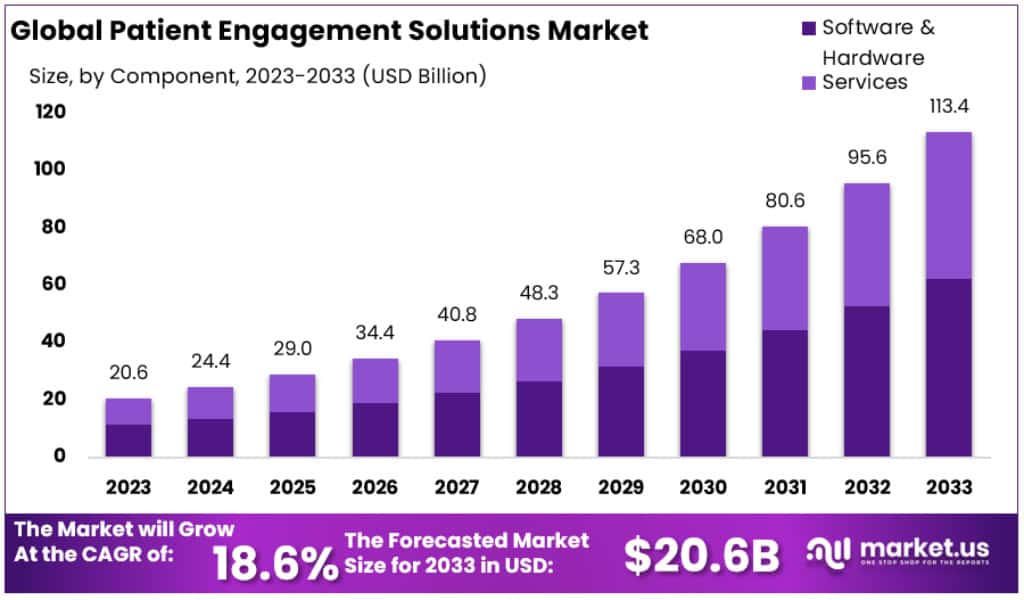
The Global Patient Engagement Solutions Market size is expected to be worth around USD 113.4 Billion by 2033, from USD 20.6 Billion in 2023, growing at a CAGR of 18.6% during the forecast period from 2023 to 2033.
The growing emphasis on patient-centered healthcare, digital communication, and coordinated care is accelerating the adoption of patient engagement solutions across healthcare systems worldwide.
Governments and healthcare organizations are increasingly promoting technologies that help patients actively participate in managing their health through secure messaging, appointment scheduling, remote monitoring, medication reminders, and access to electronic health records. These solutions improve communication between providers and patients while supporting better treatment adherence and long-term health outcomes.
Healthcare policies encouraging interoperability and digital health are also contributing to market expansion. The U.S. Centers for Medicare & Medicaid Services (CMS) continues to promote person and family engagement strategies that integrate patients into the design, delivery, and evaluation of healthcare services, strengthening the shift toward value-based care.
Growing evidence from the U.S. Centers for Disease Control and Prevention (CDC) indicates that patients with higher levels of activation measured by their knowledge, skills, and confidence in managing their healthcare experience better health outcomes and lower healthcare costs over time.
Patient engagement initiatives are also improving healthcare quality. According to CMS, the Partnership for Patients program helped prevent an estimated 2.1 million patient harms, saved approximately 87,000 lives, and generated nearly USD 20 billion in healthcare cost savings between 2010 and 2014 through improved care coordination and patient safety initiatives. These measurable outcomes continue to reinforce investments in advanced patient engagement technologies across hospitals, clinics, and digital health platforms.
Key Takeaways
- The global Patient Engagement Solutions Market is anticipated to reach approximately USD 113.4 billion by 2033.
- The market was valued at USD 20.6 billion in 2023.
- The market is forecast to expand at a CAGR of 18.6% during the 2023–2033 forecast period.
- The Software and Hardware segment accounted for more than 55% of the global market share in 2023.
- The Cloud deployment model represented over 59% of the market share in 2023.
- The Health Management segment captured more than 36% of the market in 2023.
- The Communication functionality segment held over 37% of the total market share in 2023.
- The Chronic Disease Management segment led the market, securing more than 41% of the overall share in 2023.
- North America remained the leading regional market, accounting for 36% of the global market and generating USD 7.4 billion in revenue in 2023.
Statistical Information
- 65% of individuals in the U.S. accessed their online medical record or patient portal in 2024, compared with just 25% in 2014, highlighting the rapid adoption of digital patient engagement tools.
- 89% of patients who were offered online access reported that their healthcare provider encouraged them to use the patient portal, and 87% of those encouraged actually used it, versus 57% among those who were not encouraged.
- App-based access to electronic medical records increased from 38% in 2020 to 57% in 2024, demonstrating a strong shift toward mobile-first patient engagement.
- Proxy or caregiver access to patient portals more than doubled from 24% in 2020 to 51% in 2024, reflecting increasing family involvement in patient care and chronic disease management.
- 59% of individuals reported having multiple patient portals or online medical records in 2024, while only 16% reported having no patient portal at all.
- 99% of U.S. non-federal hospitals enabled patients to electronically view their health information in 2024, while 96% allowed patients to download their records digitally.
- 92% of hospitals offered secure messaging between patients and healthcare providers in 2024, strengthening digital communication and patient engagement.
- 81% of hospitals enabled patients to access their health information through API-enabled mobile applications in 2024, supporting greater interoperability and consumer-controlled health data.
- 85% of U.S. hospitals had implemented all major foundational and emerging patient engagement capabilities by 2024, including clinical notes access, secure messaging, and application-based health record access.
- The CMS Health Technology Ecosystem has attracted more than 30 healthcare organizations and technology companies as early adopters of its interoperability framework, supporting real-time, patient-controlled health information exchange across the U.S. healthcare system.
Regional Analysis
North America held the leading position in the Patient Engagement Solutions market in 2023, supported by its well-established healthcare infrastructure, widespread adoption of electronic health records (EHRs), and favorable government initiatives promoting digital health.
The U.S. Centers for Medicare & Medicaid Services (CMS) continues to advance interoperability and patient-centered care through its Health Technology Ecosystem and eHealth programs, encouraging providers to adopt connected digital solutions that improve patient access and engagement.
Europe accounted for the second-largest regional share, driven by strong public healthcare systems and ongoing digital transformation initiatives. NHS England is expanding Electronic Patient Record (EPR) implementation across hospitals while promoting inclusive digital healthcare to improve patient access and healthcare delivery.
The Asia-Pacific region is expected to register the fastest growth during the forecast period. Increasing internet connectivity, smartphone adoption, expanding healthcare infrastructure, and government investments in digital health are accelerating market growth across countries such as China, Japan, South Korea, and Australia. The World Health Organization (WHO) also highlights digital health as a key enabler of patient-centered care and healthcare system modernization across the region.
Emerging Trends
- AI-powered patient support is becoming mainstream. In 2025, more than 30 healthcare and technology organizations, including major digital health companies, committed to CMS’ Health Tech Ecosystem to develop AI-assisted symptom checking, appointment scheduling, and personalized patient engagement tools that improve healthcare access and coordination.
- Electronic patient-reported outcomes (ePROs) are gaining wider adoption. CMS now includes the collection of electronic patient-reported outcomes as a core care transformation activity in its Enhancing Oncology Model, encouraging providers to continuously monitor patients between visits and improve treatment quality. The model currently includes more than 2,000 practitioners across over 350 care sites.
- Connected remote patient monitoring continues to expand. CMS supports remote monitoring for both chronic and acute conditions using FDA-recognized connected devices. Medicare requires devices to digitally transmit health information with at least two days of readings every 30 days, encouraging continuous patient engagement outside hospitals.
- Healthcare providers are increasingly using real-world patient data. The U.S. FDA continues to promote the use of electronic health records, patient-generated health data, medical device information, and registries as Real-World Evidence to support better clinical decisions and accelerate digital healthcare innovation.
- Digital interoperability is becoming a strategic priority. CMS and healthcare technology partners are promoting secure health data exchange through standardized digital platforms, enabling patients to access and share medical information more easily while reducing administrative paperwork and improving care coordination.
Use Cases
- Chronic disease management through connected devices is one of the fastest-growing applications. CMS supports remote monitoring for patients with hypertension, diabetes, heart failure, and other chronic diseases by allowing providers to receive continuous health data from internet-connected medical devices for timely treatment adjustments.
- Cancer care is increasingly using remote symptom monitoring. The CMS Enhancing Oncology Model requires participating providers to implement electronic patient-reported outcomes and patient navigation services, helping clinicians detect treatment-related symptoms earlier and improve patient experiences throughout cancer therapy.
- Digital appointment scheduling and virtual care navigation are expanding rapidly. CMS’ Health Tech Ecosystem supports AI-powered tools that help patients schedule appointments, navigate healthcare services, manage chronic conditions, and securely access their health information through digital applications.
- Patient-generated health data is supporting personalized care. FDA recognizes wearable devices, electronic health records, patient-generated data, and medical device information as valuable clinical evidence, enabling providers to personalize treatments based on continuous patient health information rather than occasional clinical visits.
- Digital patient education and device onboarding are becoming standard practice. CMS emphasizes that effective remote patient monitoring begins with structured patient education and device setup, ensuring patients can correctly use connected medical devices and consistently transmit accurate health information to providers.
Frequently Asked Questions About Patient Engagement Solutions
- What factors are driving the growth of the Patient Engagement Solutions Market?
The market is growing due to increasing adoption of electronic health records, telehealth, remote patient monitoring, and value-based care. Government initiatives promoting interoperability, digital health, and patient-centered care are also encouraging healthcare providers to invest in engagement technologies. - Which technologies are commonly used in Patient Engagement Solutions?
Patient engagement platforms commonly integrate patient portals, mobile health applications, secure messaging, telehealth, cloud computing, remote monitoring devices, artificial intelligence, and electronic health records. These technologies improve communication, simplify care management, and provide patients with easier access to healthcare information. - Which healthcare settings use Patient Engagement Solutions?
Patient Engagement Solutions are widely used in hospitals, physician offices, specialty clinics, ambulatory care centers, home healthcare organizations, and healthcare payer networks. They support preventive care, chronic disease management, cancer treatment, post-discharge follow-up, and long-term patient monitoring. - How do Patient Engagement Solutions improve patient outcomes?
These solutions encourage patients to follow treatment plans, communicate regularly with healthcare teams, monitor symptoms, and report health changes promptly. Improved engagement enhances care coordination, supports informed decision-making, increases treatment adherence, and contributes to better clinical outcomes. - What challenges affect the Patient Engagement Solutions Market?
Key challenges include maintaining patient privacy, ensuring cybersecurity, integrating healthcare systems, improving digital literacy, complying with healthcare regulations, and encouraging continuous patient participation. Providers must balance security, usability, and interoperability while protecting sensitive patient information. - What is the future outlook for the Patient Engagement Solutions Market?
The market is expected to expand steadily as healthcare providers adopt AI-enabled communication, interoperable digital platforms, patient-reported outcomes, and remote monitoring technologies. Continued government support for patient-centered care and digital transformation is expected to drive long-term market growth.
Conclusion
The Patient Engagement Solutions Market is poised for strong growth as healthcare providers increasingly prioritize patient-centered care, digital communication, and connected health technologies. Rising adoption of patient portals, cloud platforms, remote patient monitoring, artificial intelligence, and interoperable electronic health records is transforming the way patients interact with healthcare systems.
Government initiatives led by organizations such as CMS, CDC, and WHO continue to support digital health adoption, interoperability, and value-based care, creating favorable market conditions. As healthcare organizations focus on improving care coordination, treatment adherence, and patient outcomes, demand for innovative engagement solutions is expected to accelerate, making patient engagement a fundamental component of modern healthcare delivery worldwide.




















