


Overview
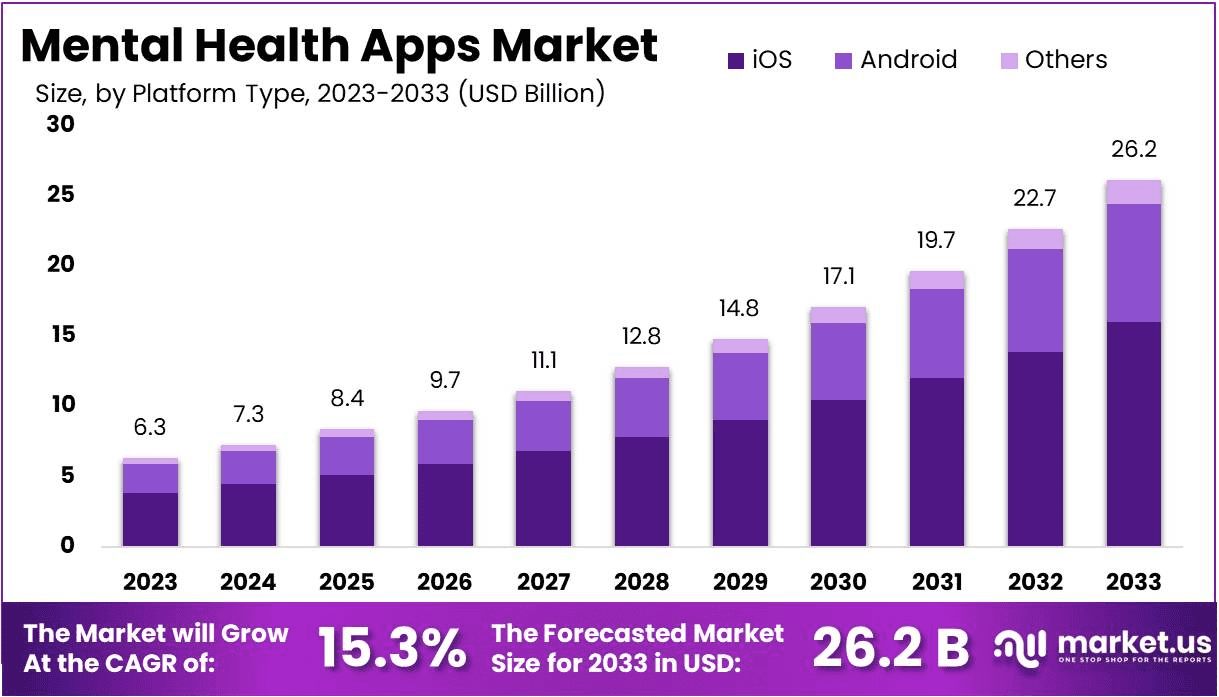
The Mental Health Apps Market size is expected to be worth around US$ 26.2 billion by 2033 from US$ 6.3 billion in 2023, growing at a CAGR of 15.3% during the forecast period 2024 to 2033.
The increasing focus on accessible mental healthcare, rising awareness of psychological well-being, and growing use of digital health platforms are accelerating the adoption of mental health applications. These apps provide users with convenient access to services such as meditation support, mood tracking, stress management, behavioral therapy programs, and virtual mental health resources. The expansion of smartphone usage and preference for remote healthcare solutions are further supporting the integration of digital tools into personal wellness management.
According to the World Health Organization (WHO), more than 1 billion people worldwide are living with mental health conditions, highlighting the urgent need to expand affordable and scalable mental health services. WHO has emphasized strengthening community-based and accessible mental healthcare systems to address global service gaps.
Government healthcare organizations are also reporting significant demand for mental health support. The National Institute of Mental Health (NIMH) stated that in 2022, adults in the U.S. experienced any mental illness, while only about 50.6% received mental health treatment during that year.
The rising use of digital interventions is encouraging healthcare providers, technology developers, and policymakers to explore secure and evidence-based mental health platforms. Features including AI-enabled support, personalized wellness programs, and remote counseling access are expected to improve user engagement while helping address shortages in traditional mental healthcare delivery.
Key Takeaways
- In 2023, the Mental Health Apps Market generated revenue of US$ 6.3 billion and is projected to expand at a CAGR of 15.3%, reaching US$ 26.2 billion by 2033.
- Based on platform type, the market is categorized into iOS, Android, and other platforms. Among these, the iOS segment dominated the market in 2023, accounting for a 61.2% share, supported by strong user adoption and widespread usage of Apple devices.
- By application, the market is segmented into stress management, depression & anxiety management, meditation management, and others. The depression & anxiety management segment emerged as the leading segment in 2023, capturing a significant 42.3% market share, driven by increasing demand for digital mental health support solutions.
- Based on end-user, the market is classified into home care settings, mental hospitals, and others. The home care settings segment held the largest revenue share of 54.3% in 2023, reflecting the growing preference for convenient, remote, and personalized mental wellness solutions.
- Regionally, North America dominated the Mental Health Apps Market in 2023, accounting for a 38.7% market share, supported by increasing awareness of mental health services, digital healthcare adoption, and the availability of advanced technology infrastructure.
Statistical Information
- The National Institute of Mental Health (NIMH) reported that 59.3 million U.S. adults experienced any mental illness in 2022, creating strong demand for accessible digital mental health support tools, including mobile applications for self-management and behavioral care.
- Among U.S. adults experiencing mental illness in 2022, 30.0 million people (50.6%) received mental health treatment, highlighting a significant opportunity for digital platforms that improve access to mental health resources and support services.
- In 2022, 15.4 million U.S. adults experienced serious mental illness (SMI), representing 6.0% of all U.S. adults, increasing the need for continuous monitoring, early intervention, and technology-supported mental healthcare solutions.
- According to the Pew Research Center, approximately 91% of U.S. adults owned a smartphone, providing a strong consumer base for mobile mental health applications such as meditation, anxiety management, mood tracking, and digital therapy platforms.
- Pew Research Center data shows that 98% of U.S. adults own a cellphone of some type, demonstrating the widespread availability of mobile technology that supports access to digital healthcare services.
- Around 16% of U.S. adults are smartphone-dependent internet users, meaning they rely on smartphones for online access without home broadband connectivity, emphasizing the importance of mobile-first healthcare solutions.
- Among younger adults aged 18–29 years, smartphone dependency reaches 27%, indicating strong potential adoption of app-based mental wellness services among younger populations seeking flexible and private healthcare options.
- The World Health Organization (WHO) estimates that more than 1 billion people globally live with mental health conditions, reinforcing the need for scalable digital solutions that expand access to mental health information, prevention, and support services.
- According to NIMH data, treatment access remains uneven, with only 49.1% of young adults aged 18–25 years with mental illness receiving mental health treatment in 2022, indicating a gap where digital mental health applications can provide additional support pathways.
- The increasing use of mobile devices for healthcare engagement is supported by consumer technology adoption trends, as smartphone ownership has increased significantly from 35% of U.S. adults in 2011 to 91% in recent surveys, enabling broader reach for digital wellness applications
Regional Analysis
North America dominates the Mental Health Apps Market
North America accounted for the leading position in the Mental Health Apps Market, supported by increasing mental health awareness, growing acceptance of digital wellness platforms, and strong adoption of mobile healthcare technologies.
The region’s advanced healthcare infrastructure, high smartphone penetration, and rising demand for convenient mental health support have encouraged the adoption of applications offering counseling access, meditation programs, mood tracking, and behavioral health management. The growing focus on improving access to mental healthcare is further strengthening digital solutions across the region.
The World Health Organization (WHO) highlights that mental health conditions remain a major public health challenge globally, increasing the need for scalable and accessible care models. Additionally, GSMA reported strong mobile connectivity growth in North America, with 5G adoption continuing to expand and supporting digital health service accessibility.
Asia Pacific expected to register the fastest growth during the forecast period
Asia Pacific is projected to witness significant growth due to increasing awareness of mental health issues, expanding internet access, and rising adoption of smartphones and digital healthcare solutions. Governments and healthcare organizations across the region are focusing on improving mental health services and reducing treatment gaps through technology-enabled platforms.
According to WHO, China has approximately 54 million people living with depression and around 41 million experiencing anxiety disorders, creating demand for accessible digital mental health solutions. The integration of localized content, multilingual support, and culturally relevant features in mental health apps is expected to improve user engagement and accelerate market expansion across emerging economies.
Emerging Trends
- AI-Based Personalized Mental Health Support: Artificial intelligence is becoming a key trend in mental health apps by enabling personalized conversations, emotional support, and behavior analysis. Developers are focusing on safer AI-driven solutions as regulatory agencies such as the FDA evaluate AI-enabled digital mental health technologies.
- Integration of Digital Therapeutics with Healthcare Systems: Mental health apps are increasingly moving beyond wellness tools toward clinically supported digital interventions. Healthcare providers are exploring app-based solutions that complement traditional treatment by improving patient monitoring, engagement, and continuous support between medical appointments.
- Wearable Device and Biomarker Integration: Mental health applications are increasingly connecting with smartwatches and wearable sensors to analyze sleep patterns, activity levels, and behavioral signals. Research using wearable data from 29,307 participants demonstrates growing interest in AI-based models for predicting mental health-related patterns.
- Expansion of Tele-Mental Healthcare Services: Telehealth integration is becoming an important trend as consumers increasingly accept remote mental healthcare. SAMHSA reported that 31.3 million U.S. adults received mental health treatment through telehealth in 2023, supporting continued adoption of virtual counseling and app-based care models.
- Focus on Data Privacy and Responsible Digital Care: Mental health app providers are increasingly prioritizing secure data management, transparency, and user consent because applications collect sensitive emotional and behavioral information. Regulatory discussions around AI mental health tools highlight the importance of safety, privacy, and responsible technology development.
Use Cases
- Stress and Anxiety Management Applications: Mental health apps are widely used for daily stress reduction through meditation, breathing exercises, mindfulness programs, and mood tracking. These tools support preventive mental wellness by helping users identify emotional changes and develop healthier coping behaviors without requiring immediate clinical visits.
- Remote Therapy and Counseling Access: Apps are increasingly being used as digital gateways for professional mental healthcare by connecting users with therapists, counselors, and support programs. In 2023, 12.1% of U.S. adults received mental health treatment through telehealth, showing the growing role of remote care delivery.
- Early Detection and Mental Health Monitoring: Applications are being developed to track mood changes, sleep quality, activity patterns, and behavioral indicators that may signal worsening mental health conditions. AI-powered monitoring tools aim to provide earlier support and encourage users to seek professional help when needed.
- Employee Mental Wellness Programs: Organizations are adopting mental health apps to provide employees with confidential stress management resources, mindfulness programs, and emotional wellness support. These platforms help companies improve workplace well-being by offering flexible access to digital resources outside traditional healthcare environments.
- Youth Mental Health Support Platforms: Mental health apps are increasingly designed for younger users with features such as anonymous support, self-guided therapy exercises, and educational content. SAMHSA reported that 27.4% of young adults aged 18–25 received mental health treatment in 2023, highlighting the demand for accessible solutions among younger populations.
Frequently Asked Questions About Mental Health Apps
- What are the main applications of mental health apps?
Mental health apps are used for anxiety management, depression support, stress reduction, mindfulness training, sleep improvement, emotional tracking, and virtual counseling. These platforms provide users with convenient tools for monitoring mental health conditions and developing healthier daily habits. - Can mental health apps replace professional therapy?
Mental health apps are generally designed to support traditional healthcare rather than replace professional therapists. They provide self-help resources, symptom monitoring, and communication options, while individuals with serious mental health concerns may require guidance from qualified healthcare professionals. - Why is the demand for mental health apps increasing?
Demand for mental health apps is increasing because digital platforms provide flexible, private, and convenient access to emotional support. Growing acceptance of virtual healthcare, smartphone-based services, and remote consultations is encouraging more users to adopt technology-enabled mental wellness solutions. - What features are included in mental health apps?
Common features of mental health apps include mood monitoring, meditation sessions, breathing exercises, journaling, sleep tracking, educational resources, therapist communication, and personalized recommendations. Advanced platforms may also include artificial intelligence, wearable integration, and behavioral pattern analysis. - Are mental health apps safe and reliable?
Mental health apps can provide useful support, but users should consider privacy protection, developer credibility, and scientific evidence before selecting an application. Healthcare organizations highlight the importance of evaluating app quality because digital mental health tools vary in accuracy and effectiveness. - What factors are driving the growth of the mental health apps market?
The growth of the mental health apps market is supported by rising digital health adoption, increasing demand for remote care, smartphone-based healthcare access, and advancements in mobile technologies. Healthcare organizations are exploring digital solutions to improve prevention, monitoring, and mental health service delivery.
Conclusion
The Mental Health Apps Market is witnessing strong growth as digital healthcare solutions become an important part of modern mental wellness management. Increasing mental health awareness, smartphone adoption, remote care preferences, and advancements in AI-driven technologies are encouraging users to adopt app-based support platforms.
These applications are expanding access to stress management, therapy support, mood monitoring, and preventive mental healthcare. Healthcare organizations are also recognizing the potential of digital interventions to improve engagement and continuity of care. Future growth will depend on improving clinical validation, data security, personalization, and integration with healthcare systems to deliver safe and effective mental health solutions.




















