


Overview
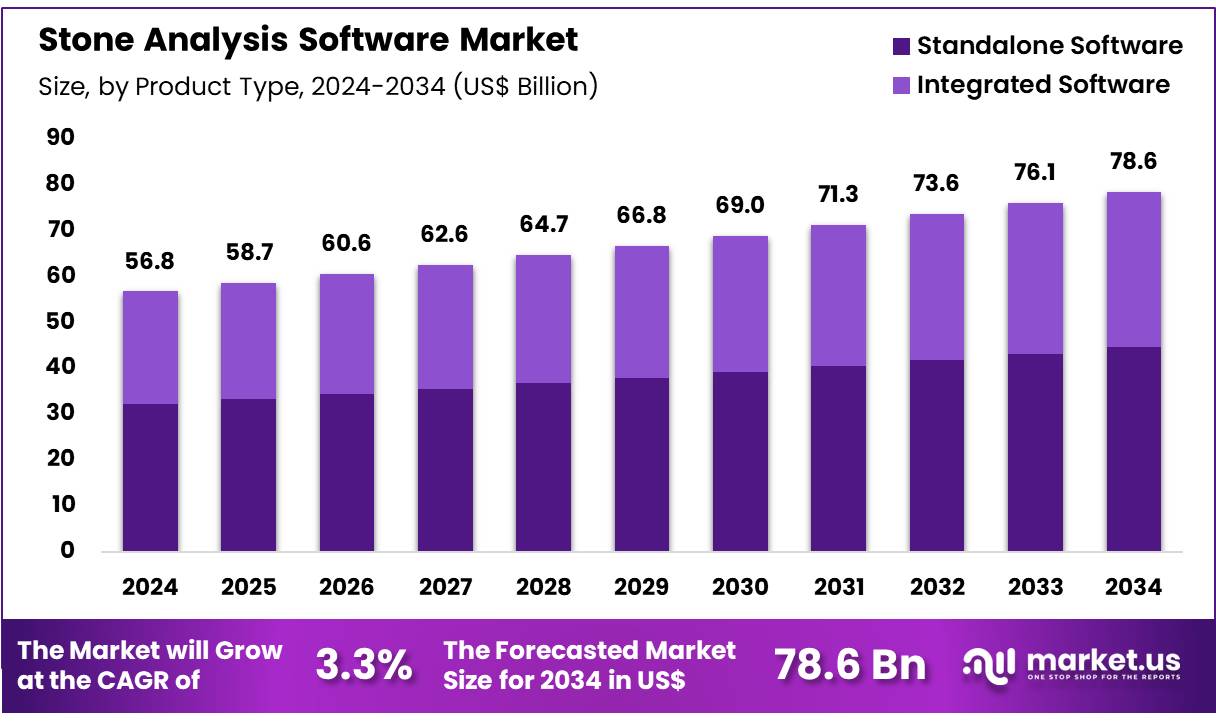
Global Stone Analysis Software Market size is expected to be worth around US$ 78.6 Billion by 2034 from US$ 56.8 Billion in 2024, growing at a CAGR of 3.3% during the forecast period 2025 to 2034. In 2024, North America led the market, achieving over 35.9% share with a revenue of US$ 20.4 Billion.
The adoption of advanced healthcare software is improving the efficiency and accuracy of kidney stone diagnosis and laboratory analysis. Stone analysis software supports healthcare professionals by organizing test results, analyzing stone characteristics, improving reporting processes, and enabling better clinical decisions.
These digital platforms are increasingly being integrated with laboratory information systems and imaging technologies to streamline workflows in hospitals, diagnostic centers, and research facilities.
Kidney stone analysis is essential for understanding stone composition and developing effective prevention strategies. Healthcare providers use laboratory and imaging tests to identify kidney stones and evaluate factors that contribute to their formation.
According to the National Institute of Diabetes and Digestive and Kidney Diseases (NIDDK), diagnostic approaches include urine tests, blood tests, and imaging techniques such as computed tomography (CT) scans to assess kidney stones and related conditions.
The rising focus on automation and artificial intelligence is creating new opportunities for stone analysis software development. NIDDK-supported research has highlighted automated measurement technologies that can improve the reliability of kidney stone evaluation.
One machine-learning-based system studied by researchers analyzed kidney stone measurements and provided results faster, with an average measurement time of approximately 12 seconds.
Increasing demand for precision diagnostics, growing use of digital laboratory solutions, and advancements in AI-based healthcare technologies are expected to support the expansion of stone analysis software.
These solutions can help clinicians improve diagnostic accuracy, enhance patient management, and support personalized treatment planning for individuals affected by kidney stone disorders.
Key Takeaways
- The global Stone Analysis Software Market generated US$ 56.8 billion in revenue in 2024 and is projected to reach US$ 78.6 billion by 2034, expanding at a CAGR of 3.3% during the forecast period.
- Based on product type, the market is segmented into standalone software and integrated software. Among these, the standalone software segment dominated the market, accounting for 56.8% of the total market share.
- By application, the market is categorized into kidney stone analysis, research & laboratory, and urolithiasis diagnosis. The kidney stone analysis segment emerged as the leading application, capturing 45.5% of the overall market share.
- In terms of end users, the market is classified into hospitals, research & academic institutes, and diagnostic centers. The hospitals segment held the largest share, contributing 52.5% of the market revenue.
- Regionally, North America dominated the global Stone Analysis Software market, securing a 35.9% market share in 2024.
Statistical Information
- Approximately 70% of patients diagnosed with urinary stone disease underwent a CT scan within 15 months surrounding their diagnosis in 2020, making CT the predominant imaging modality for kidney stone evaluation and increasing the importance of software that supports image analysis and stone characterization.
- Between 2012 and 2021, the proportion of adults aged 18–64 with urinary stone disease who filled an opioid prescription within one year of diagnosis declined from 71% to 56%, reflecting a shift toward improved diagnosis and alternative treatment approaches.
- During the same period, the use of extracorporeal shock wave lithotripsy (ESWL) among adults aged 18–64 decreased from 9% to 6%, indicating changing clinical management strategies for kidney stones.
- An NIDDK-funded machine-learning algorithm evaluated data from 94 children and adults and matched human reviewers by correctly identifying 42 patients with kidney stones, while delivering more consistent stone measurements.
- The same automated kidney stone measurement system completed image analysis in an average of 12 seconds, regardless of the number of stones present, substantially reducing manual interpretation time.
- 71% of U.S. non-federal hospitals reported using predictive AI integrated with electronic health records (EHRs) in 2024, up from 66% in 2023, demonstrating growing adoption of AI-enabled clinical software platforms.
- A 2024 survey of 2,174 U.S. hospitals found that 31.5% had already implemented generative AI, while 24.7% planned implementation within one year, reflecting increasing confidence in advanced healthcare software solutions.
- According to the CDC, more than 1 in 7 U.S. adults may have chronic kidney disease, a major risk factor associated with kidney stone complications and the need for advanced diagnostic monitoring technologies.
Regional Analysis
North America dominated the Stone Analysis Software market in 2024, supported by advanced healthcare infrastructure, widespread adoption of digital diagnostics, and strong investments in precision medicine. Healthcare providers are increasingly implementing AI-enabled imaging, laboratory information systems, and automated stone composition analysis to improve diagnostic accuracy and patient outcomes.
According to the National Institute of Diabetes and Digestive and Kidney Diseases (NIDDK), about 11% of men and 6% of women in the United States experience kidney stones at least once during their lifetime, reinforcing the demand for advanced diagnostic software.
Asia Pacific is projected to register the fastest growth during the forecast period due to expanding healthcare infrastructure, rising awareness of kidney stone management, and increasing adoption of digital health technologies.
Countries such as China, India, Japan, and South Korea are investing in laboratory automation and AI-assisted diagnostics to strengthen urology services. Growing healthcare expenditure, medical tourism, and government initiatives supporting digital healthcare are expected to accelerate software adoption across hospitals and diagnostic laboratories throughout the region.
Emerging Trends
- Artificial intelligence is improving stone analysis workflows. Healthcare organizations are increasingly using AI to assist laboratory specialists in interpreting kidney stone composition, reducing manual review and improving consistency in clinical reporting and quality assurance.
- Software-assisted CT image analysis is replacing manual measurements. Hospitals are adopting automated tools that help clinicians evaluate stone size, volume, and location more accurately, supporting better treatment planning and follow-up care.
- Cloud-based platforms are making collaboration easier. Stone analysis software is increasingly integrated with laboratory information systems, allowing clinicians, radiologists, and pathologists to securely access patient data and collaborate on treatment decisions across healthcare facilities.
- Standardized digital reporting is becoming a priority. Research institutions and hospitals are adopting software that provides consistent stone characterization and reporting, helping improve clinical research, patient monitoring, and diagnostic accuracy across different healthcare centers.
- Integration with advanced laboratory technologies is expanding. Modern stone analysis software is increasingly being combined with infrared spectroscopy, digital pathology, and automated laboratory instruments to improve workflow efficiency and support precision diagnostics.
Use Cases
- Hospitals use the software to support treatment decisions. Digital analysis helps physicians identify stone composition, compare previous results, and develop personalized treatment and prevention plans for patients with recurrent kidney stones.
- Clinical laboratories use software to automate reporting. Automated interpretation reduces manual workload, improves report consistency, and supports faster delivery of laboratory results to healthcare providers.
- Research centers use digital platforms for clinical studies. Standardized stone analysis software enables researchers to compare findings across studies and evaluate new diagnostic methods using consistent analytical processes.
- Urology specialists use software for patient follow-up. Digital comparison of imaging and laboratory records helps monitor stone progression, evaluate treatment effectiveness, and support long-term patient management.
- Healthcare organizations use integrated software to improve workflow. Connecting stone analysis software with hospital information systems enables secure data sharing, reduces duplicate documentation, and supports coordinated care among multidisciplinary teams.
Frequently Asked Questions About Stone Analysis Software
- Why is Stone Analysis Software important in healthcare?
Stone analysis software helps healthcare professionals accurately identify kidney stone composition and supports personalized treatment planning. It also improves laboratory efficiency, standardizes reporting, and enables better collaboration between urologists, radiologists, and laboratory specialists, leading to improved patient care and reduced manual workload. - Who uses Stone Analysis Software?
The software is widely used by hospitals, diagnostic laboratories, urology clinics, academic research institutes, and healthcare researchers. These users rely on digital analysis tools to manage patient data, evaluate stone characteristics, generate standardized reports, and support research on urinary stone disease. - Which technologies are commonly integrated with Stone Analysis Software?
Modern stone analysis software is integrated with computed tomography (CT) imaging, laboratory information systems, infrared spectroscopy, X-ray diffraction, and clinical decision support platforms. These integrations improve diagnostic workflows, enhance data sharing, and help clinicians make informed treatment decisions more efficiently. - What factors are driving the Stone Analysis Software Market?
The market is expanding due to increasing adoption of digital healthcare technologies, greater use of laboratory automation, growing implementation of artificial intelligence in diagnostics, and rising demand for accurate kidney stone analysis. Healthcare providers are also investing in software that improves efficiency, standardization, and patient outcomes. - How does artificial intelligence improve Stone Analysis Software?
Artificial intelligence helps automate image interpretation, identify stone characteristics, reduce manual measurement errors, and support clinical decision-making. AI-powered software can analyze medical images more consistently and assist healthcare professionals in providing faster and more accurate diagnoses for patients with kidney stones. - What is the future outlook for the Stone Analysis Software Market?
The market is expected to benefit from continued digital transformation in healthcare, increased adoption of cloud-based laboratory systems, integration of AI-driven diagnostic tools, and expanding use of clinical decision support software. These advancements are likely to improve efficiency, diagnostic accuracy, and patient management across healthcare facilities.
Conclusion
The Stone Analysis Software market is steadily evolving as healthcare providers increasingly adopt digital technologies to improve kidney stone diagnosis, laboratory efficiency, and clinical decision-making. Growing integration of artificial intelligence, cloud-based platforms, laboratory information systems, and advanced imaging technologies is enabling more accurate stone characterization and streamlined workflows.
Research supported by the National Institute of Diabetes and Digestive and Kidney Diseases (NIDDK) highlights the potential of automated CT-based measurement tools to improve consistency and reduce manual variability in kidney stone assessment, reinforcing the value of intelligent diagnostic software.
As hospitals and diagnostic laboratories continue to prioritize precision medicine, standardized reporting, and workflow automation, the market is expected to witness sustained growth. Continuous technological innovation and increasing investments in digital healthcare infrastructure will further strengthen the adoption of stone analysis software, improving patient outcomes and supporting the future of urological diagnostics worldwide.




















