


Introduction
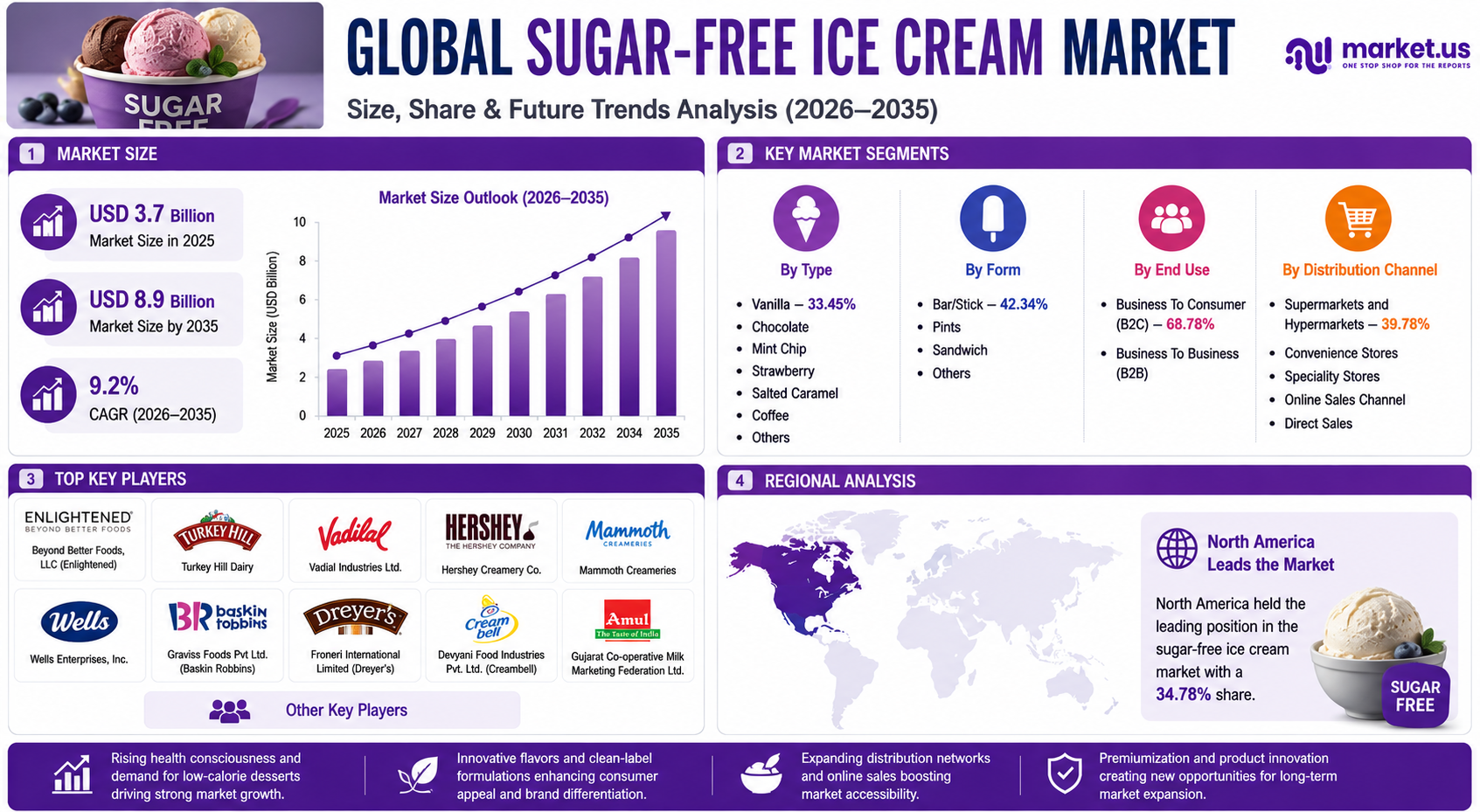
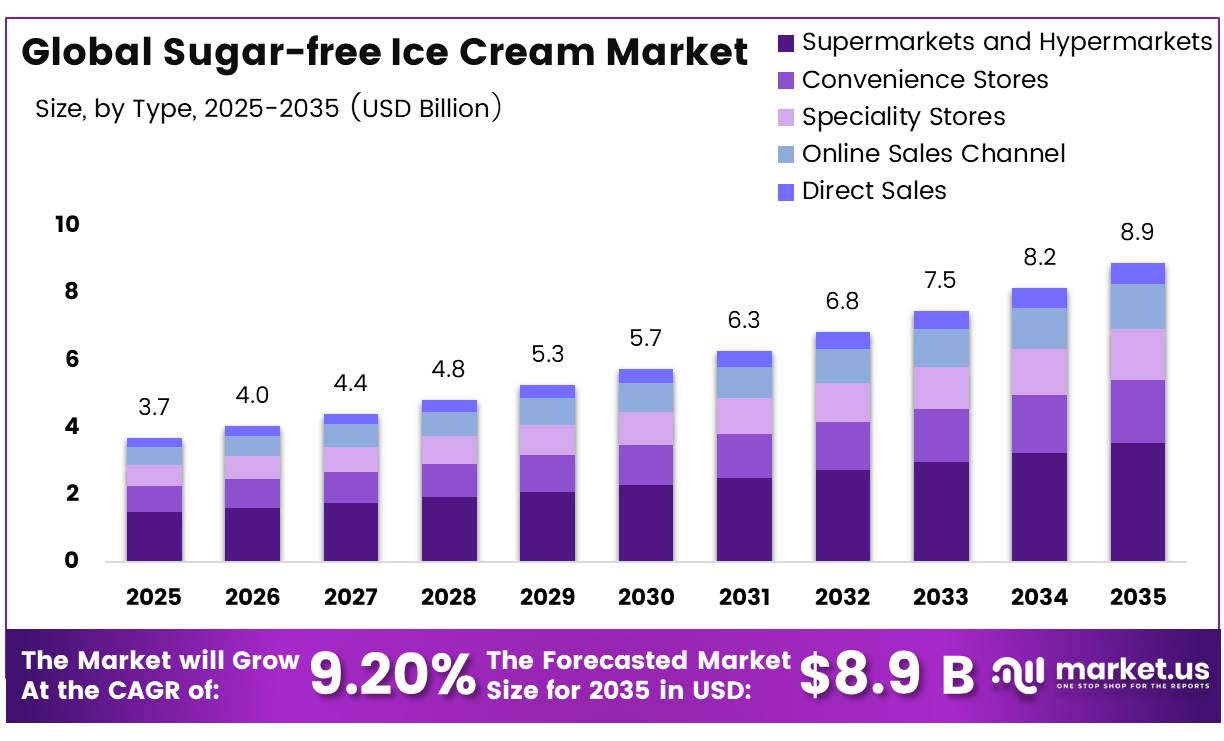
In 2025, the Global Sugar-free Ice Cream Market was valued at USD 3.7 billion and is expected to grow at a 9.2% CAGR from 2026 to 2035, reaching nearly USD 8.9 billion by 2035. North America dominated the market with more than 34.78% share, generating around USD 1.29 billion in revenue.
Sugar-free ice cream is gradually shifting from a product mainly targeted at diabetic consumers to a broader better-for-you frozen dessert category. Manufacturers are increasingly using sweeteners such as stevia, monk fruit, erythritol, and allulose while improving creaminess, taste, and freezing stability.
USDA data showed that U.S. ice cream and frozen dairy production reached around 1,386 million gallons in 2024. Regular ice cream represented nearly 60–65% of production, while low-fat and nonfat products accounted for approximately 24–34%, highlighting demand for different nutritional formulations.
Growing diabetes prevalence and greater awareness of sugar intake are supporting demand for sugar-free products. The International Diabetes Federation reported 589 million adults living with diabetes in 2024, equal to around 1 in 9 adults, with the number projected to reach 853 million by 2050.
Product innovation is expected to focus on high-protein recipes, plant-based alternatives, portion-controlled formats, and clean-label sweetener combinations. Under FDA requirements, a product can use a “sugar free” claim when it contains less than 0.5 gram of sugar per serving. The FDA Daily Value for added sugar is 50 grams, while dietary guidance recommends keeping added sugars below 10% of total daily calories.
Key Takeaways
- The global Sugar-free Ice Cream market was valued at USD 3.7 billion in 2025.
- The global market is projected to grow at a CAGR of 9.2% and is estimated to reach USD 8.9 billion by 2035.
- On the basis of type, the Vanilla Sugar-free Ice Cream dominated the market, constituting 33.45% of the total market share.
- Based on the Form, the Bar/Stick dominated the Sugar-free Ice Cream market, with a substantial market share of around 42.34%.
- Based on the End Use, Business To Consumer (B2C) led the market, comprising 68.78% of the total market.
- Among the Distribution Channel, the Supermarkets and Hypermarkets held a major share in the Sugar-free Ice Cream market, 39.78% of the market share.
- In 2025, the North America was the most dominant region in the Sugar-free Ice Cream market, accounting for 34.78% of the total global consumption.
Market Segmentation Overview
Type Analysis
Vanilla Dominates with 33.45% Market Share
In 2025, Vanilla held the leading position in the sugar-free ice cream market with a 33.45% share. Its mild and familiar taste works well with sweeteners such as stevia, monk fruit, and allulose. Vanilla is widely used in retail tubs, food-service desserts, and plant-based products. U.S. milk production exceeded 231 billion pounds in 2025, providing a strong dairy supply base for conventional and reduced-sugar frozen desserts.
Form Analysis
Bar/Stick Leads with 42.34% Market Share
In 2025, Bar/Stick held the dominant position with a 42.34% share. The format benefits from portion control, easy handling, individual packaging, and suitability for on-the-go consumption. It is commonly sold through supermarkets, convenience stores, vending locations, and food-service outlets. USDA reported that U.S. food-away-from-home spending reached USD 1.41 trillion in 2025, supporting demand for portable frozen dessert formats.
End Use Analysis
Business-to-Consumer Dominates with 68.78% Market Share
In 2025, Business-to-Consumer accounted for the largest share of the sugar-free ice cream market at 68.78%. Its strong position is supported by direct availability through supermarkets, convenience stores, brand websites, and online grocery platforms. Consumers can easily compare flavors, ingredients, calories, and sweetener claims before purchasing. U.S. retail e-commerce sales reached USD 326.7 billion in the first quarter of 2026, improving opportunities for frozen dessert delivery, multipacks, and direct-to-consumer sales.
Distribution Channel Analysis
Supermarkets and Hypermarkets Lead with 39.78% Share
In 2025, Supermarkets and Hypermarkets held the leading position with a 39.78% share. Their dominance is supported by high customer traffic, large freezer sections, and wide product selections across different flavors, package sizes, and price points. USDA reported that U.S. food-at-home expenditure reached USD 1.10 trillion in 2025, highlighting the strong consumer spending base available to grocery-led frozen dessert sales.
Drivers
Rising Diabetes Burden Drives Demand for Sugar-Free Desserts
The growing burden of diabetes is becoming a major demand driver for sugar-free ice cream. Consumers are paying closer attention to sugar content while still looking for familiar desserts that provide taste and convenience. According to the International Diabetes Federation, 589 million adults aged 20–79 were living with diabetes worldwide in 2024, equal to about 1 in 9 adults. The number is expected to reach 853 million by 2050, or around 1 in 8 adults. Diabetes was also linked with approximately USD 1.015 trillion in global health expenditure and 3.4 million deaths in 2024.
High added-sugar intake is also strengthening consumer interest in reformulated desserts. In April 2026, the U.S. Centers for Disease Control and Prevention reported that 3 in 5 Americans aged two years and older consumed more added sugar than recommended. Adult men consumed an average of 19 teaspoons of added sugar per day, compared with 15 teaspoons among women. Desserts and sweet snacks contributed around 19% of added-sugar intake, showing that frozen desserts have considerable room for lower-sugar alternatives.
Government nutrition policy further supports this shift. The FDA sets the Daily Value for added sugars at 50 grams based on a 2,000-calorie diet and recommends keeping added sugars below 10% of daily calories. FDA rules also permit a “sugar free” claim when a food contains less than 0.5 gram of sugars per serving. In addition, the U.S. Healthy People 2030 program aims to reduce average added-sugar intake from the latest 13.2% of daily calories toward an 11.5% target.
Business Opportunities
Premium Portion-Controlled Products Expand Across Digital Retail Channels
A major business opportunity for sugar-free ice cream lies in premium portion-controlled products designed for both home consumption and food-service channels. Consumers increasingly have access to frozen desserts through supermarkets, restaurants, convenience outlets, and delivery platforms, giving manufacturers several routes to introduce low-sugar bars, mini cups, pints, and multipacks. USDA Economic Research Service reported that total U.S. food spending reached USD 2.51 trillion in 2025. Food-at-home expenditure accounted for USD 1.10 trillion, while food-away-from-home spending reached USD 1.41 trillion. This large spending base gives sugar-free ice cream brands room to build both retail and food-service product lines instead of depending on a single sales channel.
Online retail creates another attractive opportunity, especially for premium multipacks, subscription boxes, and grocery-delivery partnerships. The U.S. Census Bureau reported seasonally adjusted retail e-commerce sales of USD 326.7 billion in the first quarter of 2026. Online sales increased 9.8% compared with the same quarter of 2025 and represented 16.9% of total U.S. retail sales. This digital channel allows sugar-free ice cream producers to reach consumers directly, test new flavours faster, and offer mixed packs or specialized products that may receive limited freezer space in physical stores.
Smaller package formats also offer a clear product-development opportunity. The U.S. Census Bureau counted 39.7 million one-person households in 2025, representing 29% of all U.S. households. Smaller households can support demand for individual bars, mini tubs, and resealable pints that reduce waste and improve portion control. At the same time, FDA rules allow manufacturers to use a “sugar free” claim when a product contains less than 0.5 gram of sugars per serving, giving brands a clear regulatory framework for developing and positioning compliant products.
Emerging Trends
Clean-Label Sweetener Blends Reshape Sugar-Free Ice Cream Formulations
The U.S. Food and Drug Administration reports that purified steviol glycosides can be around 200 to 400 times sweeter than table sugar. This high sweetness intensity allows manufacturers to use much smaller quantities while reformulating frozen desserts with lower sugar content.
Allulose is becoming particularly important because it behaves more like conventional sugar in food formulations while providing fewer calories. According to the FDA, manufacturers may calculate allulose at only 0.4 calories per gram, compared with 4 calories per gram for traditional sugar. Sugar-free products must contain less than 0.5 gram of sugars per serving, while a reduced-sugar claim generally requires at least 25% less sugar than an appropriate reference food.
Public-health initiatives are reinforcing this formulation trend. In April 2026, the CDC reported that 3 in 5 Americans aged two and older consumed more added sugar than recommended. Adult men consumed an average of 19 teaspoons daily, compared with 15 teaspoons for women, while desserts and sweet snacks contributed approximately 19% of added-sugar intake.
Use Cases
1. Diabetes-Conscious Frozen Dessert Options: Sugar-free ice cream is increasingly used as a dessert option for consumers who actively monitor their sugar intake. The International Diabetes Federation reported that 589 million adults aged 20–79 were living with diabetes worldwide in 2024, equal to around 1 in 9 adults. This number is expected to increase to 853 million by 2050. The scale of this population creates a large consumer base for products with clearly controlled sugar content, although individual dietary requirements still depend on total carbohydrates, calories, and serving size.
2. Lower Added-Sugar Dessert Alternatives: Sugar-free ice cream can be positioned as an alternative for consumers trying to reduce added sugars without completely avoiding frozen desserts. In April 2026, the CDC reported that 3 in 5 Americans aged two and older consumed more added sugar than recommended. Adult men consumed an average of 19 teaspoons of added sugar per day, compared with 15 teaspoons among women. Desserts and sweet snacks contributed approximately 19% of total added-sugar intake, creating room for reformulated frozen dessert products.
3. Restaurants, Cafés and Hospitality Dessert Menus: Sugar-free ice cream has growing use in restaurants, cafés, hotels, healthcare catering, and other food-service environments where operators are widening dessert choices. USDA reported that U.S. food-away-from-home spending reached USD 1.41 trillion in 2025 and represented 56.3% of total food expenditure. Full-service restaurant sales reached USD 488.4 billion, while limited-service establishments generated about USD 516.1 billion. This large food-service base provides opportunities for bulk tubs, individually wrapped bars, plated desserts, and reduced-sugar menu options.
Regional Analysis
North America led the Sugar-free Ice Cream Market with a 34.78% share. The region benefits from strong frozen-food retail networks, high nutrition-label awareness, and wide availability of reduced-sugar and low-calorie products. U.S. retail and food-service sales reached USD 757.1 billion in April 2026, while diagnosed diabetes affected 9.8% of U.S. adults during 2021–2024, supporting demand for controlled-sugar dessert options.
Asia-Pacific is the fastest-growing regional market, supported by rising health awareness, expanding modern retail, and reformulation of frozen desserts. Japan reported nearly 11 million people strongly suspected of having diabetes, while another 7 million were considered at possible risk. In Australia, diabetes affected 6.6% of adults during 2022–2024, creating demand for portion-controlled, naturally sweetened, and dairy-free sugar-free ice cream products.
Recent Developments
In May 2026, Wells Enterprises announced a USD 512 million expansion of its Dunkirk facility across three phases. The project is expected to retain 380 jobs, create 270 new positions, and increase frozen-dessert production capacity while adding integrated chocolate manufacturing capabilities.
In January 2026, Turkey Hill Dairy expanded its frozen dessert portfolio with two soft-serve-inspired products, Vanilla Soft and Chocolate & Vanilla Twist. The new offerings were designed to provide a smoother, scoopable texture directly from household freezers, improving convenience for at-home consumers.
Conclusion
The Sugar-free Ice Cream Market is well positioned for continued development as consumers become more careful about sugar intake while still seeking convenient and indulgent desserts. The International Diabetes Federation reported that 589 million adults aged 20–79 were living with diabetes worldwide, equal to around 1 in 9 adults, highlighting a large population paying greater attention to dietary choices.
In the United States, the CDC reported in 2026 that 3 in 5 Americans aged two and older consumed more added sugar than recommended, while desserts and sweet snacks contributed about 19% of added-sugar intake. At the same time, USDA reported total U.S. food spending of USD 2.51 trillion in 2025, including USD 1.10 trillion for food at home and USD 1.41 trillion for food away from home, providing a broad sales base for frozen desserts. Going forward, growth is likely to be supported by better-tasting sweetener blends, high-protein recipes, plant-based options, smaller portion sizes, premium pints, and wider availability through supermarkets, food service, and online channels.
Looking for data tailored to your specific market, region, or business need? Request a custom report or consultation — write to us at [email protected]




















