


Market Overview
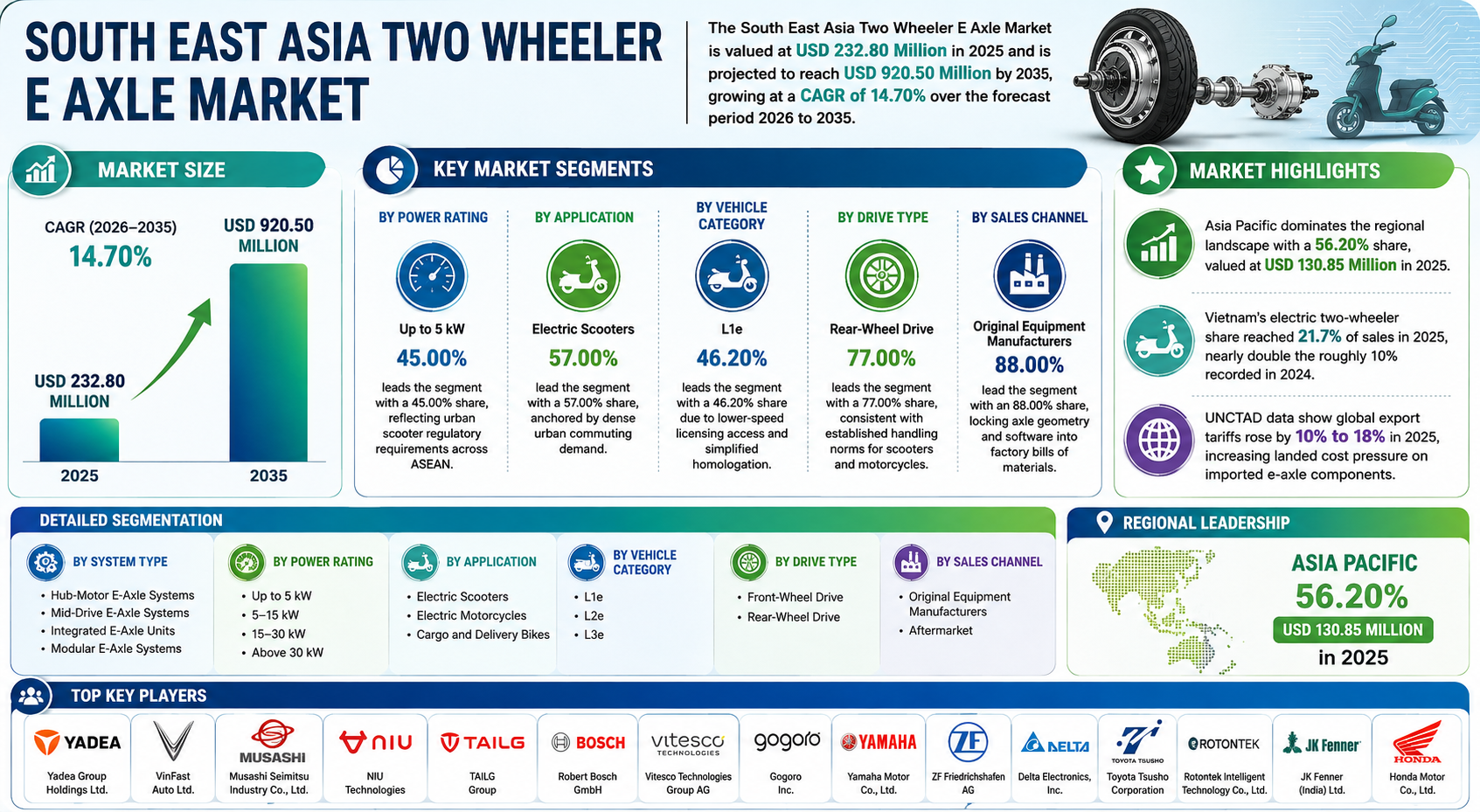
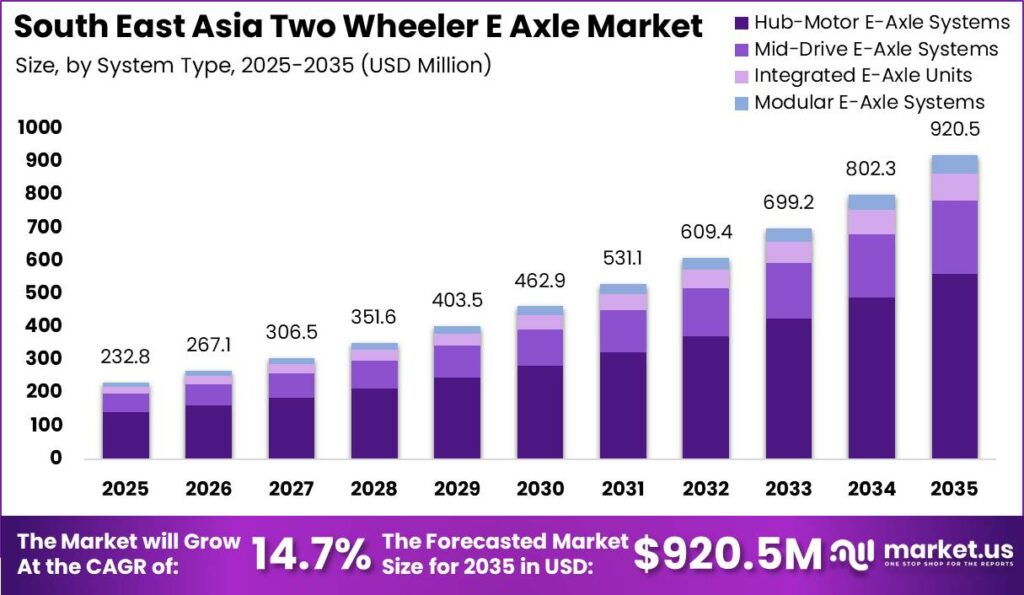
The South East Asia Two Wheeler E Axle Market is valued at USD 232.80 Million in 2025 and is projected to reach USD 920.50 Million by 2035, growing at a CAGR of 14.70% over the forecast period 2026 to 2035. This expansion reflects rising electric two-wheeler assembly across ASEAN production hubs in Vietnam, Indonesia, and Thailand.
Two-wheeler e-axle systems are integrated electric drive units that combine motor, gearbox, and axle functions into a single compact assembly. Scooters, motorcycles, and cargo bikes rely on these units to replace conventional combustion powertrains. OEMs and fleet operators adopt e-axles to reduce emissions and lower total operating costs.
Urban mobility, last-mile delivery, and commercial fleet electrification are the primary sectors driving e-axle adoption across ASEAN. Vietnam and Indonesia concentrate the largest two-wheeler fleets in the region. Cargo and food delivery platforms accelerate volume demand by electrifying rider fleets at scale.
Advances in hub-motor efficiency, thermal management for tropical climates, and software-defined power control are improving e-axle competitiveness. Suppliers integrate brushless motors with compact inverters to reduce assembly steps and weight. These gains lower energy cost per kilometer and raise rider acceptance versus legacy combustion designs.
Municipal ICE restrictions in Hanoi, Indonesia’s nickel-linked localization mandates, and Thailand’s EV 3.5 subsidy program create a reinforcing policy framework for e-axle demand. Vietnam’s transport policy targets 22% electric motorcycle penetration by 2030, establishing a measurable adoption floor. OEMs that align axle designs to local homologation rules secure preferred-supplier status across these corridors.
ICCT data show Vietnam’s electric two-wheeler share reached 21.7% of sales in the measured 2025 window, up from roughly 10% in 2024. IEA-linked analysis confirms Asia-Pacific held over 85% of global electric two-wheeler stock in recent measures. These figures signal that ASEAN is the dominant demand center for compact drive units through the forecast period.
Get further insight into the global trends shaping the future of the two-wheeler e-axle industry. Get a Sample PDF
Key Takeaways
- The market is valued at USD 232.80 Million in 2025 and is projected to reach USD 920.50 Million by 2035, growing at a CAGR of 14.70%.
- Hub-Motor E-Axle Systems lead the By System Type segment with a 61.00% share, driven by compact packaging suited to scooter platforms.
- Up to 5 kW leads the By Power Rating segment with a 45.00% share, reflecting urban scooter regulatory requirements across ASEAN.
- Electric Scooters lead the By Application segment with a 57.00% share, anchored by dense urban commuting demand.
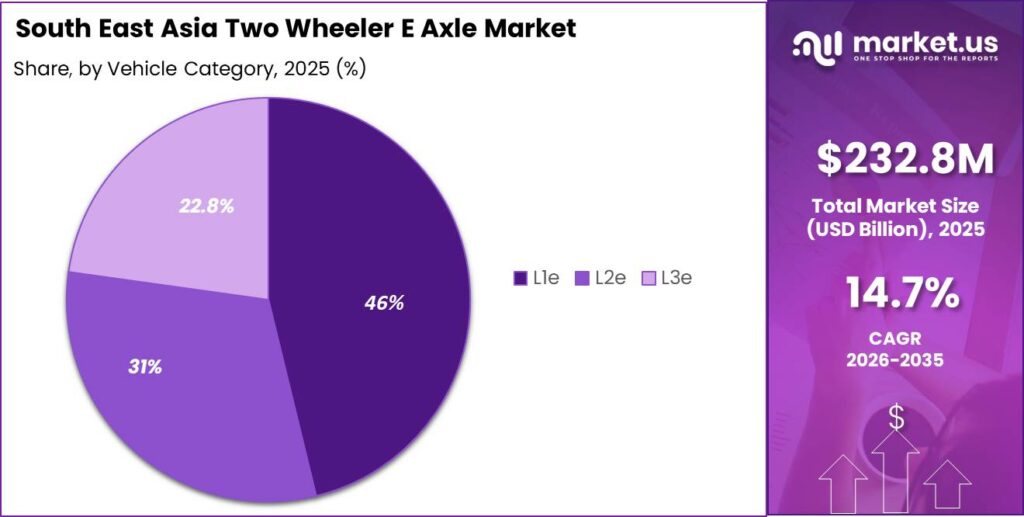
- L1e leads the By Vehicle Category segment with a 46.20% share due to lower-speed licensing access and simplified homologation.
- Rear-Wheel Drive leads the By Drive Type segment with a 77.00% share, consistent with established handling norms for scooters and motorcycles.
- Original Equipment Manufacturers lead the By Sales Channel segment with an 88.00% share, locking axle geometry and software into factory bills of materials.
- Asia Pacific dominates the regional landscape with a 56.20% share, valued at USD 130.85 Million in 2025.
- Vietnam’s electric two-wheeler share reached 21.7% of sales in 2025, nearly double the roughly 10% recorded in 2024.
- UNCTAD data show global export tariffs rose by 10% to 18% in 2025, increasing landed cost pressure on imported e-axle components.
Market Segmentation Overview
Hub-Motor E-Axle Systems hold the largest system-type share at 61.00% in 2025. Their compact packaging slots directly into scooter rear wheels without extensive frame redesign. Dat Bike’s 2025 upgrade of hub-motor units in Vietnam reportedly delivered a 25% efficiency gain and extended motorcycle range, reinforcing OEM preference for this architecture on urban platforms.
Mid-Drive E-Axle Systems position the motor near the crank for balanced weight distribution and stronger hill-climb torque. Integrated E-Axle Units consolidate motor, inverter, and reduction gear to reduce assembly steps. Modular E-Axle Systems enable power and gearing swaps across multiple platforms, lowering tooling cost for OEMs managing diverse model lines.
The Up to 5 kW power band commands a 45.00% share, matching L-class urban speed limits and simplifying homologation across ASEAN markets. The Honda EM1 e: sold in the Philippines uses a 1.7 kW peak motor and achieves a range of up to 48 km in economy mode. This combination reduces battery pack size and retail price, making it the natural fit for high-volume scooter assembly lines.
The 5 to 15 kW band serves mid-weight motorcycles requiring stronger acceleration on mixed urban and peri-urban routes. The 15 to 30 kW and Above 30 kW tiers address performance motorcycles and heavy cargo platforms. Axle vendors who offer scalable winding sets across all power bands reduce SKU complexity for OEMs managing multiple vehicle segments.
Electric Scooters lead the application segment with a 57.00% share, driven by dense urban commuting demand across Jakarta, Ho Chi Minh City, and Manila. The Indonesian GESITS G1 delivers 2,000 W rated output and 30 Nm of torque, accelerating from 0 to 50 km/h in 5 seconds. Scooter-focused axle designs with these performance envelopes fit last-mile fleets and personal mobility programs.
Electric Motorcycles require higher continuous torque and improved thermal headroom for highway-speed use. Cargo and Delivery Bikes demand reinforced housings and higher duty-cycle ratings for multi-shift fleet operations. Axle makers who certify cargo-rated seals and bearings extend their addressable base well beyond personal scooter volumes into fleet replacement programs.
L1e vehicles hold a 46.20% vehicle-category share, benefiting from lower speed thresholds that ease licensing and city access rules across most ASEAN jurisdictions. Rear-Wheel Drive commands a 77.00% drive-type share, preserving familiar handling dynamics for riders switching from ICE scooters and motorcycles. OEM sales channels retain an 88.00% share as factory installation locks axle geometry, software, and warranty into each vehicle program.
Drivers
Hanoi’s phased restrictions on gasoline motorcycle circulation inside core urban rings took formal shape through municipal directives in 2025 and expanded through 2026. ICCT fleet registration patterns show faster electric conversion in the capital than the national average. E-axle attach rates on new electric two-wheelers rose as OEMs prioritized compact integrated drives, and local suppliers cut imported axle lead times by an estimated 15% to 20% as capacity scaled.
Indonesia’s nickel-linked localization mandate, Thailand’s EV 3.5 purchase subsidy, battery-swap network expansion for delivery fleets, and corporate fleet electrification commitments add further unit pull across ASEAN. World Bank urban transport lending tied to emissions goals reinforces localized casting and winding investment. First-mover e-axle plants near Hanoi capture margin advantages of roughly 150 to 250 basis points over import-heavy rivals.
Use Cases
Urban commuters in Vietnam, Indonesia, and Thailand adopt electric scooters equipped with sub-5 kW hub-motor axles for daily point-to-point travel within city boundaries. Compact axle units match the power and range requirements of L1e and L2e vehicle categories without exceeding licensing thresholds. Scooter fleets running these drives achieve lower per-kilometer energy costs than comparable ICE models, raising rider retention for mobility platforms.
Moreover, food and parcel delivery platforms across Jakarta and Ho Chi Minh City electrify rider fleets using cargo-rated e-axle assemblies built for high duty cycles. The GESITS G1’s 5,000 W peak output and reinforced torque profile support multi-shift delivery routes. Cargo axle makers who certify tropical-duty seals and bearings win fleet replacement contracts as platforms scale route density in secondary cities.
Major Challenges
Integrated e-axle units carry higher material and precision-gear costs than conventional chain drives due to rare-earth magnets and tight assembly tolerances. ASEAN automotive federation benchmarking places electric two-wheeler retail prices roughly 20% to 35% above comparable ICE models in Indonesia, Vietnam, and the Philippines. Benchmark lending rates in the 6% to 8% range through 2026 raise financing cost for delivery riders and first-time buyers, slowing price-sensitive adoption.
However, fragmented ASEAN component supply chains force e-axle makers to source motors, controllers, and housings across Vietnam, Thailand, and China under uneven certification frameworks. Industry data link this split to average cross-border lead times of 6 to 10 weeks versus sub-2-week domestic sourcing in tighter hubs. Customs and logistics friction adds an estimated 8% to 12% to landed component cost, compressing margins for assemblers serving price-sensitive OEM programs.
Business Opportunities
Tens of millions of gasoline two-wheelers remain on the road in Indonesia and Vietnam with no dedicated retrofit program yet at scale. Retrofit axle-kit costs run an estimated 30% to 40% below full new-vehicle e-axle integration per regional supplier benchmarks. Certified installation networks combined with conversion financing can lift blended fleet margins by roughly 200 to 300 basis points once service density rises in key urban corridors.
Additionally, axle-as-a-service subscription and leasing models reduce upfront cost barriers for fleet operators and individual riders across ASEAN. Smart-axle telematics packages bundled into service contracts create recurring revenue streams that complement hardware margins. Early movers who launch these models in Thailand and the Philippines access a structurally underserved segment with +1.5% potential CAGR upside per forecast modeling.
Regional Analysis
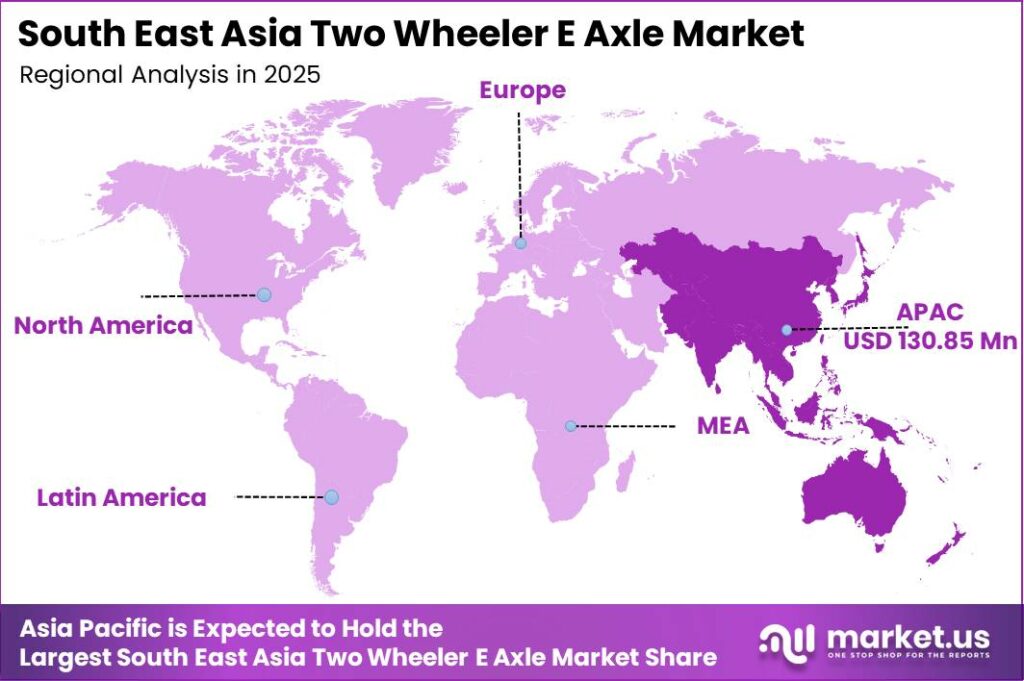
Asia Pacific dominates the South East Asia Two Wheeler E Axle Market with a 56.20% share valued at USD 130.85 Million in 2025. Vietnam, Indonesia, and Thailand anchor demand through dense two-wheeler fleets, municipal ICE restrictions, and OEM localization programs. Suppliers who site assembly near Hanoi and Jakarta corridors cut freight cost and respond faster to OEM schedule changes, capturing the steepest unit growth curve in the forecast period.
Consequently, Southeast Asian policy tools including purchase subsidies, localization mandates, and battery-swap infrastructure investment lift the regional growth rate ahead of markets outside the ASEAN core cluster. Vietnam’s electric two-wheeler export ambitions add a cross-border dimension, with the country emerging as a potential regional e-axle manufacturing hub. Investors funding winding and housing capacity in Vietnam and Indonesia position for multi-year volume contracts as urban fleet electrification accelerates through 2035.
Recent Developments
- January 2025 — Yadea Group Holdings Ltd. launched new electric two-wheeler models and smart mobility products at CES 2025, featuring improved battery technology, connectivity functions, and intelligent riding features targeting global urban markets.
- April 2025 — Gogoro Inc. expanded its battery-swapping ecosystem partnerships across Southeast Asia, supporting wider deployment of electric two-wheelers using its battery-swapping technology platform.
- May 2025 — NIU Technologies introduced updated smart electric scooter models with enhanced connectivity, improved range, and upgraded electronic control systems targeting urban mobility markets across the region.
- June 2025 — Yamaha Motor Co., Ltd. advanced electric motorcycle and scooter platforms for Asian markets, supporting multi-architecture axle demand across ASEAN OEM programs.
- July 2025 — Robert Bosch GmbH expanded compact motor and control technologies for electric two-wheelers, strengthening its position in ASEAN drivetrain supply chains.
Conclusion
The South East Asia Two Wheeler E Axle Market is on a sustained high-growth trajectory, propelled by municipal ICE restrictions, government purchase incentives, and rapid OEM localization of electric drivetrains across Vietnam, Indonesia, and Thailand. A 14.70% CAGR through 2035 reflects structural demand rather than a cyclical uptick, as fleet operators and urban planners commit to multi-year electrification programs.
Hub-Motor E-Axle Systems and sub-5 kW power ratings dominate the segmentation landscape, anchored by Electric Scooter applications that serve the highest-volume urban commuting use cases. Asia Pacific holds a commanding 56.20% regional share, with Vietnam and Indonesia emerging as both the primary consumption centers and the next wave of regional manufacturing hubs for compact drive units.
Companies that localize winding and housing capacity near Hanoi and Jakarta corridors, certify axle platforms across L-class homologation paths, and develop retrofit and service-based revenue models will capture the broadest share of a market expanding to USD 920.50 Million by 2035. Speed to certification and depth of OEM co-development partnerships will define which suppliers secure multi-model awards through the end of the forecast window.
Looking for data tailored to your specific market, region, or business need? Request a custom report or consultation — write to us at [email protected]




















