


Report Overview
Global South East Asia Two Wheeler E Axle Market size is expected to be worth around USD 920.50 Million by 2035 from USD 232.80 Million in 2025, growing at a CAGR of 14.70% during the forecast period 2026 to 2035. This expansion reflects rising electric two-wheeler assembly across ASEAN production hubs. Investors who lock supply contracts early capture volume leverage before capacity tightens.
Therefore, the South East Asia Two Wheeler E Axle Market covers integrated electric drive units that combine motor, gearbox, and axle functions for scooters, motorcycles, and cargo bikes. System types, power ratings, applications, vehicle categories, drive layouts, and sales channels structure demand. OEMs that align axle design with local homologation rules secure preferred-supplier status.
Key Takeaways
- The market is valued at USD 232.80 Million in 2025 and is projected to reach USD 920.50 Million by 2035, expanding at a CAGR of 14.70%.
- Hub-Motor E-Axle Systems lead the By System Type segment with a 61.00% share.
- Up to 5 kW leads the By Power Rating segment with a 45.00% share.
- Electric Scooters lead the By Application segment with a 57.00% share.
- L1e leads the By Vehicle Category segment with a 46.20% share.
- Rear-Wheel Drive leads the By Drive Type segment with a 77.00% share.
- Original Equipment Manufacturers lead the By Sales Channel segment with an 88.00% share.
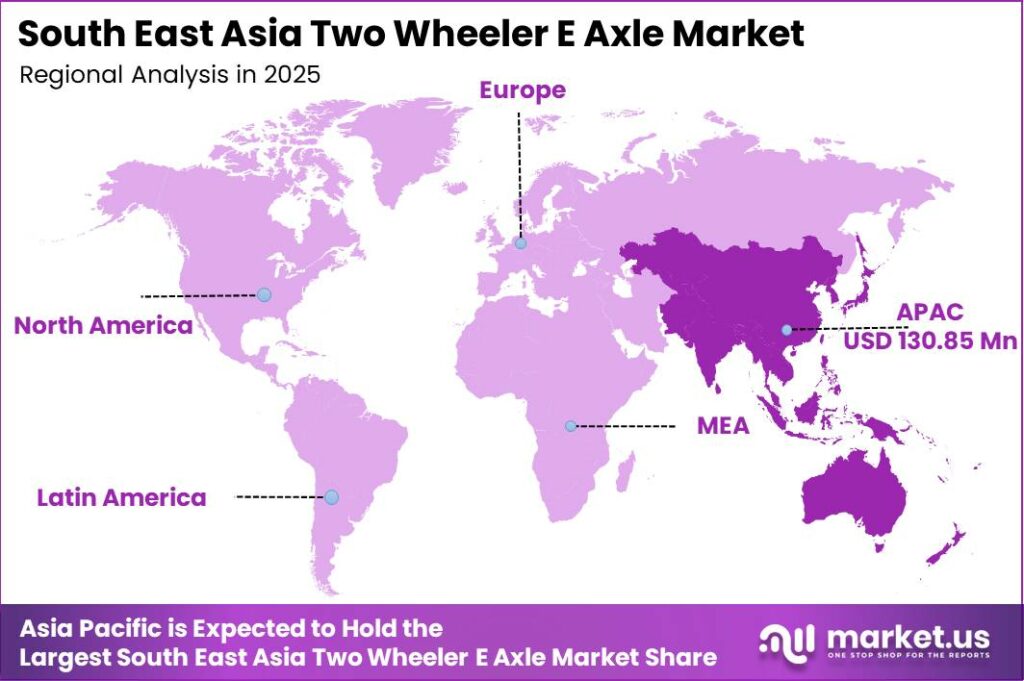
- Asia Pacific dominates the regional landscape with a 56.20% share, valued at USD 130.85 Million.
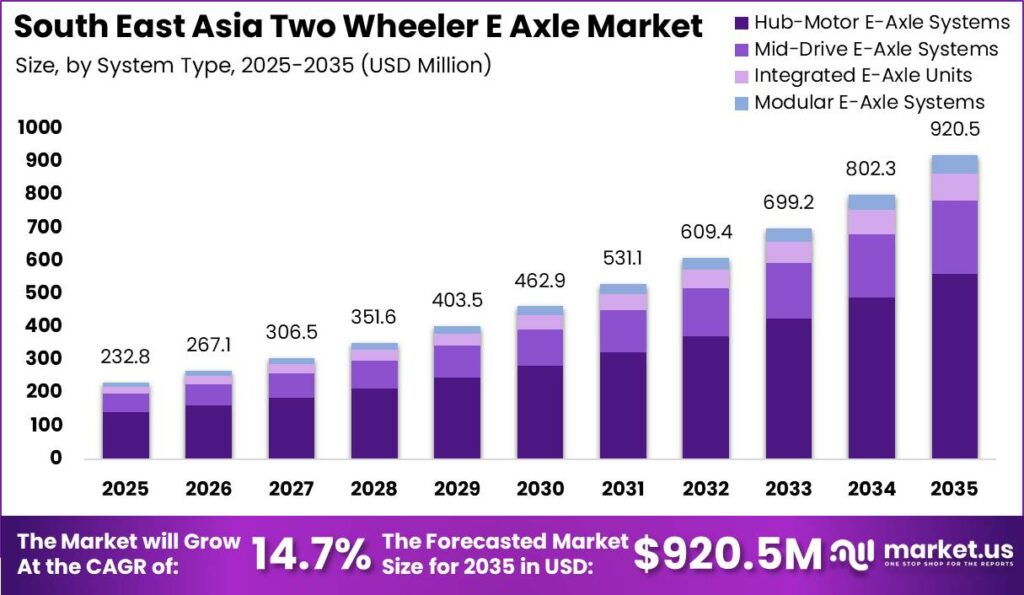
As per our research, electric two-wheelers sold in China, India and Vietnam collectively represented 95% of worldwide electric two-wheeler sales during January to October 2025. Vietnam sits inside this concentration and anchors regional e-axle pull-through. Suppliers who localize winding and casting near Vietnamese lines cut lead times and protect margin.
Consequently, Vietnam transport policy cited in 2025 set a target for electric models to reach 22% of motorcycles by 2030. This adoption floor expands the addressable base for compact drive units on new and converted fleets. Component makers that scale modular platforms now position for multi-year volume contracts.
This signals that VinFast VF DrgnFly uses a 250 W motor and delivers up to 110 km of power-assisted range with a 640 Wh battery needing slightly more than 5 hours to charge. July 2025 saw Robert Bosch GmbH expand compact motor and control technologies for electric two-wheelers. OEMs pairing efficient axles with faster charge profiles win urban fleet tenders first.
System Type Analysis
Hub-Motor E-Axle Systems dominates with 61.00% due to compact packaging for scooters.
In 2025, Hub-Motor E-Axle Systems held a dominant market position in the By System Type segment of South East Asia Two Wheeler E Axle Market, with a 61.00% share. Dat Bike upgraded hub-motor e-axle systems in Vietnam in 2025 and reportedly delivered a 25% efficiency gain while extending motorcycle range. This efficiency lift lowers energy cost per kilometer for delivery fleets. Suppliers who certify hub units for tropical duty cycles lock OEM platforms early.
Mid-Drive E-Axle Systems place the motor near the crank and feed power through the drivetrain for balanced weight distribution. Buyers seeking hill-climb torque favor this layout on heavier frames. Integrated E-Axle Units combine motor, inverter, and reduction gear in one housing to cut assembly steps. Modular E-Axle Systems allow power and gearing swaps across platforms. Yamaha Motor Co., Ltd. advanced electric motorcycle and scooter platforms for Asian markets in June 2025, supporting multi-architecture axle demand.
Power Rating Analysis
Up to 5 kW dominates with 45.00% due to urban scooter regulatory fit.
In 2025, Up to 5 kW held a dominant market position in the By Power Rating segment of South East Asia Two Wheeler E Axle Market, with a 45.00% share. The 2026 Honda EM1 e: sold in the Philippines uses an in-wheel brushless three-phase motor with peak output of 1.7 kW and maximum torque of 90 Nm at 25 rpm. This rating matches L-class urban speed caps and simplifies homologation. Axle makers who tool for sub-5 kW volumes capture the densest scooter build rates.
The Honda EM1 e: posts a standard operating range of 41.3 km, rising to 48 km in economy mode, with a maximum speed of 45 km/h. Range-efficient low-power axles reduce battery pack size and retail price. The 5 to 15 kW band serves mid-weight motorcycles needing stronger acceleration. The 15 to 30 kW and Above 30 kW bands address performance and cargo platforms. Vendors who offer scalable winding sets across these bands reduce OEM SKU complexity.
Application Analysis
Electric Scooters dominates with 57.00% due to dense urban commuting demand.
In 2025, Electric Scooters held a dominant market position in the By Application segment of South East Asia Two Wheeler E Axle Market, with a 57.00% share. The Indonesian GESITS G1 permanent-magnet BLDC drivetrain produces 2,000 W rated output, 5,000 W peak output and 30 Nm of torque. Scooter-focused axles with this power envelope fit last-mile and personal mobility fleets. Suppliers who harden controllers for stop-start duty win volume scooter programs.
The GESITS G1 accelerates from 0 to 50 km/h in 5 seconds and reaches a maximum speed of 70 km/h. Quick urban acceleration raises rider acceptance versus ICE scooters. Electric Motorcycles need higher continuous torque and thermal headroom for highway use. Cargo and Delivery Bikes require reinforced housings and higher duty cycles. Axle makers who certify cargo-rated seals and bearings open fleet replacement cycles beyond personal scooters.
Vehicle Category Analysis
L1e dominates with 46.20% due to low-speed moped regulatory access.
In 2025, L1e held a dominant market position in the By Vehicle Category segment of South East Asia Two Wheeler E Axle Market, with a 46.20% share. L1e vehicles typically stay within lower speed and power thresholds that ease licensing and city access rules. Compact e-axles sized for these limits keep bill-of-materials cost down. Manufacturers who pre-certify L1e axle packages accelerate time-to-market for entry scooters.
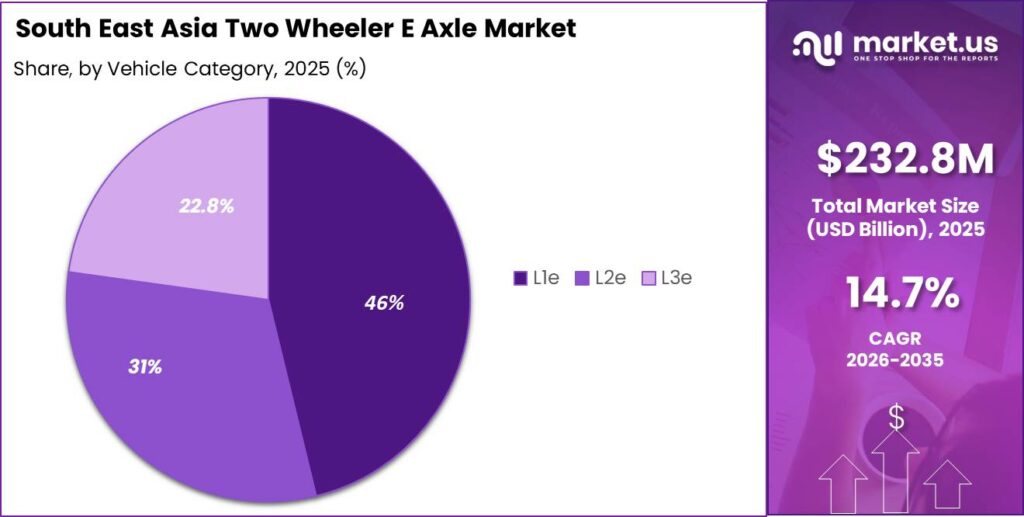
L2e covers three-wheel configurations that need different load paths and differential behavior in some designs. L3e motorcycles demand higher continuous power and stronger mechanical interfaces. ICCT data shows Vietnam e2W share reached 21.7% of two-wheeler sales in the measured 2025 window, far above roughly 10% in 2024. Rising L-class electrification multiplies axle attach rates. Suppliers aligned to each L-class homologation path avoid redesign delays.
Drive Type Analysis
Rear-Wheel Drive dominates with 77.00% due to traction and packaging norms.
In 2025, Rear-Wheel Drive held a dominant market position in the By Drive Type segment of South East Asia Two Wheeler E Axle Market, with a 77.00% share. Rear drive preserves familiar handling for riders moving from ICE scooters and motorcycles. Hub or mid layouts at the rear simplify front fork design. Axle vendors who optimize rear thermal paths reduce warranty risk in tropical heat.
Front-Wheel Drive appears on selected light platforms where rear space is reserved for batteries or cargo. Dual packaging choices force OEMs to qualify two mechanical interfaces. IEA-linked regional analysis notes Asia-Pacific held over 85% of global electric two-wheeler stock in recent stock measures. High installed base favors standardized rear-drive service parts. Aftermarket and OEM programs that stock common rear housings cut inventory cost.
Sales Channel Analysis
Original Equipment Manufacturers dominates with 88.00% due to factory-fit integration.
In 2025, Original Equipment Manufacturers held a dominant market position in the By Sales Channel segment of South East Asia Two Wheeler E Axle Market, with an 88.00% share. Factory installation locks axle geometry, software, and warranty into the vehicle bill of materials. Long-term supply agreements stabilize volume for axle plants. Component firms that co-develop with OEMs secure multi-model awards.
Aftermarket channels serve replacement, upgrade, and retrofit demand once vehicles age or fleets convert. Service density and parts certification determine aftermarket share gains. Vietnamese manufacturers account for more than 70% of new E2W sales in that market per ICCT-linked industry tracking. Strong local OEM production keeps most axles on the factory channel. Aftermarket players who certify retrofit kits still address the large ICE installed base over time.
Key Market Segments
By System Type
- Hub-Motor E-Axle Systems
- Mid-Drive E-Axle Systems
- Integrated E-Axle Units
- Modular E-Axle Systems
By Power Rating
- Up to 5 kW
- 5–15 kW
- 15–30 kW
- Above 30 kW
By Application
- Electric Scooters
- Electric Motorcycles
- Cargo and Delivery Bikes
By Vehicle Category
- L1e
- L2e
- L3e
By Drive Type
- Front-Wheel Drive
- Rear-Wheel Drive
By Sales Channel
- Original Equipment Manufacturers
- Aftermarket
Regional Analysis
Asia Pacific Dominates the South East Asia Two Wheeler E Axle Market with a Market Share of 56.20%, Valued at USD 130.85 Million
Asia Pacific anchors demand through dense two-wheeler fleets in Vietnam, Indonesia, Thailand, and neighboring production centers. Municipal ICE restrictions and OEM localization programs pull e-axle volumes into regional plants. Suppliers who site assembly near Hanoi and Jakarta corridors cut freight cost and respond faster to OEM schedule changes.
Southeast Asian policy tools such as purchase support and localization mandates lift the growth rate ahead of mature ICE-heavy corridors outside the core cluster. Battery-swap and charging build-out for delivery fleets further concentrate axle demand in high-use urban rings. Investors funding regional winding and housing capacity capture the steepest unit growth curve.
North America, Europe, Latin America, and Middle East and Africa remain secondary for this SEA-defined market scope yet influence component standards and export design rules. Cross-border parts flows still expose landed cost to tariff swings. Regional dual-sourcing strategies protect ASEAN OEMs from single-corridor disruption.
Key Regions and Countries
North America
- US
- Canada
Europe
- Germany
- France
- The UK
- Spain
- Italy
- Rest of Europe
Asia Pacific
- China
- Japan
- South Korea
- India
- Australia
- Rest of APAC
Latin America
- Brazil
- Mexico
- Rest of Latin America
Middle East and Africa
- GCC
- South Africa
- Rest of MEA
Market Dynamics
Market Opportunity Analysis - Retrofit kits, secondary cities, and modular platforms open white space beyond factory scooter fitment
ICE-to-electric axle retrofit services remain underexploited while new-vehicle e-axle sales dominate current volumes. Tens of millions of gasoline two-wheelers in Indonesia and Vietnam form a conversion pool largely outside OEM channels. Kit economics that sit well below full new-vehicle integration costs create room for certified installers. Entrants who build financing and workshop density capture deferred fleet demand first.
As a result, rural and secondary-city electrification in Indonesia and the Philippines lags dense capital-city scooter programs. Lower dealer coverage and thinner charging access leave powertrain suppliers under-indexed outside metros. Modular e-axle systems that share housings across L1e and light cargo frames reduce SKU cost for smaller OEMs. Investors funding secondary-city distribution unlock volume that premium urban scooters do not reach.
By contrast, Aftermarket still holds a minority channel share against OEM factory fit. Replacement and upgrade cycles will expand as early electric fleets age. Suppliers who stock common rear-drive hub parts and flashable controllers own service revenue streams. This channel also supports axle-as-a-service models that lower upfront cost for delivery fleets.
This creates space in Mid-Drive and higher power bands above the scooter-centric core. Performance motorcycles and cargo bikes need different torque and thermal packages than sub-5 kW urban hubs. Specialists who certify 15 to 30 kW and above packages avoid head-on price wars in the crowded low-power hub segment.
Technology and Innovation Landscape - Efficiency gains, in-wheel motors, and higher-power charging redefine axle competitiveness
Dat Bike hub-motor upgrades introduced in Vietnam in 2025 reportedly delivered a 25% efficiency improvement with extended operating range. Higher efficiency lowers battery size for a target range and cuts energy cost per kilometer. Manufacturers who publish verified efficiency maps win fleet RFPs that score total cost of ownership. Lagging thermal and magnetic designs lose share on delivery contracts.
Honda EM1 e: in-wheel brushless three-phase motors at 1.7 kW peak with 90 Nm torque show how compact hub architectures meet L-class rules. In-wheel packaging frees frame space for batteries and simplifies mechanical driveline parts. OEMs standardizing on validated in-wheel e-axles shorten vehicle development cycles. Component firms without in-wheel IP face exclusion from next scooter platforms.
Consequently, the 2025 Dat Bike Quantum S charger draws up to about 1,800 W from a 220 V, 50 Hz supply. Higher charge power shortens downtime for commercial riders and raises daily vehicle utilization. Axle and battery system suppliers who co-design for elevated charge rates support fleet uptime targets. Slow charge ecosystems leave vehicles idle and weaken electrification economics.
This reflects rising demand for smart connectivity and electronic control upgrades on scooters, as seen in 2025 model refreshes across major brands. Controllers that report torque, temperature, and fault codes enable predictive maintenance for fleets. Investors backing software-defined e-axle stacks gain recurring diagnostic revenue beyond one-time hardware sales.
Drivers
Hanoi phased restrictions on gasoline motorcycle circulation inside core urban rings took formal shape through municipal directives in 2025 and expanded through 2026. ICCT fleet registration patterns show faster electric conversion in the capital than the national average. E-axle attach rates on new electric two-wheelers rose as OEMs prioritized compact integrated drives. Local suppliers cut imported axle lead times by an estimated 15% to 20% as capacity scaled.
World Bank urban transport lending tied to emissions goals reinforces this shift toward localized casting and winding. First-mover e-axle plants near Hanoi can capture margin advantages of roughly 150 to 250 basis points over import-heavy rivals. Indonesia nickel-linked localization, Thailand EV 3.5 subsidies, battery-swap fleets, OEM axle localization, and corporate fleet commitments add further unit pull across ASEAN.
| Driver | (~) % Impact on CAGR Forecast | Geographic Relevance | Impact Timeline |
|---|---|---|---|
| Hanoi ICE motorcycle ban zones | +2.8% | Vietnam | Short term (2 years or less) |
| Indonesia nickel-linked EV localization mandate | +2.3% | Indonesia | Medium term (2 to 4 years) |
| Thailand EV 3.5 purchase subsidy program | +1.9% | Thailand | Short term (2 years or less) |
| Battery-swap network expansion for delivery fleets | +1.6% | Vietnam, Indonesia | Short term (2 years or less) |
| Rising OEM localization of e-axle assembly | +1.2% | ASEAN-wide | Medium term (2 to 4 years) |
| Corporate fleet electrification commitments | +0.9% | Singapore, Malaysia | Medium term (2 to 4 years) |
Restraints
Integrated e-axle units carry higher material and precision gear costs than conventional chain drives because of rare-earth magnets and tight assemblies. ASEAN automotive federation cost benchmarking places electric two-wheeler retail prices roughly 20% to 35% above comparable ICE models in Indonesia, Vietnam, and the Philippines. Benchmark lending rates in the 6% to 8% range through 2026 raise financing cost for delivery riders and first-time buyers.
National registration data still show electric penetration below 3% of new two-wheeler registrations in several key markets. E-axle makers face a choice between absorbing about 300 to 400 basis points of margin or delaying capacity CapEx. Interest-rate pressure, uneven safety standards, tariff swings on motors and axles, and weak consumer credit all slow price-sensitive adoption across ASEAN.
| Restraint | (~) % Impact on CAGR Forecast | Geographic Relevance | Impact Timeline |
|---|---|---|---|
| High upfront e-axle unit cost vs conventional powertrain | -2.1% | ASEAN-wide | Short term (2 years or less) |
| Elevated regional interest rates constraining OEM CapEx | -1.7% | Indonesia, Philippines | Short term (2 years or less) |
| Lack of harmonized e-axle safety and performance standards | -1.4% | ASEAN-wide | Short term (2 years or less) |
| Import tariff volatility on motor and axle components | -1.1% | Thailand, Philippines | Short term (2 years or less) |
| Limited consumer financing access in price-sensitive segments | -0.8% | Indonesia, Vietnam | Short term (2 years or less) |
Challenges
ASEAN lacks a consolidated e-axle component base, so makers source motors, controllers, and housings across Vietnam, Thailand, and China under uneven certification. Industry association trade data link this split to average cross-border lead times of 6 to 10 weeks versus sub-2-week domestic sourcing in tighter hubs. Customs and logistics friction adds an estimated 8% to 12% to landed component cost.
OECD trade facilitation indicators flag divergent homologation rules among Indonesia, Vietnam, and Thailand that block scale in housing tooling. Dual-sourcing and regional co-location could cut logistics overhead by about 4 to 6 percentage points over several years. Talent gaps, tropical thermal reliability, thin after-sales coverage, and rare-earth price swings add further friction that rewards patient capital and certified service networks.
| Challenge | (~) % CAGR Friction Drag | Geographic Relevance | Mitigation Horizon |
|---|---|---|---|
| Fragmented ASEAN component supply chains | -1.3% | ASEAN-wide | Medium term (2 to 4 years) |
| Skilled e-drivetrain engineering talent shortage | -1.0% | Vietnam, Thailand | Medium term (2 to 4 years) |
| Thermal management reliability in tropical climates | -0.9% | Indonesia, Philippines | Medium term (2 to 4 years) |
| Inconsistent after-sales service network coverage | -0.7% | Indonesia, Philippines | Long term (4 years or more) |
| Rare-earth magnet raw material price exposure | -0.6% | ASEAN-wide | Medium term (2 to 4 years) |
Opportunities
Growth today centers on new electric vehicles, while tens of millions of gasoline two-wheelers in Indonesia and Vietnam remain largely untouched by dedicated axle retrofit programs. Retrofit axle-kit costs run an estimated 30% to 40% below full new-vehicle e-axle integration per regional supplier benchmarks. Lower kit cost opens margin for assemblers even at modest price points because labor and installation become the main value-add.
Certified installation networks and conversion financing can lift blended fleet margins by roughly 200 to 300 basis points once density rises. Axle-as-a-service leasing, Vietnam export hub builds, smart-axle telematics for fleets, and rural secondary-city demand extend white space beyond factory-fit scooters. Early movers who separate retrofit go-to-market from OEM sales capture deferred fleet demand first.
| Opportunity | (~) % Potential CAGR Upside | Geographic Relevance | Execution Window |
|---|---|---|---|
| ICE-to-electric axle retrofit conversion services | +2.0% | Indonesia, Vietnam | Medium term (2 to 4 years) |
| Axle-as-a-service subscription and leasing models | +1.5% | ASEAN-wide | Medium term (2 to 4 years) |
| Cross-border e-axle export hub from Vietnam | +1.2% | Vietnam, regional export | Long term (4 years or more) |
| Integrated smart-axle telematics for fleet operators | +0.9% | Thailand, Philippines | Long term (4 years or more) |
| Untapped rural and secondary-city electrification demand | +1.1% | Indonesia, Philippines | Long term (4 years or more) |
Key Company Insights
Yadea Group Holdings Ltd. launched new electric two-wheeler models and smart mobility products at CES 2025, including upgraded scooters with improved battery technology and connectivity. This product refresh strengthens brand reach into global urban mobility channels that pull SEA-sourced e-axle volumes. Rivals without comparable smart feature roadmaps risk losing specification share on connected scooter platforms.
VinFast Auto Ltd. expanded its electric two-wheeler ecosystem in March 2025 through new scooter initiatives and stronger battery-swapping and charging infrastructure in Southeast Asia. VinFast Zgoo offers a stated 203 km range per full charge with a 400 W charging system needing about 10 hours from empty to full. Deep ecosystem control ties axle demand to proprietary vehicle and energy networks.
Key Players
- Yadea Group Holdings Ltd.
- VinFast Auto Ltd.
- Musashi Seimitsu Industry Co., Ltd.
- NIU Technologies
- TAILG Group
- Robert Bosch GmbH
- Vitesco Technologies Group AG
- Gogoro Inc.
- Yamaha Motor Co., Ltd.
- ZF Friedrichshafen AG
- Delta Electronics, Inc.
- Toyota Tsusho Corporation
- Rotontek Intelligent Technology Co., Ltd.
- JK Fenner (India) Ltd.
- Honda Motor Co., Ltd.
Recent Developments
- January 2025: Yadea Group Holdings Ltd. launched new electric two-wheeler models and smart mobility products at CES 2025, including upgraded electric scooters featuring improved battery technology, connectivity functions, and intelligent riding features for global markets.
- April 2025: Gogoro Inc. expanded its battery-swapping ecosystem partnerships in Southeast Asia, supporting wider deployment of electric two-wheelers using its battery-swapping technology platform.
- May 2025: NIU Technologies introduced updated smart electric scooter models with enhanced connectivity, range improvements, and upgraded electronic control systems targeting urban mobility markets.
Geopolitical Impact Analysis
Data from UNCTAD shows global tariffs on exports rose sharply in 2025, by 10% for developed countries, 16% for developing countries, and 18% for least developed economies. ASEAN e-axle builders that import magnets, copper windings, and controllers face higher landed cost on cross-border parts. This pressure favors local casting and winding near Vietnam and Indonesia vehicle plants to defend retail price points.
Therefore, UNCTAD trade monitoring also flags continued use of tariffs as strategic tools into 2026 while non-tariff measures raise compliance cost on multi-country bills of materials. Fragmented ASEAN homologation already stretches component lead times and adds logistics friction on motor and housing flows. Dual-sourcing and regional sub-assembly cut exposure to sudden tariff and customs shocks on e-axle inputs.
Report Scope
| Report Features | Description |
|---|---|
| Market Value (2025) | USD 232.80 Million |
| Forecast Revenue (2035) | USD 920.50 Million |
| CAGR (2026-2035) | 14.70% |
| Base Year for Estimation | 2025 |
| Historic Period | 2020-2024 |
| Forecast Period | 2026-2035 |
| Report Coverage | Revenue Forecast, Market Dynamics, Market Opportunity Analysis, Technology and Innovation Landscape, Competitive Landscape, Recent Developments |
| Segments Covered | By System Type (Hub-Motor E-Axle Systems, Mid-Drive E-Axle Systems, Integrated E-Axle Units, Modular E-Axle Systems), By Power Rating (Up to 5 kW, 5–15 kW, 15–30 kW, Above 30 kW), By Application (Electric Scooters, Electric Motorcycles, Cargo and Delivery Bikes), By Vehicle Category (L1e, L2e, L3e), By Drive Type (Front-Wheel Drive, Rear-Wheel Drive), By Sales Channel (Original Equipment Manufacturers, Aftermarket) |
| Regional Analysis | North America (US and Canada), Europe (Germany, France, The UK, Spain, Italy, and Rest of Europe), Asia Pacific (China, Japan, South Korea, India, Australia, and Rest of APAC), Latin America (Brazil, Mexico, and Rest of Latin America), Middle East and Africa (GCC, South Africa, and Rest of MEA) |
| Competitive Landscape | Yadea Group Holdings Ltd., VinFast Auto Ltd., Musashi Seimitsu Industry Co., Ltd., NIU Technologies, TAILG Group, Robert Bosch GmbH, Vitesco Technologies Group AG, Gogoro Inc., Yamaha Motor Co., Ltd., ZF Friedrichshafen AG, Delta Electronics, Inc., Toyota Tsusho Corporation, Rotontek Intelligent Technology Co., Ltd., JK Fenner (India) Ltd., Honda Motor Co., Ltd. |
| Customization Scope | Customization for segments, region / country-level will be provided. Additional customization can be done based on requirements. |
| Purchase Options | We have three licenses to opt for: Single User License | Multi-User License (Up to 5 Users) | Corporate Use License (Unlimited User and Printable PDF) |





































