


Introduction
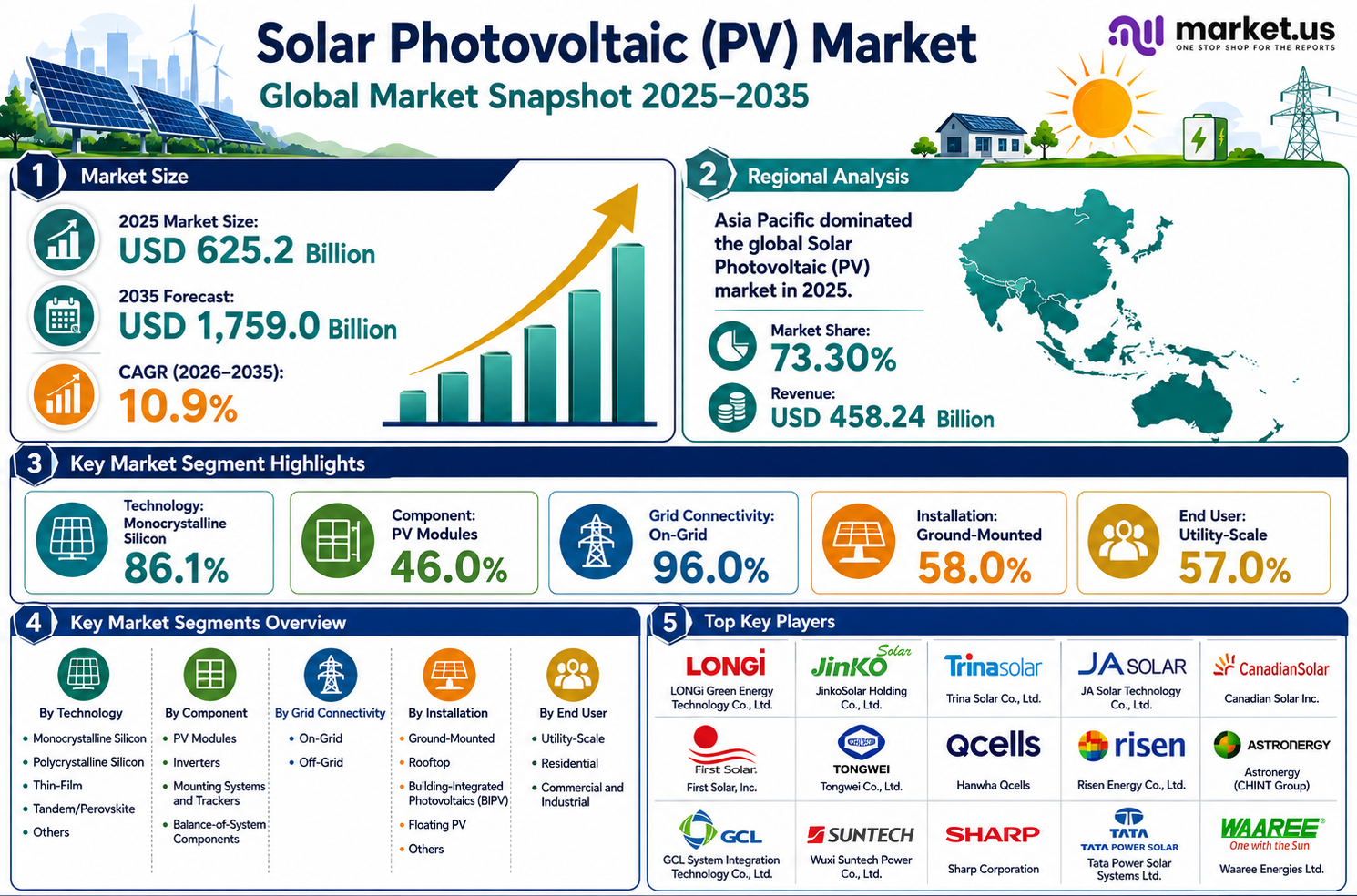
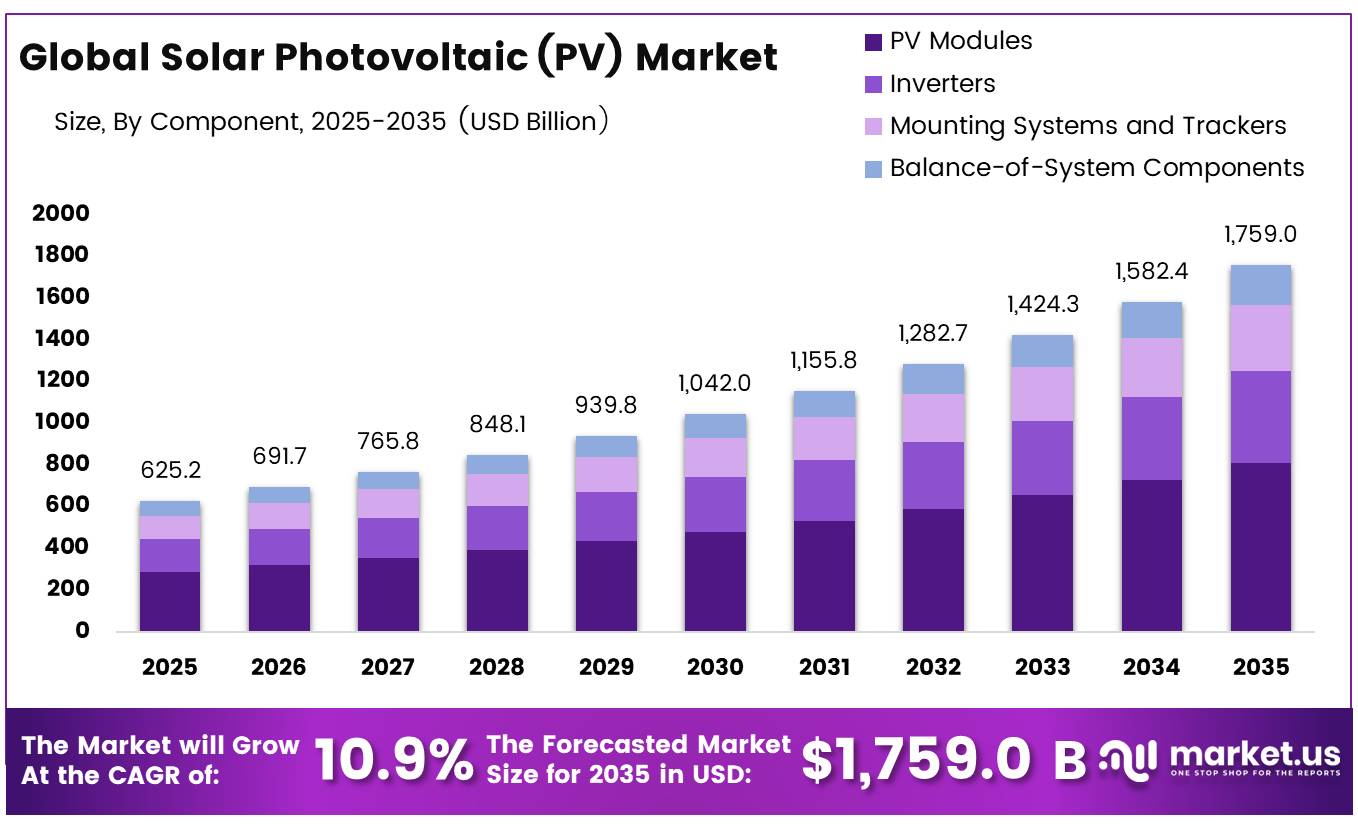
In 2025, the Global Solar Photovoltaic (PV) Market was valued at USD 625.2 billion, and between 2026 and 2035, this market is estimated to register a CAGR of 10.9%, reaching about USD 1,759.0 billion by 2035. In 2025, North America held a dominant market position, capturing more than a 73.30% share, holding USD 458.24 Billion revenue.
Solar Photovoltaic (PV) technology converts sunlight into electricity through semiconductor cells, supported by modules, inverters, mounting systems, monitoring tools and grid-connection equipment across utility, commercial and residential projects. The global solar PV industry expanded strongly in 2025, with annual installations rising by about 12% to more than 600 GW, lifting cumulative capacity to nearly 2,800 GW. Solar accounted for over 75% of the record 800 GW of renewable capacity added worldwide, while 30 countries installed more than 1 GW each.
Solar generation increased by around 600 TWh to nearly 2,700 TWh, supplying over 8% of global electricity and meeting about 70% of annual electricity demand growth. Battery storage additions climbed nearly 40% to almost 110 GW, supporting grid integration. Growth opportunities remain strong in utility-scale projects, rooftops, floating solar, agrivoltaics, recycling, smart inverters and solar-plus-storage. The IEA expects nearly 4,600 GW of renewable additions during 2025–2030, with solar PV contributing close to 80%, despite grid, financing and manufacturing challenges across major markets.
Key Takeaways
- The global Solar Photovoltaic (PV) market was valued at US$625.2 billion in 2025 .
- The market is projected to register a CAGR of 10.9%, reaching approximately US$1,759.0 billion by 2035.
- By technology, Monocrystalline Silicon remained the leading segment, accounting for 86.1% of the total market share.
- By component, PV Modules dominated the market with a significant revenue share of around 46.0%.
- Based on grid connectivity, the On-Grid segment led the industry, representing 96.0% of the overall market.
- Among installation types, Ground-Mounted systems captured a major share of 58.0%.
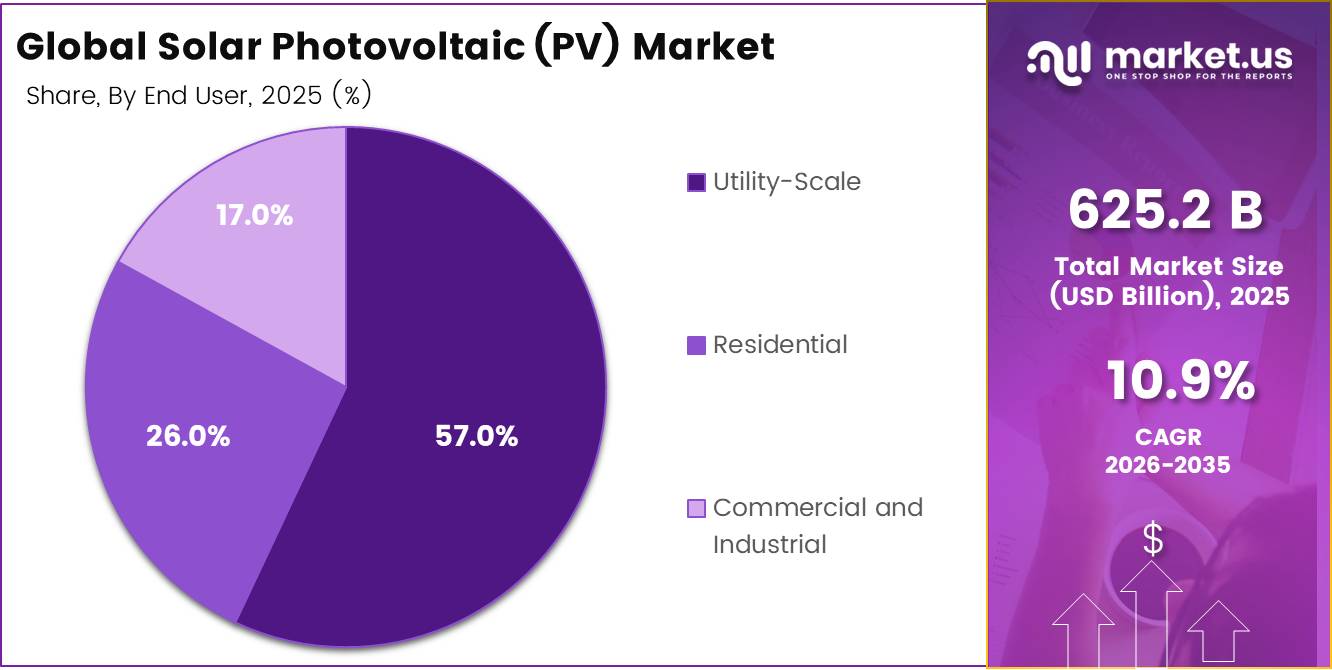
- By end user, Utility-Scale applications emerged as the largest segment, contributing nearly 57.0% of total revenue.
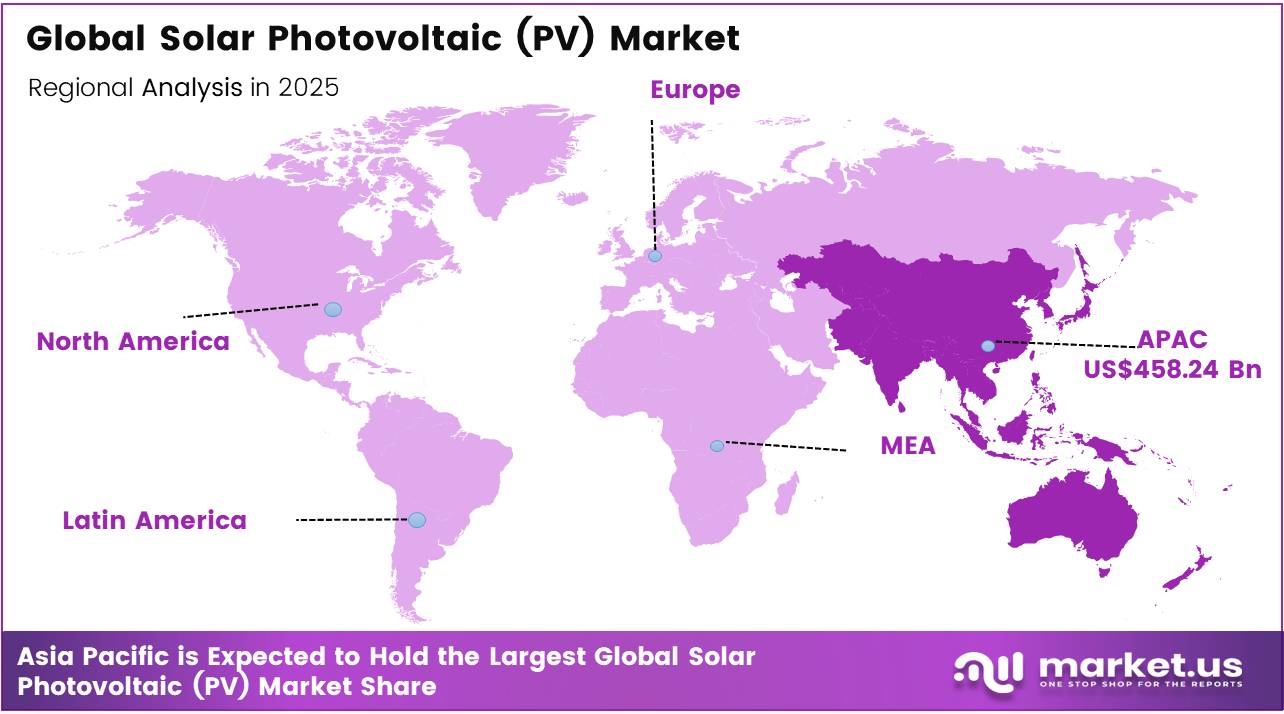
- In 2025, Asia Pacific maintained its leading position in 2025, accounting for 73.3% of global consumption.
Market Segmentation Overview
Technology Analysis
Monocrystalline Silicon Remains the Dominant Type Segment
Monocrystalline silicon held the dominant position in the Solar Photovoltaic (PV) Market, accounting for 86.10% of the total share. Its strong market position is supported by higher conversion efficiency, long operating life and suitability for automated, large-volume manufacturing. According to the U.S. Department of Energy, commercially available silicon modules generally achieve efficiencies of 20%–22%, while laboratory-scale monocrystalline cells can exceed 27%. The technology also represented 96% of global solar module shipments in 2022, highlighting its widespread adoption across utility-scale, commercial and residential rooftop projects. Its established supply chain, reliable performance and ability to generate more electricity from limited space continue to support demand.
Component Analysis
PV Modules Lead Holds a Significant Market Position
PV modules captured the largest share of the Solar Photovoltaic Component Market, accounting for 46.00%. These modules form the core of every solar installation because they directly convert sunlight into usable electricity. Their demand continues to increase across residential rooftops, commercial buildings and utility-scale solar farms. The U.S. Energy Information Administration reported that 27.2 GW of utility-scale solar capacity was installed in 2025. Developers are expected to add another 43.4 GW in 2026, representing an annual increase of 60%. This strong expansion in solar projects is expected to support continued demand for efficient, durable and high-output PV modules.
Grid Connectivity Analysis
On-Grid Systems Leads Grid Connectivity
On-grid systems dominated the Solar Photovoltaic Market, capturing 96.00% of the total share. Their leadership is driven by the widespread development of utility-scale plants, commercial solar systems and grid-connected residential rooftops. These installations allow users to supply excess electricity to the power network while drawing electricity when solar generation is insufficient. The U.S. Energy Information Administration recorded 149,798.5 MW of utility-scale solar PV capacity and 59,505.5 MW of small-scale solar capacity in 2025. Combined capacity reached approximately 209,304 MW, supporting growing demand for smart inverters, advanced meters, grid controls and power-management equipment.
Installation Analysis
Ground-Mounted Systems Leads Installation
Ground-mounted systems held the leading position in the Solar Photovoltaic Market, accounting for 58.00% of the total share. These systems are widely selected for large solar power plants because they support extensive module arrays, tracking technologies and easier maintenance without the space limitations associated with rooftops. U.S. utility-scale solar PV capacity reached 122,061.8 MW in 2024, while these facilities generated approximately 216.7 TWh of electricity. The large operating base continues to increase demand for mounting foundations, tracking structures, high-capacity inverters, transformers and grid-connection infrastructure used in large-scale solar developments.
End User Analysis
Solar Photovoltaic (PV)s Are Mostly Utilized in the Utility-Scale.
Utility-scale applications dominated the Solar Photovoltaic Market, contributing 57.00% of total revenue. Large solar farms remain attractive because they generate electricity in bulk, support long-term power-purchase agreements and allow developers to deploy tracking systems, high-capacity inverters and battery storage. U.S. utility-scale solar facilities generated approximately 296,000 GWh of electricity during the year, representing an increase of 34% compared with 2024. This strong rise in solar power generation highlights the growing role of utility-scale projects in national electricity systems and continues to support investment in grid-scale renewable energy infrastructure.
Drivers
Decarbonization Mandates Accelerate Utility-Scale PV Deployment
Decarbonization policies introduced between 2024 and 2026 are increasing utility-scale solar deployment and could add nearly 2.2 percentage points to the market’s baseline CAGR by 2030. Global solar generation has expanded by four orders of magnitude over two decades, with annual growth exceeding 35%. In 2025, approximately 664 GW of new capacity was installed, raising cumulative capacity to nearly 3 TW. Renewables are projected to supply around 45% of global electricity by 2030, while solar and wind could add nearly 1,000 TWh by 2026.
Business Opportunities
Agrivoltaics Unlock New Land and Revenue Potential
Agrivoltaics currently represent less than 5% of global utility-scale PV additions, leaving a multi-hundred-GW opportunity and potentially adding 2.4 percentage points to the market’s baseline CAGR. Elevated and widely spaced panels can maintain around 70%–90% of existing crop yields while producing solar electricity. Shading may also reduce water stress and improve growing conditions for selected crops. Dedicated auctions, tariff incentives, standardized engineering practices and integrated agricultural services could convert substantial rural solar potential into commercially viable projects within the next 2–4 years.
Major Challenge
Concentrated Equipment Supply Limits Manufacturing Expansion
Upstream solar manufacturing remains dependent on a limited number of machinery suppliers. More than 90% of critical tools, including reactors, ingot furnaces, diamond-wire saws and deposition systems, are imported into several emerging production hubs. Equipment lead times can reach 12–24 months, while capital costs per GW may be 10%–20% higher in less-developed supply ecosystems. This concentration slows regional capacity expansion and increases geopolitical and export-control risks. With mitigation requiring at least 4 years, limited equipment access could reduce the market’s theoretical CAGR by around 1.3 percentage points.
Use Cases
Utility-Scale Electricity Generation
Large ground-mounted PV plants supply bulk electricity to national and regional grids. Global solar PV additions exceeded 600 GW in 2025, increasing cumulative capacity to approximately 2,800 GW. Solar generation rose by around 600 TWh to nearly 2,700 TWh, representing more than 8% of global electricity. In the United States, developers plan to install 43.4 GW of utility-scale solar capacity in 2026, showing strong demand for modules, trackers, inverters and grid infrastructure.
Residential Rooftop Power
Residential rooftop PV allows households to produce electricity, reduce grid purchases and improve power reliability. U.S. residential small-scale solar capacity reached approximately 40,474.8 MW in 2025, compared with 36,501.8 MW in 2024. Residential systems generated around 63.27 TWh during 2025. Puerto Rico recorded 191,929 rooftop solar systems by the end of the year, while 171,372 homes and businesses operated distributed batteries with 2,864 MWh of storage capacity.
Commercial and Industrial Self-Generation
Businesses, warehouses, factories, shopping centres and office buildings use rooftop or on-site PV systems to control electricity expenses and support sustainability targets. U.S. commercial small-scale solar capacity reached 16,031.4 MW in 2025, rising from 14,014.0 MW in 2024. Industrial small-scale capacity increased to approximately 2,999.3 MW. These installations create demand for high-capacity rooftop modules, energy-management software, inverters, electrical equipment and long-term maintenance services.
Regional Analysis
In 2025, Asia Pacific held the dominant position in the global Solar Photovoltaic (PV) Market, accounting for 73.30% of the total share. The region’s leadership is supported by extensive solar manufacturing capacity, large utility-scale projects, supportive energy policies and increasing electricity demand across major economies. By June 2026, China’s installed solar power capacity reached approximately 1.27 billion kW, reflecting a 15.8% year-over-year increase. This rapid capacity expansion continues to strengthen regional demand for PV modules, smart inverters, tracking systems, battery storage, transmission equipment and grid-management infrastructure.
Recent Developments
- In July 2026, LONGi Green Energy Technology Co., Ltd. announced that its crystalline silicon-perovskite tandem solar cell achieved a conversion efficiency of 5%. The result was independently certified by the European Solar Test Installation and established a new global record for photovoltaic cell efficiency.
- In April 2026, JinkoSolar Holding Co., Ltd. reported solar module shipments of 86 GW for 2025, bringing its cumulative global deliveries to more than 390 GW. Shipments of the company’s Tiger Neo series also exceeded 220 GW, highlighting the strong commercial adoption of its N-type solar module portfolio.
Conclusion
The Solar Photovoltaic (PV) industry is entering a stronger phase of global expansion, supported by rising electricity demand, decarbonization policies and investment in energy security. According to the International Energy Agency, more than 600 GW of solar capacity was added worldwide in 2025, increasing cumulative capacity to approximately 2,800 GW. Solar PV also generated nearly 2,700 TWh of electricity and supplied more than 8% of global power generation. Battery storage additions reached almost 110 GW, improving the ability of grids to manage variable solar output.
Utility-scale plants, rooftop installations, agrivoltaics, floating solar and solar-plus-storage systems are expected to create new commercial opportunities. However, grid congestion, connection delays, supply-chain concentration and financing pressure may affect project timelines. Overall, solar PV will remain a central part of the global energy transition as governments, utilities and businesses seek affordable, scalable and low-emission electricity solutions.
Looking for data tailored to your specific market, region, or business need? Request a custom report or consultation — write to us at [email protected]




















