


Introduction
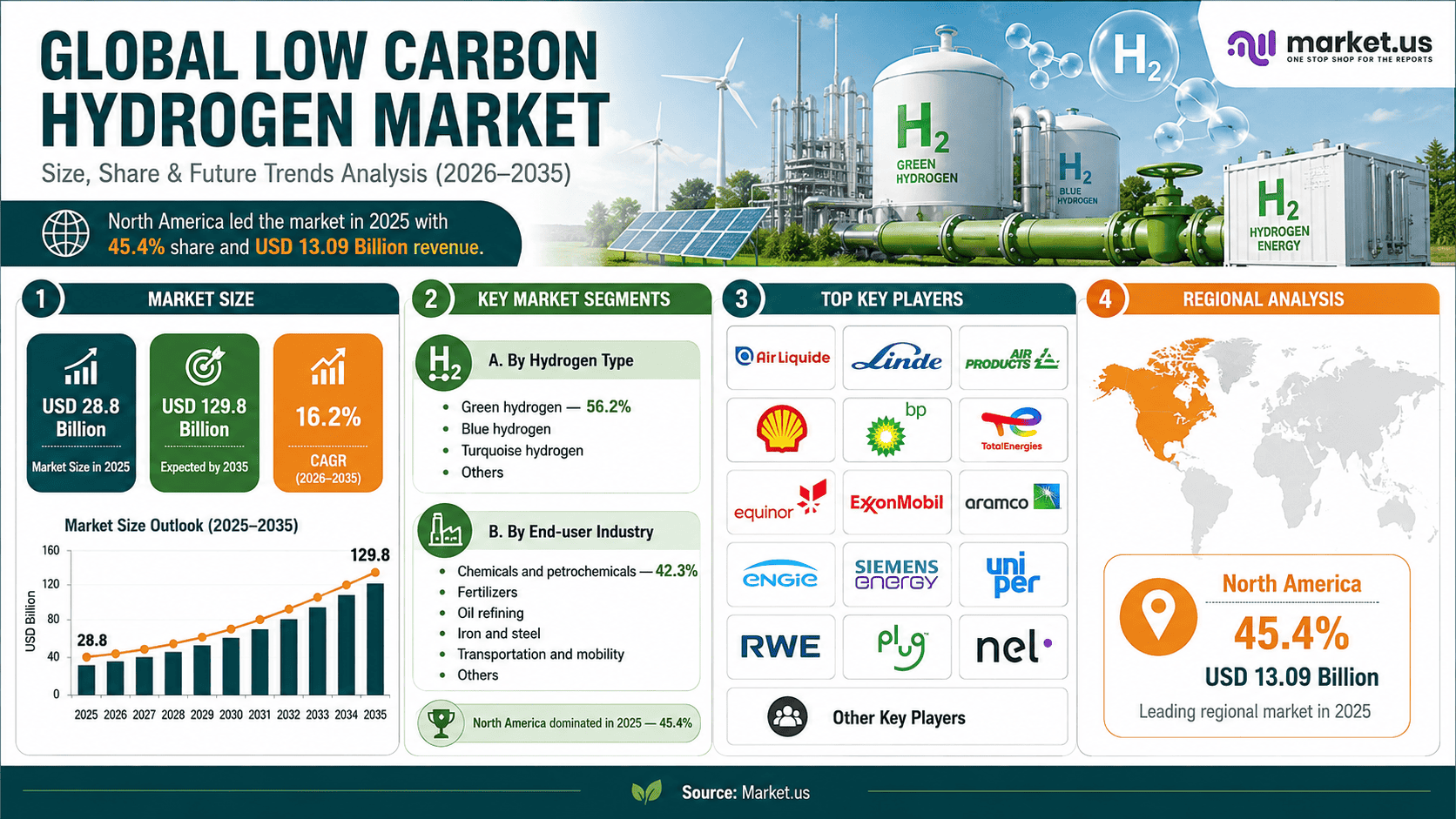
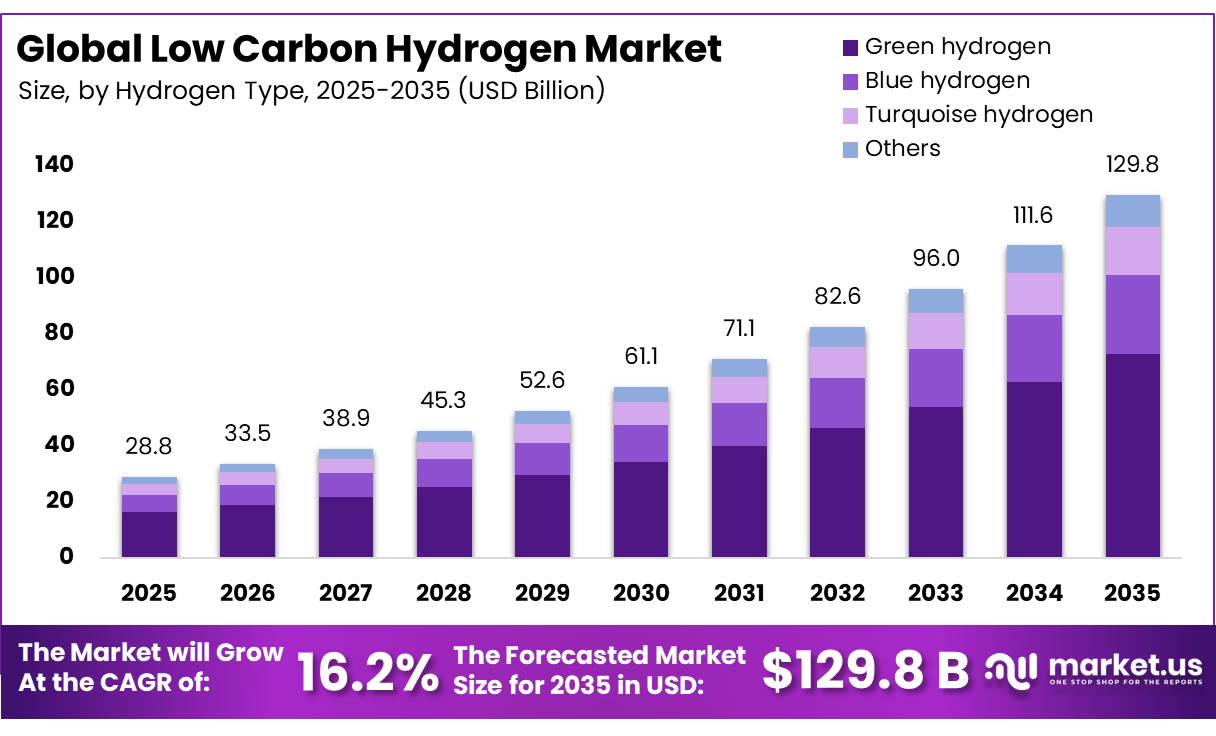
In 2025, the Global Low Carbon Hydrogen Market was valued at USD 28.8 billion and is projected to grow at a CAGR of 16.2% during 2026–2035, reaching approximately USD 129.8 billion by 2035. North America dominated the market in 2025, accounting for over 45.4% of the global share, with revenue of USD 13.09 billion.
Low-carbon hydrogen is becoming an important part of the global energy transition as industries seek to reduce emissions while ensuring reliable energy and feedstock supply. It includes hydrogen produced through renewable-powered electrolysis, natural gas with carbon capture and storage (CCS), and other low-emission production methods. Its use is expanding beyond refining and ammonia production into steel, chemicals, power generation, heavy transport, shipping, and aviation.
According to the International Energy Agency (IEA) – Global Hydrogen Review 2025, global hydrogen demand reached nearly 100 million tonnes in 2024, up 2% from the previous year, while low-emissions hydrogen production increased by 10% and is expected to reach around 1 million tonnes in 2025.
Government support and investments continue to accelerate market growth. In May 2026, the European Commission announced EUR 1.09 billion in funding for nine hydrogen projects across seven European countries, supporting 1.1 GW of electrolyzer capacity and the production of over 1.3 million tonnes of hydrogen during their first decade of operation. The IEA also reports that more than 200 low-emissions hydrogen projects have reached final investment decisions globally, with up to 10 million tonnes of production capacity expected by 2030 if planned projects proceed.
Key Takeaways
- The Global Low Carbon Hydrogen Market was valued at USD 28.8 billion in 2025.
- The market is projected to grow at a CAGR of 16.2% and is estimated to reach USD 129.8 billion by 2035.
- On the basis of hydrogen type, Green hydrogen dominated the market, constituting 56.2% of the total market share.
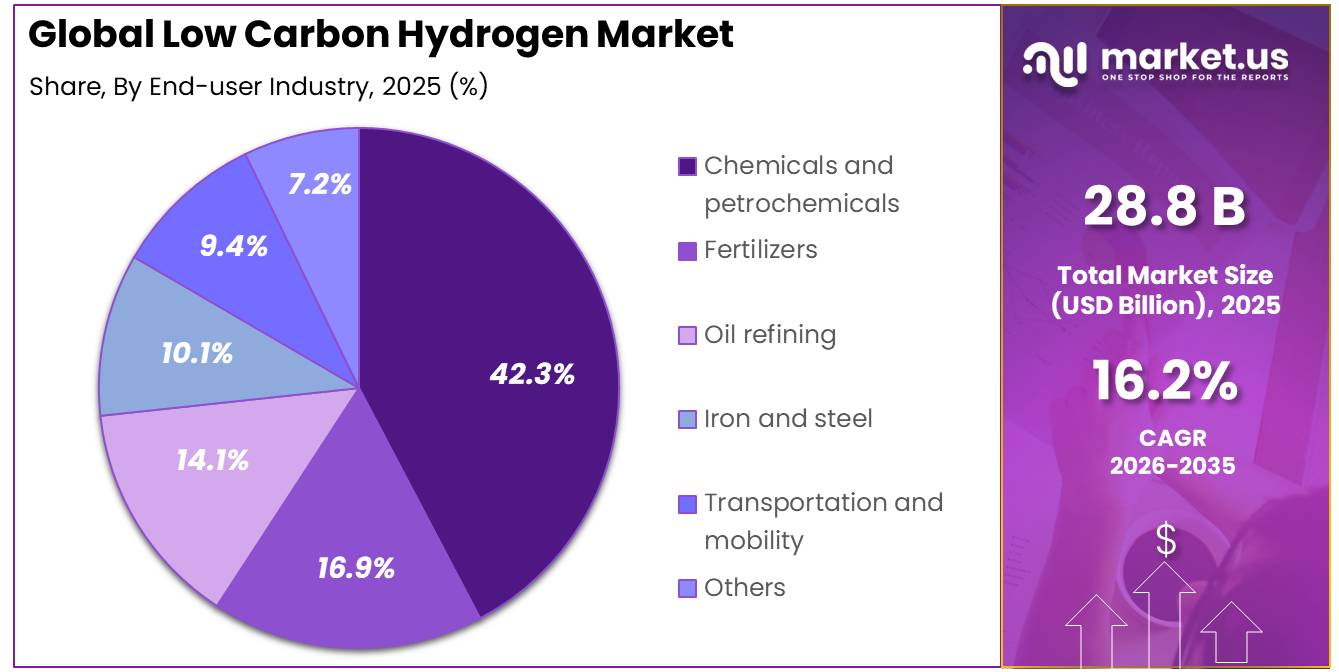
- Based on the end-user industry, Chemicals and petrochemicals dominated the market, with a substantial market share of around 42.3%.
- In 2025, North America was the most dominant region in the market, accounting for 45.4% of the total global consumption.
Market Segmentation Overview
Hydrogen Type Analysis
Green Hydrogen Dominates the Market with a 56.2% Share, Driven by Large-Scale Electrolyzer Investments
In 2025, green hydrogen accounted for the largest share of the market, representing over 56.2%. Its strong position was supported by increasing renewable power generation, stricter decarbonization policies, and growing demand from industries such as refining, chemicals, steel, and sustainable fuels. According to the European Commission, renewable hydrogen projects submitted under the European Hydrogen Bank represent around 6.3 GW of electrolyzer capacity and have the potential to produce more than 7.3 million tonnes of renewable hydrogen, reinforcing the commercial growth of green hydrogen production.
End-user Industry Analysis
Chemicals and Petrochemicals Lead with a 42.3% Share, Backed by High Hydrogen Consumption
In 2025, the chemicals and petrochemicals segment held the leading market position, accounting for more than 42.3% of the global market. The segment continues to dominate because hydrogen is a critical feedstock in the production of ammonia, methanol, refining products, and other industrial chemicals. According to the European Commission, the Hydrogen Mechanism had registered 47 renewable or low-carbon ammonia projects and 37 renewable or low-carbon methanol projects as of April 2026, reflecting the growing adoption of low-carbon hydrogen across the chemical industry.
Drivers
Government Support Accelerates Low Carbon Hydrogen Industrial Adoption
Government policy is becoming a major growth driver for the Low Carbon Hydrogen market because it reduces project risk and creates clearer demand from refineries, chemical plants and heavy industries. The International Energy Agency reported that global hydrogen demand exceeded 100 million tonnes in 2025, while demand for low-emissions hydrogen increased by 20% and reached close to 1 million tonnes. This shows that cleaner hydrogen is beginning to gain practical industrial use, although it still represents a small part of total supply.
Government support is also moving closer to actual projects. The IEA stated that cumulative announced public funding for low-emissions hydrogen reached USD 38 billion, while 112 demand-side policies advanced across major economies. Legislated measures could generate nearly 6 million tonnes per year of low-emissions hydrogen demand by 2030. These incentives, mandates and procurement programs are helping producers secure buyers, improve project economics and accelerate investment in cleaner hydrogen facilities.
Major Challenges
High Costs And Weak Demand Delay Hydrogen Projects
High costs and weak demand remain one of the biggest obstacles to expanding low-carbon hydrogen. The IEA reported that new final investment decisions fell below 0.8 Mtpa in 2025, while the global project pipeline shrank by 10 Mt to about 27 Mt expected by 2030. More than 100 GW of announced electrolysis capacity could also miss operation by 2030 unless investment decisions are taken before the end of 2027. High renewable electricity costs, expensive equipment, financing pressure and limited hydrogen infrastructure continue to weaken project economics.
Governments are increasing support, but implementation remains uneven. The IEA identified USD 41 billion in public hydrogen funding in recent policy updates, with nearly two-thirds linked to legislation already in force and about 25% disbursed to projects. Even with this support, fossil-based hydrogen remains cheaper in most regions. This cost gap makes buyers cautious about long-term contracts, delaying projects and slowing wider industrial adoption.
Business Opportunities
Industrial Demand Policies Open New Low Carbon Opportunities
Growing industrial demand creates a strong business opportunity for low carbon hydrogen producers, especially in refining, chemicals and other hard-to-abate industries. The IEA reported that low-emissions hydrogen demand increased by 20% in 2025 and reached close to 1 million tonnes. Based on committed projects, around 2.5 million tonnes of low-emissions hydrogen, equal to 60% of committed global production, is expected to be consumed by refineries and industrial facilities by 2030. This creates room for suppliers to build production close to large industrial users and secure long-term offtake contracts.
Government support is also improving the investment environment. The IEA identified USD 41 billion in public hydrogen funding in policy updates during 2026, with nearly two-thirds linked to legislation already in force and almost 25% already disbursed to projects. These measures can help reduce early project risk, strengthen demand visibility and support new hydrogen hubs, infrastructure and industrial partnerships across major markets.
Use Cases
Petroleum Refining and Industrial Hydrogen Replacement
Refineries are one of the most practical early markets for low carbon hydrogen because hydrogen is already widely used for removing sulphur and upgrading petroleum products. Global hydrogen demand increased by nearly 3% in 2025 and surpassed 100 million tonnes, with refining and industry remaining the largest users. Low-emissions hydrogen demand also increased by 20%, reaching close to 1 million tonnes.
Based on projects that have already reached final investment decision, around 2.5 million tonnes of low-emissions hydrogen could be produced and consumed annually by refineries and industrial facilities by 2030. This makes replacement of conventional fossil-based hydrogen an important near-term commercial opportunity.
Ammonia, Fertilizers and Chemical Manufacturing
Low carbon hydrogen can significantly reduce emissions from ammonia, fertilizer and methanol manufacturing because these industries consume hydrogen as a basic feedstock. According to the IEA, ammonia and methanol together account for roughly 50% of global hydrogen consumption. Demand is beginning to move toward cleaner production routes.
Procurement tenders for low-emissions hydrogen exceeded 1 million tonnes per year in 2025, while more than 0.3 million tonnes per year had already been contracted by the first quarter of 2026. Progress was mainly concentrated in refining and fertilizers, supported by regulations in Europe and other major markets. Low carbon hydrogen therefore offers chemical producers a pathway to manufacture lower-emission ammonia, urea, methanol and related products.
Low Emission Iron and Steel Production
Steel manufacturing represents an important emerging use case for low carbon hydrogen. Conventional blast furnace-basic oxygen furnace technology still represents around 70% of global steel production. Hydrogen-based direct reduced iron combined with electric arc furnaces is emerging as an alternative that can replace coal in the iron-reduction process and lower production emissions.
Policy support is also developing. In 2026, the European Commission proposed low-emissions steel requirements for public procurement and measures encouraging its use in cars and vans. Hydrogen-based steel can therefore create a sizeable industrial market for hydrogen producers, particularly where renewable electricity and iron ore are available at competitive costs.
Regional Analysis
North America Dominates the Low Carbon Hydrogen Market
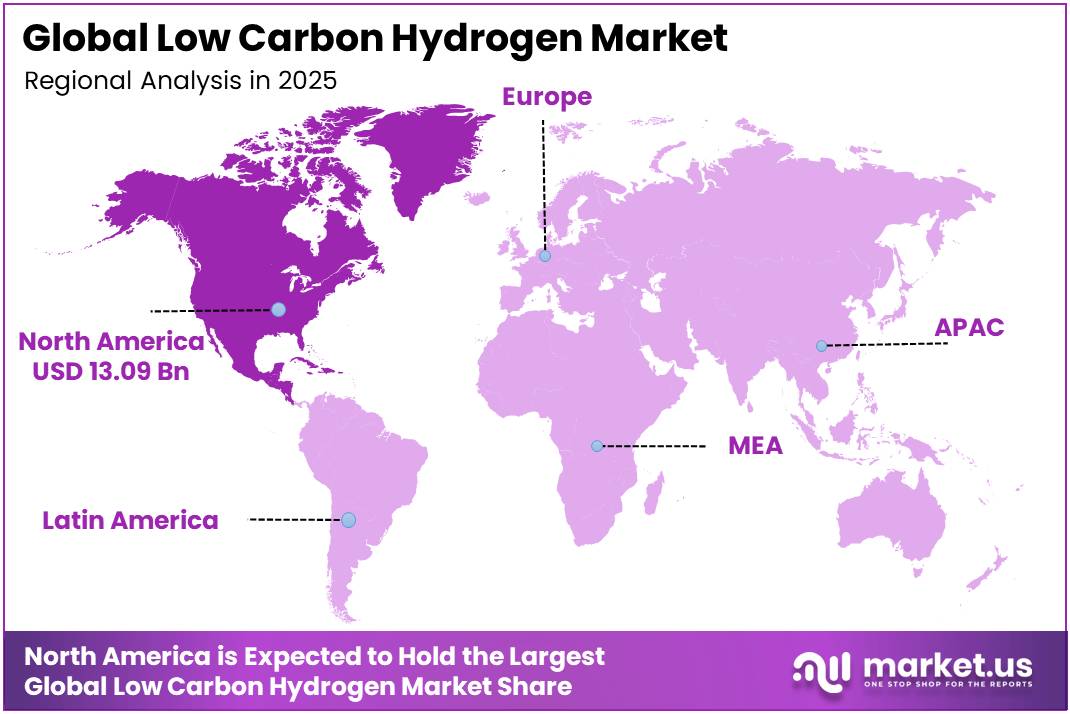
North America accounted for the largest share of the global Low Carbon Hydrogen Market in 2025, holding 45.4% of the market and generating approximately USD 13.09 billion in revenue. The region’s leadership is supported by strong demand from the refining and chemical industries, well-developed natural gas infrastructure, significant carbon storage capacity, abundant renewable energy resources, and advanced engineering capabilities.
Government incentives continue to strengthen market growth. In January 2025, the U.S. Department of Energy confirmed that eligible clean hydrogen projects can receive a production tax credit of up to USD 3.00 per kilogram. This policy is encouraging greater investment in hydrogen production through electrolysis and carbon capture-enabled reforming, while also supporting the expansion of hydrogen storage, transportation infrastructure, and industrial applications.
Recent Developments
- In January 2026, Air Liquide S.A. completed the EUR 2.85 billion acquisition of DIG Airgas, expanding its presence in South Korea. The acquisition is expected to generate around EUR 900 million in combined annual sales and adds nearly 20 secured projects across industrial gases, clean energy, and mobility.
- In August 2025, Linde plc introduced its advanced European liquid hydrogen trailer with a transport capacity of up to 3.9 tonnes. The trailer offers 50% higher payload than conventional 2.6-tonne units, improving delivery efficiency while lowering transportation frequency and operating costs.
Conclusion
The Low Carbon Hydrogen sector is moving from early demonstration toward wider industrial use, supported by stronger policy measures, rising investment and growing demand from refining, chemicals, fertilizers and clean fuels. According to the IEA, global hydrogen demand surpassed 100 million tonnes in 2025, while demand for low-emissions hydrogen increased by 20% to nearly 1 million tonnes. Installed electrolysis capacity also doubled to more than 4 GW, showing that production infrastructure is expanding.
From a market perspective, investment momentum provides a positive long-term signal. Capital spending on low-emissions hydrogen projects reached nearly USD 7 billion in 2025 and could approach USD 10 billion in 2026. Governments have also identified around USD 41 billion in new public funding for hydrogen-related policies. However, high production costs, uncertain demand, infrastructure gaps and slow project approvals remain key barriers. Overall, stronger offtake agreements, supportive regulations and declining technology costs are expected to gradually improve the commercial position of low carbon hydrogen.
Looking for data tailored to your specific market, region, or business need? Request a custom report or consultation — write to us at [email protected]




















