


Overview
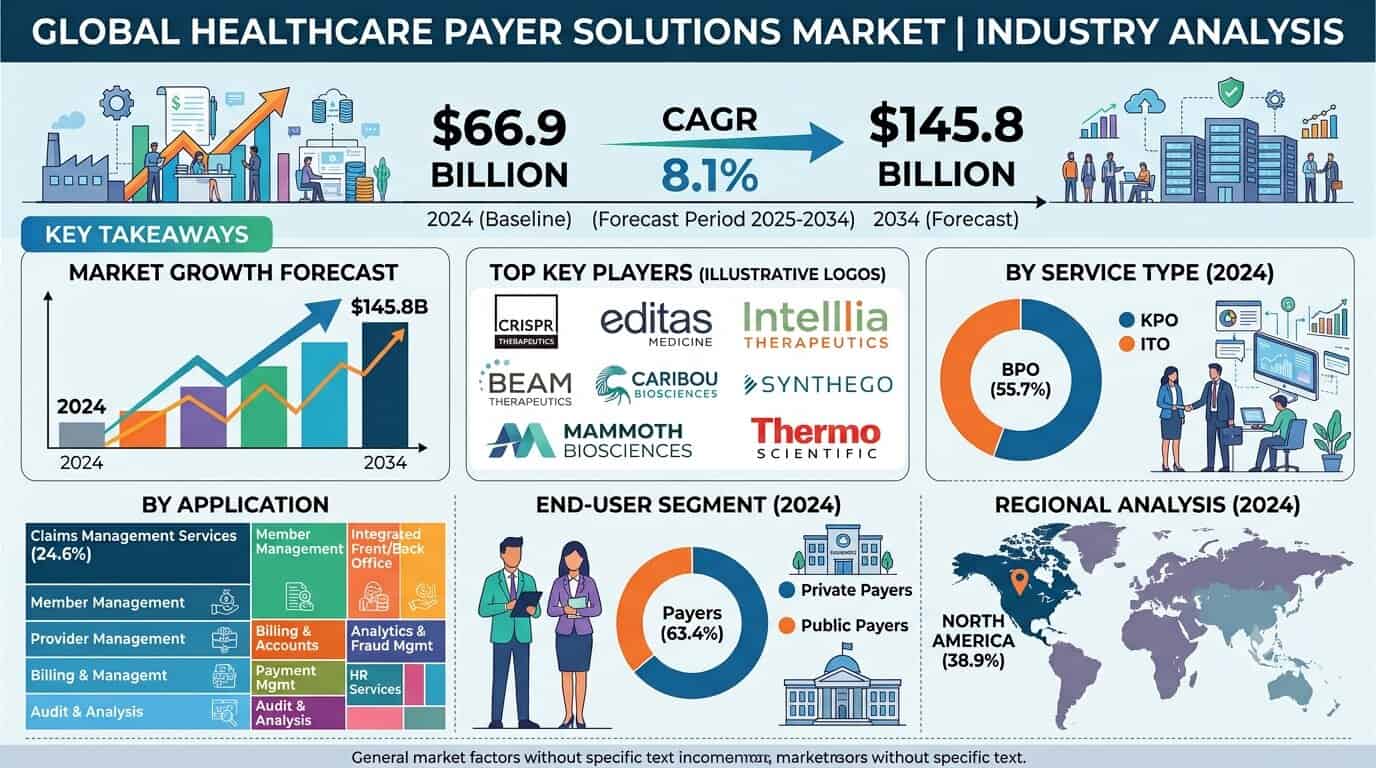
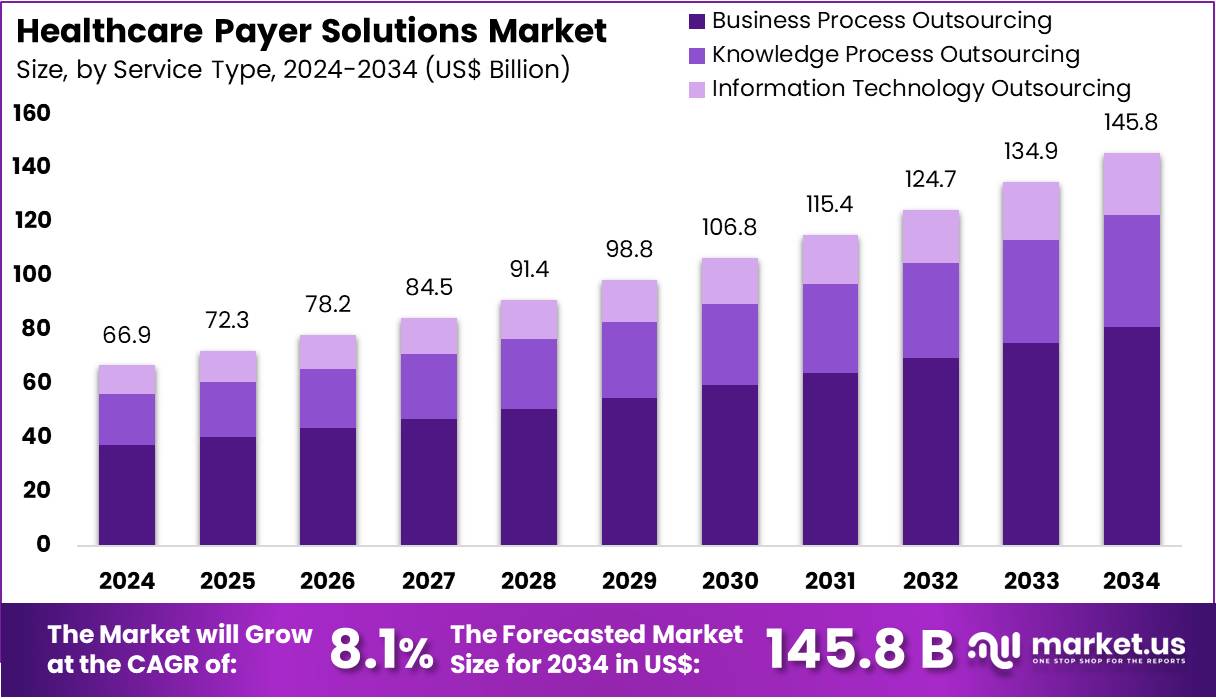
The Healthcare Payer Solutions Market size is expected to be worth around US$ 145.8 Billion by 2034 from US$ 66.9 Billion in 2024, growing at a CAGR of 8.1% during the forecast period 2025 to 2034.
The Healthcare Payer Solutions Market is gaining momentum as insurers and healthcare organizations increasingly adopt digital technologies to improve claims administration, member engagement, care coordination, payment processing, and data exchange. Healthcare payer solutions are being used to modernize traditionally complex administrative workflows while supporting greater transparency and more efficient interactions between payers, providers, and patients.
A major factor shaping the market is the growing emphasis on healthcare interoperability. The Centers for Medicare & Medicaid Services (CMS) has established requirements for impacted payers to implement technologies that enable electronic exchange of health information, including Patient Access, Provider Access, Payer-to-Payer, and Prior Authorization APIs. Many of these requirements have compliance dates beginning in 2026 and 2027, creating additional demand for payer technology platforms and integration capabilities.
Healthcare coverage participation also demonstrates the scale of payer operations. CMS reported that 22.8 million consumers had selected or been automatically re-enrolled in individual-market Marketplace coverage for 2026 as of January 12, 2026. In addition, CMS finalized new standards in March 2026 for electronic healthcare claims attachments and electronic signatures. The agency estimates these measures could save the healthcare industry approximately US$ 781 million annually, highlighting the financial benefits of administrative automation and standardized digital transactions.
Key Takeaways
- In 2024, the healthcare payer solutions market generated US$ 66.9 billion in revenue and is projected to reach US$ 145.8 billion by 2033, expanding at a CAGR of 8.1% during the forecast period.
- By service type, the market is segmented into business process outsourcing, knowledge process outsourcing, and information technology outsourcing. Business process outsourcing dominated in 2024, accounting for a 55.7% market share.
- Based on application, the market includes claims management, member management, integrated front office and back office operations, provider management, billing and accounts management, analytics and fraud management, payment management, HR services, and audit and analysis systems. Claims management services held a leading 24.6% share.
- By end user, the healthcare payer solutions market is categorized into private payers and public payers. Private payers maintained their dominance in 2024, capturing the largest revenue share of 63.4%.
- Regionally, North America emerged as the leading market in 2024, supported by strong healthcare technology adoption and payer digitalization. The region accounted for a 38.9% share of the global healthcare payer solutions market.
Statistical Information
- 92.0% of the U.S. population, or 310 million people, had health insurance for some or all of 2024, according to the U.S. Census Bureau. Private coverage reached 66.1%, while public coverage accounted for 35.5%, highlighting the enormous administrative base served by payer technologies.
- CMS reported 22.8 million consumers selected or were automatically re-enrolled in Marketplace coverage for 2026, including 2.8 million new Marketplace consumers. This creates substantial demand for digital enrollment, eligibility, member-management, and customer-service capabilities.
- CMS projected 34 million Medicare Advantage enrollees in 2026, representing approximately 48% of all Medicare beneficiaries. The scale of MA enrollment creates opportunities for payer platforms supporting claims, member engagement, provider management, and payment operations.
- The 2024 CAQH Index identified a US$ 20 billion opportunity to simplify healthcare administration by shifting manual processes to automated workflows. The organization estimated that automation could eliminate approximately 22% of the tracked administrative costs in the transactions it studied.
- The CAQH analysis estimates that administrative healthcare activities cost the U.S. system approximately US$ 440 billion annually, covering activities such as eligibility verification, treatment authorization, claims submission, and payment processing. This supports demand for automation and payer workflow technologies.
- More than 9,200 organizations had signed up to participate in the U.S. TEFCA Exchange by August 2025. These organizations represented more than 41,000 unique connections involving clinicians, hospitals, clinics, post-acute facilities, long-term care organizations, and public-health authorities.
- A 2026 American Medical Association survey of 1,000 physicians found that only 33% believed insurers’ latest prior-authorization reform commitments would make a meaningful difference. The result indicates continuing dissatisfaction with payer administrative processes and potential demand for solutions that reduce authorization friction.
- CMS publishes monthly Medicaid and CHIP eligibility-operation dabta covering eligibility processing and enrollment performance at national and state levels. These operational datasets reinforce the importance of automation and digital systems for eligibility, enrollment, and member administration.
Market Segmentation Analysis
Service Type Analysis
The business process outsourcing segment accounted for a 55.7% market share, making it the leading service type in the healthcare payer solutions market. Its dominance is driven by the growing need among healthcare payers to control operational costs while maintaining efficient administrative processes.
Outsourcing routine activities such as claims processing, customer support, data management, and documentation enables payers to focus on core healthcare functions. Increasing regulatory requirements and complex administrative workflows are also encouraging organizations to seek specialized external expertise.
Furthermore, advancements in automation, artificial intelligence, and digital platforms are improving the speed and accuracy of outsourced services. As payers prioritize scalability, flexibility, and operational efficiency, demand for business process outsourcing solutions continues to strengthen.
Application Analysis
The claims management services segment held a 24.6% market share, representing the leading application within the healthcare payer solutions market. Growth is supported by the increasing volume and complexity of healthcare claims and the need for faster, more accurate processing. Healthcare payers are adopting advanced claims management solutions to streamline adjudication, identify errors, reduce administrative workloads, and strengthen fraud detection.
Integration with analytics and automated technologies further improves decision-making and financial oversight. In addition, evolving regulatory requirements and growing expectations for timely reimbursements are encouraging payers to modernize claims workflows. The increasing adoption of value-based healthcare models also emphasizes accurate claims processing and transparent payment practices, supporting continued investment in claims management services.
End-user Analysis
The private payers segment captured a 63.4% revenue share, establishing it as the dominant end-user segment in the healthcare payer solutions market. Private insurance providers are increasingly adopting digital solutions to manage growing healthcare costs, expanding membership bases, and increasingly complex administrative requirements. Advanced payer platforms help improve claims processing, member engagement, provider network management, billing, and operational decision-making.
Competitive pressures are also encouraging private insurers to invest in automation, analytics, and scalable technology solutions to enhance service quality and customer experience. Furthermore, changing healthcare regulations are driving demand for flexible systems that can support compliance and efficient data management. These factors are strengthening technology adoption among private payers and supporting their leading position in the market.
Regional Analysis
North America led the Healthcare Payer Solutions Market with a 38.9% revenue share, supported by high healthcare spending, mature insurance infrastructure, and continued investment in digital payer technologies.
In the United States, CMS reported that 53.4% of people with Traditional Medicare were in accountable care relationships as of January 2025, representing more than 14.8 million beneficiaries. CMS is targeting accountable care relationships for all Traditional Medicare beneficiaries by 2030, increasing the need for analytics, payment management, claims administration, and care-coordination technologies.
Asia Pacific is expected to register the fastest growth during the forecast period as governments strengthen healthcare coverage and digital infrastructure. WHO highlights digital transformation as increasingly important for advancing universal health coverage across the region.
In 2026, WHO South-East Asia reported growing adoption of digital technologies across health service delivery, telemedicine, data-driven governance, and digital public infrastructure. These developments are creating opportunities for payer solutions that improve administrative efficiency, information exchange, claims processing, and healthcare financing.
Business Opportunities
The Healthcare Payer Solutions Market presents significant business opportunities as insurers accelerate digital transformation, interoperability, and administrative automation. CMS requires impacted payers to implement FHIR-based interoperability APIs, with major API requirements generally beginning January 1, 2027, creating opportunities for vendors offering API development, integration, testing, and compliance services.
Electronic prior authorization is another high-potential area. CMS requires impacted payers to support electronic prior authorization workflows, while decisions are generally required within 72 hours for expedited requests and seven calendar days for standard requests. This creates opportunities for AI-assisted authorization, workflow automation, clinical-documentation management, and decision-support platforms.
Payer-to-payer and provider data exchange also create demand for secure interoperability platforms, analytics, and data-management solutions. ONC’s TEFCA framework supports nationwide electronic health-information exchange involving payers, providers, patients, and public-health organizations, strengthening opportunities for connected healthcare platforms.
Additionally, growing administrative complexity creates opportunities in claims automation, fraud detection, payment management, member engagement, cloud infrastructure, and analytics, particularly for solutions that can integrate with existing payer systems while improving efficiency and regulatory compliance.
Emerging Trends
- Outcomes-Based Payer Models: Healthcare payers are moving toward payment models that reward measurable health outcomes rather than service volume. In February 2026, CMS said payers representing 165 million Americans joined the ACCESS Payer Pledge. This signals stronger demand for platforms that measure outcomes, coordinate care, and connect payment with results.
- Risk Adjustment Modernization: Risk adjustment is becoming more data-driven as payers need payment models that better reflect members’ health needs. CMS finalized further risk-adjustment changes for 2026, including adding HIV PrEP as a separate factor. This trend increases demand for accurate coding, predictive analytics, clinical data processing, and payment-integrity solutions.
- Digital Provider Directory Infrastructure: Payers are increasingly focusing on reliable provider information as healthcare networks become more complex. CMS announced plans in 2025 to build a dynamic, interoperable national provider directory. This creates opportunities for solutions that continuously validate provider information, improve network accuracy, support search tools, and reduce administrative errors.
- Smarter Medicare Advantage Payment Management: Medicare Advantage payment management is becoming more sophisticated as CMS strengthens payment accuracy and program accountability. For 2027, CMS projected a 2.48% net average increase, representing additional payments to plans. This encourages investment in payment analytics, risk management, coding oversight, and financial forecasting.
- Technology-Supported Chronic Care: Payers are increasingly supporting technology-enabled approaches for chronic-condition management rather than relying only on traditional care delivery. CMS’s ACCESS Model begins its 10-year performance period in July 2026, encouraging technology-supported care tied to measurable outcomes. This supports demand for remote monitoring, care coordination, patient-engagement, and outcomes-tracking solutions.
Use Cases
- Predictive Risk Scoring: Payers can use predictive analytics to identify members who may require higher levels of care or generate greater future healthcare costs. CMS describes risk scores as estimates of predicted patient costs relative to the average Medicare patient. This supports use cases involving population segmentation, care planning, and resource allocation.
- Provider Network Intelligence: Healthcare payer platforms can combine provider information with analytics to identify inaccurate, outdated, or incomplete network records. CMS’s planned national provider-directory infrastructure creates a strong use case for automated provider verification, directory synchronization, network adequacy monitoring, and better provider search capabilities for healthcare organizations and members.
- Payment Forecasting and Financial Planning: Advanced payer analytics can help insurers model how regulatory changes, member risk, healthcare utilization, and payment policies could affect future revenue. CMS’s 2027 Medicare Advantage policy estimates more than US$ 13 billion in additional plan payments, illustrating the scale of financial changes that payer forecasting platforms need to accommodate.
- Chronic-Care Outcome Tracking: Payers can deploy digital platforms to monitor whether technology-supported chronic-care interventions actually improve patient outcomes. Under the ACCESS approach, participating payers are expected to align payment arrangements with measurable improvements in health outcomes. This creates practical applications for patient monitoring, care-gap identification, outcome dashboards, and provider performance analytics.
- Program Integrity and Coding Analytics: Payers can use advanced analytics to identify unusual coding patterns, inaccurate risk information, and potential payment issues. CMS is working toward a Medicare Advantage risk-adjustment system emphasizing simplicity, competition, accurate payment, program integrity, and accountability. These priorities create opportunities for automated coding review, anomaly detection, audit support, and payment-integrity platforms.
Recent Developments
- In May 2026, CVS Health reported that Aetna’s Claims Assist Manager reduced claims-processing time by more than 20% through AI-enabled automation. The solution uses predictive analytics and intelligent workflows to modernize claims operations, forming part of CVS Health’s US$ 20 billion multi-year digital investment.
- In February 2026, Humana expanded its collaboration with Google Cloud through Agent Assist, an AI tool designed to help member-service representatives deliver faster and more personalized support. Humana began using Agent Assist with member advocates in October 2025, with a broader rollout planned across service centers in 2026.
- In October 2025, Waystar completed its acquisition of Iodine Software for US$ 1.25 billion, combining Waystar’s healthcare-payment technology with Iodine’s AI-powered clinical intelligence. The transaction expanded Waystar’s total addressable market by more than 15% and strengthened its AI capabilities.
- In September 2025, HealthEdge and UST HealthProof completed their merger under Bain Capital, creating an integrated healthcare payer technology and services company. The combined organization provides capabilities spanning claims, payments, care and utilization management, payment integrity, and member engagement, serving more than 115 health plans.
- In September 2025, Evernorth Health Services announced a US$ 3.5 billion investment in Shields Health Solutions following Shields’ establishment as a standalone company. The investment strengthens Evernorth’s specialty-pharmacy capabilities and expands its healthcare-services platform around complex medication management.
- In August 2025, CVS Health committed to a US$ 20 billion technology investment over the next decade and joined the CMS Health Technology Ecosystem initiative with more than 60 healthcare and technology organizations. The investment is aimed at developing a more connected digital healthcare environment.
- In July 2025, Aetna launched Aetna Care Paths and additional AI-enabled digital tools as part of CVS Health’s US $20 billion multi-year digital investment. The tools are designed to simplify healthcare navigation and support members and providers across different stages of care.
- In July 2025, Humana and Epic announced a new MyChart integration, making Humana health-plan information directly accessible within patients’ existing MyChart accounts. Humana described the initiative as the first integration of its kind by a health insurer, connecting coverage and clinical information in one location.
- In March 2025, Cotiviti completed its acquisition of Edifecs, adding healthcare interoperability capabilities to its data-driven healthcare solutions portfolio. The combined business is designed to improve payer-provider connectivity, increase collaboration in care delivery, and accelerate deployment of healthcare technology solutions.
Conclusion
The Healthcare Payer Solutions Market is evolving rapidly as insurers prioritize digital transformation, automation, interoperability, and data-driven decision-making. Growing healthcare coverage, administrative complexity, and regulatory requirements are encouraging payers to modernize claims, member management, payment, provider, and analytics operations. North America remains a key market, while Asia Pacific offers strong growth opportunities through healthcare digitalization and expanding coverage.
Emerging technologies such as artificial intelligence, predictive analytics, automated workflows, and interoperable platforms are creating new opportunities for solution providers. Strategic investments, acquisitions, partnerships, and technology launches by leading companies further demonstrate the sector’s shift toward connected, efficient, scalable, and patient-focused payer operations.




















