


Overview
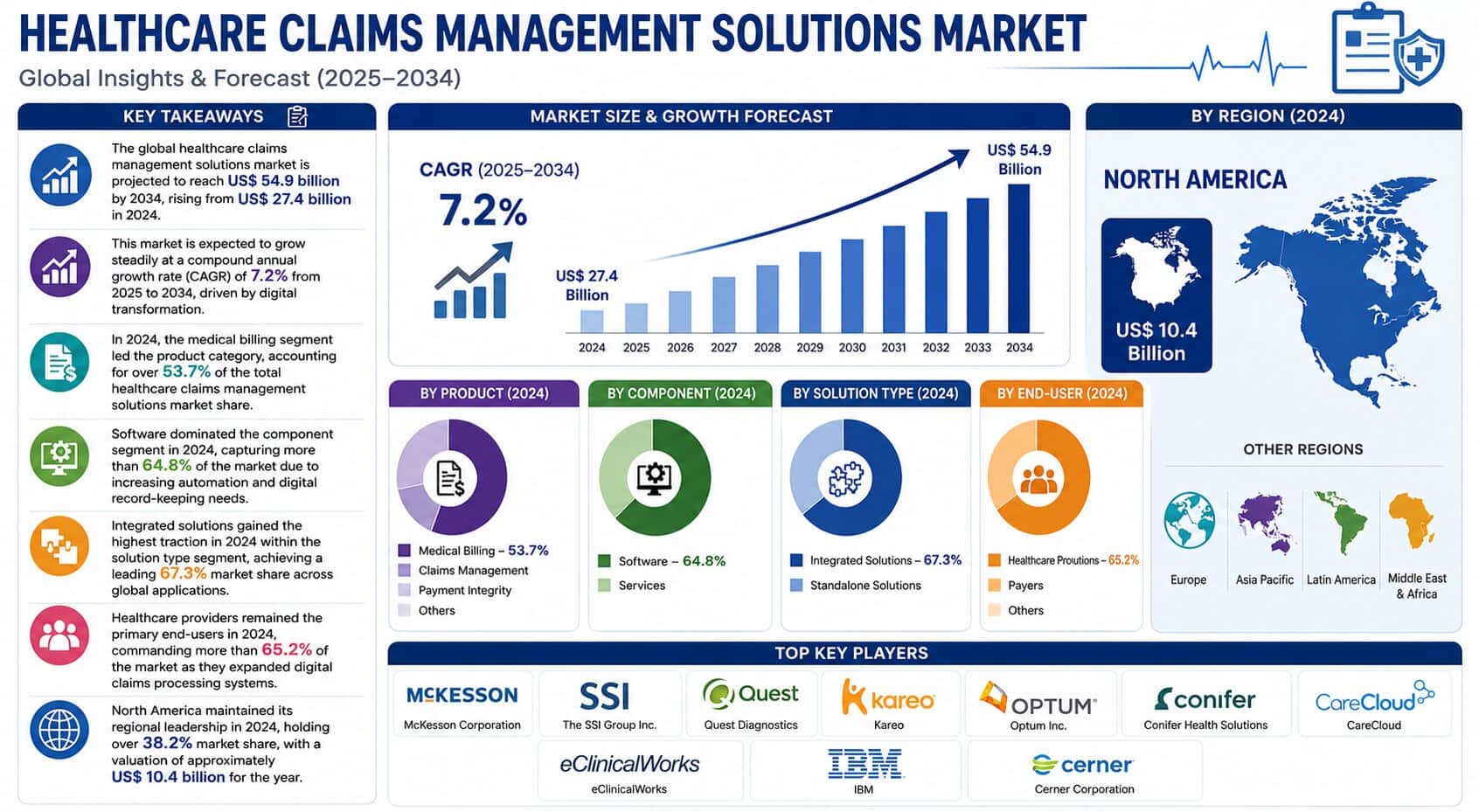
The Global Healthcare Claims Management Solutions Market Size is expected to be worth around US$ 54.9 Billion by 2034, from US$ 27.4 Billion in 2024, growing at a CAGR of 7.2% during the forecast period from 2025 to 2034. North America held a dominant market position, capturing more than a 38.2% share and holds US$ 10.4 Billion market value for the year.
The healthcare claims management landscape is undergoing transformation as providers, payers, and clearinghouses prioritize automated workflows, standardized data exchange, and stronger payment integrity controls. Regulatory initiatives and administrative inefficiencies are encouraging organizations to replace manual claims processes with digital platforms that improve accuracy, accelerate adjudication, and support efficient revenue-cycle operations.
The Centers for Medicare & Medicaid Services (CMS) finalized a major administrative simplification rule in March 2026 establishing national standards for electronic health care claims attachments and electronic signatures. The rule supports secure electronic exchange of medical records, imaging, clinical notes, telemedicine documentation, and laboratory results used to support claims. CMS estimates these changes could save the healthcare industry roughly US$ 781 million annually while reducing administrative workload and speeding claims-related decision-making.
Payment accuracy is another factor driving demand for claims management capabilities. CMS reported that Medicare Fee-for-Service had an estimated improper payment rate of 6.55% in fiscal year 2025, representing approximately US$ 28.83 billion. The agency also reported that Medicaid had an estimated improper payment rate of 6.12%, with insufficient documentation accounting for 77.17% of Medicaid improper payments. These figures highlight the importance of accurate documentation, coding, eligibility verification, claim validation, and automated error detection.

Key Takeaways
- The global healthcare claims management solutions market is anticipated to reach US$ 54.9 billion by 2034, increasing from US$ 27.4 billion in 2024.
- The market is projected to expand at a steady 7.2% CAGR between 2025 and 2034, supported by accelerating digital transformation across healthcare administration.
- Within the product category, medical billing emerged as the leading segment in 2024, representing more than 53.7% of the overall healthcare claims management solutions market.
- Software accounted for the largest share of the component segment in 2024, exceeding 64.8%, driven by growing automation and the adoption of digital record-keeping systems.
- Integrated solutions recorded the strongest position within the solution type segment in 2024, capturing a leading 67.3% share across global applications.
- Healthcare providers represented the largest end-user segment in 2024, accounting for more than 65.2% of the market as organizations increasingly adopted digital claims processing technologies.
- North America retained its leading regional position in 2024, securing more than 38.2% of the global market and generating approximately US$ 10.4 billion in market value.
Statistical Information
- 98% of medical claims were submitted electronically, indicating that electronic claims processing is approaching full adoption and creating opportunities for more advanced automation, validation, and payment workflows.
- 76% of hospitals engaged in all four measured interoperability activities electronically finding, sending, receiving, and integrating health information supporting greater connectivity between clinical and administrative systems.
- Physicians complete an average of 40 prior authorization requests per week, demonstrating the substantial administrative workload that automated claims and authorization solutions can address.
- 32% of physicians reported that prior authorization requests are often or always denied, highlighting demand for automated eligibility checks, documentation validation, denial prevention, and appeals management.
- 74% of physicians said prior authorization denials have increased over the past five years, reinforcing the need for technologies that identify potential issues before claims or authorization requests are submitted.
- Prior authorization consumes an average of 13 hours of physician and staff time each week, creating a clear opportunity for workflow automation and intelligent administrative tools.
- 40% of physicians employ staff dedicated exclusively to prior authorization tasks, showing how much organizational capacity is being allocated to repetitive administrative processes.
- 95% of physicians said prior authorization delays access to necessary care, demonstrating that administrative inefficiencies can directly affect patient access and creating demand for faster digital workflows.
- 79% of physicians reported that patients abandon treatment because of authorization challenges, connecting administrative friction with patient behavior and highlighting the importance of streamlined authorization and claims processes.
- CMS finalized national standards for electronic claims attachments and electronic signatures, enabling secure digital exchange of medical records, imaging, clinical notes, telemedicine documentation, and laboratory results used to support claims.
Market Segmentation Analysis
Product Analysis
In 2024, the Medical Billing segment dominated the product category of the Healthcare Claims Management Solutions Market, accounting for more than 53.7% of the market. Its leadership was supported by the rising need for accurate billing, coding, and reimbursement management. Healthcare providers increasingly adopted digital billing systems to reduce claim errors, minimize denials, and accelerate payment cycles.
Integration with electronic health records (EHRs) further improved data accuracy and streamlined claims workflows. The Professional Claims segment also maintained significant demand as outpatient care and physician-led services expanded. Meanwhile, Institutional Claims solutions gained traction among hospitals and nursing facilities by automating high-volume claim submissions, verification, and adjudication processes.
Component Analysis
In 2024, Software held the leading position in the component segment of the Healthcare Claims Management Solutions Market, capturing more than 64.8% of the market. Growth was driven by increasing demand for automated platforms that improve claims accuracy, reduce manual workloads, and support regulatory compliance. Healthcare organizations increasingly integrated claims software with electronic health records and revenue cycle management systems to streamline administrative processes.
The Services segment also experienced steady adoption as hospitals and clinics outsourced activities such as claim submission, denial management, and insurance follow-ups. Cloud-based software further strengthened market demand by providing scalable access, centralized data management, analytics capabilities, and easier integration across multiple healthcare facilities.
Solution Type Analysis
In 2024, Integrated Solutions dominated the solution type segment of the Healthcare Claims Management Solutions Market, securing more than 67.3% of the market. Their strong position was driven by increasing demand for centralized platforms capable of managing billing, coding, claims processing, and reimbursement activities within a unified environment. Integrated systems help healthcare organizations reduce administrative errors, improve workflow visibility, and accelerate reimbursement cycles.
Standalone Solutions maintained demand among smaller clinics and specialty centers requiring focused claims management capabilities without extensive system integration. However, the market is increasingly shifting toward comprehensive platforms as healthcare organizations seek end-to-end revenue cycle management, real-time claims tracking, automated workflows, and improved financial performance.
End-use Analysis
In 2024, Healthcare Providers dominated the end-use segment of the Healthcare Claims Management Solutions Market, accounting for more than 65.2% of the market. Hospitals, clinics, and diagnostic centers increasingly adopted digital claims management platforms to handle large claim volumes, reduce administrative workloads, and improve reimbursement efficiency. Integration between claims systems and electronic health records helped enhance coding accuracy and accelerate claim submissions. Automated workflows also supported denial reduction and regulatory compliance.
Meanwhile, Healthcare Payers continued adopting advanced claims technologies to improve processing accuracy, fraud detection, and policy compliance. Growing investments in analytics, automation, and AI-enabled adjudication are expected to strengthen payer adoption as insurers manage increasingly complex claims environments.
Regional Analysis
In 2024, North America remained the leading region in the Healthcare Claims Management Solutions Market, accounting for more than 38.2% of the market and reaching approximately US$ 10.4 billion in value. Healthcare providers and insurers across the region are increasingly adopting automated claims platforms to simplify billing, coding, eligibility verification, claims submission, and payment processes.
The United States remains a major contributor to regional adoption, supported by healthcare regulations that emphasize secure data exchange, standardized electronic transactions, and patient information protection. Government initiatives have encouraged healthcare organizations to move away from paper-based administrative processes and adopt interoperable digital systems.
The growing integration of electronic health records with claims management platforms is further improving data accuracy and workflow efficiency. Healthcare organizations are also utilizing artificial intelligence, analytics, and automation to identify potential errors, manage denials, detect suspicious claims, and improve reimbursement processes. Cloud-based platforms and real-time claims tracking are additionally supporting flexible, connected workflows across providers and payers, strengthening North America’s continued adoption of advanced claims management technologies.
Business Opportunities
The Healthcare Claims Management Solutions Market presents significant business opportunities as healthcare organizations seek to modernize administrative workflows and improve coordination between providers, payers, and clearinghouses. The growing shift from manual documentation toward standardized electronic claims creates opportunities for vendors offering automated claims submission, eligibility verification, denial management, payment reconciliation, and electronic claims attachments.
CMS has established standards supporting secure electronic exchange of clinical documentation, creating demand for platforms capable of integrating administrative and clinical information. Artificial intelligence and advanced analytics also offer opportunities for companies developing solutions for automated claim validation, fraud detection, coding assistance, denial prediction, and payment integrity. Cloud-based platforms can serve healthcare networks seeking scalable and centralized claims operations, while interoperability solutions can connect claims systems with EHRs and other healthcare applications.
There is also growing potential for specialized services that help providers and payers implement regulatory requirements, migrate legacy workflows, and maintain compliance. As healthcare administrative processes become increasingly digital, vendors that combine automation, interoperability, security, and analytics can strengthen their competitive position in the market.
Emerging Trends
- Electronic Prior Authorization Integration: Claims platforms are increasingly connecting prior authorization directly with EHRs and payer systems. CMS is promoting FHIR-based workflows that allow providers to submit requests, receive decisions, and exchange required documentation electronically, reducing manual communication between stakeholders.
- FHIR-Based Claims Exchange: Healthcare organizations are moving toward standardized FHIR interfaces for sharing claims and encounter information. CMS is expanding API-based access between providers and payers, making claims information easier to exchange, reconcile, and use within connected healthcare workflows.
- AI With Human Oversight: AI is increasingly being explored for claims review, authorization, and administrative decision support. However, physician concerns about automated denials are pushing vendors toward explainable AI, stronger human review, and transparent decision-making rather than fully automated claim decisions.
- API-Connected Administrative Systems: Healthcare organizations are increasingly connecting third-party technologies with EHR environments for administrative workflows. ONC reported that about 9 in 10 hospitals enabled patient access through APIs in 2024, creating a stronger technical foundation for connected claims and revenue-cycle applications.
- Faster Claims Data Availability: Timely claims data is becoming more important for care coordination and value-based healthcare. CMS’s BCDA platform provides claims information within days rather than weeks, enabling organizations to identify care gaps, monitor utilization, and intervene earlier.
Use Cases
- Automated Claim Validation: Healthcare providers can use intelligent software to check patient information, coding, eligibility, documentation, and payer requirements before submitting claims. This helps identify potential errors earlier and reduces unnecessary manual review during the billing process.
- Denial Prevention: Claims platforms can analyze previous payer responses and identify common reasons for rejected or denied claims. Providers can use these insights to correct documentation, coding, authorization, or eligibility issues before submitting future claims.
- Real-Time Authorization Tracking: Integrated platforms can track authorization requests from submission through payer response. CMS’s emerging electronic prior authorization framework supports digital request-and-response workflows, giving providers better visibility into outstanding requests and reducing reliance on phone-based follow-ups.
- Claims-Based Care Coordination: Payers and healthcare organizations can use claims information alongside clinical records to identify gaps in care and support earlier interventions. CMS’s updated claims-sharing infrastructure specifically supports more timely information for coordinated, value-based care.
- Automated Documentation Management: Claims solutions can connect supporting clinical documentation with administrative transactions, helping providers supply required records during claims and authorization workflows. This creates opportunities for automated document retrieval, matching, validation, and electronic submission.
Recent Developments
- In June 2026, CareCloud acquired Empower Healthcare & Compliance Partners, adding a compliance-focused business to its AI-powered healthcare technology platform. The acquisition expands CareCloud’s capabilities in healthcare compliance and complements its existing revenue-cycle management, automation, and AI offerings.
- In June 2026, Oracle Health collaborated with Theator to introduce AI-powered surgical intelligence capabilities aimed at improving documentation accuracy and revenue-cycle management for surgical procedures. The collaboration connects clinical documentation with financial workflows, supporting more accurate capture of services and billing information.
- In March 2026, Conifer Health Solutions signed a multi-year, multi-facility partnership with Healthcare Systems of America, covering hospitals across Florida, Louisiana, and Texas. Conifer will provide end-to-end revenue-cycle services using ConiferCore, including analytics, intelligent workflow automation, real-time dashboards, denial reduction, and collections optimization.
- In February 2026, The SSI Group introduced an AI-focused approach to revenue-cycle management, highlighting AI-powered payment prediction as an entry point for healthcare organizations adopting intelligent RCM. The technology is designed to help revenue-cycle teams make more informed financial decisions and progressively expand automation.
- In October 2025, Optum introduced Optum Real, a platform designed to digitize payer eligibility, claims, payment data, contracts, benefits, and guidelines. The solution aims to make this information real-time, accessible, and actionable, supporting faster and more connected healthcare payment workflows.
- In August 2025, Quest Diagnostics completed its acquisition of selected clinical-testing assets from Fresenius Medical Care’s Spectra Laboratories, expanding Quest’s dialysis-related testing services in the United States. The transaction strengthens Quest’s relationships with independent dialysis providers and expands its connected healthcare-services infrastructure.
Conclusion
The Healthcare Claims Management Solutions Market is evolving as healthcare providers and payers prioritize automation, interoperability, payment accuracy, and streamlined revenue-cycle operations. Growing adoption of electronic transactions, AI-enabled workflows, integrated platforms, and digital documentation is creating new opportunities for technology providers. Regulatory initiatives are further encouraging standardized data exchange and reducing administrative complexity across claims processes.
North America remains a key regional market, supported by advanced healthcare infrastructure and strong digital adoption. Going forward, solutions combining claims automation, denial prevention, analytics, secure data exchange, and real-time processing are expected to gain greater importance as healthcare organizations seek improved operational efficiency and financial performance.




















