


Introduction
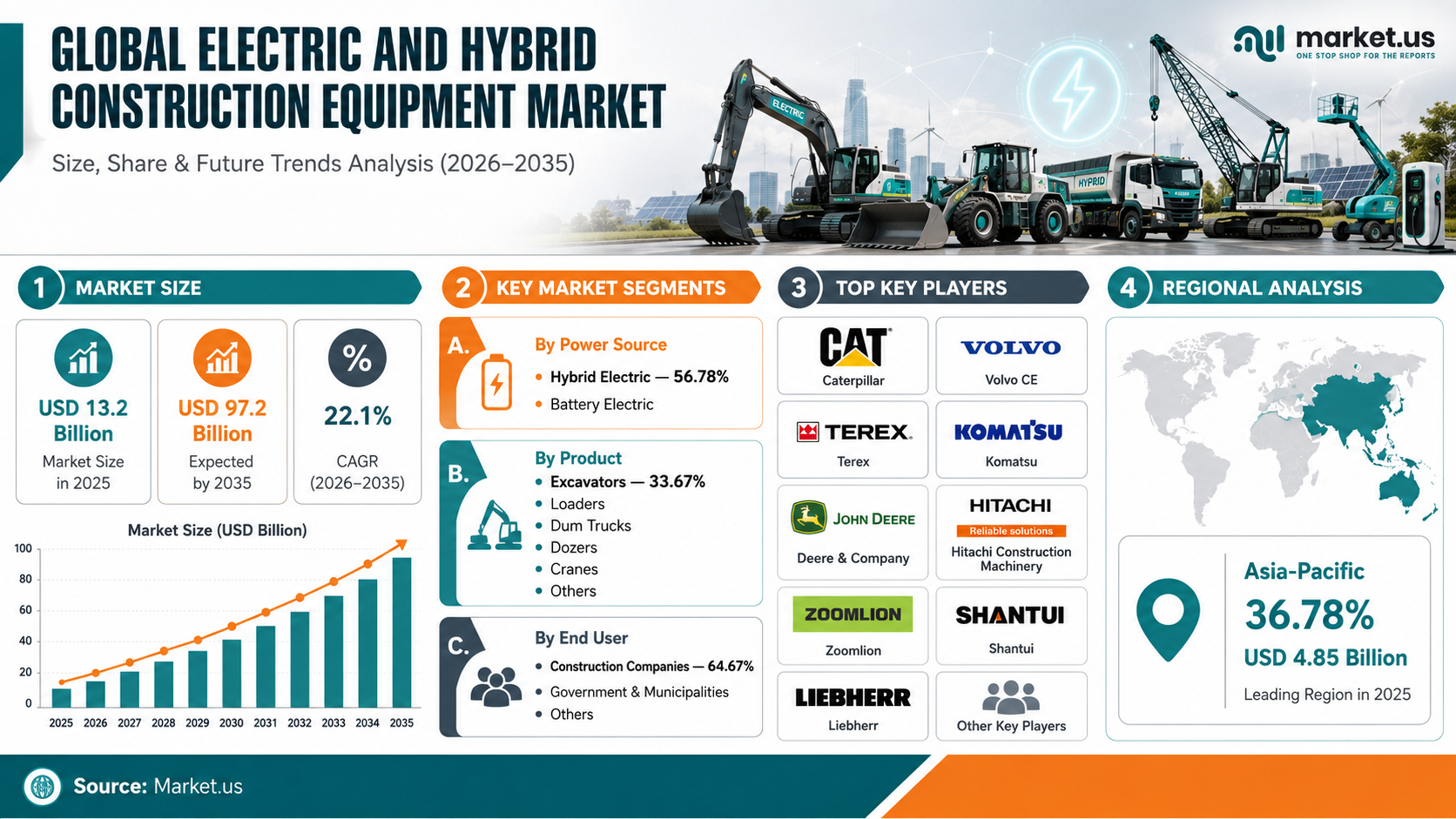
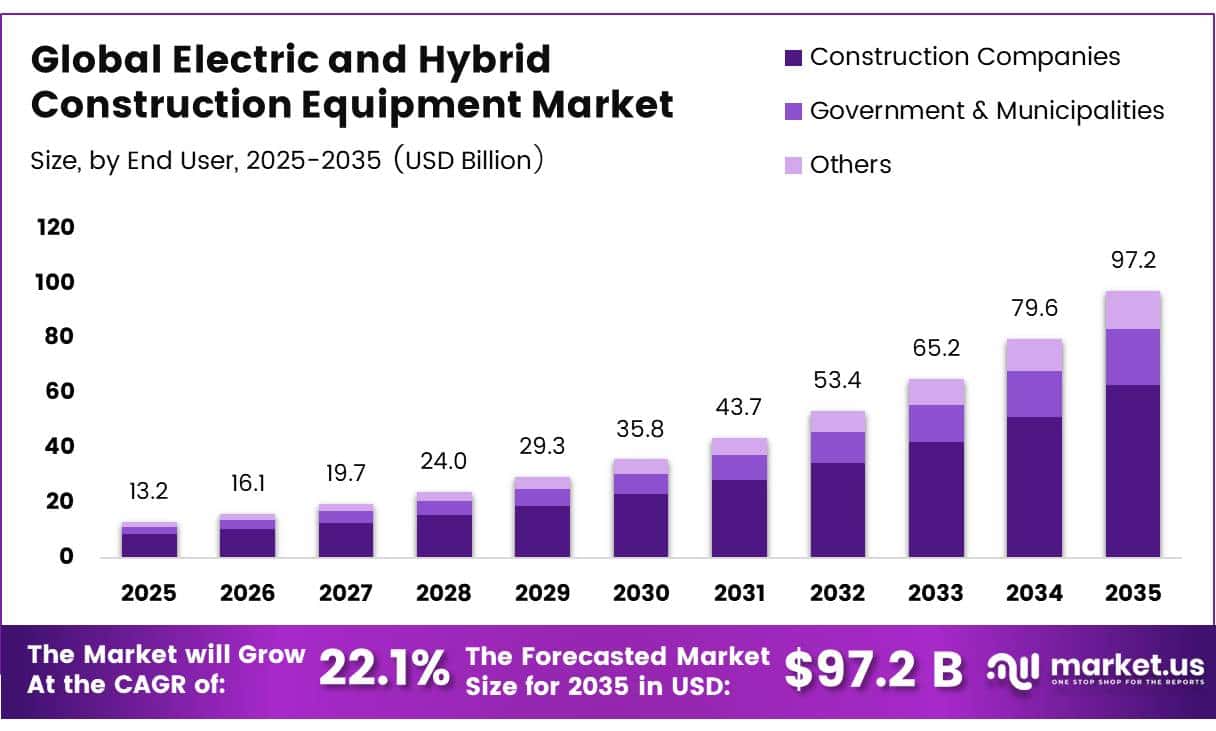
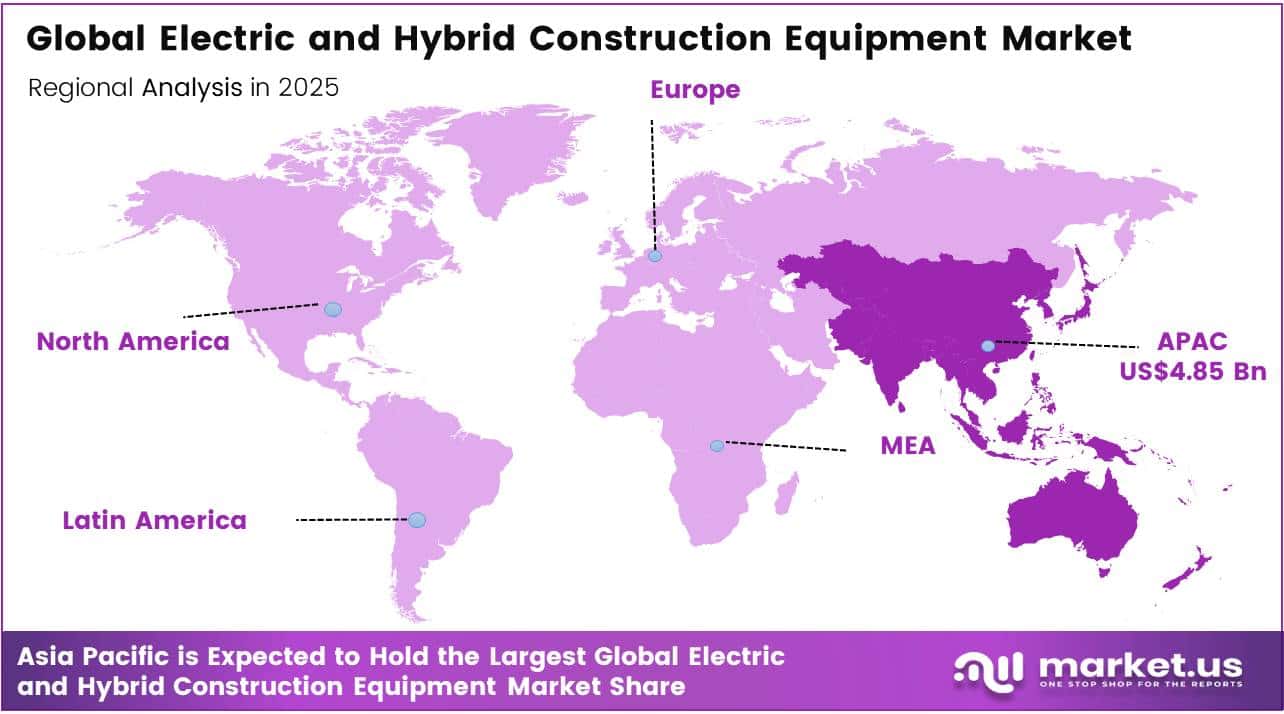
In 2025, the Global Electric and Hybrid Construction Equipment Market was valued at USD 13.2 billion, and between 2026 and 2035, this market is estimated to register a CAGR of 22.1%, reaching about USD 97.2 billion by 2035. In 2025, Asia Pacific held a dominant market position, capturing more than a 37.78% share, holding USD 4.85 Billion revenue.
The electric and hybrid construction equipment industry is expanding across medium- and heavy-duty excavators, loaders, haulers, and tethered machinery as contractors shift toward cleaner fleets. Europe’s emission-free machinery database added more than 170 products across 22 categories in 2025, showing growing commercial availability. Construction-related non-road machinery across 12 European countries generated 56,860 tonnes of nitrogen oxides and 2,380 tonnes of fine particulate emissions in 2023, increasing pressure for low-emission alternatives.
Battery economics are also improving. Average battery prices declined 8% in 2025, while lithium iron phosphate packs were more than 40% cheaper per kilowatt-hour than nickel-based alternatives and represented over 55% of global electric-vehicle battery deployment. Medium-class electric excavators can now support full-shift operations, while fast charging can provide partial recharge within roughly one hour. U.S. policy targets net-zero off-road transport emissions by 2050, with the segment contributing 10% of transportation emissions.
Key Takeaways
- The global Electric and Hybrid Construction Equipment market was valued at USD 13.2 billion in 2025.
- The market is expected to expand at a CAGR of 22.1%, reaching approximately USD 97.2 billion by 2035.
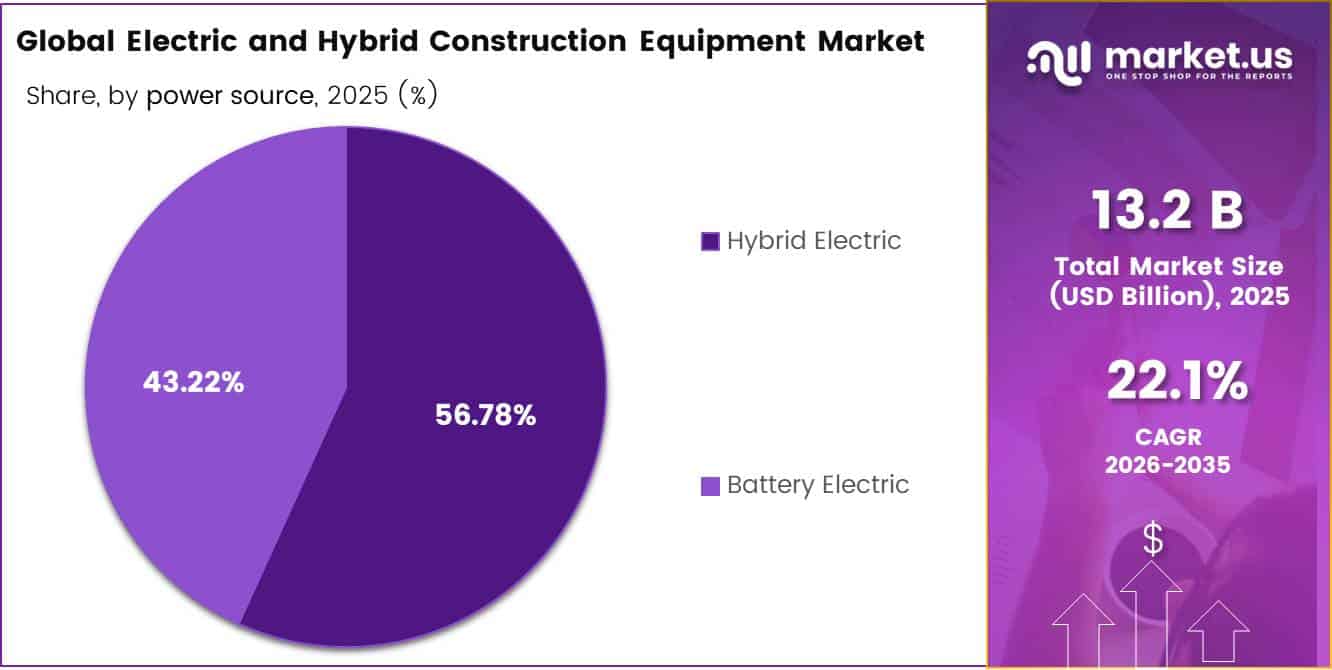
- By Power Source, Hybrid Electric held the leading position, accounting for 56.78% of the total market share.
- By Product, Excavators dominated the Electric and Hybrid Construction Equipment market, capturing around 33.67% of the total market share.
- By End User, Construction Companies emerged as the leading segment, representing 64.67% of the overall market.
- In 2025, Asia Pacific dominated the Electric and Hybrid Construction Equipment market, accounting for 36.78% of total global consumption.
Market Segmentation Overview
Power Source Analysis
Hybrid Electric Represents the Dominant Segment
Hybrid Electric leads the market with a 56.78% share, supported by lower diesel use and reliable operating time. London data show construction and infrastructure equipment contributes 96% of non-road machinery emissions, including around 1,660 tonnes of nitrogen oxides and 440,159 tonnes of carbon dioxide annually, increasing demand for cleaner hybrid systems.
Product Analysis
Excavators Hold a Significant Market Position
Excavators dominate the product segment with a 33.67% share, driven by strong use in earthmoving, trenching, demolition, and infrastructure projects. In fiscal 2025, the U.S. Department of Transportation allocated USD 62 billion across 12 highway formula programs, up USD 18.8 billion from fiscal 2021, while more than 60,000 infrastructure projects were advancing under federal funding.
End User Analysis
Construction Companies Remain the Largest End Users
Construction Companies account for a 64.67% share, supported by large residential, commercial, and infrastructure activity. In May 2026, U.S. private construction spending reached USD 1.669 trillion, including USD 930.2 billion in residential construction and USD 738.7 billion in non-residential projects, supporting greater adoption of electric and hybrid equipment.
Driver
Urban zero-emission rules and public procurement
Regulatory changes are making electrification increasingly important for construction equipment procurement and site access, particularly for compact excavators, loaders, telehandlers, aerial work platforms, and municipal fleets. EU Stage V standards regulate emissions from non-road mobile machinery, while U.S. Tier 4 rules have delivered around 90% reductions in particulate matter and nitrogen oxides from regulated new non-road diesel engines. These stricter requirements increase diesel compliance costs and improve the competitive position of electric equipment.
Europe’s Net-Zero Industry Act further requires sustainability considerations in relevant public procurement and targets domestic net-zero manufacturing capacity equal to at least 40% of annual EU deployment needs by 2030. OEMs are therefore expanding beyond equipment sales toward chargers, energy planning, service agreements, emissions reporting, and residual-value support. For contractors, zero-tailpipe-emission fleets can improve access to urban and public-sector projects, supporting an estimated +3.0 percentage-point uplift to sector CAGR.
Major Challenges
Component supply concentration
Electric and hybrid construction equipment continues to face supply-chain pressure from concentrated production of battery cells, graphite, rare-earth magnets, power semiconductors, and refined battery materials. China is the leading refiner for 19 of 20 strategic minerals assessed by the IEA, with an average share of nearly 70%. In 2024, the top three refining countries controlled around 86% of key energy-mineral refining supply, up from 82% in 2020, while almost 90% of supply growth during 2020–2024 came from the leading supplier in major categories.
China also holds more than 80% share across several battery midstream and downstream segments and approximately 95% or more in precursor-cathode and LFP-cathode materials. This concentration increases exposure to export controls, logistics disruptions, and material shortages. OEMs are responding through dual sourcing, higher safety stocks, regional battery-pack assembly, and commodity hedging, but these measures increase working-capital requirements and reduce just-in-time manufacturing efficiency. This supply-chain resilience burden is estimated to create a -1.6 percentage-point drag on sector growth through the early 2030s.
Business Opportunities
Fleet-as-a-service bundles
A machine-plus-energy subscription model is emerging as a future revenue opportunity for electric and hybrid construction equipment, as most equipment is still sold or rented through conventional channels. OEMs and rental companies could offer 36–60-month contracts covering the machine, charger, mobile storage, energy-management software, preventive maintenance, battery-health warranty, and guaranteed uptime. This approach can shift customer focus from upfront purchase cost to productive-hour economics, making electrified equipment more accessible to smaller contractors.
Charging-as-a-service and fleet-electrification models are already creating new value-chain opportunities, although integrated equipment-and-energy packages remain underpenetrated in off-highway markets. A target of 15–25% recurring revenue from services, energy, and software by the early 2030s could reduce dependence on one-time machinery sales, improve customer retention, and strengthen battery residual-value opportunities. Successful adoption could contribute an estimated +2.6 percentage points to sector CAGR, particularly in regulated urban construction markets where uptime guarantees carry greater value.
Use Cases
Urban Construction and Demolition
Electric excavators, compact loaders, and hybrid machines are increasingly suited to dense urban construction sites where emissions and noise are closely controlled. London’s construction and infrastructure machinery accounts for around 96% of the city’s non-road mobile machinery emissions, including approximately 1,660 tonnes of NOx and 440,159 tonnes of CO₂ annually. London also requires construction machinery in the 37–560 kW range to meet defined emission standards, supporting cleaner equipment adoption on building and demolition projects.
Road, Bridge, and Infrastructure Construction
Electric and hybrid excavators, loaders, and earthmoving machines can be used for road construction, bridge rehabilitation, utility work, and major infrastructure projects. In the United States, the Federal Highway Administration provided USD 62 billion for 12 highway formula programs in fiscal 2025, an increase of USD 18.8 billion compared with fiscal 2021. More than 60,000 infrastructure projects had also received funding under the Bipartisan Infrastructure Law, creating a large operating base for cleaner construction machinery
Regional Analysis
Asia-Pacific leads the electric and hybrid construction equipment market with a 36.78% share, supported by government-backed electrification of excavators and other high-use machinery. Japan’s Ministry of Economy, Trade and Industry targets annual sales of 3,000 electric mini excavators below six tonnes by 2030, equal to a 10% electrification rate, rising to 10,000 units and 30% by 2040.
For excavators above six tonnes, the scenario reaches 1,000 electric units and 5% electrification by 2030, increasing to 6,000 units and 20% by 2040. These targets strengthen regional investment in batteries, charging systems, power electronics, and low-emission construction fleets.
Key Development
- In March 2026, Caterpillar launched the Cat D8 XE electric-drive dozer, strengthening its electrified heavy-equipment portfolio. Company testing indicated up to 10% lower fuel consumption and 6% higher material movement compared with the standard D8. The machine is powered by a 259 kW engine and has an operating weight of approximately 40,100 kg.
- In April 2026, Volvo Construction Equipment started serial production of its A30 Electric and A40 Electric articulated haulers. The models offer payload capacities of 29 tonnes and 39 tonnes, respectively, with operating capability of up to six hours per charge. Initial production and deployment are focused on the European market.
Conclusion
The Electric and Hybrid Construction Equipment market is moving steadily from small electric machines toward heavier, high-productivity equipment. Battery economics are improving, with average battery prices declining 8% in 2025, while LFP battery packs were more than 40% cheaper per kWh than NMC alternatives. Government support is also strengthening adoption. Japan targets annual sales of 3,000 electric mini excavators with a 10% electrification rate by 2030, rising to 10,000 units and 30% by 2040. Commercial capability is expanding as well, with Volvo CE beginning serial production of 29-tonne A30 Electric and 39-tonne A40 Electric articulated haulers in April 2026. Overall, falling battery costs, stricter emission requirements, charging development, and wider availability of heavy electric machinery are expected to strengthen long-term adoption across construction, infrastructure, quarrying, and material-handling applications.
Looking for data tailored to your specific market, region, or business need? Request a custom report or consultation — write to us at [email protected]



