


Report Overview
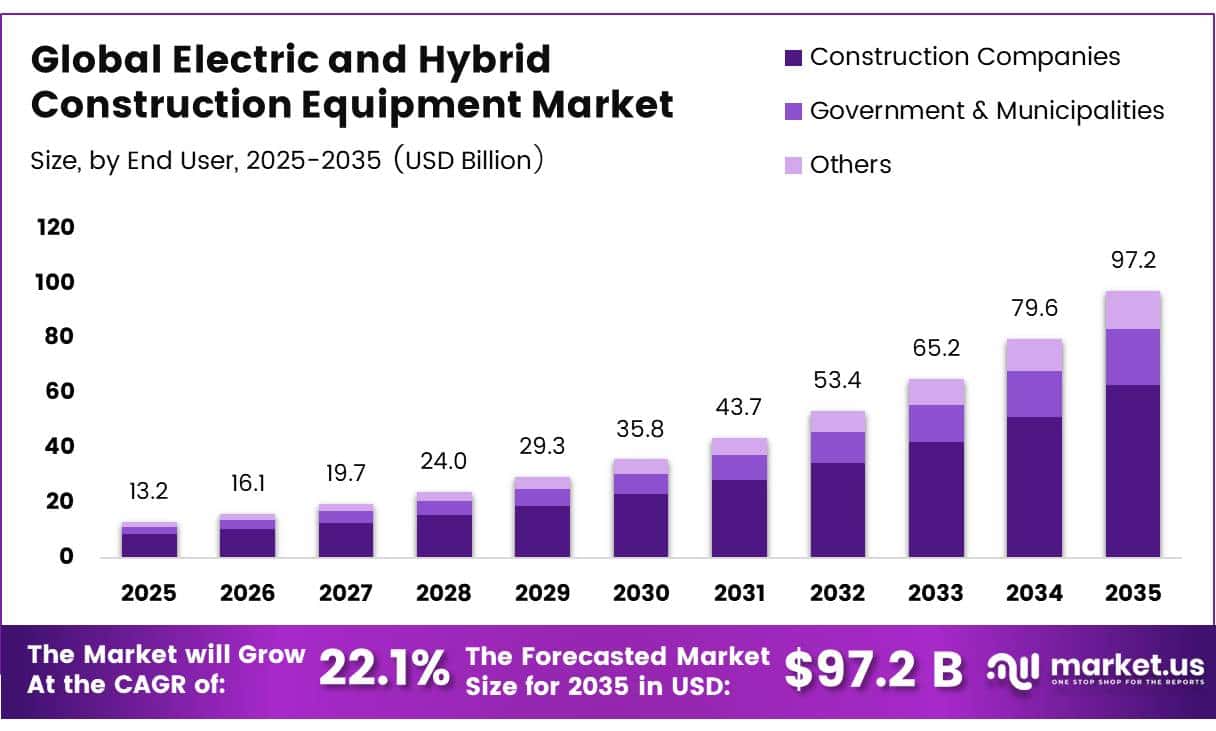
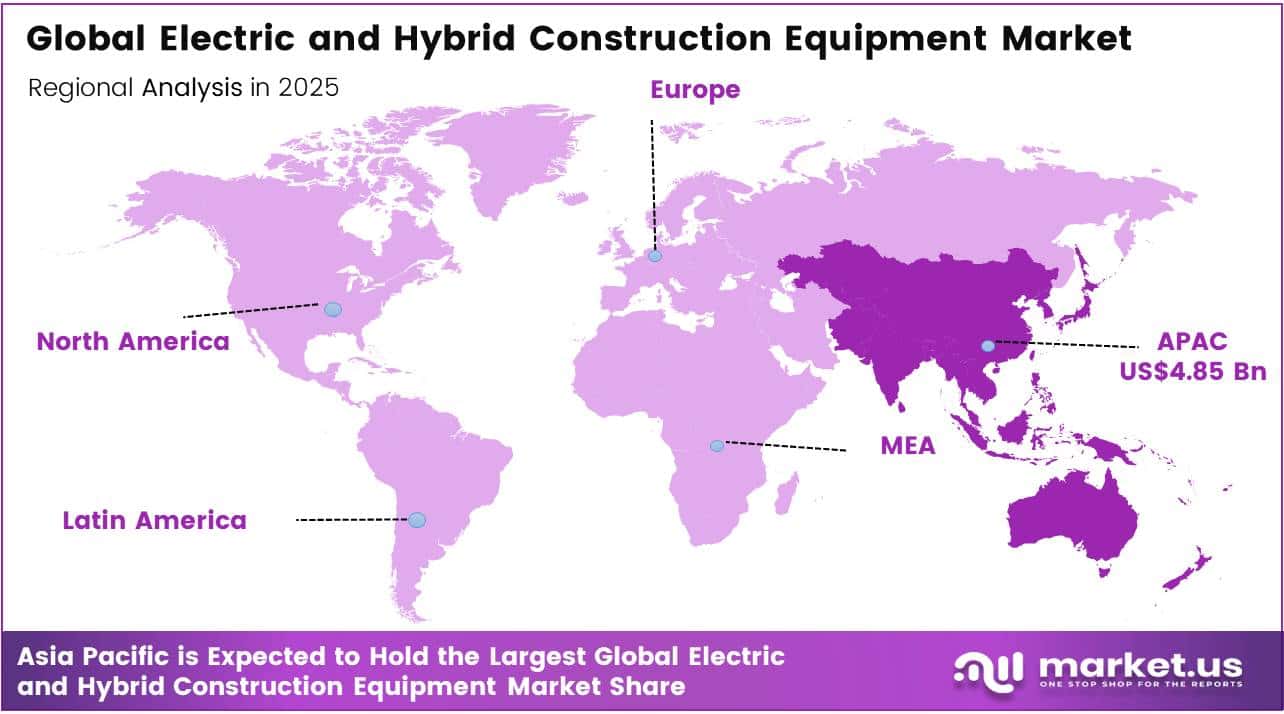
In 2025, the Global Electric and Hybrid Construction Equipment Market was valued at USD 13.2 billion, and between 2026 and 2035, this market is estimated to register a CAGR of 22.1%, reaching about USD 97.2 billion by 2035. In 2025, Asia Pacific held a dominant market position, capturing more than a 37.78% share, holding USD 4.85 Billion revenue.
The electric and hybrid construction equipment industry is expanding into medium and heavy-duty excavators, loaders, haulers, and tethered equipment. Europe’s updated emission-free machinery database added more than 170 products across 22 categories in 2025, demonstrating commercial availability.
- Construction-related non-road machinery across 12 European countries generated 56,860 tonnes of nitrogen oxides and 2,380 tonnes of fine particulate emissions in 2023, strengthening pressure for cleaner fleets.
Industrial capability is improving. Government and intergovernmental assessments of electric construction equipment indicate that medium-class electric excavators can typically complete a full work shift on a single charge depending on duty cycle, with fast-charging systems enabling partial recharge within roughly one hour.
Future opportunities will emerge in fast-charging systems, battery swapping, hybrid powertrains, fleet software, and grid-connected machinery. U.S. policy also targets net-zero off-road transport emissions by 2050; the segment contributes 10% of transportation emissions.
Key Takeaways
- The global Electric and Hybrid Construction Equipment market was valued at USD 13.2 billion in 2025.
- The global market is projected to grow at a CAGR of 22.1% and is estimated to reach USD 97.2 billion by 2035.
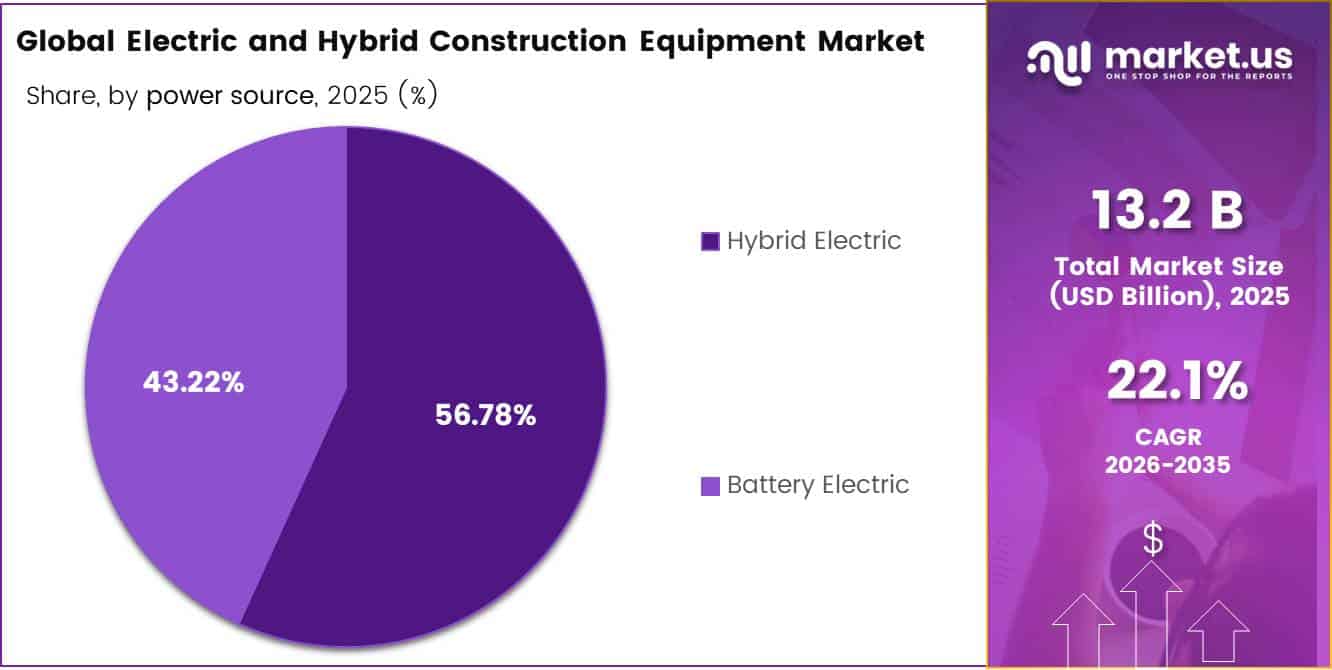
- On the basis of Power Source, the Hybrid Electric dominated the market, constituting 56.78% of the total market share.
- Based on the Product, the Excavators dominated the Electric and Hybrid Construction Equipment market, with a substantial market share of around 33.67%.
- Based on the End User, Construction Companies led the market, comprising 64.67% of the total market.
- In 2025, the Asia Pacific was the most dominant region in the Electric and Hybrid Construction Equipment market, accounting for 36.78% of the total global consumption.
Power Source Analysis
Hybrid Electric represents dominant Segment in the Market.
Hybrid Electric leads the power source category with a 56.78% market share, supported by its ability to reduce diesel dependence without limiting operating time on demanding construction sites. This balance remains important for large excavators, loaders, and earthmoving machines working across remote locations where charging access is still developing.
- London government data show that construction and infrastructure equipment accounts for 96% of the city’s non-road machinery emissions, including approximately 1,660 tonnes of nitrogen oxides and 440,159 tonnes of carbon dioxide annually. These operating conditions strengthen demand for hybrid systems that combine lower fuel consumption with dependable range.
Battery Electric is the growing segment as public incentives reduce high initial equipment and charging costs. California’s Clean Off-Road Equipment program offers construction machinery vouchers of up to USD 500,000, alongside infrastructure support of up to USD 30,000. The program has funded 2,350 zero-emission heavy-duty machines and estimates that supported deployments will prevent approximately 250,000 tons of carbon dioxide-equivalent emissions over their contracted operating periods.
Product Analysis
Excavators a significant product.
Excavators lead the electric and hybrid construction equipment market with a 33.67% share. Their strong position reflects their central role in earthmoving, trenching, demolition, roadwork, and large infrastructure projects.
- In the United States, the Department of Transportation allocated USD 62 billion across 12 highway formula programs for fiscal 2025, representing an increase of USD 18.8 billion compared with fiscal 2021. More than 60,000 infrastructure projects were already moving forward under federal funding, creating sustained demand for cleaner excavators capable of operating on urban and regulated construction sites.
Dump Trucks are emerging as the growing product segment as mining and large construction operators seek cleaner material-hauling solutions. In June 2026, the Government of Canada announced up to CAD 73 million for 12 sustainable mining projects, including an electric haul-truck demonstration. The initiative provided CAD 2.4 million specifically to replace large diesel haul trucks with electric vehicles and install charging infrastructure. These programs support wider testing of electric drivetrains under demanding load, distance, and terrain conditions.
End User Analysis
Electric and Hybrid Construction Equipment Are Mostly Utilized in the Construction Companies.
Construction Companies lead the electric and hybrid construction equipment market with a 64.67% share. Their position is supported by the scale of privately financed building and infrastructure activity, where equipment productivity, lower fuel consumption, and compliance with urban emission rules directly influence project costs.
- In May 2026, U.S. private construction spending reached an annualized USD 1.669 trillion. Private residential construction contributed USD 930.2 billion, while non-residential projects accounted for USD 738.7 billion. This sizeable project pipeline encourages contractors to adopt electric excavators, loaders, and hybrid machines across both short-cycle and demanding applications.
Government & Municipalities are emerging as the growing segment as public agencies prioritize cleaner fleets and lower-emission construction sites. U.S. public construction spending reached USD 541.2 billion in May 2026, increasing 0.5% from April. Highway construction represented USD 150.6 billion, while educational construction reached USD 113.4 billion, creating a substantial base for future electric and hybrid equipment procurement.
Key Market Segments
By Power Source
- Hybrid Electric
- Battery Electric
By Product
- Excavators
- Loaders
- Dum Trucks
- Dozers
- Cranes
- Others
By End User
- Construction Companies
- Government & Municipalities
- Others
Driver Analysis
Urban zero-emission rules and public procurement
Regulation is shifting electrification from a sustainability option to a bid-qualification and site-access issue, especially for compact excavators, loaders, telehandlers, aerial work platforms and municipal fleets operating near residents or indoors. The EU’s Stage V rules regulate non-road mobile machinery pollutants, while U.S. Tier 4 standards achieved roughly 90% reductions in particulate matter and nitrogen oxides from regulated new non-road diesel engines; this raises the engineering and after-treatment burden of diesel equipment and narrows the practical cost gap versus electric alternatives.
Europe’s Net-Zero Industry Act also requires sustainability as a minimum consideration in relevant public procurement, and its 2030 objective is domestic net-zero manufacturing capacity equal to at least 40% of annual EU deployment needs. For OEMs, the commercial effect is a change in revenue mix: sales teams must package machine, charger, energy planning, service agreement, emissions reporting and residual-value support rather than sell a stand-alone asset. For contractors, a zero-tailpipe-emission fleet can protect access to urban, hospital, airport, tunnel and public-works tenders, supporting an estimated +3.0 percentage-point uplift to sector CAGR through faster replacement of smaller machines and premium specification rates.
Drivers Impact Analysis
| Driver | (~) % Impact on CAGR | Geographic Relevance | Impact Timeline |
|---|---|---|---|
| Urban zero-emission rules and public procurement | +3.0 pp | EU core, UK, North America metros, China, Japan | Short term (≤ 2 years) |
| Battery-cost decline and localized supply chains | +2.4 pp | China, APAC export hubs, EU, North America | Medium term (2–4 years) |
| Infrastructure and grid-build investment | +1.8 pp | North America, India, ASEAN, EU, Gulf states | Medium term (2–4 years) |
| Total-cost-of-ownership and indoor-site productivity | +1.7 pp | Europe, North America, Japan, Korea, urban APAC | Short term (≤ 2 years) |
| Charging ecosystems and battery-as-a-service | +1.4 pp | China, EU, North America, Australia | Medium term (2–4 years) |
| Hybrid transition for high-duty-cycle equipment | +1.2 pp | Global mining, APAC, North America, Latin America | Long term (≥ 4 years) |
Restraint Analysis
High purchase premium
The principal adoption barrier remains the front-loaded capital requirement: batteries, high-voltage harnesses, inverters, thermal-management systems, onboard chargers and reinforced machine structures raise the purchase price before contractors can capture lower fuel and maintenance expenditure. Public industry discussion commonly identifies electric-equipment acquisition premiums of roughly 50–100% versus comparable diesel units in the most battery-intensive categories; this is commercially problematic because many contractors evaluate equipment against a 3–5-year ownership or financing horizon rather than the full technical life of the asset.
Even after lithium-ion pack prices declined 20% in 2024, the cost benefit passes through unevenly because construction-machine packs are lower-volume, ruggedised and application-specific relative to automotive cells. The result is margin compression for OEMs that absorb part of the premium, slower fleet renewal where rental rates cannot recover higher depreciation, and delayed CapEx among small and mid-sized contractors; this restraint is estimated to deduct 2.8 percentage points from forecast CAGR through 2028, with the greatest effect in price-sensitive India, Latin America and non-subsidised North American fleet segments.
Restraint Impact Analysis
| Restraint | (~) % Impact on CAGR | Geographic Relevance | Impact Timeline |
|---|---|---|---|
| High purchase premium | -2.8 pp | North America, EU, India, Latin America | Short term (≤ 2 years) |
| Grid and charging constraints | -2.4 pp | North America, EU, India, ASEAN, remote sites | Medium term (2–4 years) |
| Battery-material concentration | -1.9 pp | North America, EU, Japan, Korea | Medium term (2–4 years) |
| Heavy-duty range limits | -1.8 pp | Mining regions, North America, APAC, Latin America | Long term (≥ 4 years) |
| Battery compliance burden | -1.3 pp | EU core, UK spill-over, global exporters | Short term (≤ 2 years) |
| Service-skills and residual risk | -1.1 pp | North America, EU, India, ASEAN | Medium term (2–4 years) |
Opportunity Analysis
Fleet-as-a-service bundles
A machine-plus-energy subscription is a future monetisation opportunity rather than a current driver because most electric and hybrid construction equipment is still transacted as a conventional asset sale or short-term rental, leaving financing, charging, battery risk and uptime management fragmented across the OEM, dealer, contractor and utility. An OEM or rental major can package a 36–60-month contract covering the machine, charger, mobile storage, energy-management software, preventative maintenance, battery-health warranty and guaranteed availability; shifting the customer decision from purchase price to productive-hour cost can unlock smaller contractors that cannot absorb a battery-driven capital premium.
Fleet-electrification models are already generating value-chain opportunities around charging-as-a-service, but site-specific equipment-energy bundles remain underpenetrated in off-highway markets. A portfolio target of 15–25% recurring revenue from service, energy and software by the early 2030s would reduce cyclicality relative to one-time machinery sales, improve customer retention, and allow OEMs to retain battery residual-value upside; successful execution could add an estimated +2.6 percentage points to CAGR, particularly in regulated urban construction markets where uptime guarantees command a premium.
Opportunity Impact Analysis
| Opportunity | (~) % Potential CAGR | Geographic Relevance | Execution Window |
|---|---|---|---|
| Fleet-as-a-service bundles | +2.6 pp | EU, North America, Japan, Korea | Short term (≤ 2 years) |
| Mobile power and energy services | +2.2 pp | North America, EU, Australia, Gulf | Medium term (2–4 years) |
| Battery second-life ecosystems | +1.8 pp | EU, China, North America, Japan | Medium term (2–4 years) |
| Electrified industrial adjacencies | +1.7 pp | EU core, North America, China, APAC | Medium term (2–4 years) |
| Autonomous electric micro-fleets | +1.5 pp | Japan, Korea, EU, China, North America | Long term (≥ 4 years) |
| Dealer and rental M&A roll-ups | +1.3 pp | North America, EU, India, ASEAN | Short term (≤ 2 years) |
Challenges Analysis
Component supply concentration
Electric and hybrid construction equipment does not face a complete supply failure today, but sustained growth remains exposed to concentrated upstream supply for cells, graphite, rare-earth magnets, power semiconductors and battery-material refining, creating persistent lead-time, inventory and pricing volatility. China is the leading refiner for 19 of 20 strategic minerals assessed by the IEA, with an average share near 70%; the top three refining countries accounted for approximately 86% of key energy-mineral refining supply in 2024, versus 82% in 2020, while close to 90% of 2020–2024 supply growth came from the leading supplier in major categories.
China also retains shares above 80% across several battery midstream and downstream segments and approximately 95% or more in precursor-cathode and LFP-cathode materials, making a single export-control, quality or logistics disruption capable of affecting electric drive-unit production even when machinery demand remains intact. OEMs must therefore carry dual-source qualifications, longer safety stock, regional battery-pack assembly and commodity hedging, tying up working capital and limiting just-in-time manufacturing benefits; this persistent resilience cost is modelled as a -1.6 percentage-point friction drag through the early 2030s.
Challenges Impact Analysis
| Challenge | (~) % CAGR Friction | Geographic Relevance | Mitigation Horizon |
|---|---|---|---|
| Component supply concentration | -1.6 pp | North America, EU, Japan, Korea | Long term (≥ 4 years) |
| Cross-platform charging interoperability | -1.4 pp | EU, North America, China, APAC | Medium term (2–4 years) |
| High-voltage service skills | -1.3 pp | North America, EU, India, ASEAN | Medium term (2–4 years) |
| Battery thermal durability | -1.2 pp | Gulf, India, Australia, Nordics, Canada | Long term (≥ 4 years) |
| Fleet-data cybersecurity exposure | -0.9 pp | North America, EU, Japan, Korea | Medium term (2–4 years) |
| Multi-powertrain factory complexity | -0.8 pp | Global OEM production hubs | Medium term (2–4 years) |
Geopolitical Impact Analysis
Geopolitical Competition for Critical Minerals Reshaping Equipment Electrification
Electric and hybrid construction equipment manufacturers face geopolitical exposure because batteries, traction motors, inverters, and controls depend on concentrated mineral supply chains.
- The U.S. Geological Survey reported that China produced 82% of global natural graphite, 71% of mined rare earths, 87% of silicon metal, 99% of primary gallium, 88% of primary magnesium, and 82% of mined tungsten in 2024. China also supplied 60% of global aluminium and 54% of raw steel.
Governments are responding through tariffs, domestic processing, recycling, and supplier diversification. The U.S. Trade Representative’s tariff schedule sets a 25% rate for Chinese natural graphite, permanent magnets, and non-electric-vehicle lithium-ion batteries in 2026, affecting components used beyond passenger cars.
The European Critical Raw Materials Act sets 2030 targets for domestic extraction to meet 10% of annual strategic-material demand, processing to cover 40%, and recycling to provide 25%. It also seeks to keep dependence on any single non-EU country below 65%. These policies may increase near-term sourcing expenses but create opportunities for regional battery plants, recycled materials, local motor production, alternative chemistries, and equipment platforms designed around interchangeable components.
Regional Analysis
Asia Pacific Held the Largest Share of the Global Electric and Hybrid Construction Equipment Market.
Asia-Pacific leads the electric and hybrid construction equipment market with a 36.78% share, supported by government-backed electrification of excavators and other high-use machinery. Japan’s Ministry of Economy, Trade and Industry targets annual sales of 3,000 electric mini excavators below six tonnes by 2030, equal to a 10% electrification rate, rising to 10,000 units and 30% by 2040.
- For excavators above six tonnes, the scenario reaches 1,000 electric units and 5% electrification by 2030, increasing to 6,000 units and 20% by 2040. These targets strengthen regional investment in batteries, charging systems, power electronics, and low-emission construction fleets.
North America is the fastest-growing region as public incentives reduce the cost of deploying zero-emission off-road machinery. California allocated USD 125 million for clean equipment incentives covering 9 categories, including construction equipment. The program’s first funding round supported more than 460 vouchers for machinery and charging equipment, representing over USD 62 million in assistance. This funding is improving commercial access and encouraging contractors to replace diesel machines
Key Regions and Countries Covered
- North America
- The US
- Canada
- Europe
- Germany
- France
- The UK
- Spain
- Italy
- Russia & CIS
- Rest of Europe
- APAC
- China
- Japan
- South Korea
- India
- ASEAN
- Rest of APAC
- Latin America
- Brazil
- Mexico
- Rest of Latin America
- Middle East & Africa
- GCC
- South Africa
- Rest of MEA
Key Players Analysis
Electric and hybrid construction equipment manufacturers focus on strengthening powertrain efficiency, operating reliability, and charging compatibility to maintain competitiveness. A key priority is continuous product innovation, including the development of higher-density batteries, regenerative braking systems, modular power electronics, and hybrid drivetrains that extend operating hours while reducing fuel consumption and emissions. Companies are also expanding platform-based manufacturing, as shared components across excavators, loaders, dump trucks, and compact equipment improve production efficiency and lower development costs.
Closer integration with battery suppliers, charging providers, and fleet-management software companies helps secure component availability and improve lifecycle performance. Strategic capacity expansion across Asia-Pacific, Europe, and North America supports demand from infrastructure, mining, municipal, and urban construction projects. Additionally, manufacturers emphasize automation, telematics, predictive maintenance, and standardized charging systems to improve equipment uptime, while forming long-term agreements with rental companies and contractors to strengthen customer retention and accelerate fleet electrification.
The Major Players In The Industry
- Caterpillar
- Volvo CE
- Terex
- Komatsu
- Deere & Company
- Hitachi Construction Machinery
- Zoomlion
- Shantui
- Liebherr
- Other Key Players
Key Development
- In March 2026, Caterpillar introduced the Cat D8 XE electric-drive dozer. Internal testing showed up to 10% lower fuel consumption and 6% more material moved than the standard D8, while its 259 kW engine supported a 40,100 kg operating weight.
- In April 2026, Volvo CE began serial production of A30 Electric and A40 Electric haulers, offering 29-tonne and 39-tonne payloads and up to six hours per charge, initially in Europe.
Report Scope
| Report Features | Description |
|---|---|
| Market Value (2025) | USD 13.2 Bn |
| Forecast Revenue (2035) | USD 97.2 Bn |
| CAGR (2026-2035) | 22.1% |
| Base Year for Estimation | 2025 |
| Historic Period | 2020-2024 |
| Forecast Period | 2026-2035 |
| Report Coverage | Revenue Forecast, Market Dynamics, Competitive Landscape, Recent Developments |
| Segments Covered | By Power Source (Hybrid Electric and Battery Electric), By Type (Coated Separator and Non-coated Separator), By Product (Excavators, Loaders, Dum Trucks, Dozers, Cranes and Others), By End User (Construction Companies, Government & Municipalities and Others) |
| Regional Analysis | North America – The US & Canada; Europe – Germany, France, The UK, Spain, Italy, Russia & CIS, Rest of Europe; APAC– China, Japan, South Korea, India, ASEAN & Rest of APAC; Latin America– Brazil, Mexico & Rest of Latin America; Middle East & Africa– GCC, South Africa, & Rest of MEA |
| Competitive Landscape | Caterpillr, Volvo CE, Terex, Komatsu, Deere & Company, Hitachi Construction Machinery, Zoomlion, Shantui, Liebherr and Other Key Players. |
| Customization Scope | Customization for segments, region/country-level will be provided. Moreover, additional customization can be done based on the requirements. |
| Purchase Options | We have three licenses to opt for: Single User License, Multi-User License (Up to 5 Users), Corporate Use License (Unlimited Users and Printable PDF) |
Lithium Compound for Battery Application Market





































